Mostrando entradas con la etiqueta European Space Agency-ESA. Mostrar todas las entradas

domingo, 13 de octubre de 2013

ESA : Rosetta: 100 days to wake-up


Rosetta’s twelve-year journey in space
This animation tracks Rosetta’s journey through the Solar System, using gravity slingshots from Earth and Mars to reach its final destination: Comet 67P/Churyumov–Gerasimenko. Rosetta made three flybys of Earth, on 4 March 2005, 13 November 2007 and 13 November 2009, and one of Mars, on 25 February 2007. Rosetta has also visited two asteroids, taking extensive close-up images of 2867 Steins on 5 September 2008 and 21 Lutetia on 10 July 2010. Once the spacecraft is woken up from deep space hibernation on 20 January 2014, it will head for rendezvous with the comet in May. In November the Philae probe will be deployed to the comet surface. Rosetta will follow the comet to its closest distance to the Sun on 13 August 2015 and as it moves back towards the outer Solar System. The nominal mission end is December 2015.

Rosetta: 100 days to wake-up

11 October 2013
ESA’s comet-chasing mission Rosetta will wake up in 100 days’ time from deep-space hibernation to reach the destination it has been cruising towards for a decade.
Comets are the primitive building blocks of the Solar System and the likely source of much of Earth’s water, perhaps even delivering to Earth the ingredients that helped life evolve.
By studying the nature of a comet close up with an orbiter and lander, Rosetta will show us more about the role of comets in the evolution of the Solar System.
Rosetta was launched on 2 March 2004, and through a complex series of flybys – three times past Earth and once past Mars – set course to its destination: comet 67P/Churyumov–Gerasimenko. It also flew by and imaged two asteroids, Steins on 5 September 2008 and Lutetia on 10 July 2010.
In July 2011 Rosetta was put into deep-space hibernation for the coldest, most distant leg of the journey as it travelled some 800 million kilometres from the Sun, close to the orbit of Jupiter. The spacecraft was oriented so that its solar wings faced the Sun to receive as much sunlight as possible, and it was placed into a slow spin to maintain stability.
Now, as both the comet and the spacecraft are on the return journey back into the inner Solar System, the Rosetta team is preparing for the spacecraft to wake up.
Rosetta mission milestones 2014-2015
Rosetta’s internal alarm clock is set for 10:00 GMT on 20 January 2014.
Once it wakes up, Rosetta will first warm up its navigation instruments and then it must stop spinning to point its main antenna at Earth, to let the ground team know it is still alive.
“We don’t know exactly at what time Rosetta will make first contact with Earth, but we don’t expect it to be before about 17:45 GMT on the same day,” says Fred Jansen, ESA’s Rosetta mission manager.
“We are very excited to have this important milestone in sight, but we will be anxious to assess the health of the spacecraft after Rosetta has spent nearly 10 years in space.”
After wake-up, Rosetta will still be about 9 million km from the comet. As it moves closer, the 11 instruments on the orbiter and 10 on the lander will be turned on and checked.
In early May, Rosetta will be 2 million km from its target, and towards the end of May it will execute a major manoeuvre to line up for rendezvous with the comet in August.
The first images of a distant 67P/Churyumov–Gerasimenko are expected in May, which will dramatically improve calculations of the comet’s position and orbit.
Closer in, Rosetta will take thousands of images that will provide further details of the comet’s major landmarks, its rotation speed and spin axis orientation.
Continue reading below

Rosetta’s Philae lander on comet nucleus
Rosetta will also make important measurements of the comet’s gravity, mass and shape, and will make an initial assessment of its gaseous, dust-laden atmosphere, or coma.
Rosetta will also probe the plasma environment and analyse how it interacts with the Sun’s outer atmosphere, the solar wind.
After extensive mapping of the comet’s surface during August and September, a landing site for the 100 kg Philae probe will be chosen. It will be the first time that landing on a comet has ever been attempted.
Given the almost negligible gravity of the comet’s 4 km-wide nucleus, Philae will ‘dock’ with it using ice screws and harpoons to stop it from rebounding back into space.
Philae will send back a panorama of its surroundings and very high-resolution pictures of the surface and will perform on-the-spot analysis of the composition of the ices and organic material. A drill will take samples from 20–30 cm below the surface, feeding them to the onboard laboratory for analysis.
“The focus of the mission then moves towards what we call the ‘escort’ phase, whereby Rosetta will stay alongside the comet as it moves closer to the Sun,” notes Fred.
The comet will reach its closest distance to the Sun on 13 August 2015 at about 185 million km, roughly between the orbits of Earth and Mars.
As the comet hurtles through the inner Solar System at around 100 000 km/h, the relative speed between orbiter and comet will remain equivalent to walking pace. During this ‘escort’ phase the orbiter will continue to analyse dust and gas samples while monitoring the ever-changing conditions on the surface as the comet warms up and its ices sublimate.
“This unique science period will reveal the dynamic evolution of the nucleus as never seen before, allowing us to build up a thorough description of all aspects of the comet, its local environment and revealing how it changes even on a daily basis,” says Matt Taylor, ESA’s Rosetta project scientist.
Rosetta will follow the comet throughout the remainder of 2015, as it heads away from the Sun and activity begins to subside.
“For the first time we will be able to analyse a comet over an extended period of time – it is not just a flyby. This will give us a unique insight into how a comet ‘works’ and ultimately help us to decipher the role of comets in the formation of the Solar System,” adds Matt.

For further information, please contact:

Markus Bauer

ESA Science and Robotic Exploration Communication Officer


Tel: +31 71 565 6799


Mob: +31 61 594 3 954


Email: markus.bauer@esa.int
Fred Jansen
ESA Rosetta mission manager
Email: fjansen@rssd.esa.int
Matt Taylor
ESA Rosetta project scientist
Email: matthew.taylor@esa.int
 
Europe's comet chaser
 
In November 1993, the International Rosetta Mission was approved as a Cornerstone Mission in ESA's Horizons 2000 Science Programme.
Since then, scientists and engineers from all over Europe and the United States have been combining their talents to build an orbite
Rosetta orbiting Comet 67P/Churyumov-Gerasimenko
r and a lander for this unique expedition to unravel the secrets of a mysterious 'mini' ice world – a comet.
Initially scheduled for January 2003, the launch of Rosetta had been postponed due to a failure of an Ariane rocket in December 2002. The adventure began March 2004, when a European Ariane 5 rocket lifted off from Kourou in French Guiana.
During a circuitous ten-year trek across the Solar System, Rosetta will cross the asteroid belt and travel into deep space, more than five times Earth’s distance from the Sun. Its destination will be a periodic comet known as Comet 67P/Churyumov-Gerasimenko.
The Rosetta orbiter will rendezvous with Comet 67P/Churyumov-Gerasimenko and remain in close proximity to the icy nucleus as it plunges towards the warmer inner reaches of the Sun’s domain. At the same time, a small lander will be released onto the surface of this mysterious cosmic iceberg.
More than a year will pass before the remarkable mission draws to a close in December 2015. By then, both the spacecraft and the comet will have circled the Sun and be on their way out of the inner Solar System.
Historic mission
The Rosetta mission will achieve many historic firsts.
  • Rosetta will be the first spacecraft to orbit a comet’s nucleus.
  • It will be the first spacecraft to fly alongside a comet as it heads towards the inner Solar System.
  • Rosetta will be the first spacecraft to examine from close proximity how a frozen comet is transformed by the warmth of the Sun.
  • Shortly after its arrival at Comet 67P/Churyumov-Gerasimenko, the Rosetta orbiter will despatch a robotic lander for the first controlled touchdown on a comet nucleus.
  • The Rosetta lander’s instruments will obtain the first images from a comet’s surface and make the first in situ analysis to find out what it is made of.
  • On its way to Comet 67P/Churyumov-Gerasimenko, Rosetta will pass through the main asteroid belt, with the option to be the first European close encounter with one or more of these primitive objects.
  • Rosetta will be the first spacecraft ever to fly close to Jupiter’s orbit using solar cells as its main power source.
Scientists will be eagerly waiting to compare Rosetta’s results with previous studies by ESA’s Giotto spacecraft and by ground-based observatories. These have shown that comets contain complex organic molecules - compounds that are rich in carbon, hydrogen, oxygen and nitrogen.
Intriguingly, these are the elements which make up nucleic acids and amino acids, the essential ingredients for life as we know it. Did life on Earth begin with the help of comet seeding? Rosetta may help us to find the answer to this fundamental question.
ESA

About Rosetta

  • About comets
  • About the spacecraft
  • About the journey
  • About the arrival
  • Multimedia
  • VideoTalk
  • 3D Flash 'model'
  • Rosetta images
  • Rosetta videos
  • Rosetta wallpaper
  • Services
  • Frequently asked questions
  • Guillermo Gonzalo Sánchez Achutegui
    domingo, 19 de mayo de 2013

    ESA - First new Galileo satellite arrives at ESA for space testing


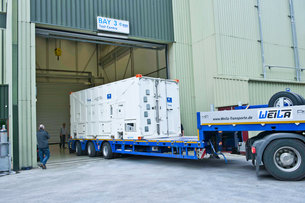
    First Galileo FOC satellite arrives at ESTEC for space testing
    16 May 2013 The first satellite of Galileo’s next phase has arrived at ESA’s technical heart in the Netherlands for a rigorous set of tests to check its readiness for launch.
    This first Galileo Full Operational Capability – FOC – satellite is functionally identical to the first four Galileo In-Orbit Validation satellites already in orbit, the operational nucleus of the full Galileo constellation, but has been built by a separate industrial team.
    Like all the other 21 FOC satellites so far procured by ESA, the satellite’s prime contractor is OHB in Bremen, Germany and the navigation payload was produced by Surrey Satellite Technology Ltd in Guildford, UK.
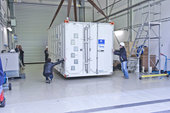
    This first FOC satellite arrived by road at ESTEC’s Test Centre in Noordwijk, the Netherlands, on 15 May to undergo a series of tests simulating different aspects of launch and space environment. The comprehensive test programme will validate the new design and all the satellites to follow.
    A unique facility for Europe, ESA’s test centre has all the facilities needed to validate a satellite for launch under a single roof.
    Thermal vacuum testing will simulate the temperature extremes the satellites must endure in the airlessness of space throughout their 12-year working lifetimes. Without any moderating atmosphere, temperatures can shift hundreds of degrees from sunlight to shadow.
    First Galileo FOC satellite arrives at ESTEC for space testing.
    Other activities on the schedule include shaker and acoustic noise testing – simulating the vibration and noise of launch – as well as electromagnetic compatibility and antenna testing, placing the satellite in chambers shielded from all external radio signals to reproduce infinite space and check that its various antennas and electrical systems are interoperable without harmful interference.
    Each satellite will offer the full range of Galileo positioning, navigation and timing services, plus search and rescue message relays, their accuracy ensured by onboard atomic clocks kept synchronised by a worldwide ground network.
    “The Galileo FOC satellites provide the same capabilities as the previous IOV satellites, but with improved performance, such as higher transmit power,” explains Giuliano Gatti, the Head of the Galileo Space Segment Procurement Office. “They are to all intents a new design that requires a full checkout before getting the green light for launch.
    “By fully validating this satellite, the second flight model due to follow it here at beginning of June, and the third one due to arrive in ESTEC at middle of July, we gain full knowledge of their characteristics, and the further satellites in the series will require less rigorous functional testing.”
    The first four Galileo IOV satellites, launched in 2011 and 2012, were provided by EADS Astrium with Thales Alenia Space Italy responsible for integrating the satellites and Astrium in Portsmouth, UK, providing the navigation payloads. They provided their first navigation fix in March 2013.
    The first FOC satellites are due to be launched together on a Soyuz from Europe’s Spaceport in Kourou, French Guiana this autumn, with two more due to follow by the end of the year.
    The definition, development and In-Orbit Validation phases of the Galileo programme are being carried out by ESA and co-funded with the European Commission (EC).
    The subsequent FOC phase is managed and funded by the EC. The Commission has delegated the role of design and procurement agent to ESA for the FOC phase. At the same time as the satellites are being assembled on a production-line basis, ground stations are also being established on far-flung European territories around the globe.

    European Space Research and Technology Centre (ESTEC) - ESA

    ESA has sites in several European countries, but the European Space Research and Technology Centre (ESTEC) in Noordwijk, the Netherlands, is the largest. ESTEC is our technical heart - the incubator of the European space effort - where most ESA projects are born and where they are guided through the various phases of development.
    • Developing and managing all types of ESA missions: science, exploration, telecommmunications, human spaceflight, satellite navigation and Earth observation.
    • Providing all the managerial and technical competences and facilities needed to initiate and manage the development of space systems and technologies.
    • Operating an environmental test centre for spacecraft, with supporting engineering laboratories specialised in systems engineering, components and materials, and working within a network of other facilities and laboratories.
    • Supporting European space industry and working closely with other organisations, such as universities, research institutes and national agencies from ESA Member States, and cooperating with space agencies all over the world.

    ESTEC is located in Noordwijk, the Netherlands. Our postal address is:
    European Space Research & Technology Centre
    Postbus 299
    2200 AG Noordwijk (The Netherlands)
    Tel: +31 (0)71 565 6565
    If you want to get in touch with ESTEC via ESA, please send your question to contactesa @ esa.int.
    Last update: 23 March 2010
    ESA
    Guillermo Gonzalo Sánchez Achutegui
    ayabaca@gmail.com
    ayabaca@hotmail.com
    ayabaca@yahoo.com

    domingo, 10 de marzo de 2013

    ESA - Cassini espía a Venus desde la órbita de Saturno


    Venus from Saturn
    5 marzo 2013 Un remoto planeta brilla iluminado por la luz del Sol. Venus destaca como un faro a través de los anillos de Saturno en esta imagen tomada por la sonda internacional Cassini.
    Esta imagen fue tomada el pasado mes de noviembre, cuando Cassini se encontraba a la sombra de Saturno, lo que le permitió mirar en dirección al Sol y fotografiar el planeta y sus anillos a contraluz. 
    Asomándose entre los anillos de Saturno, podemos ver al planeta ‘gemelo’ de la Tierra, Venus, en el centro de la sección superior de la imagen, ligeramente hacia la derecha. 
    La cámara apuntaba hacia la cara no iluminada de los anillos de Saturno, a unos 17° por debajo de su plano. El arco brillante a la derecha de la imagen es el limbo del planeta. Una pequeña porción de los anillos aparece superpuesta sobre la superficie del planeta, débilmente iluminada por la luz dispersada por los anillos. 
    Venus, junto a Mercurio, la Tierra y Marte, es uno de los planetas rocosos del Sistema Solar interior. Aunque tiene un tamaño, masa y composición similares a las de la Tierra, dista mucho de ser un gemelo de nuestro planeta. 
    La presión en la superficie de Venus, oculta bajo una densa y asfixiante capa de nubes de dióxido de carbono y dióxido de azufre, es unas 100 veces más alta que en la Tierra. La temperatura ambiente, de unos 500°C, hacen que la superficie de este planeta sea la más abrasadora de todo el Sistema Solar. 
    Las nubes perpetuas de azufre son precisamente las que reflejan tal cantidad de luz solar que hacen que este planeta brille intensamente, siendo visible incluso desde el Sistema Solar exterior. 
    La misión Cassini-Huygens es un proyecto conjunto de la NASA, la ESA y la Agencia Espacial Italiana, ASI. El laboratorio JPL de la NASA, una división del Instituto de Tecnología de California en Pasadena, gestiona la misión para el Directorado de Misiones Científicas de la NASA, con sede en Washington.
    ARTÍCULOS RELACIONADOS:
    Ring clumps and strands
    Scrambling Saturn’s B-ring10 septiembre 2012

    ESA
    Guillermo Gonzalo Sánchez Achutegui
    ayabaca@gmail.com
    ayabaca@hotmail.com
    ayabaca@yahoo.com

    martes, 29 de enero de 2013

    ESA - La cara más fría de Andrómeda

    Andromeda: our nearest large galactic neighbour


    The Andromeda Galaxy is our nearest large galactic neighbour, containing several hundred billion stars. Combined, these images show all stages of the stellar life cycle. The infrared image from Herschel shows areas of cool dust that trace reservoirs of gas in which forming stars are embedded. The optical image shows adult stars. XMM-Newton’s X-ray image shows the violent endpoints of stellar evolution, in which individual stars explode or pairs of stars pull each other to pieces.
    5 January 2011 Two ESA observatories have combined forces to show the Andromeda Galaxy in a new light. Herschel sees rings of star formation in this, the most detailed image of the Andromeda Galaxy ever taken at infrared wavelengths, and XMM-Newton shows dying stars shining X-rays into space.
    During Christmas 2010, ESA’s Herschel and XMM-Newton space observatories targeted the nearest large spiral galaxy M31. This is a galaxy similar to our own Milky Way – both contain several hundred billion stars. This is the most detailed far-infrared image of the Andromeda Galaxy ever taken and shows clearly that more stars are on their way.
    Andromeda Galaxy seen in infrared
    Sensitive to far-infrared light, Herschel sees clouds of cool dust and gas where stars can form. Inside these clouds are many dusty cocoons containing forming stars, each star pulling itself together in a slow gravitational process that can last for hundreds of millions of years. Once a star reaches a high enough density, it will begin to shine at optical wavelengths. It will emerge from its birth cloud and become visible to ordinary telescopes.
    Many galaxies are spiral in shape but Andromeda is interesting because it shows a large ring of dust about 75 000 light-years across encircling the centre of the galaxy. Some astronomers speculate that this dust ring may have been formed in a recent collision with another galaxy. This new Herschel image reveals yet more intricate details, with at least five concentric rings of star-forming dust visible.
    La cara más fría de Andrómeda

    ESA Herschel space observatory image of Andromeda (M31) using both PACS and SPIRE instruments to observe at infrared wavelengths of 70 mm (blue), 100 mm (green) and 160 mm and 250 mm combined (red). The image spans approximately 1 x 3 degrees.
    This image was featured as space science image of the week on 28 January 2013.

    La Cara más fría de Andrómeda.
    Esta nueva imagen de la galaxia de Andrómeda, tomada por el observatorio espacial Herschel de la ESA, nos muestra las regiones de la galaxia en las que se están formando nuevas estrellas con un nivel de detalle sin precedentes.
    La galaxia de Andrómeda, también conocida como M31, se encuentra a 2.5 millones de años luz de nuestro planeta, lo que la convierte en la galaxia principal más cercana a la Vía Láctea y en un objetivo ideal para estudiar la formación de las estrellas y la evolución de las galaxias.
    Los instrumentos de Herschel, capaces de detectar la luz emitida por la fría mezcla de polvo y gas interestelar en la banda del infrarrojo lejano, estudia las nubes de las que surgirán nuevas estrellas. Esta imagen nos muestra algunas de las nubes más frías de la galaxia – a tan sólo unas décimas de grado por encima del cero absoluto – coloreadas en rojo.
    El color azul marca las regiones relativamente más cálidas, como el bulbo galáctico, densamente poblado por estrellas más antiguas.
    La galaxia de Andrómeda, con una extensión de 200.000 años luz, presenta una compleja estructura en la que las regiones de formación de estrellas están organizadas a lo largo de brazos en espiral y de al menos cinco anillos concéntricos, intercalados con bandas oscuras sin actividad.
    Esta imagen revela que en la galaxia de Andrómeda, hogar de cientos de miles de millones de estrellas, pronto comenzarán a brillar muchas más.
    ESA
    Guillermo Gonzalo Sánchez Achutegui
    ayabaca@gmail.com
    ayabaca@hotmail.com
    ayabaca@yahoo.com

    sábado, 29 de diciembre de 2012

    ESA - Hubble view of star-forming region S106


    Un ángel de nieve surca los cielos en esta preciosa imagen de la región de formación de estrellas Sharpless 2-106, o S106, tomada por el Telescopio Espacial Hubble.
     
    No obstante, las apariencias engañan: detrás de esta delicada fachada se oculta una diabólica estrella que expulsa materia a un ritmo frenético, perturbando la nube de polvo y gas que la rodea.
     
    La estrella central tiene una masa equivalente a 15 veces la de nuestro Sol, y se encuentra en las últimas etapas de su proceso de formación.
     
    Las ‘alas’ de este ángel, de color azul brillante, son en realidad dos lóbulos gemelos de hidrógeno súper caliente expulsado por la estrella. En esta región la temperatura puede alcanzar los 10.000°C, en contraste con el frío espacio interestelar que la rodea.
     
    Un frío cinturón de polvo de color rojo cruza la imagen, ocultando prácticamente a la estrella central. Su luz se refleja en las diminutas partículas de polvo de su entorno, lo que hace que las ‘alas’ parezcan tener ‘venas’ rojas.
     
    S106 se encuentra a 2.000 años luz de nuestro planeta en dirección a <i>Cygnus</i>, la constelación del Cisne, y tiene una extensión de unos 2 años luz.
     
    Esta es una imagen de archivo, publicada por primera vez en la sección de Ciencia Espacial el día 15 de Diciembre de 2011.
    Guillermo Gonzalo Sánchez Achutegui
    ayabaca@gmail.com
    ayabaca@hotmail.com
    ayabaca@yahoo.com

    jueves, 1 de noviembre de 2012

    ESA Portal - Meet ESA, the space agency for Europe


     ESA now has 20 Member States
    Download:

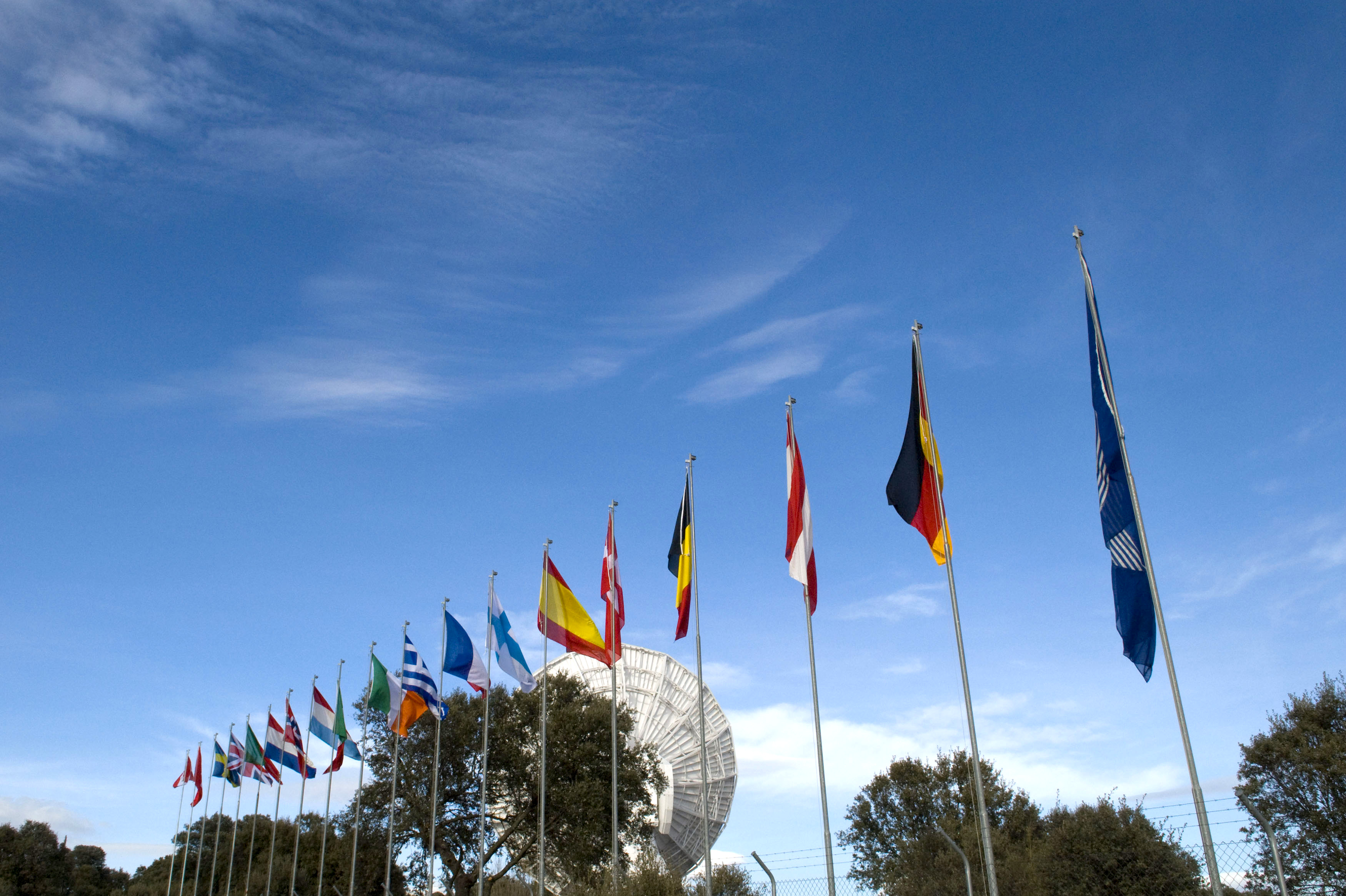
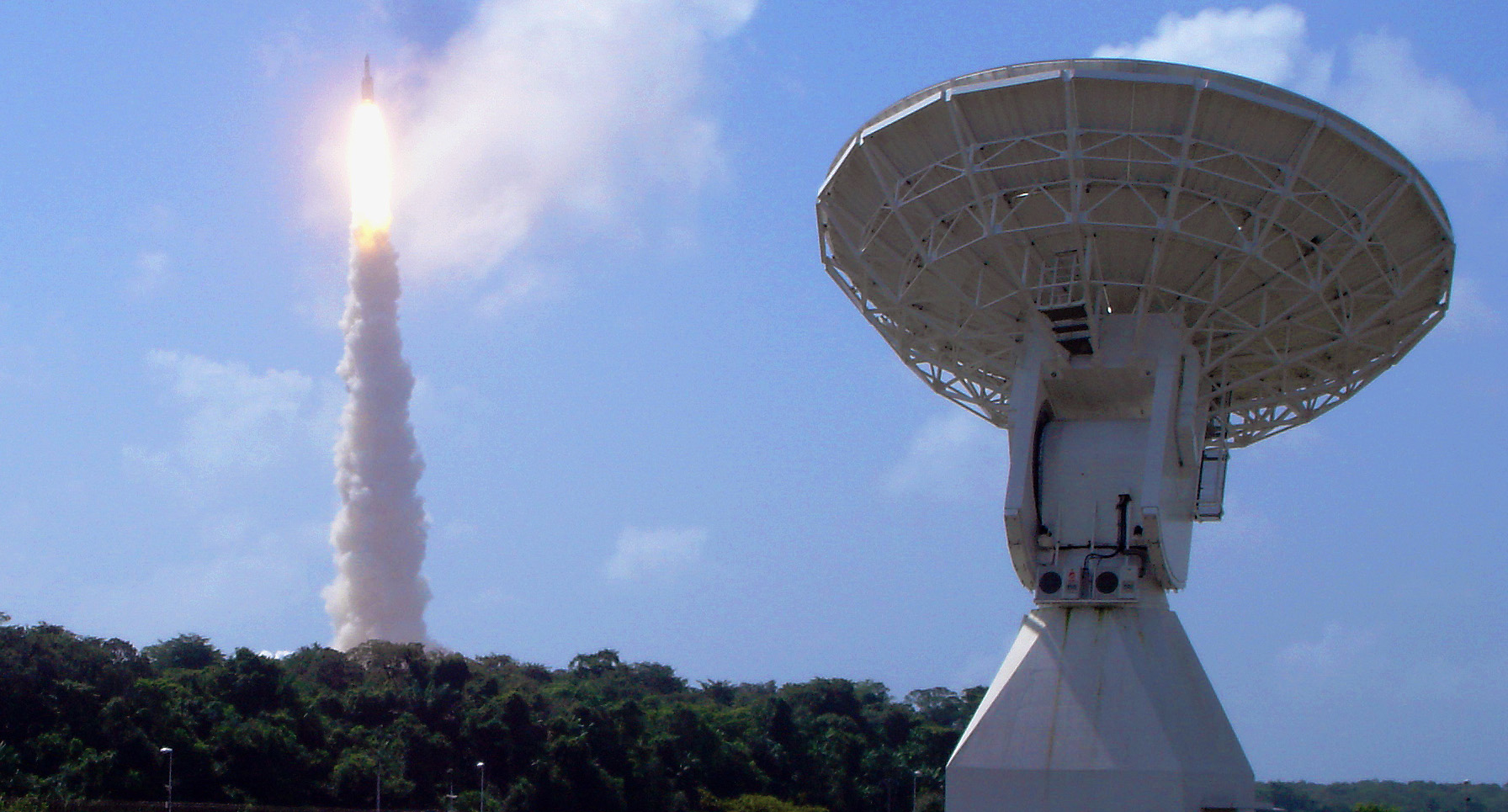
    ESA's Villafranca VIL-2 15m S-band antenna with flags of ESA member states. Its 15m diameter dish antenna performs reception and transmission in S-band including an auto track capability, a ranging system, a frecuency and timing system, a monitoring and control system, and a communications system. 
    Credits: ESA - S. Corvaja

    You, together with your 500 million fellow citizens from ESA’s 20 European member nations, are the collective owners of one of the world’s leading space agencies.

    The European Space Agency is an intergovernmental organisation, a cooperative coming together of its Member States in their national interest and common good. With Europe’s space ministers meeting on 20-21 November to decide the Agency’s future course, this new video offers a quick introduction: Europe, meet ESA. 
    ESA does a lot with little, its budget several times lower than its international counterparts.
    For an investment equivalent to a cinema ticket for each of us per year, the European Space Agency is one of the few organisations in the world active in all areas of space: exploring space and safeguarding the terrestrial environment while also boosting our continent’s technical knowhow and economic competitiveness.
    “We can do more, together” was the credo that led 10 European states to found ESA back in 1975. Today, the success of this approach is clear. ESA technical leadership and the permanent support of its Member States have built a competitive European space industry in the global front rank.
    Ariane-5 ECA launch
    Download:
     HI-RES JPEG (Size: 1179 kb)
    Ariane-5 ECA launch of Herschel and Planck in May 2009 from Europe's Spaceport in French Guiana. Credits: ESA/CNES/Arianespace-Service Optique CSG

    From weather satellites to space-based telecommunications, navigation and environmental monitoring, the systems ESA has put in place have helped to strengthen Europe’s strategic independence and its place in the world, along with our quality of life and prosperity. ESA activities have given rise to new jobs, businesses and entire high-value industries.
    “We can do more together” turned out to be an accurate prediction. Almost four decades on, this space agency for Europe has 20 member states, collectively achieving results that no single nation could match.
    ESA has forged a culture of diversity, collaboration and excellence. Good work tends to have an impact, and ESA’s long-term record of cooperative success has in turn inspired a new ethos of cooperation among global space powers.
    To learn more about ESA and its many and varied impacts on Europe and the world, watch the short video above.


    This image shows molecular clouds in the Pegasus region as seen through the glow of carbon monoxide (CO) with Planck (blue).

    Molecular clouds, the dense and compact regions throughout the Milky Way where gas and dust clump together, represent one of the sources of foreground emission seen by Planck. The vast majority of gas in these clouds consists of molecular hydrogen (H2), and it is in these cold regions that stars are born. Since cold H2 does not easily radiate, astronomers trace these cosmic cribs across the sky by targeting other molecules, which are present there in very low abundance but radiate quite efficiently. The most important of these tracers is carbon monoxide (CO), which emits a number of rotational emission lines in the frequency range probed by Planck's High Frequency Instrument (HFI).

    Emission lines affect a very limited range of frequencies compared to the broad range to which each of Planck’s detectors is sensitive, and are usually observed using spectrometers. But some CO lines are so bright that they actually dominate the total amount of light collected by certain detectors on Planck when they are pointed towards a molecular cloud like those in the Pegasus region.

    The all-sky CO map compiled with Planck data shows concentrations of molecular gas in portions of the sky that had never before been surveyed. For example, many regions at high galactic latitude, such as the Pegasus region, had not been covered by previous CO surveys. Planck's high sensitivity to CO also means that even very low-density clouds can be detected, as in the case of the Pegasus clouds.

    Follow-up observations and further studies of this and other stellar nurseries will allow a detailed investigation of the physical and chemical conditions that lead to the formation of molecular clouds, shedding new light on the very early phases of star formation.

    Credits: ESA/Planck Collaboration
    ESA

    Guillermo Gonzalo Sánchez Achutegui
    ayabaca@gmail.com
    ayabaca@hotmail.com
    ayabaca@yahoo.com

    domingo, 14 de octubre de 2012

    ESA Portal: Lost asteroid rediscovered with a little help from ESA


    http://www.esa.int/images/Animation-J04-Recovery-2008SE85.gif
    Asteroid 2008SE85
    Download:
    Animation of asteroid 2008SE85, moving between the stars. The images were tracked on the asteroid, thus the stars appear as small trails. 
    Credits: ESA/E. Schwab
    A potentially hazardous asteroid once found but then lost has been rediscovered and its orbit confirmed by a determined amateur astronomer working with ESA’s space hazards programme. The half-kilometre object will not threaten Earth anytime soon.

    Amateur astronomer Erwin Schwab, from Germany, conducted his asteroid hunt in September during a regular observation slot at ESA’s Optical Ground Station in Tenerife, Spain, sponsored by the Agency’s Space Situational Awareness programme.
    He was determined to rediscover the object, known by its catalogue name as 2008SE85.
    Potentially Hazardous Asteroid 2008SE85 was discovered in September 2008 by the Catalina Sky Survey, and observed by a few observatories to October 2008.  

    Asteroid considered lost

    Since then, however, nobody had observed the object and predictions for its current position had become so inaccurate that the object was considered to be ‘lost’.
    http://www.esa.int/images/2012SE85_orbit.png
     Orbit of 2008SE85
    Download:
    The asteroid takes about two years to circle the Sun. The next close approach to our planet will be on 29 March 2013, to within a safe distance of about 15 million km, or about a tenth of the distance to the Sun. A much closer passage is predicted for 2098, when the asteroid will fly by at about 6 million km. This is twice the distance it was predicted to have before its re-discovery. 
    Credits: ESA/Deimos
     Erwin planned his observing sequence to look for the object within the area of uncertainty of its predicted position. After only a few hours, he found it about 2° – four times the apparent size of the Moon – away from its predicted position.
    “I found the object on the evening of Saturday, 15 September, while checking the images on my computer,” says Erwin.
    “I then saw it again at 01:30 on Sunday morning – and that was my birthday! It was one of the nicest birthday presents.”
     

    These new observations of the roughly 500 m-diameter asteroid will allow a much more accurate determination of its orbit and help confirm that it will not be a threat to Earth anytime soon.
    Potentially Hazardous Asteroids approach Earth closer than about 7 million km; about 1300 are known.
    When a new asteroid is discovered, follow-up observations must be done within a few hours and then days to ensure it is not subsequently lost.
     

    USA-based Minor Planet Center acknowledges the find

    Asteroid position measurements are collected from observers worldwide by the US-based Minor Planet Center, which acknowledged the rediscovery of 2008SE85 by releasing a Minor Planet Electronic Circular announcing the new observations.

    http://esamultimedia.esa.int/images/ogs_telescope.jpg
     1m telescope at ESA's Optical Ground Station
    Download:


    OGS telescope 
    Credits: ESA
    "These observations were part of the strong collaboration that we have with a number of experienced backyard observers,” says Detlef Koschny, Head of the Near-Earth Object segment of ESA’s Space Situational Awareness programme. "It’s not the first time our collaboration with amateurs has scored such a success. Members of the Teide Observatory Tenerife Asteroid Survey started by Matthias Busch from Heppenheim, Germany, discovered two new near-Earth objects during the last year while working with our observing programme."
      Contact
    ESA
    Guillermo Gonzalo Sánchez Achutegui
    ayabaca@gmail.com
    ayabaca@hotmail.com
    ayabaca@yahoo.com

    ESA: Follow the Galileo IOV launch live


    http://www.esa.int/images/19528A4.jpg
    Download:
     HI-RES JPEG (Size: 506 kb)  HI-RES TIFF (Size: 25 425 kb)
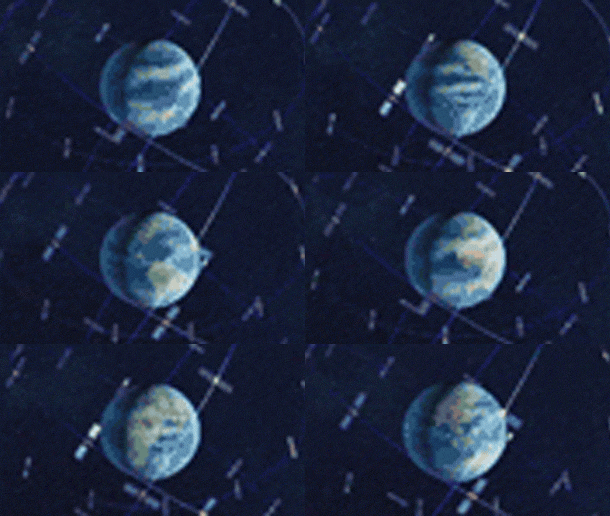
    The four Galileo In-Orbit Validation satellites in their orbits 
    Credits: ESA - P. Carril
    Join us for the launch of the second pair of Galileo satellites, from Europe's Spaceport in French Guiana. Launch is scheduled for 18:15:00 GMT (20:15:00 CEST) on 12 October. Live streaming will begin at 17:48 GMT (19:48 CEST) for about 1 hour. Streaming resumes at 21:25 GMT (23:25 CEST) to cover the final deployment. 
    ESA
    Guillermo Gonzalo Sánchez Achutegui
    ayabaca@gmail.com
    ayabaca@hotmail.com
    ayabaca@yahoo.com

    domingo, 23 de septiembre de 2012

    La ESA transfiere el control del satélite meteorológico MetOp-B a EUMETSAT

    Headquarters in Darmstadt, Germany
    EUMETSAT (European Organisation for the Exploitation of Meteorological Satellites) is an intergovernmental organisation created through an international convention agreed by a current total of 26 European Member States: Austria, Belgium, Croatia, the Czech Republic, Denmark, Finland, France, Germany, Greece, Hungary, Ireland, Romania, Italy, Latvia, Luxembourg, the Netherlands, Norway, Poland, Portugal, Slovakia, Slovenia, Spain, Sweden, Switzerland, Turkey, and the United Kingdom. These States fund the EUMETSAT programs and are the principal users of the systems. EUMETSAT also has 5 Cooperating States. Cooperation agreements with Iceland, Lithuania, Bulgaria, Estonia and Serbia have entered into force. The convention establishing EUMETSAT was opened for signature in 1983 and entered into force in 19 June 1986.
    EUMETSAT's primary objective is to establish, maintain and exploit European systems of operational meteorological satellites. EUMETSAT is responsible for the launch and operation of the satellites and for delivering satellite data to end-users as well as contributing to the operational monitoring of climate and the detection of global climate changes.
    The activities of EUMETSAT contribute to a global meteorological satellite observing system coordinated with other space-faring nations.
    Satellite observations are an essential input to numerical weather prediction systems and also assist the human forecaster in the diagnosis of potentially hazardous weather developments. Of growing importance is the capacity of weather satellites to gather long term measurements from space in support of climate change studies.WIKIPEDIA
    PR 30 2012 – Ayer a las 18.30 hora local, EUMETSAT tomó el control de las operaciones del satélite MetOp-B, puesto en órbita el pasado día 17 de septiembre. Este evento marca el fin de la Fase de Lanzamiento y Operaciones Iniciales coordinada por la ESA desde el Centro Europeo de Operaciones Espaciales (ESOC).

    Desde el lanzamiento de MetOp-B el pasado lunes por la tarde, los técnicos del Centro Europeo de Operaciones Espaciales de la ESA en Darmstadt, Alemania, han estado trabajando día y noche para completar la Fase de Lanzamiento y Operaciones Iniciales. Durante estos tres días se comprobaron todos los subsistemas del satélite y se aseguró el correcto despliegue y apuntamiento del panel solar de MetOp-B, que garantizará el suministro de potencia eléctrica al satélite y a sus 11 instrumentos científicos.
    Durante el primer día de la fase LEOP, el equipo de operaciones comprobó la temperatura, el suministro de potencia, el software y los enlaces de comunicaciones, y activó varios subsistemas. Al día siguiente se desplegaron las antenas de cinco instrumentos científicos. El tercer día se encendió el motor del satélite para realizar un ligero ajuste de su órbita, a 800 kilómetros sobre la superficie de la Tierra y con una inclinación de 99 grados, y para ponerlo ‘en fase’ con MetOp-A. Finalmente, se preparó para transferir su control a EUMETSAT.
    Tras recibir el control de la misión, EUMETSAT empezó a trabajar de forma inmediata en la fase de verificación en órbita de MetOp-B, un proceso que llevará seis semanas y durante el que se encenderán, uno a uno, los 11 instrumentos del satélite.
    La secuencia de activación de los instrumentos europeos a bordo de MetOp-B será la siguiente:
    - GOME-2, el espectrómetro ultravioleta para la monitorización del ozono, se activará cinco días después del lanzamiento;
    - ASCAT, el difusómetro avanzado, se activará a la semana;
    - GRAS, el instrumento para el sondeo atmosférico a través de la ocultación de las señales de los Sistemas Globales de Navegación por Satélite (GNSS), también se activará a la semana;
    - MHS, la sonda de humedad por microondas, a las tres semanas y media;
    - IASI, el interferómetro para el sondeo atmosférico en el infrarrojo, a las seis semanas.
    Juntos, estos instrumentos permitirán medir el perfil vertical de temperatura, humedad y concentración de gases traza en la atmósfera, los campos de viento en la superficie de los océanos y la humedad del terreno.
    Las tareas de verificación en órbita de MetOp-B utilizarán el segmento de tierra del Sistema Polar de EUMETSAT (EPS) y se coordinarán desde el Centro de Control de EUMETSAT, ubicado en la sede de esta organización en Darmstadt, Alemania. En esta fase, EUMETSAT contará con el apoyo de la ESA, la agencia espacial francesa (CNES), la Administración Oceánica y Atmosférica de los Estados Unidos (NOAA) y la industria.

    Más información
     EUMETSAT (European Organisation for the Exploitation of Meteorological Satellites)
    European Space Agency-ESA
     Guillermo Gonzalo Sánchez Achutegui
    ayabaca@gmail.com
    ayabaca@hotmail.com
    ayabaca@yahoo.com

    Sigue el simposio sobre altimetría radar en directo desde Venecia


    L'ingresso del Palazzo del Cinema durante la 66ª Mostra internazionale d'arte cinematografica di Venezia.
    Il Palazzo del Cinema è il luogo che ospita la Mostra del Cinema di Venezia, ubicato al Lido di Venezia.
    La prima Mostra si tenne sulla terrazza dell'Hotel Excelsior il 6 agosto 1932. Ma con il successo crescente diventa necessario edificare una sede propria e di prestigio e questo avviene tra il 1937 e il 1938 secondo il progetto dell'ingegnere Luigi Quagliata, fedele ai dettami del modernismo. Nella stessa zona viene costruito il Casinò su progetto dell'ingegnere capo del Comune Eugenio Miozzi che cura anche l'assetto dell'intera area.
    Il Palazzo è allora composto da una semplice hall e da una sala cinematografica (l'attuale Sala Grande). In seguito al continuo successo del festival diventa necessario l'ampliamento dell'edificio che viene affidato allo stesso Quagliata nel 1952. Il progetto complessivo prevedeva l'ampliamento della Sala Grande, un'arena scoperta, altre sale cinematografiche, uffici e servizi, ma furono realizzati solo l'avancorpo e l'arena scoperta.
    Però le strutture rimangono insufficienti di fronte al crescente numero di spettatori e nel 1991 in occasione della XX Mostra Internazionale di Architettura, viene indetto un concorso su inviti per la progettazione di un nuovo Palazzo del Cinema. Il bando prevede la demolizione del vecchio Palazzo ad eccezione della Sala Grande. Viene scelto il progetto dell'architetto spagnolo Rafael Moneo, però l'edificio viene ritenuto troppo costoso ed il Comune di Venezia abbandona l'idea.
    Si decide quindi di realizzare lavori di adeguamento del Palazzo del Cinema (1995) e di costruire delle strutture temporanee per potere accogliere più spettatori. Vengono realizzati nel 1991 il Palagalileo (nome che prende dalle Industrie Ottiche Galileo che finanziano la sua costruzione) sul sito dell'arena e nel 1999 la PalaBNL, una tensostruttura che viene alzata ogni anno sul campo da rugby delle Quattro Fontane. Inoltre a partire del 1999 viene concesso in uso il Casinò.
    La necessità di nuovi spazi e la volontà di riorganizzare l'intera area ha portato la Fondazione Biennale di Venezia a bandire nel 2004 un concorso di progettazione per un nuovo palazzo del Cinema e la sistemazione delle aree limitrofe. Il 26 maggio 2005 la Biennale di Venezia ha annunciato che l'appalto è stato assegnato allo studio italiano "5+1AA Alfonso Femia Gianluca Peluffo" in collaborazione con l'architetto francese Rudy Ricciotti.
    Il 28 agosto 2008 è stata posta la prima pietra del Nuovo Palazzo del Cinema: l'opera sarebbe dovuta rientrare tra quelle realizzate in occasione del 150º anniversario dell'unità d'Italia, che ha avuto luogo nel 2011.

    Erano state progettate quattro sale cinematografiche, una in superficie denominata “Il Sasso” e altre tre sotterranee. I progettisti vincono il concorso, nella presentazione si notano queste parole “sarebbe scandaloso distruggere l'area verde del Lido “. Per la costruzione viene nominato dal Presidente del Consiglio il Commissario Straordinario per le grandi opere e, superando ogni vincolo, il 12 febbraio 2009, malgrado le proteste del Coordinamento delle Associazioni Ambientaliste e dei cittadini del Lido (raccolte 2760 firme) vengono abbattuti 132 alberi: la completa pineta del piazzale (pini marittimi domestici), parte del giardino del Casinò (protetto) e un filare di lecci del lungomare. La sovvenzione di tali opere era legata ad una complicata operazione di vendita dell’ospedale del Lido al Comune e rivendita ai privati che alla fine doveva avere un guadagno che, in parte, avrebbe dovuto sovvenzionare l’opera. Il ritardo e forse il fallimento nel completamento dell’operazione (non ancora andata a buon fine) e il ritrovamento d’amianto nel sottosuolo, hanno fatto sì che la ditta costruttrice abbia restituito le chiavi del cantiere che attualmente è fermo da più mesi. Il commissario straordinario, che nel frattempo ha visto i suoi vice indagati e carcerati per le note vicende legate alla protezione civile, ha comunicato lo slittamento nei tempi di completamento dell’opera che non sarà più nella ricorrenza del 150º anniversario dell’Unità d’Italia ma forse a fine 2012 , inoltre, il progetto, per mancanza di fondi si ridurrà ad una sola sala cinematografica, cosa che si sarebbe potuta realizzare semplicemente sopraelevando (come previsto dal vecchio progetto iniziale) la sala cinematografica attuale.
    Il 17 marzo 2011, festa nazionale per la ricorrenza del 150º anniversario dell'unità d'Italia, la sistuazione è la stessa, il cantiere è chiuso e al posto del nuovo palazzo c'è soltanto una grande buca. Il Coordinamento delle Associazioni Ambientaliste organizza una cerimonia-burla di inaugurazione del nuovo palazzo essendo stata prevista questa data per la fine dei lavori. Due mesi dopo, e dopo aver speso finora circa 37 milioni di euro, il Ministero per i Beni e le Attività Culturali decide di azzerare quanto fatto finora e indire una gara europea per un altro nuovo palazzo in project-financing. Dopo aver speso milioni di euro pubblici la mano, quindi, passa ai privati.
    Per l'edizione 2011 della Mostra del Cinema, la Sala Grande si presenta completamente rinnovata. Grazie alla collaborazione fra la Biennale e lo Studio di Acustica Ing. R. FURLAN, la Sala Grande ha ritrovato il fascino del suo aspetto originario insieme ad un'acustica ottimale per la cinematografia di oggi.
    Il 31 dicembre 2011 il commissario straordinario Dott. Vincenzo Spaziante decade dall'incarico. Lascia i lavori del Nuovo Palazzo del Cinema incompiuti, anzi, lascia soltanto un buco di terra profondo 3 metri e un buco di 37 milioni di euro, le spese, però, non sono ancora finite, secondo i giornali locali vengono spesi ancora 20.000 euro al mese per spese di sorveglianza, luce e accessori.
    In febbraio 2012 viene rinominato ancora il Commissario Spaziante ma ora non più come Commissario Straordinario, ma Commissario Ordinario
    Finora per tutta l'operazione sono stati spesi circa 43 milioni per nulla, niente di quanto previsto è stato fatto.
    Il malcontento dei cittadini, che vedono sprecati questi soldi (circa 80 miliardi delle vecchie lire), fa sì che il Coordinamento delle Associazioni Ambientaliste chieda l'accesso agli atti ambientali per vedere come effettivamente siano stati spesi questi soldi e lancia una campagna di raccolta firme con la richiesta dei dati.
    Malgrado intimidazioni a consegnarli da parte dei difensori civici del comune e della regione ed anche della commissione centrale di Roma per l'accesso ai dati, di questi conti non si vede nemmeno l'ombra. Anche la Corte dei Conti incarica la Guardia di Finanza che però non trova la documentazione.
    Il Coordinamento della Associazioni Ambientaliste del Lido crea un gruppo di lavoro formato da ingegneri, naturalisti, architetti ed esperti vari che con il rettore e il preside dell'Universita I.U.A.V di Architettura di Venezia, aprono un tavolo di lavoro per una progettazione compatibile del "Palabuco".
    Il progetto di un giardino sotto il livello stradale viene presentato alle commissioni consiliari. Viene accolto con successo in quanto sfruttando l'opportunità di avere il "Palbuco" e poterlo ricoprire di soli 5 cm. di terra e creare un giardino con vialetti, avrebbe comportato una spesa irrisoria in confronto a quella della copertura totale di terra. Si sarebbe, inoltre, mantenuto il rudere del vecchio forte austriaco ritrovato durante gli scavi.
    Il Sindaco, invece, dopo un incontro col Coordinamento decide di ricoprire interamente mezzo buco e creare un piazzale. L'altro mezzo buco resta così in attesa di costriure, quando ci saranno i finanziamenti, un palazzetto del cinema.
    Per i lavori di riempimento sono prevetivati 6 milioni e mezzo di euro.
    Si procede subito al riempimento del mezzo buco.
    Al 5 luglio la copertura è terminata e inizia l'opera di ripristino della strada e della piazza. L' 8 agosto la strada è stata ripristinata, il piazzale asfaltato. Il Casinò non ha più la grande scalinata d'entrata. Il coordinamento ambientalista organizza una protesta: 130 persone vestite di bianco con le "Braccia al Cielo" per ricordare i 130 alberi abbattuti. WIKIPEDIA.
    The ‘20 Years of Progress in Radar Altimetry Symposium’ is being held at the Venice Convention Centre Palazzo del Casinó.

    Credits: CLS/LEGOS/CNES

     Sigue el simposio sobre altimetría radar en directo desde Venecia
     
    21 septiembre 2012
    La conferencia científica sobre la tecnología que nos permite estudiar la altura de la superficie de los océanos se celebrará en una ciudad para la que la subida del nivel del mar es de especial importancia. Sigue el evento en directo el día 24 de septiembre de 09:00 a 13:00 CEST.

    El simposio ‘20 Years of Progress in Radar Altimetry’ se celebrará del 24 al 29 de septiembre en el centro de convenciones ‘Palazzo del Casino’ de Venecia.
    El tema de este evento es la altimetría radar: la técnica que permite medir desde el espacio la altura de la superficie de los océanos y de las masas de agua dulce, hielo o tierra en prácticamente cualquier punto del planeta.
    El lunes 24 de septiembre se retransmitirá en directo la sesión de apertura de este simposio, a partir de las 09:00 CEST.
    El acto comenzará con los discursos de bienvenida del alcalde de Venecia, Giorgi Orsoni, del Director del Departamento de Ciencia, Aplicaciones y Futuras Tecnologías de Observación de la Tierra de la ESA, Maurice Borgeaud, y del director de observación de la Tierra del CNES, Pascale Ultré-Guérard.
    A continuación, una serie de presentaciones resumirán los principales retos, los resultados y el futuro de la altimetría radar.
    El programa detallado de la sesión, así como la información para registrarse en el evento, está disponible en la página web del simposio.
    Este evento está organizado por la ESA con la colaboración de la agencia espacial francesa, CNES. 
    European Space Agency-ESA.
    Guillermo Gonzalo Sánchez Achutegui
    ayabaca@gmail.com
    ayabaca@hotmail.com
    ayabaca@yahoo.com