Mostrando entradas con la etiqueta The Sun. Mostrar todas las entradas

domingo, 19 de octubre de 2014

NASA : NASA Spacecraft Provides New Information About Sun’s Atmosphere

Hola amigos: AL VUELO DE UN QUINDE EL BLOG., la Agencia Espacial NASA, nos informa que: NASA's Interface Region Imaging Spectrograph (IRIS); ha proporcionado a los científicos con cinco nuevos hallazgos sobre cómo la atmósfera del Sol, o corona, se calienta mucho más caliente que su superficie, lo que causa constante flujo de salida del sol de partículas llamado viento solar, y qué mecanismos aceleran partículas que alimentan las erupciones solares....
 
La nueva información ayudará a los investigadores a entender mejor cómo nuestra energía transferencias estrella más cercana a través de su atmósfera y realizar un seguimiento de la actividad solar dinámico que puede afectar a la infraestructura tecnológica en el espacio y en la Tierra. Los detalles de los hallazgos aparecen en la edición actual de la Ciencia.

  "Estos resultados revelan una región del Sol más complicado de lo que se pensaba anteriormente", dijo Jeff Newmark, director interino de la División de Heliofísica de la NASA en Washington. "La combinación de datos de IRIS con las observaciones de otras misiones Heliofísica está permitiendo grandes avances en nuestra comprensión del Sol y sus interacciones con el sistema solar."..........
NASA’s Solar Dynamics Observatory provided the outer image of a coronal mass ejection on May 9, 2014.
NASA’s Solar Dynamics Observatory provided the outer image of a coronal mass ejection on May 9, 2014. The IRIS spacecraft. The IRIS mission views the interface region that lies between the sun’s photosphere and corona in unprecedented detail for researchers to study.
Image Credit: 
NASA, Lockheed Martin Solar & Astrophysics Laboratory
 

NASA's Interface Region Imaging Spectrograph (IRIS) has provided scientists with five new findings into how the sun’s atmosphere, or corona, is heated far hotter than its surface, what causes the sun’s constant outflow of particles called the solar wind, and what mechanisms accelerate particles that power solar flares.
The new information will help researchers better understand how our nearest star transfers energy through its atmosphere and track the dynamic solar activity that can impact technological infrastructure in space and on Earth. Details of the findings appear in the current edition of Science.
 "These findings reveal a region of the sun more complicated than previously thought," said Jeff Newmark, interim director for the Heliophysics Division at NASA Headquarters in Washington. "Combining IRIS data with observations from other Heliophysics missions is enabling breakthroughs in our understanding of the sun and its interactions with the solar system."
The first result identified heat pockets of 200,000 degrees Fahrenheit, lower in the solar atmosphere than ever observed by previous spacecraft. Scientists refer to the pockets as solar heat bombs because of the amount of energy they release in such a short time. Identifying such sources of unexpected heat can offer deeper understanding of the heating mechanisms throughout the solar atmosphere.
For its second finding, IRIS observed numerous, small, low lying loops of solar material in the interface region for the first time. The unprecedented resolution provided by IRIS will enable scientists to better understand how the solar atmosphere is energized.
A surprise to researchers was the third finding of IRIS observations showing structures resembling mini-tornadoes occurring in solar active regions for the first time. These tornadoes move at speeds as fast as 12 miles per second and are scattered throughout the chromosphere, or the layer of the sun in the interface region just above the surface.  These tornados provide a mechanism for transferring energy to power the million-degree temperatures in the corona.
Another finding uncovers evidence of high-speed jets at the root of the solar wind.  The jets are fountains of plasma that shoot out of coronal holes, areas of less dense material in the solar atmosphere and are typically thought to be a source of the solar wind.
The final result highlights the effects of nanoflares throughout the corona. Large solar flares are initiated by a mechanism called magnetic reconnection, whereby magnetic field lines cross and explosively realign. These often send particles out into space at nearly the speed of light. Nanoflares are smaller versions that have long been thought to drive coronal heating. IRIS observations show high energy particles generated by individual nanoflare events impacting the chromosphere for the first time.     
"This research really delivers on the promise of IRIS, which has been looking at a region of the sun with a level of detail that has never been done before," said De Pontieu, IRIS science lead at Lockheed Martin in Palo Alto, California. "The results focus on a lot of things that have been puzzling for a long time and they also offer some complete surprises."
IRIS is a Small Explorer mission managed by NASA’s Goddard Space Flight Center, in Greenbelt, Maryland for the agency’s Science Mission Directorate at NASA Headquarters. NASA's Ames Research Center in Moffett Field, California, provides mission operations and ground data systems. The Norwegian Space Centre is providing regular downlinks of science data. Lockheed Martin designed the IRIS observatory and manages the mission for NASA. The Harvard-Smithsonian Center for Astrophysics in Cambridge, Massachusetts, built the telescope. Montana State University in Bozeman designed the spectrograph. Other contributors for this mission include the University of Oslo and Stanford University in Stanford, California.
For more information about IRIS, visit:
NASA
Guillermo Gonzalo Sánchez Achutegui

domingo, 7 de septiembre de 2014

NASA : NASA Launches Satellite to Study How Sun's Atmosphere Is Energized


NASA Launches Satellite to Study How Sun's Atmosphere Is Energized

WASHINGTON -- NASA's Interface Region Imaging Spectrograph (IRIS) spacecraft launched Thursday at 7:27 p.m. PDT (10:27 p.m. EDT) from Vandenberg Air Force Base, Calif. The mission to study the solar atmosphere was placed in orbit by an Orbital Sciences Corporation Pegasus XL rocket.
"We are thrilled to add IRIS to the suite of NASA missions studying the sun," said John Grunsfeld, NASA's associate administrator for science in Washington. "IRIS will help scientists understand the mysterious and energetic interface between the surface and corona of the sun."
IRIS is a NASA Explorer Mission to observe how solar material moves, gathers energy and heats up as it travels through a little-understood region in the sun's lower atmosphere. This interface region between the sun's photosphere and corona powers its dynamic million-degree atmosphere and drives the solar wind. The interface region also is where most of the sun's ultraviolet emission is generated. These emissions impact the near-Earth space environment and Earth's climate.
The Pegasus XL carrying IRIS was deployed from an Orbital L-1011 carrier aircraft over the Pacific Ocean at an altitude of 39,000 feet, off the central coast of California about 100 miles northwest of Vandenberg. The rocket placed IRIS into a sun-synchronous polar orbit that will allow it to make almost continuous solar observations during its two-year mission.
The L-1011 took off from Vandenberg at 6:30 p.m. PDT and flew to the drop point over the Pacific Ocean, where the aircraft released the Pegasus XL from beneath its belly. The first stage ignited five seconds later to carry IRIS into space. IRIS successfully separated from the third stage of the Pegasus rocket at 7:40 p.m. At 8:05 p.m., the IRIS team confirmed the spacecraft had successfully deployed its solar arrays, has power and has acquired the sun, indications that all systems are operating as expected.
"Congratulations to the entire team on the successful development and deployment of the IRIS mission," said IRIS project manager Gary Kushner of the Lockheed Martin Solar and Atmospheric Laboratory in Palo Alto, Calif. "Now that IRIS is in orbit, we can begin our 30-day engineering checkout followed by a 30-day science checkout and calibration period."
IRIS is expected to start science observations upon completion of its 60-day commissioning phase. During this phase the team will check image quality and perform calibrations and other tests to ensure a successful mission.
NASA's Explorer Program at Goddard Space Flight Center in Greenbelt, Md., provides overall management of the IRIS mission. The principal investigator institution is Lockheed Martin Space Systems Advanced Technology Center. NASA's Ames Research Center will perform ground commanding and flight operations and receive science data and spacecraft telemetry.
The Smithsonian Astrophysical Observatory designed the IRIS telescope. The Norwegian Space Centre and NASA's Near Earth Network provide the ground stations using antennas at Svalbard, Norway; Fairbanks, Alaska; McMurdo, Antarctica; and Wallops Island, Va. NASA's Launch Services Program at the agency's Kennedy Space Center in Florida is responsible for the launch service procurement, including managing the launch and countdown. Orbital Sciences Corporation provided the L-1011 aircraft and Pegasus XL launch system.
For more information about the IRIS mission, visit:
NASA
Guillermo Gonzalo Sánchez Achutegui

domingo, 1 de septiembre de 2013

NASA - Annular Eclipse of the Sun by Phobos, as Seen by Curiosity


Annular Eclipse of the Sun by Phobos, as Seen by Curiosity
This set of three images shows views three seconds apart as the larger of Mars' two moons, Phobos, passed directly in front of the sun as seen by NASA's Mars rover Curiosity. Curiosity photographed this annular, or ring, eclipse with the telephoto-lens camera of the rover's Mast Camera pair (right Mastcam) on Aug. 17, 2013, the 369th Martian day, or sol, of Curiosity's work on Mars.
Curiosity paused during its drive that sol for a set of observations that the camera team carefully calculated to record this celestial event. The rover's observations of Phobos help make researchers' knowledge of the moon's orbit even more precise. Because this eclipse occurred near mid-day at Curiosity's location on Mars, Phobos was nearly overhead, closer to the rover than it would have been earlier in the morning or later in the afternoon. This timing made Phobos' silhouette larger against the sun -- as close to a total eclipse of the sun as is possible from Mars.
› Related release
Image credit: NASA/JPL-Caltech/Malin Space Science Systems/Texas A&M Univ.
NASA
Guillermo Gonzalo Sánchez Achutegui
ayabaca@gmail.com
ayabaca@hotmail.com
ayabaca@yahoo.com

domingo, 25 de agosto de 2013

ESA - Sun-diving comet meets solar storm

http://www.esa.int
 
A comet, streaking into the image from the bottom right, appears to be headed for an encounter with a coronal mass ejection (CME) launched from the Sun. In fact, the comet is in the foreground with the CME occurring on the farside of the Sun. The comet, probably just a few tens of metres wide, was vaporised on its approach to the Sun, and did not survive the flyby.
The image was captured by the ESA/NASA SOHO space telescope on 19 August, 2013. The white circle shows the size and position of the visible Sun. The shaded disc is a mask in SOHO’s LASCO instrument that blots out direct sunlight to allow study of the faint details in the Sun's corona.
Credits: ESA & NASA/SOHO
ESA
Guillermo Gonzalo Sánchez Achutegui
ayabaca@gmail.com
ayabaca@hotmail.com
ayabaca@yahoo.com

sábado, 8 de junio de 2013

NASA - NASA Prepares for Launch of Next Solar Satellite


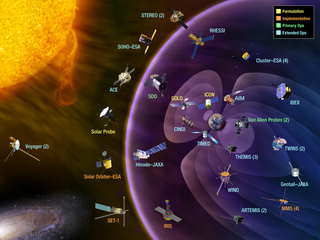
This image shows the Heliophysics System Observatory (HSO). The HSO utilizes the entire fleet of solar, heliospheric, geospace, and planetary spacecraft as a distributed observatory to discover the larger scale and/or coupled processes at work throughout the complex system that makes up our space environment. The HSO consist of 18 operating missions: Voyager, Geotail, Wind, SOHO, ACE, Cluster, TIMED, RHESSI, TWINS, Hinode, STEREO, THEMIS, AIM, CINDI, IBEX, SDO, ARTEMIS, Van Allen Probes
Credit: NASA

Available formats:
  1500 x 1125     JPEG   931 KB

WASHINGTON -- NASA's next scientific satellite, which is scheduled for launch June 26, will provide the most detailed look ever at the sun's lower atmosphere or interface region.

The Interface Region Imaging Spectrograph (IRIS) mission will observe how solar material moves, gathers energy, and heats up as it travels through this largely unexplored region of the solar atmosphere. The interface region, located between the sun's visible surface and upper atmosphere, is where most of the sun's ultraviolet emission is generated. These emissions impact the near-Earth space environment and Earth's climate.

The IRIS spacecraft was designed and built by Lockheed Martin's Advanced Technology Center in Palo Alto, Calif. It will launch aboard an Orbital Sciences Corp. Pegasus XL rocket deployed by the company's L-1011 aircraft from Vandenberg Air Force Base on the central California coast.

"IRIS data will fill a crucial gap in our understanding of the solar interface region upon joining our fleet of heliophysics spacecraft," said Jeffrey Newmark, NASA's IRIS program scientist in Washington. "For the first time we will have the necessary observations for understanding how energy is delivered to the million-degree outer solar corona and how the base of the solar wind is driven."

IRIS carries an ultraviolet telescope that feeds a multi-channel imaging spectrograph. The satellite is the first mission designed to use an ultraviolet telescope to obtain high-resolution images and spectra every few seconds and provide observations of areas as small as 150 miles across the sun.

"Previous observations suggest there are structures in this region of the solar atmosphere 100 to 150 miles wide, but 100,000 miles long," said Alan Title, IRIS principal investigator at Lockheed Martin. "Imagine giant jets like huge fountains that have a footprint the size of Los Angeles and are long enough and fast enough to circle Earth in 20 seconds. IRIS will provide our first high-resolution views of these structures along with information about their velocity, temperature and density."

After launch, IRIS will travel in a polar, sun-synchronous orbit around Earth, crossing nearly directly over the poles in such a way that it moves over the equator at the same local time each day. The spacecraft will orbit at an altitude range of 390 miles to 420 miles. This orbit allows for almost continuous solar observations on IRIS' two-year mission.

NASA's Ames Research Center in Moffett Field, Calif., will provide IRIS mission operations and ground data systems. The Norwegian Space Centre in Oslo, Norway, will provide regular downlinks of science data. NASA's Launch Services Program at the agency's Kennedy Space Center is responsible for launch management.

IRIS is a NASA Small Explorer Mission, which the agency's Goddard Space Flight Center in Greenbelt, Md., manages for the Science Mission Directorate in Washington. The goal of the Explorers Program is to provide frequent flight opportunities for world-class scientific investigations from space utilizing innovative, streamlined and efficient management approaches within the heliophysics and astrophysics science areas.

Other IRIS contributors include the Smithsonian Astrophysical Observatory in Cambridge, Mass.; Montana State University in Bozeman, Mont.; Stanford University in Stanford, Calif.; and the University of Oslo in Norway.

For graphics related from the June 4 IRIS news conference, visit:

For more information about the IRIS mission, visit:

  Next Animation Number

IRIS L-14 Media Briefing

Lying just above the sun's surface is an enigmatic region of the solar atmosphere called the interface region. A relatively thin region, just 3,000 to 6,000 miles thick, it pulses with movement: zones of different temperature and density are scattered throughout, while energy and heat course through the solar material.
Understanding how the energy travels through this region – energy that helps heat the upper layer of the atmosphere, the corona, to temperatures of 1,000,000 kelvins, some thousand times hotter than the sun's surface itself – is the goal of NASA's Interface Region Imaging Spectrograph, or IRIS, scheduled to launch on June 26, 2013 from California's Vandenberg Air Force Base.

Scientists wish to understand the interface region in exquisite detail, since energy flowing through this region has an effect on so many aspects of near-Earth space. For one thing, despite the intense amount of energy deposited into the interface region, only a fraction leaksthrough, but this fraction drives the solar wind, the constant stream of particles that flows out to fill the entire solar system. The interface region is also the source of most of the sun's ultraviolet emission, which impacts both the near-Earth space environment and Earth's climate.

IRIS's capabilities are uniquely tailored to unravel the interface region by providing both high-resolution images and a kind of data known as spectra, which can see many wavelengths at once. For its high-resolution images, IRIS will capture data on about one percent of the sun at a time. While these are relatively small snapshots, IRIS will be able to see very fine features, as small as 150 miles across.

This image shows the Heliophysics System Observatory (HSO). The HSO utilizes the entire fleet of solar, heliospheric, geospace, and planetary spacecraft as a distributed observatory to discover the larger scale and/or coupled processes at work throughout the complex system that makes up our space environment. The HSO consist of 18 operating missions: Voyager, Geotail, Wind, SOHO, ACE, Cluster, TIMED, RHESSI, TWINS, Hinode, STEREO, THEMIS, AIM, CINDI, IBEX, SDO, ARTEMIS, Van Allen Probes Credit: NASA    This image shows the Heliophysics System Observatory (HSO). The HSO utilizes the entire fleet of solar, heliospheric, geospace, and planetary spacecraft as a distributed observatory to discover the larger scale and/or coupled processes at work throughout the complex system that makes up our space environment. The HSO consist of 18 operating missions: Voyager, Geotail, Wind, SOHO, ACE, Cluster, TIMED, RHESSI, TWINS, Hinode, STEREO, THEMIS, AIM, CINDI, IBEX, SDO, ARTEMIS, Van Allen ProbesCredit: NASA

Available formats:
  1500 x 1125     JPEG   931 KB


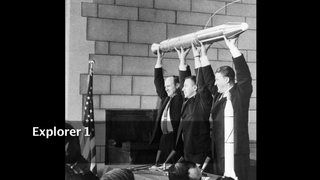
This movie shows images and data from the NASA Explorers Program since the first one Explorer 1 in 1958, through the nobel prize winning COBE, to the newest one to be launched, IRIS.  The Explorers Program is the oldest continuous program in NASA . Explorers are one of three flight programs within the Heliophysics portfolio and provide frequent spaceflight opportunities for world-class science investigations for a relatively modest cost. Credit: NASA    This movie shows images and data from the NASA Explorers Program since the first one Explorer 1 in 1958, through the nobel prize winning COBE, to the newest one to be launched, IRIS. The Explorers Program is the oldest continuous program in NASA . Explorers are one of three flight programs within the Heliophysics portfolio and provide frequent spaceflight opportunities for world-class science investigations for a relatively modest cost. Credit: NASA
Duration: 50.3 seconds
Available formats:
  1280x720 (59.94 fps) QT         886 MB
  1280x720 (59.94 fps) QT         106 MB
  1280x720 (29.97 fps) QT         18 MB
  640x360 (29.97 fps) QT         16 MB
  1280x720 (29.97 fps) MPEG-4   13 MB
How to play our movies


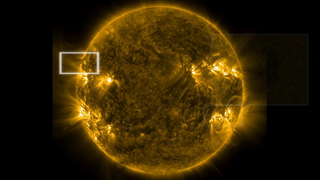
IRIS will advance our understanding of how the enigmatic interface region on the sun powers its dynamic million-degree atmosphere called the corona. IRIS will join the Solar Dynamics Observatory (SDO) which launched in 2010 and NASA/JAXA Hinode (launched in 2006).  Together they will explore how the solar atmosphere works and impacts Earth – SDO and Hinode monitoring the solar surface and outer atmosphere, with IRIS watching the region in between. This movie shows a full disk movie of the corona as seen by SDO with movies of the surface of the Sun, called the photosphere, and the chromosphere as seen by Hinode. Credit: NASA SDO; NASA/JAXA Hinode; GSFC    IRIS will advance our understanding of how the enigmatic interface region on the sun powers its dynamic million-degree atmosphere called the corona. IRIS will join the Solar Dynamics Observatory (SDO) which launched in 2010 and NASA/JAXA Hinode (launched in 2006). Together they will explore how the solar atmosphere works and impacts Earth – SDO and Hinode monitoring the solar surface and outer atmosphere, with IRIS watching the region in between. This movie shows a full disk movie of the corona as seen by SDO with movies of the surface of the Sun, called the photosphere, and the chromosphere as seen by Hinode.Credit: NASA SDO; NASA/JAXA Hinode; GSFC
Duration: 30.1 seconds
Available formats:
  1280x720 (59.94 fps) QT         521 MB
  1280x720 (59.94 fps) QT         138 MB
  1280x720 (29.97 fps) QT         19 MB
  1280x720 (29.97 fps) MPEG-4   5 MB
  640x360 (29.97 fps) QT         23 MB
How to play our movies


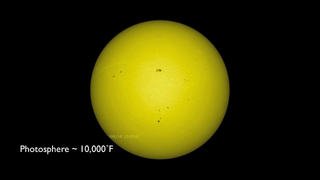
A sequence of images from the surface to the Corona taken by the Heliospheric and Magnetic Imager (HMI)  and Atmospheric Imaging Assembly (AIA) instruments on the Solar Dynamics Observatory (SDO). Credit: NASA SDO    A sequence of images from the surface to the Corona taken by the Heliospheric and Magnetic Imager (HMI) and Atmospheric Imaging Assembly (AIA) instruments on the Solar Dynamics Observatory (SDO).Credit: NASA SDO
Duration: 37.5 seconds
Available formats:
  1280x720 (59.94 fps) QT         606 MB
  1280x720 (29.97 fps) QT         8 MB
  1280x720 (59.94 fps) QT         40 MB
  1280x720 (29.97 fps) MPEG-4   5 MB
  640x360 (29.97 fps) QT         7 MB
How to play our movies


Jets at the limb seen in the light of Calcium II by the Focal Plane Package on the JAXA/ISAS Hinode Mission. Credit: JAXA/ISAS Hinode    Jets at the limb seen in the light of Calcium II by the Focal Plane Package on the JAXA/ISAS Hinode Mission.Credit: JAXA/ISAS Hinode
Duration: 16.7 seconds
Available formats:
  1280x720 (59.94 fps) QT         287 MB
  1280x720 (59.94 fps) QT         116 MB
  1280x720 (29.97 fps) QT         39 MB
  1280x720 (29.97 fps) MPEG-4   15 MB
  640x360 (29.97 fps) QT         30 MB
How to play our movies


Jet and plumes near a sunspot near the limb seen in the light of Calcium II by the Focal Plane Package on the JAXA/ISAS Hinode Mission. Credit: JAXA/ISAS, Hinode    Jet and plumes near a sunspot near the limb seen in the light of Calcium II by the Focal Plane Package on the JAXA/ISAS Hinode Mission.Credit: JAXA/ISAS, Hinode
Duration: 20.9 seconds
Available formats:
  1280x720 (59.94 fps) QT         355 MB
  1280x720 (59.94 fps) QT         73 MB
  1280x720 (29.97 fps) QT         13 MB
  1280x720 (29.97 fps) MPEG-4   5 MB
  640x360 (29.97 fps) QT         19 MB
How to play our movies


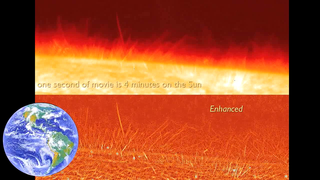
Blinks between and image in He II and an enhanced image.  The original image is from AIA on SDO and the enhanced image was created at the LM Solar and Astrophysics Laboratory (LMSAL). Credit: Dr. Alan Title, LMSAL    Blinks between and image in He II and an enhanced image. The original image is from AIA on SDO and the enhanced image was created at the LM Solar and Astrophysics Laboratory (LMSAL).Credit: Dr. Alan Title, LMSAL
Duration: 18.8 seconds
Available formats:
  1280x720 (59.94 fps) QT         318 MB
  1280x720 (59.94 fps) QT         69 MB
  1280x720 (29.97 fps) QT         21 MB
  1280x720 (29.97 fps) MPEG-4   11 MB
  640x360 (29.97 fps) QT         13 MB
How to play our movies


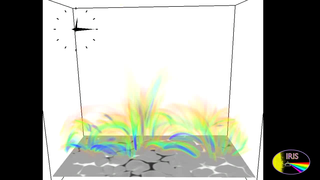
A simulation of the Sun in UV light.  The movie pans from disk center to the limb. Credit: Prof. Mats Carlsson at Oslo University    A simulation of the Sun in UV light. The movie pans from disk center to the limb. Credit: Prof. Mats Carlsson at Oslo University
Duration: 15.4 seconds
Available formats:
  1280x720 (59.94 fps) QT         262 MB
  1280x720 (59.94 fps) QT         70 MB
  1280x720 (29.97 fps) QT         16 MB
  1280x720 (29.97 fps) MPEG-4   7 MB
  640x360 (29.97 fps) QT         21 MB
How to play our movies


A simulation of heating by a jet. Credit: Dr. Juan Sykora at LMSAL    A simulation of heating by a jet. Credit: Dr. Juan Sykora at LMSAL
Duration: 8.6 seconds
Available formats:
  1280x720 (59.94 fps) QT         151 MB
  1280x720 (59.94 fps) QT         18 MB
  1280x720 (29.97 fps) QT         5 MB
  1280x720 (29.97 fps) MPEG-4   4 MB
  640x360 (29.97 fps) QT         4 MB
How to play our movies


A simulation of the location of heating in the transition region. Credit: Prof. Viggo Hansteen University of Oslo    A simulation of the location of heating in the transition region. Credit: Prof. Viggo Hansteen University of Oslo
Duration: 21.6 seconds
Available formats:
  1280x720 (59.94 fps) QT         286 MB
  1280x720 (59.94 fps) QT         21 MB
  1280x720 (29.97 fps) QT         3 MB
  1280x720 (29.97 fps) MPEG-4   2 MB
  640x360 (29.97 fps) QT         5 MB
How to play our movies


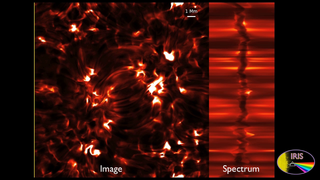
A simulation of the Sun and corresponding spectra in Mg II. Credit: Prof. Mats Carlsson, University of Oslo    A simulation of the Sun and corresponding spectra in Mg II. Credit: Prof. Mats Carlsson, University of Oslo
Duration: 21.7 seconds
Available formats:
  1280x720 (59.94 fps) QT         379 MB
  1280x720 (59.94 fps) QT         21 MB
  1280x720 (29.97 fps) QT         5 MB
  1280x720 (29.97 fps) MPEG-4   4 MB
  640x360 (29.97 fps) QT         6 MB
How to play our movies


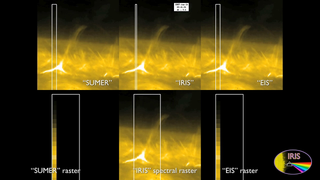
A comparison of IRIS image reconstruction with previous instruments. Credit: Dr. Bart de Pontieu at LMSAL    A comparison of IRIS image reconstruction with previous instruments. Credit: Dr. Bart de Pontieu at LMSAL
Duration: 56.8 seconds
Available formats:
  1280x720 (59.94 fps) QT         999 MB
  1280x720 (59.94 fps) QT         83 MB
  1280x720 (29.97 fps) QT         9 MB
  1280x720 (29.97 fps) MPEG-4   9 MB
  640x360 (29.97 fps) QT         17 MB
How to play our movies


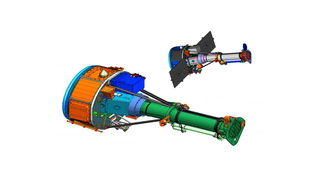
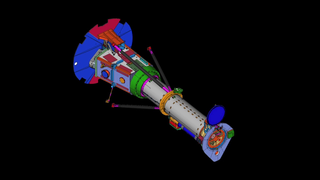
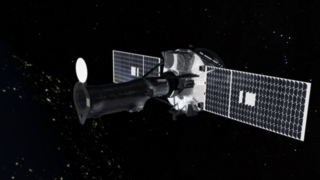
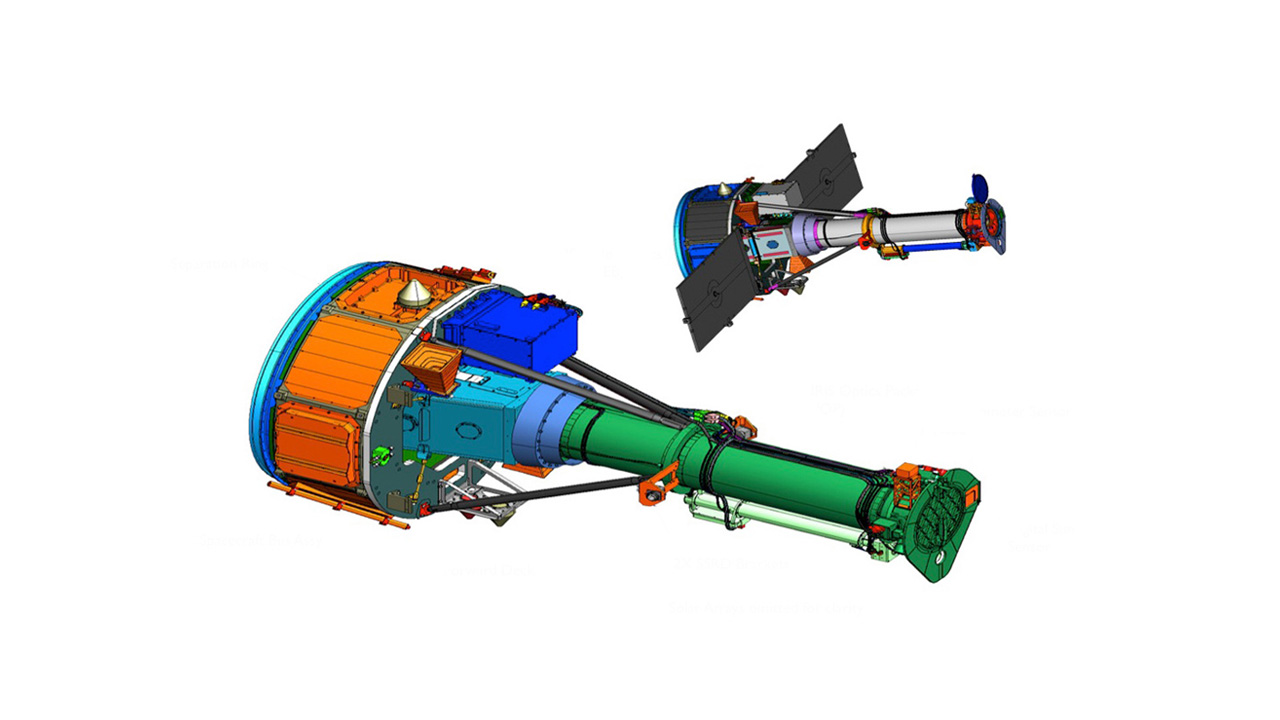
This graphic shows the IRIS observatory with the solar arrays removed.  The orange section to the left is the spacecraft bus which includes the spacecraft support structure, the command and data handling system, power distribution system, reaction wheels, X- and S-Band communications systems, Li-Ion battery, magnetic torque rods, and electronics for the sun sensors.  The section to the right of the spacecraft includes the instrument optics package and electronics, several components of the attitude control system, and the solar arrays.  The instrument includes a 20cm telescope optimized for solar observations which feeds a 5 channel imaging spectrograph.  The green section is the telescope assembly, the light blue section is the spectrograph, and the dark blue box is the separate instrument electronics box. Credit:  LMSAL, LM ATC    This graphic shows the IRIS observatory with the solar arrays removed. The orange section to the left is the spacecraft bus which includes the spacecraft support structure, the command and data handling system, power distribution system, reaction wheels, X- and S-Band communications systems, Li-Ion battery, magnetic torque rods, and electronics for the sun sensors. The section to the right of the spacecraft includes the instrument optics package and electronics, several components of the attitude control system, and the solar arrays. The instrument includes a 20cm telescope optimized for solar observations which feeds a 5 channel imaging spectrograph. The green section is the telescope assembly, the light blue section is the spectrograph, and the dark blue box is the separate instrument electronics box. Credit: LMSAL, LM ATC

Available formats:
  1280 x 720       JPEG   147 KB


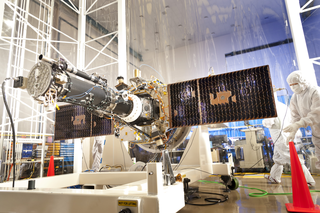
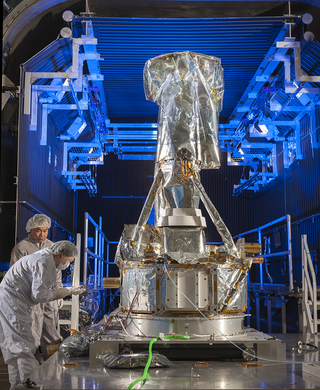
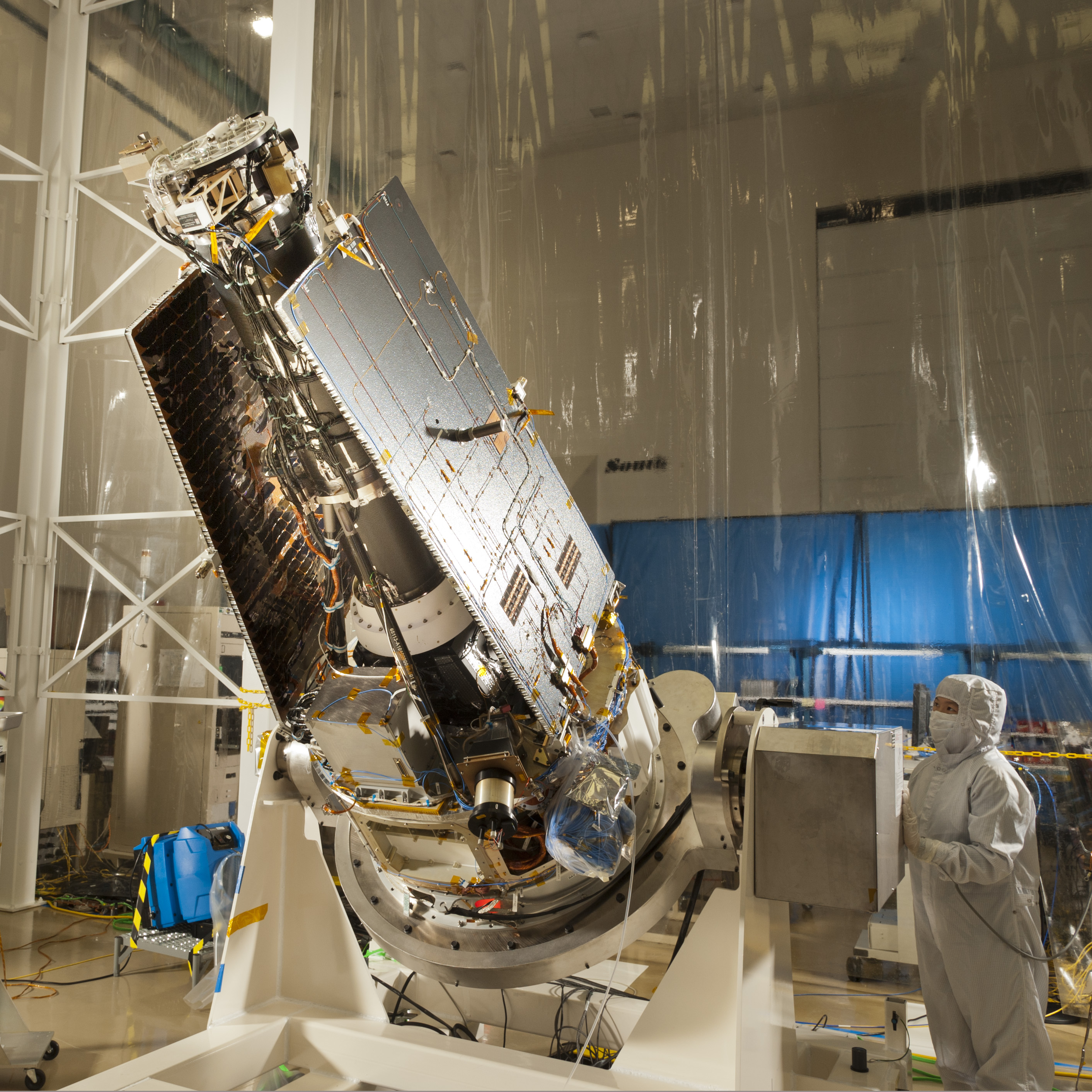
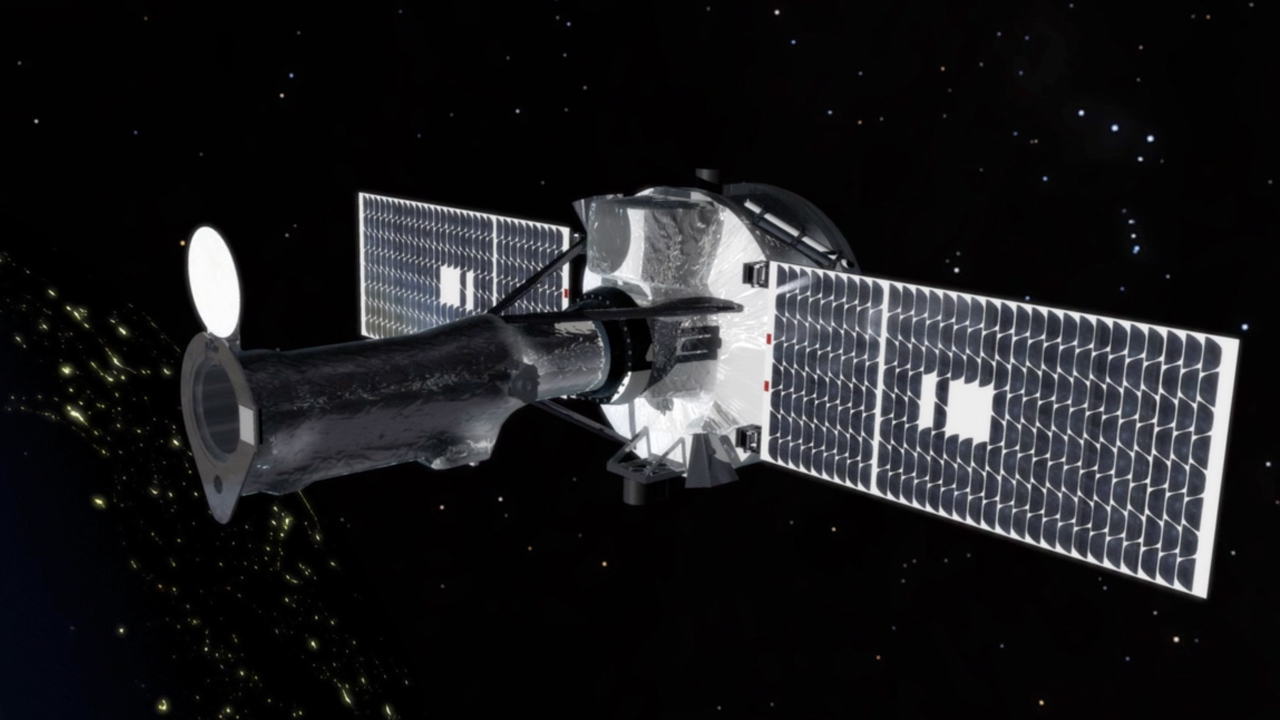
This is a photo of the complete IRIS observatory with the solar arrays deployed.  This is taken in a large clean tent at LM prior to vibration testing and prior to installation of the flight MLI blankets.  The solar arrays have just been deployed using flight commands. Credit: LM photo    This is a photo of the complete IRIS observatory with the solar arrays deployed. This is taken in a large clean tent at LM prior to vibration testing and prior to installation of the flight MLI blankets. The solar arrays have just been deployed using flight commands. Credit: LM photo


Available formats:
  4256 x 2832     JPEG       2 MB


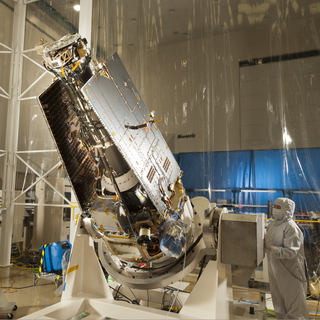
A second picture of the IRIS observatory.  The solar arrays have been stowed in preparation for vibration and shock testing. Credit: LM Photo    A second picture of the IRIS observatory. The solar arrays have been stowed in preparation for vibration and shock testing. Credit: LM Photo


Available formats:
  2825 x 2825     JPEG       1 MB


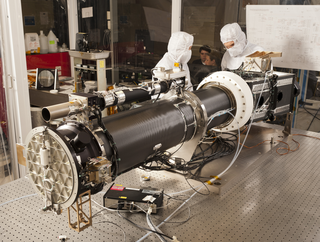
Photo of the instrument optics package prior to instrument level thermal vacuum testing.  The section to the left of the white collar is the 20cm solar telescope and the section to the right of the collar is the imaging spectrograph.  The spectrograph includes 18 optics used for transmitting the light from the telescope through the 4 channels to the focal planes as shown in the next sequence of images.  On top of the telescope assembly is the smaller guide telescope which provides the pointing signal to the secondary mirror of the telescope and to the attitude control system in the spacecraft.  The white collar is the primary mirror radiator used to reject the solar thermal load. Credit: LM Photo    Photo of the instrument optics package prior to instrument level thermal vacuum testing. The section to the left of the white collar is the 20cm solar telescope and the section to the right of the collar is the imaging spectrograph. The spectrograph includes 18 optics used for transmitting the light from the telescope through the 4 channels to the focal planes as shown in the next sequence of images. On top of the telescope assembly is the smaller guide telescope which provides the pointing signal to the secondary mirror of the telescope and to the attitude control system in the spacecraft. The white collar is the primary mirror radiator used to reject the solar thermal load.Credit: LM Photo


Available formats:
  3705 x 2798     JPEG       2 MB


The  optical portion of the instrument and the light paths from the primary and secondary mirror of the telescope assembly into the spectrograph.  The spectrograph then breaks the light into 2 Near Ultra Violet (NUV)(2785A – 2835A) and 2 Far Ultra-violet (FUV) (1332A-1406A) and one imaging channel. Credit: LMSAL    The optical portion of the instrument and the light paths from the primary and secondary mirror of the telescope assembly into the spectrograph. The spectrograph then breaks the light into 2 Near Ultra Violet (NUV)(2785A – 2835A) and 2 Far Ultra-violet (FUV) (1332A-1406A) and one imaging channel.Credit: LMSAL

Duration: 27.2 seconds
Available formats:
  1280x720 (59.94 fps) QT         278 MB
  1280x720 (59.94 fps) QT         7 MB
  1280x720 (29.97 fps) QT         1 MB
  1280x720 (29.97 fps) MPEG-4   2 MB
  640x360 (29.97 fps) QT         1 MB
How to play our movies


These series of photos show the fabrication of the bus structure from a large block of aluminum to the completed bus assembly. Credit: LM Video    These series of photos show the fabrication of the bus structure from a large block of aluminum to the completed bus assembly. Credit: LM Video

Duration: 24.0 seconds
Available formats:
  1280x720 (59.94 fps) QT         407 MB
  1280x720 (59.94 fps) QT         110 MB
  1280x720 (29.97 fps) QT         2 MB
  1280x720 (29.97 fps) MPEG-4   2 MB
  640x360 (29.97 fps) QT         2 MB
How to play our movies


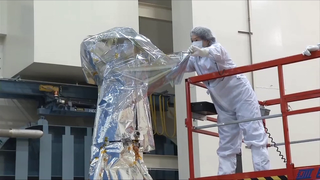
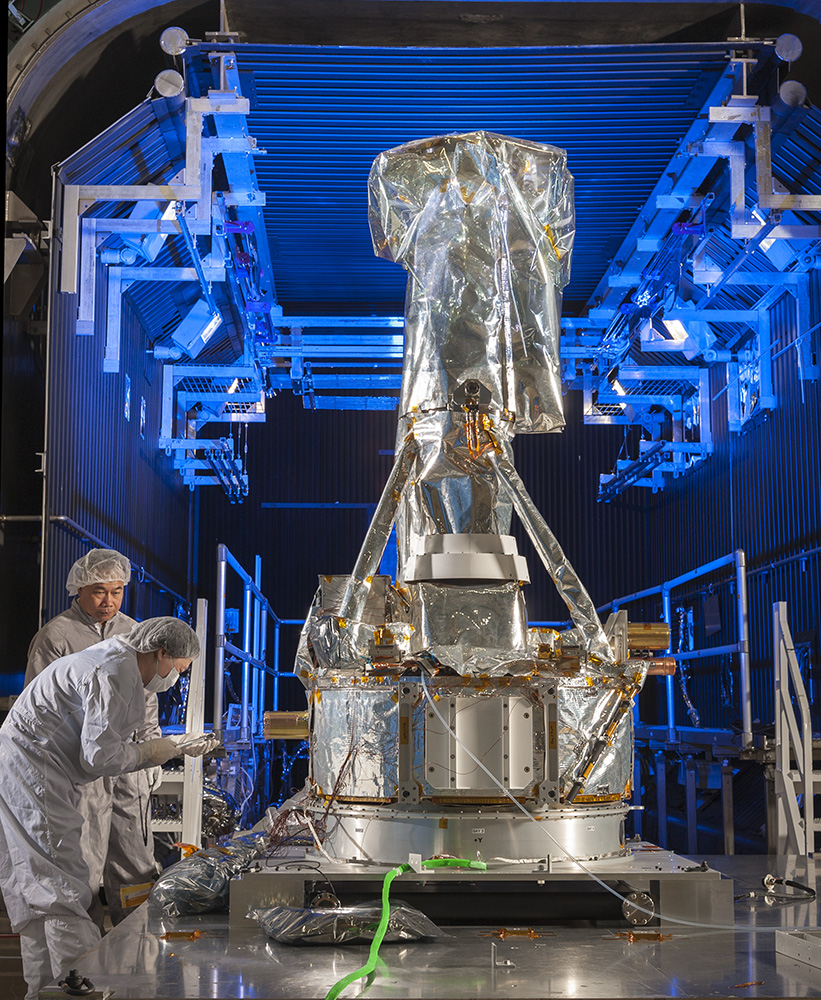
IRIS observatory (without solar arrays) after completion of thermal vacuum and thermal balance testing.  Engineers are inspecting the observatory and preparing for transport back to the clean tent for solar array install and final performance testing.  A protective cover is on top of the telescope assembly.  The vacuum chamber is in the background.  Thermal vacuum testing was the last in a series of environmental tests including:  vibration testing, pyro-shock (separation) testing, EMI/EMC testing, and thermal vacuum and thermal balance.  Optical and system performance tests are carried out throughout the test program to ensure that the observatory meets all of its requirements. Credit: PM Photo    IRIS observatory (without solar arrays) after completion of thermal vacuum and thermal balance testing. Engineers are inspecting the observatory and preparing for transport back to the clean tent for solar array install and final performance testing. A protective cover is on top of the telescope assembly. The vacuum chamber is in the background. Thermal vacuum testing was the last in a series of environmental tests including: vibration testing, pyro-shock (separation) testing, EMI/EMC testing, and thermal vacuum and thermal balance. Optical and system performance tests are carried out throughout the test program to ensure that the observatory meets all of its requirements.Credit: PM Photo


Available formats:
  821 x 1000       JPEG   540 KB


This video shows the transportation of the IRIS observatory from the thermal vacuum chamber back to the clean tent for final testing and preparations for delivery to the launch site at Vandenberg Air Force Base.  The second part of the vide shows the final solar array deployment test.  The arrays were released using flight commands.  This shows the observatory in its final flight configuration including the MLI blankets.  This is how the observatory will appear in orbit with the front of the telescope facing the sun. Credit: LM Video    This video shows the transportation of the IRIS observatory from the thermal vacuum chamber back to the clean tent for final testing and preparations for delivery to the launch site at Vandenberg Air Force Base. The second part of the vide shows the final solar array deployment test. The arrays were released using flight commands. This shows the observatory in its final flight configuration including the MLI blankets. This is how the observatory will appear in orbit with the front of the telescope facing the sun.Credit: LM Video
Duration: 59.0 seconds
Available formats:
  1280x720 (59.94 fps) QT         1014 MB
  1280x720 (59.94 fps) QT         336 MB
  1280x720 (29.97 fps) QT         54 MB
  1280x720 (29.97 fps) MPEG-4   20 MB
  640x360 (29.97 fps) QT         68 MB
How to play our movies


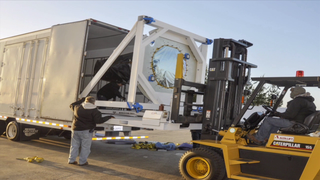
These series of photos show the receipt of the observatory at the Orbital processing facility at VAFB.  The observatory was received on April 16, 2013 and transferred to its handling fixture and then transferred to a clean tent located at the third stage of the Pegasus rocket.  Several photos show the processing of the observatory in the clean tent including the installation of the separation system that mates the observatory to the rocket.  The final photos show the Pegasus rocket and the fairings being prepared for installation. Credit: NASA/Kennedy Space Flight Center    These series of photos show the receipt of the observatory at the Orbital processing facility at VAFB. The observatory was received on April 16, 2013 and transferred to its handling fixture and then transferred to a clean tent located at the third stage of the Pegasus rocket. Several photos show the processing of the observatory in the clean tent including the installation of the separation system that mates the observatory to the rocket. The final photos show the Pegasus rocket and the fairings being prepared for installation.Credit: NASA/Kennedy Space Flight Center

Duration: 1.0 minutes
Available formats:
  1280x720 (59.94 fps) QT         1 GB
  1280x720 (59.94 fps) QT         488 MB
  1280x720 (29.97 fps) QT         25 MB
  1280x720 (29.97 fps) MPEG-4   15 MB
  640x360 (29.97 fps) QT         64 MB
How to play our movies


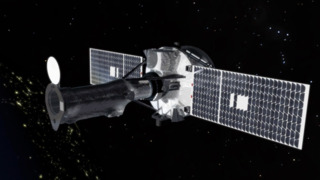
A video showing the deployment of the Pegasus Rocket with the observatory from the Orbital L1011. The rocket is dropped from the L1011 and is in unpowered, guided flight for 5 sec The first stage lights and burns for 72 sec, then coasts for 17 sec. The rocket is at 71km prior to lighting of the second stage. The second stage lights and burns for 73 sec, then coasts for 37 sec. The fairing separates at 131 sec. The rocket is at 600km prior to the firing of the third stage Third stage burns for 69 sec placing the observatory in orbit at approximately 660km. Once the payload is at 660km, the third stage and payload separate, at 786 seconds and the third stage carries out maneuvers to clear the observatory orbit. The observatory then deploys the solar arrays, acquires the sun, and begins a 30 day on-orbit checkout and commissioning phase. After a 21 day outgassing and checkout period, the front door is opened and checkout of the optical systems started. Credit: NASA/Goddard Space Flight Center/Conceptural Image Lab    A video showing the deployment of the Pegasus Rocket with the observatory from the Orbital L1011.The rocket is dropped from the L1011 and is in unpowered, guided flight for 5 sec
The first stage lights and burns for 72 sec, then coasts for 17 sec. The rocket is at 71km prior to lighting of the second stage.
The second stage lights and burns for 73 sec, then coasts for 37 sec. The fairing separates at 131 sec. The rocket is at 600km prior to the firing of the third stage
Third stage burns for 69 sec placing the observatory in orbit at approximately 660km.
Once the payload is at 660km, the third stage and payload separate, at 786 seconds and the third stage carries out maneuvers to clear the observatory orbit.
The observatory then deploys the solar arrays, acquires the sun, and begins a 30 day on-orbit checkout and commissioning phase. After a 21 day outgassing and checkout period, the front door is opened and checkout of the optical systems started.
Credit: NASA/Goddard Space Flight Center/Conceptural Image Lab
Duration: 1.8 minutes
Available formats:
  1280x720 (59.94 fps) QT         1 GB
  1280x720 (60 fps) Frames
  1280x720 (59.94 fps) QT         568 MB
  1280x720 (30 fps) QT         54 MB
  1280x720 (29.97 fps) QT         24 MB
  1280x720 (29.97 fps) MPEG-4   19 MB
  1280x720   TIFF         2 MB
How to play our movies


This video clip shows a few team members at the IRIS Mission Operations Center (MOC) preparing for a day of activities.  The IRIS MOC, part of the NASA Ames Multi-Mission Operations Center (MMOC), serves as an example of a small, low cost operations shared facility for NASA. Credit: NASA/Ames Research Center    This video clip shows a few team members at the IRIS Mission Operations Center (MOC) preparing for a day of activities. The IRIS MOC, part of the NASA Ames Multi-Mission Operations Center (MMOC), serves as an example of a small, low cost operations shared facility for NASA.Credit: NASA/Ames Research Center
Duration: 6.4 seconds
Available formats:
  1280x720 (59.94 fps) QT         107 MB
  1280x720 (59.94 fps) QT         37 MB
  1280x720 (29.97 fps) QT         4 MB
  1280x720 (29.97 fps) MPEG-4   1 MB
  640x360 (29.97 fps) QT         9 MB
How to play our movies


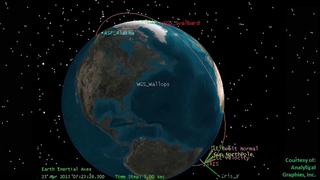
This animation shows the IRIS 620kmx670km, approximate 98 degree inclination, sun-synchronous, polar orbit.  Each 97 minute revolution results in 14-15 orbits per day on average and allows for long stretches of uninterrupted or eclipse free solar viewing. Credit: Analytical Graphics, Inc., STK/Lockheed-Martin/IRIS    This animation shows the IRIS 620kmx670km, approximate 98 degree inclination, sun-synchronous, polar orbit. Each 97 minute revolution results in 14-15 orbits per day on average and allows for long stretches of uninterrupted or eclipse free solar viewing.Credit: Analytical Graphics, Inc., STK/Lockheed-Martin/IRIS
Duration: 18.0 seconds
Available formats:
  1280x720 (59.94 fps) QT         310 MB
  1280x720 (59.94 fps) QT         37 MB
  1280x720 (29.97 fps) QT         5 MB
  1280x720 (29.97 fps) MPEG-4   4 MB
  640x360 (29.97 fps) QT         8 MB
How to play our movies


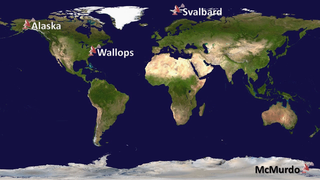
This animation shows the initial orbit ground track of the IRIS observatory once it is launched off the western coast of the United States.   Communications with the TDRSS allow immediate communications with the Observatory.  Within 15-20 minutes, IRIS passes over the McMurdo Ground Station in Antarctica.  Approximately one hour after launch IRIS passes over the north pole, Svalbard Ground Station, then shortly afterward communicates with the Alaska Satellite Facility. On the fifth orbit Wallops Ground Station comes into view. Credit: NASA/IRIS    This animation shows the initial orbit ground track of the IRIS observatory once it is launched off the western coast of the United States. Communications with the TDRSS allow immediate communications with the Observatory. Within 15-20 minutes, IRIS passes over the McMurdo Ground Station in Antarctica. Approximately one hour after launch IRIS passes over the north pole, Svalbard Ground Station, then shortly afterward communicates with the Alaska Satellite Facility. On the fifth orbit Wallops Ground Station comes into view.Credit: NASA/IRIS
Duration: 28.6 seconds
Available formats:
  1280x720 (59.94 fps) QT         500 MB
  1280x720 (29.97 fps) QT         4 MB
  1280x720 (59.94 fps) QT         23 MB
  1280x720 (29.97 fps) MPEG-4   5 MB
  640x360 (29.97 fps) QT         4 MB
How to play our movies


This animation shows the ground stations and primary facilities used to support the IRIS mission.  IRIS collaborates with the Norwegian Space Centre as they provide a science data path for the mission.  The NEN or Near Earth Network located at Goddard Space Flight Center provides the central hub for ground station support.  Data makes its way to the Mission Operations Center at NASA Ames as science data and images are eventually stored at Stanford.  The solar data is then used in multiple ways to benefit society and space exploration. Credit: NASA/IRIS    This animation shows the ground stations and primary facilities used to support the IRIS mission. IRIS collaborates with the Norwegian Space Centre as they provide a science data path for the mission. The NEN or Near Earth Network located at Goddard Space Flight Center provides the central hub for ground station support. Data makes its way to the Mission Operations Center at NASA Ames as science data and images are eventually stored at Stanford. The solar data is then used in multiple ways to benefit society and space exploration.Credit: NASA/IRIS
Duration: 41.0 seconds
Available formats:
  1280x720 (59.94 fps) QT         702 MB
  640x360 (29.97 fps) QT         7 MB
  1280x720 (59.94 fps) QT         37 MB
  1280x720 (29.97 fps) MPEG-4   6 MB
  1280x720 (29.97 fps) QT         8 MB
How to play our movies


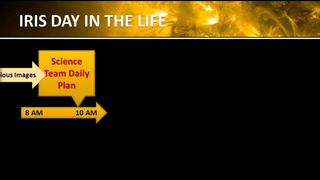
This animation provides a look at the tasks the team on the ground perform daily as they prepare for and upload a command set once per weekday. During nominal operations, science and observatory health data are captured daily in a “lights-out” mode.   Within six hours, science data is processed and stored at the Science Data Processing facility at Stanford University.  A website provides a portal for the public science community to access the data. Credit: NASA Ames Research Center/IRIS    This animation provides a look at the tasks the team on the ground perform daily as they prepare for and upload a command set once per weekday. During nominal operations, science and observatory health data are captured daily in a “lights-out” mode. Within six hours, science data is processed and stored at the Science Data Processing facility at Stanford University. A website provides a portal for the public science community to access the data.Credit: NASA Ames Research Center/IRIS
Duration: 57.5 seconds
Available formats:
  1280x720 (59.94 fps) QT         953 MB
  1280x720 (59.94 fps) QT         19 MB
  1280x720 (29.97 fps) QT         5 MB
  1280x720 (29.97 fps) MPEG-4   9 MB
  640x360 (29.97 fps) QT         4 MB
How to play our movies


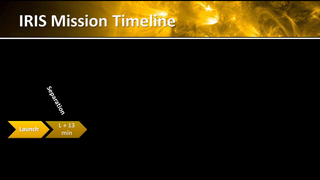
This animation shows the timeline of activities for the IRIS mission.   Following launch, during the initial orbits, the spacecraft “detumbles”, opens the solar arrays, acquires the sun and communicates with the TDRSS and ground stations.   For the first thirty days, the instrument and spacecraft are carefully checked and the telescope door is opened on day 21.   The science campaign officially begins on day 60 as IRIS begins its exploration of the sun.  Nominal daily operations continue for an exciting two year solar mission.  After two years, if the observatory is healthy and productive, NASA then has the option to extend science operations. NASA Ames Research Center/IRIS    This animation shows the timeline of activities for the IRIS mission. Following launch, during the initial orbits, the spacecraft “detumbles”, opens the solar arrays, acquires the sun and communicates with the TDRSS and ground stations. For the first thirty days, the instrument and spacecraft are carefully checked and the telescope door is opened on day 21. The science campaign officially begins on day 60 as IRIS begins its exploration of the sun. Nominal daily operations continue for an exciting two year solar mission. After two years, if the observatory is healthy and productive, NASA then has the option to extend science operations.NASA Ames Research Center/IRIS
Duration: 27.5 seconds
Available formats:
  1280x720 (59.94 fps) QT         413 MB
  1280x720 (59.94 fps) QT         5 MB
  1280x720 (29.97 fps) QT         1 MB
  1280x720 (29.97 fps) MPEG-4   3 MB
  640x360 (29.97 fps) QT         976 KB
How to play our movies


Video File for Newsrooms and Editors Cleanroom b-roll, launch, deploy, and beauty pass animations.    Video File for Newsrooms and EditorsCleanroom b-roll, launch, deploy, and beauty pass animations.
Duration: 5.2 minutes
Available formats:
  1280x720   JPEG         340 KB
  1280x720   QT         4 GB
How to play our movies


Share: Share via E-mail E-mail   Share on TwitterTwitter
 
Other multimedia items related to this story:
     IRIS Launch, Deploy and Beauty Passes (id 11089)
     IRIS: Studying the Energy Flow that Powers the Solar Atmosphere (id 11256)
Short URL to This Page:http://svs.gsfc.nasa.gov/goto?11286
Animation Number:11286
Completed:2013-05-16
Producer:Genna Duberstein (USRA)
Keywords:
SVS >> CME
SVS >> Coronal Mass Ejection
SVS >> HDTV
SVS >> Solar Flare
SVS >> Solar Ultraviolet
SVS >> Sun
GCMD >> Location >> Chromosphere
SVS >> Space Weather
SVS >> Heliophysics
SVS >> Sun-Earth interactions
SVS >> IRIS Mission

 
Please give credit for this item to:
NASA's Goddard Space Flight Center
NASA
Guillermo Gonzalo Sánchez Achutegui
ayabaca@gmail.com
ayabaca@hotmail.com
ayabaca@yahoo.com