Mostrando entradas con la etiqueta The Moon. Mostrar todas las entradas

miércoles, 12 de febrero de 2014

NASA : NASA Awards Information Technology Contract

Largest Solar System Moon Detailed in Geologic Map

Youtube Override:
Animation of a rotating globe of Jupiter's moon Ganymede, with a geologic map superimposed over a global color mosaic. The 37-second animation begins as a global color mosaic image of the moon then quickly fades in the geologic map.
Image Credit:
USGS Astrogeology Science Ctr/Wheaton/ASU/NASA/JPL-Caltech
Ganymede global geologic map
To present the best information in a single view of Jupiter's moon Ganymede, a global image mosaic was assembled, incorporating the best available imagery from NASA's Voyager 1 and 2 spacecraft and NASA's Galileo spacecraft.
Image Credit:
USGS Astrogeology Science Center/Wheaton/NASA/JPL-Caltech

More than 400 years after its discovery by astronomer Galileo Galilei, the largest moon in the solar system – Jupiter's moon Ganymede – has finally claimed a spot on the map.
A group of scientists led by Geoffrey Collins of Wheaton College has produced the first global geologic map of Ganymede, Jupiter’s seventh moon. The map combines the best images obtained during flybys conducted by NASA's Voyager 1 and 2 spacecraft (1979) and Galileo orbiter (1995 to 2003) and is now published by the U. S. Geological Survey as a global map. It technically illustrates the varied geologic character of Ganymede’s surface and is the first global, geologic map of this icy, outer-planet moon.
“This map illustrates the incredible variety of geological features on Ganymede and helps to make order from the apparent chaos of its complex surface,” said Robert Pappalardo of NASA’s Jet Propulsion Laboratory in Pasadena, Calif. “This map is helping planetary scientists to decipher the evolution of this icy world and will aid in upcoming spacecraft observations.”
The European Space Agency's Jupiter Icy Moons Explorer mission is slated to be orbiting Ganymede around 2032. NASA is contributing a U.S.-led instrument and hardware for two European-led instruments for the mission.
Since its discovery in January 1610, Ganymede has been the focus of repeated observation, first by Earth-based telescopes, and later by the flyby missions and spacecraft orbiting Jupiter. These studies depict a complex, icy world whose surface is characterized by the striking contrast between its two major terrain types: the dark, very old, highly cratered regions, and the lighter, somewhat younger (but still very old) regions marked with an extensive array of grooves and ridges.
According to the scientists who have constructed this map, three major geologic periods have been identified for Ganymede that involve the dominance of impact cratering, then tectonic upheaval, followed by a decline in geologic activity. The map, which illustrates surface features, such as furrows, grooves and impact craters, allows scientists to decipher distinct geologic time periods for an object in the outer solar system for the first time.
“The highly detailed, colorful map confirmed a number of outstanding scientific hypotheses regarding Ganymede’s geologic history, and also disproved others,” said Baerbel Lucchitta, scientist emeritus at the U.S. Geological Survey in Flagstaff, Ariz., who has been involved with geologic mapping of Ganymede since 1980. “For example, the more detailed Galileo images showed that cryovolcanism, or the creation of volcanoes that erupt water and ice, is very rare on Ganymede.”
The Ganymede global geologic map will enable researchers to compare the geologic characters of other icy satellite moons, because almost any type of feature that is found on other icy satellites has a similar feature somewhere on Ganymede.
“The surface of Ganymede is more than half as large as all the land area on Earth, so there is a wide diversity of locations to choose from,” Collins said. Ganymede also shows features that are ancient alongside much more recently formed features, adding historical diversity in addition to geographic diversity.”
Amateur astronomers can observe Ganymede (with binoculars) in the evening sky this month, as Jupiter is in opposition and easily visible.
The project was funded by NASA through its Outer Planets Research and Planetary Geology and Geophysics Programs. NASA's Jet Propulsion Laboratory is managed by the California Institute of Technology, Pasadena.
NASA
Guillermo Gonzalo Sánchez Achutegui

domingo, 3 de noviembre de 2013

NASA : NASA TV Airs Discussion on Removing Barriers to Deep Space Exploration


Attached to the Harmony node, the first Cygnus commercial cargo spacecraft built by Orbital Sciences Corp., in the grasp of the Canadarm2, is photographed by an Expedition 37 crew member on the International Space Station.
The first Cygnus commercial cargo spacecraft built by Orbital Sciences Corp., seen here attached to the International Space Station's Harmony node, will leave the orbital outpost this week.
Image Credit: NASA
Image Token:
NASA is once again open for business in a big way. While we were out, several of our on-going missions achieved significant milestones, and although it will take a little time to fully assess the impacts of the government shut down on our other operations, this week will make clear we’re back to our core mission implementing America’s ambitious space program.
Our latest moon mission, the Lunar Atmosphere and Dust Environment Explorer, or LADEE, entered lunar orbit on Oct. 6th, and now is preparing to begin its study of the moon’s atmosphere. We also are pleased that the Lunar Laser Communication Demonstration currently orbiting the moon with LADEE achieved an error-free laser communication downlink with a data rate in excess of 300 megabits-per-second. This new NASA-developed, laser-based space communication system will enable higher rates of satellite communications, similar to the high-speed fiber optic networks we have here on Earth. This will dramatically improve space communication, especially during future human missions to an asteroid and Mars.
 
Expedition 38 crew
Left to right: Expedition 38 Flight Engineer Koichi Wakata, Soyuz Commander Mikhail Tyurin and NASA Flight Engineer Rick Mastracchio clasp hands in front of a Soyuz simulator during final qualification exams ahead of their Nov. 7 launch to the space station.
Image Credit: NASA
Image Token:
 
Earth from Juno
Earth as seen from the Juno spacecraft during the gravity assist flyby on Oct. 9.
Image Credit: NASA
Image Token:
Feature Link:
On Oct. 9th, our Juno spacecraft, launched in 2011 on a five-year journey to Jupiter, made its closest approach to Earth. This gave Juno a chance to take some stunning pictures of our planet and it gave us the opportunity to confirm that the spacecraft is operating as expected with a current trajectory that is “near perfect.”

Looking ahead for this week, the Orbital Sciences' Cygnus cargo spacecraft that was launched from NASA’s Wallops Flight Facility on Sept.18, will complete its successful maiden cargo mission on Tuesday when it un-berths from the International Space Station and burns up harmlessly in Earth’s atmosphere during re-entry the following day. Orbital joins SpaceX as NASA’s second American commercial partner capable of successful resupply missions to the ISS. Sierra Nevada Corp. is poised to resume testing of its Dream Chaser spacecraft at NASA's Dryden Flight Research Center in California. Sierra Nevada Corp., Boeing and SpaceX are among the U.S. companies working with NASA to develop commercial crew transportation vehicles. Our commitment to launching astronauts from American soil again soon is moving forward.
Things are getting busy at the International Space Station, humanity's home away from Earth for almost 13 years now. The European Space Agency’s Automated Transfer Vehicle-4 is set to undock on Oct. 28 after more than four months at the station. Then, on Nov. 1, Expedition 37 crewmates Karen Nyberg, Luca Parmitano and Fyodor Yurchikhin will relocate their Soyuz 35 from one station docking port to another.
Less than a week later on Nov. 7, three new station crew members -- NASA astronaut Rick Mastracchio, Japan Aerospace Exploration Agency astronaut Koichi Wakata and Soyuz commander Mikhail Tyurin of the Russian Federal Space Agency – will launch aboard their Soyuz 37 spacecraft from the Baikonur Cosmodrome and dock to the station about six hours later.
For four days, nine astronauts and cosmonauts will live and work together aboard the station before Yurchikhin, Nyberg and Parmitano return to Earth after more than five months in space.
Meanwhile, the Mars Atmosphere and Volatile Evolution (MAVEN) spacecraft remains on track for a Nov.18th launch from Cape Canaveral Air Force Station in Florida. MAVEN is the first spacecraft devoted to exploring and understanding the Martian upper atmosphere. It will orbit the planet in an elliptical orbit that allows it to pass through and sample the entire upper atmosphere on every orbit. The spacecraft will investigate how the loss of Mars’ atmosphere to space determined the history of water on the surface.
Finally, on a sad note, on Oct.10, in the midst of the shutdown, we learned of the passing of Scott Carpenter, who in 1962 became the second American to orbit Earth. Scott was one of the original Mercury 7 astronauts who helped set the stage for more than a half-century of American leadership in space. We will miss his passion, his talent and his life-long commitment to exploration.
As we power back up, we draw inspiration from the legacy of Carpenter and so many others who overcame every obstacle to keep NASA flying high.
 
NASA TV Airs Discussion on Removing Barriers to Deep Space Exploration
NASA Television will air a roundtable discussion with aerospace industry leaders at 9 a.m. EST Tuesday, Nov. 12 about the progress being made toward sending humans into deep space.
The live broadcast will take place at the Newseum, 555 Pennsylvania Ave. NW, in Washington, and is open to visitors with paid admission.
Panelists representing NASA and its prime contractors will discuss the work being done on the agency's Orion spacecraft and Space Launch System rocket, which will carry humans farther into space than ever before. The participants are:
-- William Gerstenmaier, associate administrator for human exploration and operations, NASA
-- Julie Van Kleek, vice president, advanced space and launch programs, Aerojet Rocketdyne
-- Charlie Precourt, vice president and general manager, ATK Space Launch Division
-- John Elbon, vice president and general manager, Boeing Space Exploration
-- Jim Crocker, vice president and general manager, civil space, Lockheed Martin Space Systems
Orion and the Space Launch System will provide the United States an entirely new human space exploration capability, a flexible system that can extend human presence beyond low-Earth orbit and enable new missions of exploration in our solar system.
The discussion is sponsored by TechAmerica's Space Enterprise Council in partnership with the George Marshall Institute and the Coalition for Space Exploration.
There will be time for media to ask questions following the discussion. Media wanting to attend the broadcast must contact Sean Wilson at 832-864-3518 or
 sean@griffincg.com
by 5 p.m. Friday, Nov. 8.
For more information on NASA's human deep space exploration, visit:
For NASA TV streaming video, downlink and scheduling information, visit:
 
NASA
Guillermo Gonzalo Sánchez Achutegui

domingo, 1 de septiembre de 2013

NASA - NASA-Funded Scientists Detect Water on Moon's Surface that Hints at Water Below


NASA Prepares for First Virginia Coast Launch to Moon
Click

An artist's concept of NASA's Lunar Atmosphere and Dust Environment Explorer (LADEE) spacecraft seen orbiting near the surface of the moon. Image credit: NASA Ames / Dana Berry
Image Token:

In an attempt to answer prevailing questions about our moon, NASA is making final preparations to launch a probe at 11:27 p.m. EDT Friday, Sept. 6, from NASA's Wallops Flight Facility on Wallops Island, Va.
The small car-sized Lunar Atmosphere and Dust Environment Explorer (LADEE) is a robotic mission that will orbit the moon to gather detailed information about the structure and composition of the thin lunar atmosphere and determine whether dust is being lofted into the lunar sky. A thorough understanding of these characteristics of our nearest celestial neighbor will help researchers understand other bodies in the solar system, such as large asteroids, Mercury, and the moons of outer planets.
"The moon's tenuous atmosphere may be more common in the solar system than we thought," said John Grunsfeld, NASA's associate administrator for science in Washington. "Further understanding of the moon's atmosphere may also help us better understand our diverse solar system and its evolution."
The mission has many firsts, including the first flight of the Minotaur V rocket, testing of a high-data-rate laser communication system, and the first launch beyond Earth orbit from the agency's Virginia Space Coast launch facility.
LADEE also is the first spacecraft designed, developed, built, integrated and tested at NASA's Ames Research Center in Moffett Field, Calif. The probe will launch on a U.S. Air Force Minotaur V rocket, an excess ballistic missile converted into a space launch vehicle and operated by Orbital Sciences Corp. of Dulles, Va.
LADEE was built using an Ames-developed Modular Common Spacecraft Bus architecture, a general purpose spacecraft design that allows NASA to develop, assemble and test multiple modules at the same time. The LADEE bus structure is made of a lightweight carbon composite with a mass of 547.2 pounds -- 844.4 pounds when fully fueled.
"This mission will put the common bus design to the test," said Ames Director S. Pete Worden. "This same common bus can be used on future missions to explore other destinations, including voyages to orbit and land on the moon, low-Earth orbit, and near-Earth objects."
Butler Hine, LADEE project manager at Ames, said the innovative common bus concept brings NASA a step closer to multi-use designs and assembly line production and away from custom design. "The LADEE mission demonstrates how it is possible to build a first class spacecraft at a reduced cost while using a more efficient manufacturing and assembly process," Hine said.
Approximately one month after launch, LADEE will begin its 40-day commissioning phase, the first 30 days of which the spacecraft will be performing activities high above the moon's surface. These activities include testing a high-data-rate laser communication system that will enable higher rates of satellite communications similar in capability to high-speed fiber optic networks on Earth.
After commissioning, LADEE will begin a 100-day science phase to collect data using three instruments to determine the composition of the thin lunar atmosphere and remotely sense lofted dust, measure variations in the chemical composition of the atmosphere, and collect and analyze samples of any lunar dust particles in the atmosphere. Using this set of instruments, scientists hope to address a long-standing question: Was lunar dust, electrically charged by sunlight, responsible for the pre-sunrise glow above the lunar horizon detected during several Apollo missions?
After launch, Ames will serve as a base for mission operations and real-time control of the probe. NASA's Goddard Space Flight Center in Greenbelt, Md., will catalogue and distribute data to a science team located across the country.
NASA's Science Mission Directorate in Washington funds the LADEE mission. Ames manages the overall mission. Goddard manages the science instruments and technology demonstration payload, the science operations center and provides overall mission support. Wallops is responsible for launch vehicle integration, launch services and operations. NASA's Marshall Space Flight Center in Huntsville, Ala., manages LADEE within the Lunar Quest Program Office.
For more information about the LADEE mission, visit:

 NASA-Funded Scientists Detect Water on Moon's Surface that Hints at Water Below
NASA-funded lunar research has yielded evidence of water locked in mineral grains on the surface of the moon from an unknown source deep beneath the surface.
Using data from NASA's Moon Mineralogy Mapper (M3) instrument aboard the Indian Space Research Organization's Chandrayaan-1 spacecraft, scientists remotely detected magmatic water, or water that originates from deep within the moon's interior, on the surface of the moon.
The findings, published Aug. 25 in Nature Geoscience, represent the first detection of this form of water from lunar orbit. Earlier studies had shown the existence of magmatic water in lunar samples returned during the Apollo program.
M3 imaged the lunar impact crater Bullialdus, which lies near the lunar equator. Scientists were interested in studying this area because they could better quantify the amount of water inside the rocks due to the crater's location and the type of rocks it held. The central peak of the crater is made up of a type of rock that forms deep within the lunar crust and mantle when magma is trapped underground.
"This rock, which normally resides deep beneath the surface, was excavated from the lunar depths by the impact that formed Bullialdus crater," said Rachel Klima, a planetary geologist at the Johns Hopkins University Applied Physics Laboratory (APL) in Laurel, Md.
"Compared to its surroundings, we found that the central portion of this crater contains a significant amount of hydroxyl - a molecule consisting of one oxygen atom and one hydrogen atom -- which is evidence that the rocks in this crater contain water that originated beneath the lunar surface," Klima said.
In 2009, M3 provided the first mineralogical map of the lunar surface and discovered water molecules in the polar regions of the moon. This water is thought to be a thin layer formed from solar wind hitting the moon's surface. Bullialdus crater is in a region with an unfavorable environment for solar wind to produce significant amounts of water on the surface.
"NASA missions like Lunar Prospector and the Lunar Crater Observation and Sensing Satellite and instruments like M3 have gathered crucial data that fundamentally changed our understanding of whether water exists on the surface of the moon," said S. Pete Worden, center director at NASA's Ames Research Center in Moffett Field, Calif. "Similarly, we hope that upcoming NASA missions such as the Lunar Atmosphere and Dust Environment Explorer, or LADEE, will change our understanding of the lunar sky."
The detection of internal water from orbit means scientists can begin to test some of the findings from sample studies in a broader context, including in regions that are far from where the Apollo sites are clustered on the near side of the moon. For many years, researchers believed that the rocks from the moon were bone-dry and any water detected in the Apollo samples had to be contamination from Earth.
"Now that we have detected water that is likely from the interior of the moon, we can start to compare this water with other characteristics of the lunar surface," said Klima. "This internal magmatic water also provides clues about the moon's volcanic processes and internal composition, which helps us address questions about how the moon formed, and how magmatic processes changed as it cooled."
APL is a not-for-profit division of Johns Hopkins University. Joshua Cahill and David Lawrence of APL and Justin Hagerty of the U.S. Geological Survey's Astrogeology Science Center in Flagstaff, Ariz., co-authored the paper. NASA's Lunar Advanced Science and Engineering Program, the NASA Lunar Science Institute (NLSI) at Ames and the NASA Planetary Mission Data Analysis Program supported the research. NLSI is a virtual organization jointly funded by NASA's Science Mission Directorate and NASA's Human Exploration and Operations Mission Directorate in Washington, to enable collaborative, interdisciplinary research in support of NASA lunar science programs.
For more information about NASA programs, visit:
NASA
Guillermo Gonzalo Sánchez Achutegui

NASA - Lunar Atmosphere and Dust Environment Explorer


Lunar Atmosphere and Dust Environment Explorer
In an attempt to answer prevailing questions about our moon, NASA is making final preparations to launch a probe at 11:27 p.m. EDT Friday, Sept. 6, 2013, from NASA's Wallops Flight Facility on Wallops Island, Va.
The small car-sized Lunar Atmosphere and Dust Environment Explorer (LADEE) is a robotic mission that will orbit the moon to gather detailed information about the structure and composition of the thin lunar atmosphere and determine whether dust is being lofted into the lunar sky. A thorough understanding of these characteristics of our nearest celestial neighbor will help researchers understand other bodies in the solar system, such as large asteroids, Mercury, and the moons of outer planets.
In this photo, engineers as NASA's Wallops Flight Facility in Virginia encapsule the LADEE spacecraft into the fairing of the Minotaur V launch vehicle nose-cone. LADEE is the first spacecraft designed, developed, built, integrated and tested at NASA's Ames Research Center in Moffett Field, Calif.
Image credit: NASA Wallops / Terry Zaperach
NASA
Guillermo Gonzalo Sánchez Achutegui
ayabaca@gmail.com
ayabaca@hotmail.com
ayabaca@yahoo.com

domingo, 4 de agosto de 2013

NASA - NASA Completes First Internal Review of Concepts for Asteroid Redirect Mission


NASA has completed the first step toward a mission to find and capture a near-Earth asteroid, redirect it to a stable lunar orbit and send humans to study it.
In preparation for fiscal year 2014, a mission formulation review on Tuesday brought together NASA leaders from across the country to examine internal studies proposing multiple concepts and alternatives for each phase of the asteroid mission. The review assessed technical and programmatic aspects of the mission.
"At this meeting, we engaged in the critically important work of examining initial concepts to meet the goal of asteroid retrieval and exploration," said NASA Associate Administrator Robert Lightfoot, who chaired the review at the agency's headquarters in Washington. "The agency's science, technology and human exploration teams are working together to better understand near Earth asteroids, including ones potentially hazardous to our planet; demonstrate new technologies; and to send humans farther from home than ever before. I was extremely proud of the teams and the progress they have made so far. I look forward to integrating the inputs as we develop the mission concept further."
In addition to the internal reviews of concepts for the mission, managers also discussed the recently received more than 400 responses to a request for information in which industry, universities, and the public offered ideas for NASA’s asteroid initiative. The agency is evaluating those responses.
With the mission formulation review complete, agency officials now will begin integrating the most highly-rated concepts into an asteroid mission baseline concept to further develop in 2014.
The asteroid redirect mission is included in President Obama's fiscal year 2014 budget request for NASA, and leverages the agency's progress on its Space Launch System rocket, Orion spacecraft and cutting-edge technology development. The mission is one step in NASA's strategy to send humans to Mars in the 2030s.
For more information about NASA's asteroid initiative, visit:
 
Capturing an Asteroid
By leveraging capabilities across all of NASA, the agency is developing a first-ever mission to identify, rendezvous with, capture and redirect a small asteroid into a stable orbit in the lunar vicinity, and then send humans to visit it using the Space Launch System rocket and Orion spacecraft. This mission represents an unprecedented technological feat and allows NASA to affordably pursue the Administration's goal of visiting an asteroid by 2025. It raises the bar for human exploration and discovery while taking advantage of the diverse talents at NASA. This image represents a notional spacecraft with its asteroid capture mechanism deployed.

Image Credit: NASA/Advanced Concepts Lab
NASA
Guillermo Gonzalo Sánchez Achutegui
ayabaca@gmail.com
ayabaca@hotmail.com
ayabaca@yahoo.com

NASA - Two Moons Passing in the Night


Two Moons Passing in the Night
 
The Saturn moons Mimas and Pandora remind us of how different they are when they appear together, as in this image taken by NASA's Cassini spacecraft. Pandora's small size means that it lacks sufficient gravity to pull itself into a round shape like its larger sibling, Mimas. Researchers believe that the elongated shape of Pandora (50 miles, or 81 kilometers across) may hold clues to how it and other moons near Saturn's rings formed.
This view looks toward the anti-Saturn hemisphere of Mimas (246 miles, or 396 kilometers across). North on Mimas is up and rotated 28 degrees to the right. The image was taken in blue light with Cassini's narrow-angle camera on May 14, 2013. The view was acquired at a distance of approximately 690,000 miles (1.1 million kilometers) from Mimas. Image scale is 4 miles (7 kilometers) per pixel. Pandora was at a distance of 731,000 miles (1.2 million kilometers) when this image was taken. Image scale on Pandora is 4 miles (7 kilometers) per pixel.
The Cassini-Huygens mission is a cooperative project of NASA, the European Space Agency and the Italian Space Agency. The Jet Propulsion Laboratory, a division of the California Institute of Technology in Pasadena, manages the mission for NASA's Science Mission Directorate, Washington, D.C. The Cassini orbiter and its two onboard cameras were designed, developed and assembled at JPL. The imaging operations center is based at the Space Science Institute in Boulder, Colo.
Image Credit: NASA/JPL-Caltech/Space Science Institute
 
NASA
Guillermo Gonzalo Sánchez Achutegui
ayabaca@gmail.com
ayabaca@hotmail.com
ayabaca@yahoo.com

domingo, 21 de julio de 2013

NASA - Mission Control Celebrates Success of Apollo 11


Apollo 11 mission patch
› View larger image
"The Eagle has landed..."

Mission Control Celebrates Success of Apollo 11
Flight controllers celebrate the successful conclusion of the Apollo 11 lunar landing mission on July 24, 1969, at NASA's Mission Control Center in Houston. On July 20, Apollo 11 astronaut Neil Armstrong planted the first human foot on another world. With more than half a billion people watching on television, he climbed down the ladder and proclaimed: "That's one small step for a man, one giant leap for mankind."
Image Credit: NASA

NASA Links About Apollo:
Non-NASA Links About Apollo:
  • Apollo and the Smithsonian Institution: An interesting exhibit about Project Apollo created by the National Air and Space Museum.
  • Boeing Celebrates the 30th Anniversary of Apollo 11: A site about Boeing North American (the former Rockwell aerospace units) and McDonnell Douglas, and their roles in helping to make possible the first Moon landing.
  • The Apollo Mode Decision: A good private site at Clemson University on the debate over the method of flying to the Moon with Project Apollo.
  • "To the Moon" The companion Web site to the two-hour NOVA special that chronicles the untold science and engineering story of how we got to the moon. The program was broadcast on PBS at 8 pm on July 13,1999.
  • "Washington Goes to the Moon": A two-part radio program that deals with the political story of the acquiring and sustaining of support of the Apollo lunar landing program in the 1960s. Produced by WAMU-FM, the public radio station of the American University in Washington, D.C., the show's web site also has transcripts of the two programs, on-line documents, and transcripts of interviews with key personnel.
  • Apollo at American Samoa: Some interesting information about the Apollo missions that landed near and then passed through American Samoa.
  • Apollo Saturn Reference Page: Detailed technical information about the Saturn Launch Vehicles for modelers and space buffs, by a private enthusiast.
  • Contact Light: A personal recollection of the Apollo missions to the Moon. This site by a private enthusiast includes some cool video and audio clips, a lunar landing simulator game, and reference tables.
  • Where Were You? This web site is dedicated to collecting memories from the various points of view of people who where alive during the historic landing of Apollo 11.
  • "One Giant Leap" commemorates the anniversary of Apollo 11 with a visual journey and interesting facts and data.
  • First Moon Landing in 1969 marked an entire generation: Memories of the first moon landing.
  • Apollo 11 Commentary: Contains the complete audio air to ground transmissions in streaming format.
  • Man In Space: Study of Alternatives: This is a National Park Service study to identify possible locations and other components of the national park system that pertain to Apollo.
  • Virtual AGC and AGS Home Page Project Overview: A page devoted to the Apollo guidance computer.
  • nixontapes.org: A page of original audio of a handful of meetings and phone calls that President Nixon had with the crews of Apollo 15, 16, and 17. One can find the digitized versions of the original audio, as well as summaries of the conversations here.
On-line Books Concerning Project Apollo:
Steve Garber, NASA History Web Curator
Site design by NASA HQ Printing & Design
For further information email histinfo@hq.nasa.gov
 
APOLLO 11
Mission ObjectiveThe primary objective of Apollo 11 was to complete a national goal set by President John F. Kennedy on May 25, 1961: perform a crewed lunar landing and return to Earth.

Additional flight objectives included scientific exploration by the lunar module, or LM, crew; deployment of a television camera to transmit signals to Earth; and deployment of a solar wind composition experiment, seismic experiment package and a Laser Ranging Retroreflector. During the exploration, the two astronauts were to gather samples of lunar-surface materials for return to Earth. They also were to extensively photograph the lunar terrain, the deployed scientific equipment, the LM spacecraft, and each other, both with still and motion picture cameras. This was to be the last Apollo mission to fly a "free-return" trajectory, which would enable, if necessary, a ready abort of the mission when the combined command and service module/lunar module, or CSM/LM, prepared for insertion into lunar orbit. The trajectory would occur by firing the service propulsion subsystem, or SPS, engine so as to merely circle behind the moon and emerge in a trans-Earth return trajectory.


Mission Highlights
Apollo 11 launched from Cape Kennedy on July 16, 1969, carrying Commander Neil Armstrong, Command Module Pilot Michael Collins and Lunar Module Pilot Edwin "Buzz" Aldrin into an initial Earth-orbit of 114 by 116 miles. An estimated 530 million people watched Armstrong's televised image and heard his voice describe the event as he took "...one small step for a man, one giant leap for mankind" on July 20, 1969.

Two hours, 44 minutes and one-and-a-half revolutions after launch, the S-IVB stage reignited for a second burn of five minutes, 48 seconds, placing Apollo 11 into a translunar orbit. The command and service module, or CSM, Columbia separated from the stage, which included the spacecraft-lunar module adapter, or SLA, containing the lunar module, or LM, Eagle. After transposition and jettisoning of the SLA panels on the S-IVB stage, the CSM docked with the LM. The S-IVB stage separated and injected into heliocentric orbit four hours, 40 minutes into the flight.

The first color TV transmission to Earth from Apollo 11 occurred during the translunar coast of the CSM/LM. Later, on July 17, a three-second burn of the SPS was made to perform the second of four scheduled midcourse corrections programmed for the flight. The launch had been so successful that the other three were not needed.

On July 18, Armstrong and Aldrin put on their spacesuits and climbed through the docking tunnel from Columbia to Eagle to check out the LM, and to make the second TV transmission.

On July 19, after Apollo 11 had flown behind the moon out of contact with Earth, came the first lunar orbit insertion maneuver. At about 75 hours, 50 minutes into the flight, a retrograde firing of the SPS for 357.5 seconds placed the spacecraft into an initial, elliptical-lunar orbit of 69 by 190 miles. Later, a second burn of the SPS for 17 seconds placed the docked vehicles into a lunar orbit of 62 by 70.5 miles, which was calculated to change the orbit of the CSM piloted by Collins. The change happened because of lunar-gravity perturbations to the nominal 69 miles required for subsequent LM rendezvous and docking after completion of the lunar landing. Before this second SPS firing, another TV transmission was made, this time from the surface of the moon.

On July 20, Armstrong and Aldrin entered the LM again, made a final check, and at 100 hours, 12 minutes into the flight, the Eagle undocked and separated from Columbia for visual inspection. At 101 hours, 36 minutes, when the LM was behind the moon on its 13th orbit, the LM descent engine fired for 30 seconds to provide retrograde thrust and commence descent orbit insertion, changing to an orbit of 9 by 67 miles, on a trajectory that was virtually identical to that flown by Apollo 10. At 102 hours, 33 minutes, after Columbia and Eagle had reappeared from behind the moon and when the LM was about 300 miles uprange, powered descent initiation was performed with the descent engine firing for 756.3 seconds. After eight minutes, the LM was at "high gate" about 26,000 feet above the surface and about five miles from the landing site.

The descent engine continued to provide braking thrust until about 102 hours, 45 minutes into the mission. Partially piloted manually by Armstrong, the Eagle landed in the Sea of Tranquility in Site 2 at 0 degrees, 41 minutes, 15 seconds north latitude and 23 degrees, 26 minutes east longitude. This was about four miles downrange from the predicted touchdown point and occurred almost one-and-a-half minutes earlier than scheduled. It included a powered descent that ran a mere nominal 40 seconds longer than preflight planning due to translation maneuvers to avoid a crater during the final phase of landing. Attached to the descent stage was a commemorative plaque signed by President Richard M. Nixon and the three astronauts.

The flight plan called for the first EVA to begin after a four-hour rest period, but it was advanced to begin as soon as possible. Nonetheless, it was almost four hours later that Armstrong emerged from the Eagle and deployed the TV camera for the transmission of the event to Earth. At about 109 hours, 42 minutes after launch, Armstrong stepped onto the moon. About 20 minutes later, Aldrin followed him. The camera was then positioned on a tripod about 30 feet from the LM. Half an hour later, President Nixon spoke by telephone link with the astronauts.

Commemorative medallions bearing the names of the three Apollo 1 astronauts who lost their lives in a launch pad fire, and two cosmonauts who also died in accidents, were left on the moon's surface. A one-and-a-half inch silicon disk, containing micro miniaturized goodwill messages from 73 countries, and the names of congressional and NASA leaders, also stayed behind.

During the EVA, in which they both ranged up to 300 feet from the Eagle, Aldrin deployed the Early Apollo Scientific Experiments Package, or EASEP, experiments, and Armstrong and Aldrin gathered and verbally reported on the lunar surface samples. After Aldrin had spent one hour, 33 minutes on the surface, he re-entered the LM, followed 41 minutes later by Armstrong. The entire EVA phase lasted more than two-and-a-half hours, ending at 111 hours, 39 minutes into the mission.

Armstrong and Aldrin spent 21 hours, 36 minutes on the moon's surface. After a rest period that included seven hours of sleep, the ascent stage engine fired at 124 hours, 22 minutes. It was shut down 435 seconds later when the Eagle reached an initial orbit of 11 by 55 miles above the moon, and when Columbia was on its 25th revolution. As the ascent stage reached apolune at 125 hours, 19 minutes, the reaction control system, or RCS, fired so as to nearly circularize the Eagle orbit at about 56 miles, some 13 miles below and slightly behind Columbia. Subsequent firings of the LM RCS changed the orbit to 57 by 72 miles. Docking with Columbia occurred on the CSM's 27th revolution at 128 hours, three minutes into the mission. Armstrong and Aldrin returned to the CSM with Collins. Four hours later, the LM jettisoned and remained in lunar orbit.

Trans-Earth injection of the CSM began July 21 as the SPS fired for two-and-a-half minutes when Columbia was behind the moon in its 59th hour of lunar orbit. Following this, the astronauts slept for about 10 hours. An 11.2 second firing of the SPS accomplished the only midcourse correction required on the return flight. The correction was made July 22 at about 150 hours, 30 minutes into the mission. Two more television transmissions were made during the trans-Earth coast.

Re-entry procedures were initiated July 24, 44 hours after leaving lunar orbit. The SM separated from the CM, which was re-oriented to a heat-shield-forward position. Parachute deployment occurred at 195 hours, 13 minutes. After a flight of 195 hours, 18 minutes, 35 seconds -- about 36 minutes longer than planned -- Apollo 11 splashed down in the Pacific Ocean, 13 miles from the recovery ship USS Hornet. Because of bad weather in the target area, the landing point was changed by about 250 miles. Apollo 11 landed 13 degrees, 19 minutes north latitude and 169 degrees, nine minutes west longitude July 24, 1969.
Crew
Neil Armstrong
Commander

Edwin E. Aldrin Jr.
Lunar Module Pilot

Michael Collins
Command Module Pilot

Backup Crew
James A. Lovell
Commander

Fred W. Haise Jr.
Lunar Module Pilot

William A. Anders
Command Module Pilot

Payload
Columbia (CSM-107)
Eagle (LM-5)

Prelaunch Milestones11/21/68 - LM-5 integrated systems test
12/6/68 - CSM-107 integrated systems test
12/13/68 - LM-5 acceptance test
1/8/69 - LM-5 ascent stage delivered to Kennedy
1/12/69 - LM-5 descent stage delivered to Kennedy
1/18/69 - S-IVB ondock at Kennedy
1/23/69 - CSM ondock at Kennedy
1/29/69 - command and service module mated
2/6/69 - S-II ondock at Kennedy
2/20/69 - S-IC ondock at Kennedy
2/17/69 - combined CSM-107 systems tests
2/27/69 - S-IU ondock at Kennedy
3/24/69 - CSM-107 altitude testing
4/14/69 - rollover of CSM from the Operations and Checkout Building to the Vehicle Assembly Building
4/22/69 - integrated systems test
5/5/69 - CSM electrical mate to Saturn V
5/20/69 - rollout to Launch Pad 39A
6/1/69 - flight readiness test
6/26/69 - Countdown Demonstration Test

Launch
July 16, 1969; 9:32 a.m. EDT
Launch Pad 39A
Saturn-V AS-506
High Bay 1
Mobile Launcher Platform-1
Firing Room 1

Orbit
Altitude: 118.65 miles
Inclination: 32.521 degrees
Orbits: 30 revolutions
Duration: eight days, three hours, 18 min, 35 seconds
Distance: 953,054 miles
Lunar Location: Sea of Tranquility
Lunar Coordinates: .71 degrees north, 23.63 degrees east

LandingJuly 24, 1969; 12:50 p.m. EDT
Pacific Ocean
Recovery Ship: USS Hornet
Apollo 11 Image Gallery

All photographs on this website are courtesy of the
National Aeronautics and Space Administration, specifically the
NASA History Office and the NASA JSC Media Services Center.

Apollo 11 Image Gallery - NASA's History Office

May 24, 1969, Apollo 11 Saturn V on launch pad 39A S69-38660. Apollo 11
Saturn V on launch pad 39A July 1, 1969. Liftoff of Apollo 11. S69-39525. Liftoff of
...

Guillermo Gonzalo Sánchez Achutegui

domingo, 2 de junio de 2013

NASA - NASA's Grail Mission Solves Mystery of Moon's Surface Gravity


GRAIL artist's rendition 
Using a precision formation-flying technique, the twin GRAIL spacecraft mapped the moon's gravity field, as depicted in this artist's rendering. detail. Image credit: NASA/JPL-Caltech
› Full image and caption
  PASADENA, Calif. -- NASA's Gravity Recovery and Interior Laboratory (GRAIL) mission has uncovered the origin of massive invisible regions that make the moon's gravity uneven, a phenomenon that affects the operations of lunar-orbiting spacecraft.
Because of GRAIL's findings, spacecraft on missions to other celestial bodies can navigate with greater precision in the future.
GRAIL's twin spacecraft studied the internal structure and composition of the moon in unprecedented detail for nine months. They pinpointed the locations of large, dense regions called mass concentrations, or mascons, which are characterized by strong gravitational pull. Mascons lurk beneath the lunar surface and cannot be seen by normal optical cameras.
GRAIL scientists found the mascons by combining the gravity data from GRAIL with sophisticated computer models of large asteroid impacts and known detail about the geologic evolution of the impact craters. The findings are published in the May 30 edition of the journal Science.
"GRAIL data confirm that lunar mascons were generated when large asteroids or comets impacted the ancient moon, when its interior was much hotter than it is now," said Jay Melosh, a GRAIL co-investigator at Purdue University in West Lafayette, Ind., and lead author of the paper. "We believe the data from GRAIL show how the moon's light crust and dense mantle combined with the shock of a large impact to create the distinctive pattern of density anomalies that we recognize as mascons."
The origin of lunar mascons has been a mystery in planetary science since their discovery in 1968 by a team at NASA's Jet Propulsion Laboratory in Pasadena, Calif. Researchers generally agree mascons resulted from ancient impacts billions of years ago. It was not clear until now how much of the unseen excess mass resulted from lava filling the crater or iron-rich mantle upwelling to the crust.
On a map of the moon's gravity field, a mascon appears in a target pattern. The bulls-eye has a gravity surplus. It is surrounded by a ring with a gravity deficit. A ring with a gravity surplus surrounds the bulls-eye and the inner ring. This pattern arises as a natural consequence of crater excavation, collapse and cooling following an impact. The increase in density and gravitational pull at a mascon's bulls-eye is caused by lunar material melted from the heat of a long-ago asteroid impact.
"Knowing about mascons means we finally are beginning to understand the geologic consequences of large impacts," Melosh said. "Our planet suffered similar impacts in its distant past, and understanding mascons may teach us more about the ancient Earth, perhaps about how plate tectonics got started and what created the first ore deposits."
This new understanding of lunar mascons also is expected to influence knowledge of planetary geology well beyond that of Earth and our nearest celestial neighbor.
"Mascons also have been identified in association with impact basins on Mars and Mercury," said GRAIL principal investigator Maria Zuber of the Massachusetts Institute of Technology in Cambridge. "Understanding them on the moon tells us how the largest impacts modified early planetary crusts."
Launched as GRAIL A and GRAIL B in September 2011, the probes, renamed Ebb and Flow, operated in a nearly circular orbit near the poles of the moon at an altitude of about 34 miles (55 kilometers) until their mission ended in December 2012. The distance between the twin probes changed slightly as they flew over areas of greater and lesser gravity caused by visible features, such as mountains and craters, and by masses hidden beneath the lunar surface.
JPL, a division of the California Institute of Technology in Pasadena, Calif. managed GRAIL for NASA's Science Mission Directorate in Washington. The mission was part of the Discovery Program managed at NASA's Marshall Space Flight Center in Huntsville, Ala. NASA's Goddard Space Flight Center, in Greenbelt, Md., manages the Lunar Reconnaissance Orbiter. Operations of the spacecraft's laser altimeter, which provided supporting data used in this investigation, is led by the Massachusetts Institute of Technology in Cambridge. Lockheed Martin Space Systems in Denver built GRAIL.
For more information about GRAIL,
 visit
 http://www.nasa.gov/grail
and
 http://grail.nasa.gov .
 
 
DC Agle 818-393-9011
Jet Propulsion Laboratory, Pasadena, Calif.
agle@jpl.nasa.gov

Dwayne Brown 202-358-1726
Headquarters, Washington
dwayne.c.brown@nasa.gov

Elizabeth Gardner 765-494-2081
Purdue University, West Lafayette, Ind.
ekgardner@purdue.edu

Jennifer Chu 617-715-4531
Massachusetts Institute of Technology, Cambridge, Mass.
j_chu@mit.edu
NASA
 Guillermo Gonzalo Sánchez Achutegui
ayabaca@gmail.com
ayabaca@hotmail.com
ayabaca@yahoo.com

domingo, 3 de febrero de 2013

ESA - Building a lunar base with 3D printing


  • Description Setting up a future lunar base could be made much simpler by using a 3D printer to build it from local materials. Industrial partners including renowned architects Foster+Partners have joined with ESA to test the feasibility of 3D printing using lunar soil.
    The base is first unfolded from a tubular module that can be easily transported by space rocket. An inflatable dome then extends from one end of this cylinder to provide a support structure for construction. Layers of regolith are then built up over the dome by a robot-operated 3D printer (right) to create a protective shell.
Lunar base made with 3D printing
31 January 2013 Setting up a lunar base could be made much simpler by using a 3D printer to build it from local materials. Industrial partners including renowned architects Foster + Partners have joined with ESA to test the feasibility of 3D printing using lunar soil.
“Terrestrial 3D printing technology has produced entire structures,” said Laurent Pambaguian, heading the project for ESA.
“Our industrial team investigated if it could similarly be employed to build a lunar habitat.”
Foster + Partners devised a weight-bearing ‘catenary’ dome design with a cellular structured wall to shield against micrometeoroids and space radiation, incorporating a pressurised inflatable to shelter astronauts.
A hollow closed-cell structure – reminiscent of bird bones – provides a good combination of strength and weight.
1.5 tonne building block
The base’s design was guided in turn by the properties of 3D-printed lunar soil, with a 1.5 tonne building block produced as a demonstration.
“3D printing offers a potential means of facilitating lunar settlement with reduced logistics from Earth,” added Scott Hovland of ESA’s human spaceflight team.
“The new possibilities this work opens up can then be considered by international space agencies as part of the current development of a common exploration strategy.”
Multi-dome base being constructed
“As a practice, we are used to designing for extreme climates on Earth and exploiting the environmental benefits of using local, sustainable materials,” remarked Xavier De Kestelier of Foster + Partners Specialist Modelling Group. “Our lunar habitation follows a similar logic.”
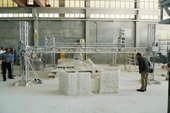
The UK’s Monolite supplied the D-Shape printer, with a mobile printing array of nozzles on a 6 m frame to spray a binding solution onto a sand-like building material.
D-Shape printer
3D ‘printouts’ are built up layer by layer – the company more typically uses its printer to create sculptures and is working on artificial coral reefs to help preserve beaches from energetic sea waves.
“First, we needed to mix the simulated lunar material with magnesium oxide. This turns it into ‘paper’ we can print with,” explained Monolite founder Enrico Dini. 
“Then for our structural ‘ink’ we apply a binding salt which converts material to a stone-like solid.
“Our current printer builds at a rate of around 2 m per hour, while our next-generation design should attain 3.5 m per hour, completing an entire building in a week.”
ESA
Guillermo Gonzalo Sánchez Achutegui
ayabaca@gmail.com
ayabaca@hotmail.com
ayabaca@yahoo.com