Mostrando entradas con la etiqueta Venus. Mostrar todas las entradas

miércoles, 22 de mayo de 2013

NASA - NASA Calls For Phase II Visionary Advanced Concepts

Windsurfing on a Wicked World
 
Notional Zephyr Entry, Descent & Landing Profile 
Notional Zephyr Entry, Descent and Landing Profile
›  Link to larger photo

Even though the cloud-shrouded Venus is often labeled as Earth’s twin due to its similar size, gravity and “terrestrial” composition—primarily made up of silicate rocks or metals—this second-planet from the Sun is a hellish place.

Venus is cloaked in a thick layer of highly reflective clouds of sulfuric acid. It has the densest atmosphere of the four terrestrial planets, consisting mostly of carbon dioxide. The crushing atmospheric pressure at the planet’s surface is 92 times that of Earth’s. To top it off, Venus’ surface temperature is hotter than an oven.

No wonder then, that investigating this wicked world gives pause to space exploration engineers.

But that’s just the challenge being tackled by Geoffrey Landis of NASA’s Glenn Research Center in Cleveland. And thanks to funding from the NASA Innovative Advanced Concepts (NIAC) program, he and his team are looking into the limits of technology in high-temperature electronics, robotics, and “Venus-hardened” systems.

Working with the Collaborative Modeling for Parametric Assessment of Space Systems (COMPASS) Laboratory at Glenn, Landis has set sail on a new type of spacecraft: the Venus Landsailing Rover, dubbed the Zephyr and taken from Aphrodite, the Greek goddess of love and beauty.

“The gentle winds carried Aphrodite across the sea, to Cythera and then to Cyprus, by the god of the west wind, Zephyrus,” Landis explained.

Clear Sailing

“Compared to Mars, Venus has been a comparatively unexplored planet,” Landis says, detailing his progress during the 2013 NIAC Spring Symposium, held last March in Chicago. “But Venus is phenomenally difficult to explore,” he quickly adds.

One bit of good news: below the murky mess of an atmosphere on Venus, it’s clear below around 18 miles high (30 kilometers).

You want to be able to rove across the surface, Landis says, using the ambient resources of Venus. “One approach is just live with the high temperatures by using high-temperature devices,” Landis says, and in fact, the environment of Venus is no harsher than that within a revved up jet engine.

Actually, Glenn technologists have pioneered sensors that work inside jet engines. Those electronics can function even at the sweltering Venus temperature of 450 degrees Celsius, or 840 degrees Fahrenheit.

But one part of the Landis NIAC study is focused on using wind force on Venus as a propulsive nudge. While the winds at the surface of Venus are low (under one meter per second, or just a little over two miles per hour), at Venus pressure, even low wind speeds develop significant force, he explains.

Wind Sailors

“A sail rover would be extraordinary for Venus. The sail has only two moving parts—just to set the sail and set the steering position—and that doesn’t require a lot of power. There’s no power required to actually drive,” says Landis.

Wind vehicles have been used on Earth for over a century, Landis adds, pointing to the Kansas wind wagons from the 1850s. Today, there’s a thriving community of wind sailors that race across the Sahara desert, for example.

The tri-wheeled Venus Landsailing Rover—rising some seven meters or 22 feet above the Venus terrain—won’t necessarily be a speedster scooting across the planet, Landis says. It will be a vehicle that mostly sits in one place, analyzing the ground, he notes, and every now and then will rove across Venus to a new spot.

“Most of Venus is remarkably flat,” Landis observes. “It is as flat and rocky as a parking lot.” The rover is designed to drive equally well forward or backward. That allows the vehicle to back off of obstructions.

Landis and his colleagues on the NIAC-funded study see their rover—replete with about 12 square meters of solar cell-laden sail—tooling across Venus for about a month, chalking up 15 minutes of sailing per day.

“So the fundamental elements of a rover for Venus are not beyond the bounds of physics,” Landis observes, “we could survive the furnace of Venus if we can come up with an innovative concept for a rover that can move on extremely low power levels.”

For Landis, the bottom line about his NIAC study: “Sailing on Venus! How cool is that?”
 NASA
Guillermo Gonzalo Sánchez Achutegui
ayabaca@gmail.com
ayabaca@hotmail.com
ayabaca@yahoo.com

domingo, 10 de marzo de 2013

ESA - Cassini espía a Venus desde la órbita de Saturno


Venus from Saturn
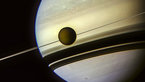
5 marzo 2013 Un remoto planeta brilla iluminado por la luz del Sol. Venus destaca como un faro a través de los anillos de Saturno en esta imagen tomada por la sonda internacional Cassini.
Esta imagen fue tomada el pasado mes de noviembre, cuando Cassini se encontraba a la sombra de Saturno, lo que le permitió mirar en dirección al Sol y fotografiar el planeta y sus anillos a contraluz. 
Asomándose entre los anillos de Saturno, podemos ver al planeta ‘gemelo’ de la Tierra, Venus, en el centro de la sección superior de la imagen, ligeramente hacia la derecha. 
La cámara apuntaba hacia la cara no iluminada de los anillos de Saturno, a unos 17° por debajo de su plano. El arco brillante a la derecha de la imagen es el limbo del planeta. Una pequeña porción de los anillos aparece superpuesta sobre la superficie del planeta, débilmente iluminada por la luz dispersada por los anillos. 
Venus, junto a Mercurio, la Tierra y Marte, es uno de los planetas rocosos del Sistema Solar interior. Aunque tiene un tamaño, masa y composición similares a las de la Tierra, dista mucho de ser un gemelo de nuestro planeta. 
La presión en la superficie de Venus, oculta bajo una densa y asfixiante capa de nubes de dióxido de carbono y dióxido de azufre, es unas 100 veces más alta que en la Tierra. La temperatura ambiente, de unos 500°C, hacen que la superficie de este planeta sea la más abrasadora de todo el Sistema Solar. 
Las nubes perpetuas de azufre son precisamente las que reflejan tal cantidad de luz solar que hacen que este planeta brille intensamente, siendo visible incluso desde el Sistema Solar exterior. 
La misión Cassini-Huygens es un proyecto conjunto de la NASA, la ESA y la Agencia Espacial Italiana, ASI. El laboratorio JPL de la NASA, una división del Instituto de Tecnología de California en Pasadena, gestiona la misión para el Directorado de Misiones Científicas de la NASA, con sede en Washington.
ARTÍCULOS RELACIONADOS:
Ring clumps and strands
Scrambling Saturn’s B-ring10 septiembre 2012

ESA
Guillermo Gonzalo Sánchez Achutegui
ayabaca@gmail.com
ayabaca@hotmail.com
ayabaca@yahoo.com

martes, 29 de enero de 2013

ESA - When a planet behaves like a comet


 Artist’s impression of an active volcano on Venus. Results from a long-term study of Venus find evidence of a clear injection of sulphur dioxide into its upper atmosphere. One possible interpretation is that volcanic activity increased the sulphur dioxide component of the upper atmosphere, although an alternative is that a change in atmospheric circulation dredged up the gas.
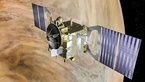
Six years of observations by ESA’s Venus Express have shown large changes in the sulphur dioxide content of the planet’s atmosphere, and one intriguing possible explanation is volcanic eruptions.
The thick atmosphere of Venus contains over a million times as much sulphur dioxide as Earth’s, where almost all of the pungent, toxic gas is generated by volcanic activity.
Most of the sulphur dioxide on Venus is hidden below the planet’s dense upper cloud deck, because the gas is readily destroyed by sunlight.
That means any sulphur dioxide detected in Venus’ upper atmosphere above the cloud deck must have been recently supplied from below.
Venus is covered in hundreds of volcanoes, but whether they remain active today is much debated, providing an important scientific goal for Venus Express.
The mission has already found clues pointing to volcanism on geologically recent timescales, within the last few hundreds of thousands to millions of years.
A previous analysis of infrared radiation from the surface pointed to lava flows atop a volcano with a composition distinct from those of their surroundings, suggesting that the volcano had erupted in the planet’s recent past.
Now, an analysis of sulphur dioxide concentration in the upper atmosphere over six years provides another clue.  

Rise and fall of sulphur dioxide
Immediately after arriving at Venus in 2006, the spacecraft recorded a significant increase in the average density of sulphur dioxide in the upper atmosphere, followed by a sharp decrease to values roughly ten times lower by today.
A similar fall was also seen during NASA’s Pioneer Venus mission, which orbited the planet from 1978 to 1992.
At that time, the preferred explanation was an earlier injection of sulphur dioxide from one or more volcanoes, with Pioneer Venus arriving in time for the decline.
“If you see a sulphur dioxide increase in the upper atmosphere, you know that something has brought it up recently, because individual molecules are destroyed there by sunlight after just a couple of days,” says Dr Emmanuel Marcq of Laboratoire Atmosphères, Milieux, Observations Spatiales, France, and lead author of the paper published in Nature Geoscience.
“A volcanic eruption could act like a piston to blast sulphur dioxide up to these levels, but peculiarities in the circulation of the planet that we don’t yet fully understand could also mix the gas to reproduce the same result,” adds co-author Dr Jean-Loup Bertaux, Principal Investigator for the instrument on Venus Express that made the detections.
Venus has a ‘super-rotating’ atmosphere that whips around the planet in just four Earth-days, much faster than the 243 days the planet takes to complete one rotation about its axis.
Such rapid atmospheric circulation spreads the sulphur dioxide around, making it difficult to isolate any individual points of origin for the gas.
Dr Marcq’s team speculate that if volcanism was responsible for the initial increase, then it could come from a relatively gentle increased output of several active volcanoes rather than one dramatic eruption.
“Alternatively, and taking into account the similar trend observed by Pioneer Venus, it’s possible that we are seeing decadal-scale variability in the circulation of the atmosphere, which is turning out to be even more complex than we could ever have imagined,” he notes.
“By following clues left by trace gases in the atmosphere, we are uncovering the way Venus works, which could point us to the smoking gun of active volcanism,” adds Håkan Svedhem, ESA’s Project Scientist for Venus Express.
Comet-like ionosphere at Venus

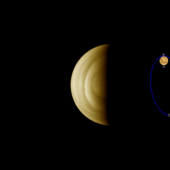
The change in ionosphere of Venus during normal solar wind conditions (left) and reduced solar wind activity (right), as observed by ESA’s Venus Express spacecraft in August 2010.  The yellow lines show a projection of the solar magnetic field lines as they interact with the ionosphere.
Venus Express follows an elliptical orbit around the planet once every 24 hours, passing within 250 km of the north pole and 66 000 km over the south pole. The observations were made on the nightside of the planet, when Venus Express was within 15 000 km of the centre of the planet. Although the spacecraft only took measurements within two Venus radii, the findings suggest that the ionosphere likely extends to even greater distances during periods of reduced solar wind intensity.

When a planet behaves like a comet.
ESA’s Venus Express has made unique observations of Venus during a period of reduced solar wind pressure, discovering that the planet’s ionosphere balloons out like a comet’s tail on its nightside.  
The ionosphere is a region of weakly electrically charged gas high above the main body of a planet’s atmosphere. Its shape and density are partly controlled by the internal magnetic field of the planet.
For Earth, which has a strong magnetic field, the ionosphere is relatively stable under a range of solar wind conditions. By comparison, Venus does not have its own internal magnetic field and relies instead on interactions with the solar wind to shape its ionosphere.
The extent to which this shaping depends on the strength of the solar wind has been controversial, but new results from Venus Express reveal for the first time the effect of a very low solar wind pressure on the ionosphere of an unmagnetised planet.
The observations were made in August 2010 when NASA’s Stereo-B spacecraft measured a drop in solar wind density to 0.1 particles per cubic centimetre, around 50 times lower than normally observed; this persisted for about 18 hours. 
As this significantly reduced solar wind hit Venus, Venus Express saw the planet’s ionosphere balloon outwards on the planet’s ‘downwind’ nightside, much like the shape of the ion tail seen streaming from a comet under similar conditions.
“The teardrop-shaped ionosphere began forming within 30–60 minutes after the normal high pressure solar wind diminished. Over two Earth days, it had stretched to at least two Venus radii into space,” says Yong Wei of the Max Planck Institute for Solar System Research in Germany, lead author of the new findings.
The new observations settle a debate about how the strength of the solar wind affects the way in which ionospheric plasma is transported from the dayside to the nightside of Venus.
Usually, this material flows along a thin channel in the ionosphere, but scientists were unsure what happens under low solar wind conditions. Does the flow of plasma particles increase as the channel widens due to the reduced confining pressure, or does it decrease because less force is available to push plasma through the channel?
“We now finally know that the first effect outweighs the second, and that the ionosphere expands significantly during low solar wind density conditions,” says Markus Fraenz, also of the Max Planck Institute and co-author on the paper.
A similar effect is also expected to occur around Mars, the other non-magnetised planet in our inner Solar System.
“We often talk about the effects of solar wind interaction with planetary atmospheres during periods of intense solar activity, but Venus Express has shown us that even when there is a reduced solar wind, the Sun can still significantly influence the environment of our planetary neighbours,” adds Håkan Svedhem, ESA’s Venus Express project scientist.
ESA.
Venus cloud tops
Chasing clouds on Venus08 October 2012

Guillermo Gonzalo Sánchez Achutegui
ayabaca@gmail.com
ayabaca@hotmail.com
ayabaca@yahoo.com
domingo, 18 de noviembre de 2012

ESA - Space Science - Snap the stars to see your photo on ESA portal


Transit of Venus as seen from Canberra, Australia
Download:
Transit of Venus as seen from Canberra, Australia, 2012. 
Credits: Manuel Castillo-Fraile and Miguel Sánchez-Portal

Have you taken an interesting astronomical photo this year? From planets and moons to the Sun, stars and galaxies, we’d like you to send us your images to feature as our Space Science Image of the Week on 31 December.

The ESA Space Science team’s favourite image will take the slot of our weekly image during the week beginning 31 December 2012 as a celebration of the astronomical events of the year gone by. The best of the rest will feature in our dedicated ESA Space Science images Flickr gallery. During 2012, the sky has staged a series of astronomical theatrics to provide plenty of inspiration for your entry. Perhaps you were lucky enough to observe a solar eclipse, or even the transit of Venus. Maybe you snapped a meteor streaking through the sky, or perhaps you found beauty in the constellations this year. Images of galaxies and nebulae are also welcomed. 
 

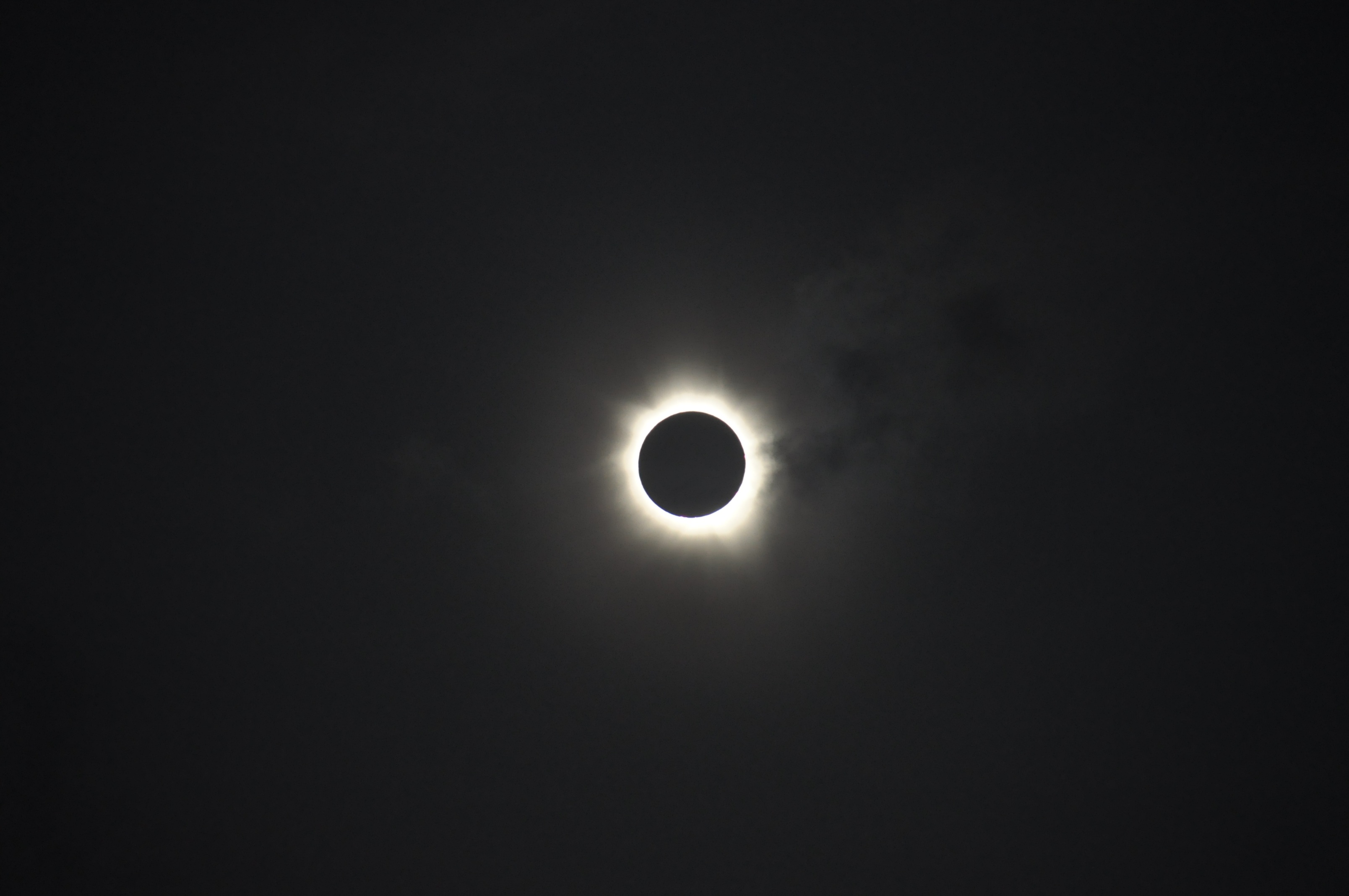
Totality
Download:
The total solar eclipse of 13/14 November 2012. The clouds cleared in time for observers at Palm Cove, Australia, to experience totality as the Moon totally obscured the Sun for around two minutes, revealing the Sun's bright corona. 
Credits: Anik De Groof

If you would like to participate but have yet to capture the perfect image, here are some upcoming events to spark some ideas:
17/18 November: Leonids meteor shower – watch ‘shooting stars’ rain from the constellation of Leo this weekend as Earth bumps into debris from Comet Tempel-Tuttle.
27 November: conjunction between Venus and the ringed planet Saturn – the two planets meet to within 1º before sunrise for European observers. With an unobstructed horizon, you may also glimpse Mercury.
28 November: penumbral lunar eclipse – watch the Moon enter Earth’s faint outer shadow (beginning 12:14 GMT and ending 16:51 GMT)
3 December: Jupiter at opposition – the gas giant will be at its closest approach to Earth with its face fully illuminated by the Sun, providing ideal conditions to view and photograph the planet with its four Galilean moons.
 We invite you to photograph these events – or review your images taken during 2012 – and submit your best shot to scicom@esa.int by Monday 10 December. Images will be judged mainly on their aesthetic value.
Amateur photographers and astronomers from around the world are encouraged to participate.
Please include your name, contact email address, your geographical location, the date you took the image, the camera/telescope you used, and any imaging/processing details that you would like to share.
The image must have been taken in 2012 and only one entry per person, please.
ESA
Guillermo Gonzalo Sánchez Achutegui
ayabaca@gmail.com
ayabaca@hotmail.com
ayabaca@yahoo.com