Mostrando entradas con la etiqueta ESA’s Herschel Space Observatory. Mostrar todas las entradas

jueves, 23 de enero de 2014

NASA : Herschel Telescope Detects Water on Dwarf Planet

 
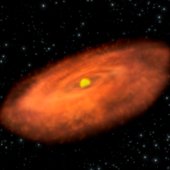
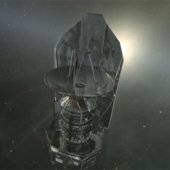
 Dwarf planet Ceres is located in the main asteroid belt, between the orbits of Mars and Jupiter, as illustrated in this artist's conception. Observations by the Herschel space observatory between 2011 and 2013 find that the dwarf planet has a thin water vapor atmosphere.
Dwarf planet Ceres is located in the main asteroid belt, between the orbits of Mars and Jupiter, as illustrated in this artist's conception. Observations by the Herschel space observatory between 2011 and 2013 find that the dwarf planet has a thin water vapor atmosphere.
Image Credit: ESA/ATG medialab
Image Token:
Scientists using the Herschel space observatory have made the first definitive detection of water vapor on the largest and roundest object in the asteroid belt, Ceres.
Plumes of water vapor are thought to shoot up periodically from Ceres when portions of its icy surface warm slightly. Ceres is classified as a dwarf planet, a solar system body bigger than an asteroid and smaller than a planet.
Herschel is a European Space Agency (ESA) mission with important NASA contributions.
"This is the first time water vapor has been unequivocally detected on Ceres or any other object in the asteroid belt and provides proof that Ceres has an icy surface and an atmosphere," said Michael Küppers of ESA in Spain, lead author of a paper in the journal Nature.
The results come at the right time for NASA's Dawn mission, which is on its way to Ceres now after spending more than a year orbiting the large asteroid Vesta. Dawn is scheduled to arrive at Ceres in the spring of 2015, where it will take the closest look ever at its surface.
"We've got a spacecraft on the way to Ceres, so we don't have to wait long before getting more context on this intriguing result, right from the source itself," said Carol Raymond, the deputy principal investigator for Dawn at NASA's Jet Propulsion Laboratory (JPL) in Pasadena, Calif. "Dawn will map the geology and chemistry of the surface in high-resolution, revealing the processes that drive the outgassing activity."
For the last century, Ceres was known as the largest asteroid in our solar system. But in 2006, the International Astronomical Union, the governing organization responsible for naming planetary objects, reclassified Ceres as a dwarf planet because of its large size. It is roughly 590 miles (950 kilometers) in diameter. When it first was spotted in 1801, astronomers thought it was a planet orbiting between Mars and Jupiter. Later, other cosmic bodies with similar orbits were found, marking the discovery of our solar system's main belt of asteroids.
Scientists believe Ceres contains rock in its interior with a thick mantle of ice that, if melted, would amount to more fresh water than is present on all of Earth. The materials making up Ceres likely date from the first few million years of our solar system's existence and accumulated before the planets formed.
Until now, ice had been theorized to exist on Ceres but had not been detected conclusively. It took Herschel's far-infrared vision to see, finally, a clear spectral signature of the water vapor. But Herschel did not see water vapor every time it looked. While the telescope spied water vapor four different times, on one occasion there was no signature.
Here is what scientists think is happening: when Ceres swings through the part of its orbit that is closer to the sun, a portion of its icy surface becomes warm enough to cause water vapor to escape in plumes at a rate of about 6 kilograms (13 pounds) per second. When Ceres is in the colder part of its orbit, no water escapes.
The strength of the signal also varied over hours, weeks and months, because of the water vapor plumes rotating in and out of Herschel's views as the object spun on its axis. This enabled the scientists to localize the source of water to two darker spots on the surface of Ceres, previously seen by NASA's Hubble Space Telescope and ground-based telescopes. The dark spots might be more likely to outgas because dark material warms faster than light material. When the Dawn spacecraft arrives at Ceres, it will be able to investigate these features.
The results are somewhat unexpected because comets, the icier cousins of asteroids, are known typically to sprout jets and plumes, while objects in the asteroid belt are not.
"The lines are becoming more and more blurred between comets and asteroids," said Seungwon Lee of JPL, who helped with the water vapor models along with Paul von Allmen, also of JPL. "We knew before about main belt asteroids that show comet-like activity, but this is the first detection of water vapor in an asteroid-like object."
The research is part of the Measurements of 11 Asteroids and Comets Using Herschel (MACH-11) program, which used Herschel to look at small bodies that have been or will be visited by spacecraft, including the targets of NASA's previous Deep Impact mission and upcoming Origins Spectral Interpretation Resource Identification Security Regolith Explorer (OSIRIS-Rex). Laurence O' Rourke of the European Space Agency is the principal investigator of the MACH-11 program.
 
More information about Herschel is online at:
More information about NASA's role in Herschel is available at:
For more information about NASA's Dawn mission, visit:
NASA
Guillermo Gonzalo Sánchez Achutegui

domingo, 15 de diciembre de 2013

ESA: Crab Nebula


Crab Nebula  DOWNLOAD HI.RES    JPG    (2.94 MB)
Crab Nebula
Across the Universe, every ending is a new beginning. When a massive star dies, exploding as a spectacular supernova, huge amounts of matter and energy are ejected into surrounding space, and the remnant of the explosion itself remains a hub of fierce activity for thousands of years.
One of the most iconic supernova remnants is the Crab Nebula. A wispy and filamentary cloud of gas and dust, it originated with a supernova explosion that was seen by Chinese astronomers in the year 1054. A spinning neutron star – or pulsar – remains at its centre, releasing streams of highly energetic particles into the nebula.
This composite image combines a new infrared view of the Crab Nebula, obtained with ESA’s Herschel Space Observatory, with an optical image from the archives of the NASA/ESA Hubble Space Telescope.
Herschel’s observations are shown in red and reveal the glow from cosmic dust present in the nebula. Hubble’s view, in blue, traces oxygen and sulphur gas in the nebula.
A team of astronomers studying the nebula with Herschel has revealed that this supernova remnant contains much more dust than they had expected – about a quarter of the mass of the Sun.
The new observations also revealed the presence of molecules containing argon, the first time a noble gas-based molecule has been found in space.
Argon is produced in the nuclear reactions that take place during supernova explosions, and astronomers had already detected this element in the Crab Nebula. However, it is surprising that argon bonded with other elements, forming molecules that survived in the hostile environment of a supernova remnant, with hot gas still expanding at high speeds after the explosion.
Read more about this discovery:
Credits: ESA/Herschel/PACS/MESS Key Programme Supernova Remnant Team; NASA, ESA and Allison Loll/Jeff Hester (Arizona State University)
ESA
Guillermo Gonzalo Sánchez Achutegui
ayabaca@gmail.com
ayabaca@hotmail.com
ayabaca@yahoo.com

miércoles, 22 de mayo de 2013

NASA - Herschel Space Observatory Finds Mega Merger of Galaxies

Herschel Space Observatory Finds Galaxy Mega Merger

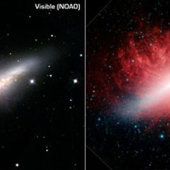
 This simulation shows the merging of two massive galaxies, sped up to cover 1.5 billion years of time. The merging galaxies are split into two views: a visible-light view is on the left, in which blue shows young stars and red indicates older stars and dust. The view at right shows emission from dust, which is what infrared telescopes like the Herschel Space Observatory see. When the galaxies finally merge, the strong burst of star formation can be seen best in infrared views.    

The making of a giant galaxy 
Several telescopes have teamed up to discover a rare and massive merging of two galaxies that took place when the universe was just 3 billion years old (its current age is about 14 billion years). Image credit: ESA/NASA/JPL-Caltech/UC Irvine/STScI/Keck/NRAO/SAO
› Full image and caption

PASADENA, Calif. - A massive and rare merging of two galaxies has been spotted in images taken by the Herschel space observatory, a European Space Agency mission with important NASA participation.
Follow-up studies by several telescopes on the ground and in space, including NASA's Hubble Space Telescope and Spitzer Space Telescope, tell a tale of two faraway galaxies intertwined and furiously making stars. Eventually, the duo will settle down to form one super-giant elliptical galaxy.
The findings help explain a mystery in astronomy. Back when our universe was 3 billion to 4 billion years old, it was populated with large reddish elliptical-shaped galaxies made up of old stars. Scientists have wondered whether those galaxies built up slowly over time through the acquisitions of smaller galaxies, or formed more rapidly through powerful collisions between two large galaxies.
The new findings suggest massive mergers are responsible for the giant elliptical galaxies.
"We're looking at a younger phase in the life of these galaxies -- an adolescent burst of activity that won't last very long," said Hai Fu of the University of California at Irvine, who is lead author of a new study describing the results. The study is published in the May 22 online issue of Nature.
"These merging galaxies are bursting with new stars and completely hidden by dust," said co-author Asantha Cooray, also of the University of California at Irvine. "Without Herschel's far-infrared detectors, we wouldn't have been able to see through the dust to the action taking place behind."
Herschel, which operated for almost four years, was designed to see the longest-wavelength infrared light. As expected, it recently ran out of the liquid coolant needed to chill its delicate infrared instruments. While its mission in space is over, astronomers still are scrutinizing the data, and further discoveries are expected.
In the new study, Herschel was used to spot the colliding galaxies, called HXMM01, located about 11 billion light-years from Earth, during a time when our universe was about 3 billion years old. At first, astronomers thought the two galaxies were just warped, mirror images of one galaxy. Such lensed galaxies are fairly common in astronomy and occur when the gravity from a foreground galaxy bends the light from a more distant object. After a thorough investigation, the team realized they were actually looking at a massive galaxy merger.
Follow-up characterization revealed the merging galaxies are churning out the equivalent of 2,000 stars a year. By comparison, our Milky Way hatches about two to three stars a year. The total number of stars in both colliding galaxies averages out to about 400 billion.
Mergers are fairly common in the cosmos, but this particular event is unusual because of the prolific amounts of gas and star formation, and the sheer size of the merger at such a distant epoch.
The results go against the more popular model explaining how the biggest galaxies arise: through minor acquisitions of small galaxies. Instead, mega smash-ups may be doing the job.
NASA's Herschel Project Office is based at the agency's Jet Propulsion Laboratory in Pasadena, Calif., which contributed mission-enabling technology for two of Herschel's three science instruments. JPL is a division of the California Institute of Technology, Pasadena.
For more information about Herschel, 
 NASA
Guillermo Gonzalo Sánchez Achutegui
ayabaca@gmail.com
ayabaca@hotmail.com
ayabaca@yahoo.com

domingo, 14 de abril de 2013

ESA - Una estrella jubilada con planetas y un disco de escombros


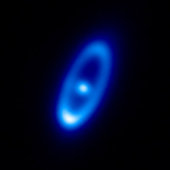
Disco de polvo alrededor de Kappa Coronae Borealis
10 abril 2013 El observatorio espacial Herschel de la ESA ha observado por primera vez un cinturón de polvo – resultado de las colisiones entre cometas o asteroides – rodeando a una estrella subgigante que también tiene un sistema planetario.
Las estrellas como nuestro Sol, después de pasar miles de millones de años quemando hidrógeno en sus núcleos de forma ininterrumpida, terminan agotando sus reservas de combustible y comienzan a quemar las capas que rodean al núcleo. Como resultado, se hinchan convirtiéndose en estrellas subgigantes, antes de transformarse en gigantes rojas. 
Durante la fase de estrella subgigante, los planetas, asteroides y cinturones de cometas que las rodean todavía tienen posibilidades de sobrevivir. Para comprender mejor este proceso, es necesario observar este tipo de sistemas y medir sus propiedades. La búsqueda comienza por las estrellas rodeadas por discos de polvo, generados por las colisiones entre cometas o asteroides. 
Gracias a la gran sensibilidad del telescopio espacial Herschel para observar en la banda del infrarrojo lejano, los astrónomos han sido capaces de analizar la brillante emisión que rodea a la estrellaKappa Coronae Borealis(κ CrB, o Kappa Cor Bor), descubriendo un disco de escombros y polvo a su alrededor. 
Esta estrella presenta una masa 1.5 veces superior a la de nuestro Sol, tiene unos 2.500 millones de años y se encuentra a unos 100 años luz de nuestro planeta. 
Al observarla desde la Tierra, se descubrió que cuenta con un planeta gigante con el doble de masa que Júpiter, a una distancia de la estrella equivalente a la del Cinturón de Asteroides de nuestro propio Sistema Solar. Los astrónomos sospechan que podría existir un segundo planeta a su alrededor, pero todavía no han podido acotar su masa. 
Las observaciones de Herschel ofrecen una inusual oportunidad para comprender mejor la vida de los sistemas planetarios en órbita a las estrellas subgigantes, y permiten estudiar en detalle la arquitectura de su disco y del sistema de planetas. 
“Es la primera vez que detectamos una estrella ‘jubilada’ con un disco de escombros y uno o más planetas”, explica Amy Bonsor, del Instituto de Planetología y Astrofísica de Grenoble, autora principal de este estudio. 
“El disco de escombros ha sobrevivido a toda la vida de la estrella sin ser destruido, al contrario que en nuestro propio Sistema Solar, donde la mayor parte de los escombros fue despejada durante una fase conocida como la era del Bombardeo Intenso Tardío, unos 600 millones de años después de que se formase el Sol”. 
El equipo de Bonsor ha propuesto tres posibles configuraciones del disco y los planetas que se ajustarían a las observaciones de Kappa Cor Bor realizadas con Herschel. 
El primer modelo sugiere la presencia de un único cinturón de polvo, continuo, que se extiende desde las 20 UA a las 220 UA (donde 1 UA, o Unidad Astronómica, es la distancia entre la Tierra y el Sol). 
Si lo comparamos con nuestro Sistema Solar, nuestro disco de escombros de hielo – conocido como el Cinturón de Kuiper – se extiende en una franja mucho más estrecha, de 30 a 50 UA del Sol. 
Según este modelo, uno de los planetas se encontraría a más de 7 UA de la estrella, y su influencia gravitatoria daría forma al borde interior del disco.
Otra posibilidad sería que el disco de polvo estuviese dividido en dos cinturones más estrechos, centrados a 40 UA y 165 UA, respectivamente. La órbita del cuerpo exterior podría estar comprendida entre estos dos cinturones, a una distancia de 7 a 70 UA, dejando abierta la posibilidad de que se trate de un cuerpo más masivo que un planeta, como una enana marrón subestelar. 
“Nos encontramos ante un sistema misterioso e intrigante: ¿hay uno o dos planetas dando forma a este disco? ¿existe una enana marrón en órbita a la estrella central, que ha dividido el disco en dos?” se planeta Bonsor. 
Como este es el primer ejemplo detectado de una estrella subgigante con planetas y un disco de escombros a su alrededor, hacen falta más ejemplos para determinar si Kappa Cor Bor es un caso excepcional o algo común en el universo. 
“Gracias a la gran sensibilidad de Herschel para observar en la banda del infrarrojo lejano, y a su gran archivo de datos, ya hemos encontrado pistas de otras estrellas subgigantes que podrían estar rodeadas por discos de polvo. Será necesario hacer nuevas observaciones para determinar si también cuentan con sistemas planetarios”, explica Göran Pilbratt, científico del proyecto Herschel para la ESA.
“Spatially Resolved Images of Dust Belt(s) Around the Planet-hosting Subgiant κ CrB”, de A. Bonsor et al., está publicado en el Monthly Notices de abril de 2013, de la Royal Astronomical Society. 
Estas observaciones fueron realizadas con el instrumento PACS de Herschel a 100 µm y 160 µm. 
Herschel es un observatorio espacial de la ESA equipado con instrumentos científicos desarrollados por consorcios de investigadores europeos con una importante participación de la NASA.
 
Para más información:
Markus Bauer


ESA Science and Robotic Exploration Communication Officer


Tel: +31 71 565 6799


Mob: +31 61 594 3 954


Email: markus.bauer@esa.int
Amy Bonsor
Institut de Planétologie et d’Astrophysique de Grenoble, France
Email: amy.bonsor@obs.ujf-grenoble.fr
Göran Pilbratt


ESA Herschel Project Scientist


Tel: +31 71 565 3621


Email: gpilbratt@rssd.esa.int
ARTÍCULOS RELACIONADOS:
NASA
Guillermo Gonzalo Sánchez Achutegui
ayabaca@gmail.com
ayabaca@hotmail.com
ayabaca@yahoo.com

domingo, 10 de marzo de 2013

ESA - Herschel to finish observing soon


Herschel operating at the second Lagrange point (L2)
Herschel will be stationed at the second Sun-Earth Lagrange point (L2), 1.5 million km from Earth. This point is theoretically stationary in space with respect to the Earth and Sun, which means that for Herschel, Earth and the Sun will always be in the same general direction.
This provides a stable thermal environment and a good view of the sky. Since the Earth is far away, Herschel is not disturbed by its radiation belts.
At the same time, the spacecraft's position in space and the resulting temperature extremes make the task of optimising the work environment for the instruments a challenge.
The Herschel spacecraft has heritage from the successful ESA Infrared Space Observatory (ISO). It has been improved and optimized for a more distant and more favourable orbit and its complement of instruments.
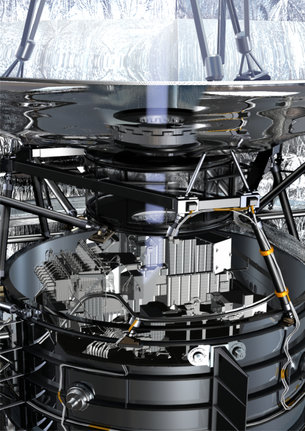
Inside Herschel
The Herschel satellite is composed of three sections.
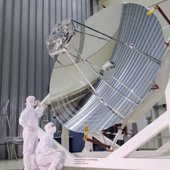
First is the telescope, which has a 3.5 m-diameter primary mirror protected by a sunshade. The telescope focuses light onto three scientific instruments; their detectors are housed in a giant thermos flask, known as a cryostat.
The cryostat provides the interface and cryogenic environment for the instrument focal plane units, and supports the telescope, the solar array and telescope sunshade, and a unit of the Heterodyne Instrument for the Far Infrared.
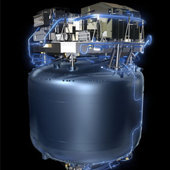
Herschel’s cooling system
Herschel’s sophisticated cooling system
Inside the cryostat, Herschel's detectors are kept at very low and stable temperatures, necessary for the instruments to operate. The cryostat contains liquid superfluid helium at temperatures lower than –271°C, which makes the instruments as sensitive as possible. The instruments detectors and the cryostat make up the second section, the payload module.
The infrared detectors must be cooled to extremely low temperatures in order to work, in fact close to absolute zero (–273.15°C or 0 K).
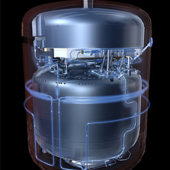
Herschel’scooling system
Herschel’s sophisticated cooling system
All three Herschel instruments will be housed inside and cooled by the cryostat which is filled at launch with more than 2300 litres of superfluid helium kept at 1.65 K, i.e. –271.5°C. Further cooling – down to 0.3 K – is required for the SPIRE and PACS bolometeric detectors. The role of the cryostat is fundamental because it determines the lifetime of the observatory.
The superfluid helium evaporates at a constant rate, gradually emptying the tank. It is expected to evaporate completely about four years after launch.
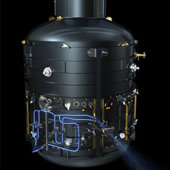
Herschel’s cooling system
Herschel’s sophisticated cooling system
When it has all gone, the temperature of the instruments will start to rise and Herschel will no longer be able to perform observations. However, the data that Herschel will have supplied will keep astronomers busy for decades.
The third element of the satellite is the service module located below the payload module. It houses the instrument electronics and the components responsible for satellite function, such as the communication hardware. The service module houses the payload electronics that do not need cooling, and provides the necessary subsystems: power, attitude and orbit control, on-board data handling, thermal control and command execution, communication, and safety.
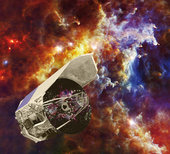
Herschel and Rosette Nebula
5 March 2013 ESA’s Herschel space observatory is expected to exhaust its supply of liquid helium coolant in the coming weeks after spending more than three exciting years studying the cool Universe. 
Herschel was launched on 14 May 2009 and, with a main mirror 3.5 m across, it is the largest, most powerful infrared telescope ever flown in space.
A pioneering mission, it is the first to cover the entire wavelength range from the far-infrared to submillimetre, making it possible to study previously invisible cool regions of gas and dust in the cosmos, and providing new insights into the origin and evolution of stars and galaxies.
In order to make such sensitive far-infrared observations, the detectors of the three science instruments – two cameras/imaging spectrometers and a very high-resolution spectrometer – must be cooled to a frigid –271°C, close to absolute zero. They sit on top of a tank filled with superfluid liquid helium, inside a giant thermos flask known as a cryostat.
Herschel’s cryostat vacuum vessel
The superfluid helium evaporates over time, gradually emptying the tank and determining Herschel’s scientific life. At launch, the cryostat was filled to the brim with over 2300 litres of liquid helium, weighing 335 kg, for 3.5 years of operations in space.
Indeed, Herschel has made extraordinary discoveries across a wide range of topics, from starburst galaxies in the distant Universe to newly forming planetary systems orbiting nearby young stars.
However, all good things must come to an end and engineers believe that almost all of the liquid helium has now gone.
It is not possible to predict the exact day the helium will finally run out, but confirmation will come when Herschel begins its next daily 3-hour communication period with ground stations on Earth.
“It is no surprise that this will happen, and when it does we will see the temperatures of all the instruments rise by several degrees within just a few hours,” says Micha Schmidt, the Herschel Mission Operations Manager at ESA’s European Space Operations Centre in Darmstadt, Germany.
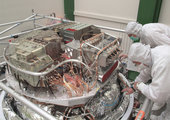
Integrating the instruments
The science observing programme was carefully planned to take full advantage of the lifetime of the mission, with all of the highest-priority observations already completed.
In addition, Herschel is performing numerous other interesting observations specifically chosen to exploit every last drop of helium.
“When observing comes to an end, we expect to have performed over 22 000 hours of science observations, 10% more than we had originally planned, so the mission has already exceeded expectations,” says Leo Metcalfe, the Herschel Science Operations and Mission Manager at ESA’s European Space Astronomy Centre in Madrid, Spain.
Herschel
“We will finish observing soon, but Herschel data will enable a vast amount of exciting science to be done for many years to come,” says Göran Pilbratt, ESA’s Herschel Project Scientist at ESA’s European Space Research and Technology Centre in Noordwijk, the Netherlands.
“In fact, the peak of scientific productivity is still ahead of us, and the task now is to make the treasure trove of Herschel data as valuable as possible for now and for the future.”
Herschel will continue communicating with its ground stations for some time after the helium is exhausted, allowing a range of technical tests. Finally, in early May, it will be propelled into its long-term stable parking orbit around the Sun. 
RELATED ARTICLES:

Spanish:
LAS OBSERVACIONES DE HERSCHE PRONTO LLEGARÁN A SU FIN:
Herschel and Rosette Nebula
5 marzo 2013 Tras pasar más de tres emocionantes años estudiando el universo frío, se estima que, en las próximas semanas, se agotará el suministro de helio liquido refrigerante del observatorio espacial Herschel de la ESA. 
Herschel fue lanzado el 14 de mayo de 2009 y, con un espejo primario de 3,5 m, es el telescopio infrarrojo más grande y potente jamás lanzado al espacio. 
Esta misión pionera ha sido la primera en cubrir todo el rango en la longitud de onda que va desde el infrarrojo lejano hasta el submilimétrico,  haciendo posible el estudio de regiones frías de gas y polvo del cosmos antes invisibles, y proporcionando nuevos conocimientos sobre el origen y la evolución de las estrellas y las galaxias.
Con la finalidad de poder llevar a cabo este tipo de observaciones tan sensibles en el infrarrojo lejano, los detectores de los tres instrumentos científicos –dos cámaras/espectrómetro de imagen y un espectrómetro de muy alta resolución  – deben enfriarse a una temperatura de –271°C, cerca del cero absoluto. Están en el extremo superior de un tanque lleno de helio superfluido líquido, dentro de un enorme tanque conocido como criostato.
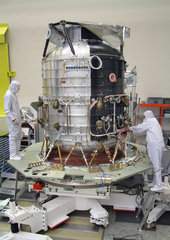
Herschel’s cryostat vacuum vessel
El helio superfluido se evapora con el tiempo, vaciando el tanque gradualmente y determinando el periodo de vida científica de Herschel. Al lanzarlo, el criostato estaba lleno hasta los bordes con cerca de 2.300 litros de helio líquido (335 kg) lo que garantizaba 3,5 años de operaciones en el espacio. 
De hecho, Herschel ha hecho extraordinarios descubrimientos en un amplio rango de temas, desde galaxias con estallidos de formación estelar en el universo distante hasta nuevos sistemas planetarios en formación orbitando jóvenes estrellas cercanas. 
Sin embargo, todo lo bueno llega a su fin, y los ingenieros creen que casi todo el helio líquido se ha gastado. 
No es posible predecir el día exacto en el que el helio se agotará por completo, pero la confirmación llegará cuando Herschel empiece su próximo periodo de comunicación diario de 3 horas con las estaciones terrestres. 
“No debe sorprendernos cuando ocurra, y cuando pase veremos la temperatura de todos los instrumentos elevarse varios grados en tan solo unas horas”, afirma Micha Schmidt, el Jefe de Operaciones de Misiones de Herschel en ESOC (European Space Operations Centre) de la ESA, en Darmstadt, Alemania.
Integrating the instruments
El programa de observación científica fue planeado minuciosamente con el fin de sacar el máximo partido del periodo de vida de la misión, y todas las observaciones de alta prioridad ya se han llevado a cabo. 
Además, Herschel está llevando a cabo numerosas observaciones de gran interés elegidas específicamente con la finalidad de explotar hasta la última gota de helio. 
“Cuando finalicen las observaciones, esperamos haber llevado a cabo 22.000 horas de observaciones científicas, un 10% más de lo planificado en un principio, por lo que la misión ya ha superado sus expectativas”, afirma Leo Metcalfe, Jefe de la Misión y Jefe de Operaciones Científicas de Herschel de la ESA en ESAC (Centro Europeo de Astronomía Espacial) en Madrid, España.
Herschel
“Pronto las observaciones llegarán a su fin, pero los datos de Herschel permitirán que se haga una enorme cantidad de ciencia emocionante durante muchos años”, señala Göran Pilbratt, Jefe Científico del Proyecto Herschel de la ESA en ESTEC (European Space Research and Technology Centre) en Noordwijk, Países Bajos. 
“De hecho, el pico de productividad científica aún está por llegar, y ahora nuestro trabajo consiste en poner en valor los datos de Herschel tanto como nos sea posible, tanto por la ciencia actual como por la futura”. 
Herschel seguirá comunicándose con las estaciones terrestres durante un tiempo después de que se haya agotado el helio, permitiendo una serie de comprobaciones técnicas. Finalmente, a principios de mayo, será impulsado hacia una órbita estable a largo plazo alrededor del Sol.
ESA


Guillermo Gonzalo Sánchez Achutegui

ayabaca@gmail.com
ayabaca@hotmail.com
ayabaca@yahoo.com

domingo, 24 de febrero de 2013

ESA - A cool discovery about the Sun’s next-door twin

Cool layer in a Sun-like star


(3.54 MB)
One of the great curiosities in solar science is that our Sun’s outer atmosphere – the corona – is heated to millions of degrees when its visible surface is ‘only’ about 6000 degrees. Even stranger is a curious temperature minimum of 4000 degrees lying between the two layers, in the chromosphere. Now, using ESA’s Herschel space observatory, scientists have made the first discovery of an equivalent cool layer in the atmosphere of the Sun-like star, Alpha Centauri A.

ESA’s Herschel space observatory has detected a cool layer in the atmosphere of Alpha Centauri A, the first time this has been seen in a star beyond our own Sun. The finding is not only important for understanding the Sun’s activity, but could also help in the quest to discover proto-planetary systems around other stars.
The Sun’s nearest neighbours are the three stars of the Alpha Centauri system. The faint red dwarf, Proxima Centauri, is nearest at just 4.24 light-years, with the tight double star, Alpha Centauri AB, slightly further away at 4.37 light-years.
Alpha Centauri B has recently been in the news after the discovery of an Earth-mass planet in orbit around it. But Alpha Centauri A is also very important to astronomers: almost a twin to the Sun in mass, temperature, chemical composition and age, it provides an ideal natural laboratory to compare other characteristics of the two stars.
One of the great curiosities in solar science is that the Sun’s wispy outer atmosphere – the corona – is heated to millions of degrees while the visible surface of the Sun is ‘only’ about 6000ºC. Even stranger, there is a temperature minimum of about 4000ºC between the two layers, just a few hundred kilometres above the visible surface in the part of Sun’s atmosphere called the chromosphere.
Both layers can be seen during a total solar eclipse, when the Moon briefly blocks the bright face of the Sun: the chromosphere is a pink-red ring around the Sun, while the ghostly white plasma streamers of the corona extend out millions of kilometres.
The heating of the Sun’s atmosphere has been a conundrum for many years, but is likely to be related to the twisting and snapping of magnetic field lines sending energy rippling through the atmosphere and out into space – possibly in the direction of Earth – as solar storms. Why there is a temperature minimum has also long been of interest to solar scientists.
Now, by observing Alpha Centauri A in far-infrared light with Herschel and comparing the results with computer models of stellar atmospheres, scientists have made the first discovery of an equivalent cool layer in the atmosphere of another star.
“The study of these structures has been limited to the Sun until now, but we clearly see the signature of a similar temperature inversion layer at Alpha Centauri A,” says René Liseau of the Onsala Space Observatory, Sweden, and lead author of the paper presenting the results.
“Detailed observations of this kind for a variety of stars might help us decipher the origin of such layers and the overall atmospheric heating puzzle.”
Understanding the temperature structure of stellar atmospheres may also help to determine the presence of dusty planet-forming discs around other stars like the Sun.
“Although it is likely only a small effect, a temperature minimum region in other stars could result in us underestimating the amount of dust present in a cold debris disc surrounding it,” says Dr Liseau.
“But armed with a more detailed picture of how Alpha Centauri A shines, we can hope to make more accurate detections of the dust in potential planet-bearing systems around other Sun-like stars.”
“These observations are an exciting example of how Herschel can be used to learn more about processes in our own Sun, as well as in other Sun-like stars and the dusty discs that may exist around them,” says Göran Pilbratt, ESA’s Herschel Project Scientist.
“α Centauri A in the far infrared. First measurement of the temperature minimum of a star other than the Sun,” by R. Liseau et al. is published in Astronomy & Astrophysics 549, L7 (2013).
The survey was conducted as part of the DUNES (Dust around Nearby Stars) Herschel Key Programme. Data were collected by the PACS instrument at 100 μm and 160 μm for the DUNES survey, and PACS 70 μm and 160μm and SPIRE 250 μm, 350 μm and 500 μm data obtained as part of the Hi-GAL programme were also analysed. Additional space- and ground-based infrared data were also included.
Herschel is an ESA space observatory with science instruments provided by European-led Principal Investigator consortia and with important participation from NASA.
For further information, please contact:
Markus Bauer


ESA Science and Robotic Exploration Communication Officer


Tel: +31 71 565 6799


Mob: +31 61 594 3 954


Email: markus.bauer@esa.int
René Liseau
Chalmers University of Technology, Onsala Space Observatory, Sweden
Tel: +46 31 772 55 05
Email: rene.liseau@chalmers.se
Göran Pilbratt

ESA Herschel Project Scientist


Tel: +31 71 565 3621


Email: gpilbratt@rssd.esa.int
ESA
Guillermo Gonzalo Sánchez Achutegui
ayabaca@gmail.com
ayabaca@hotmail.com
ayabaca@yahoo.com

domingo, 3 de febrero de 2013

ESA: Las Estrellas pueden tener una maternidad tardía


Weighing the planet-forming disc around a nearby star


  • Description The 10 million-year-old star TW Hydrae is surrounded by a dense disc of planet-forming materials. Using ESA’s Herschel space observatory, astronomers have been able to ‘weigh’ the star’s disc with ten times higher accuracy than ever before, finding it still has enough mass to spawn 50 Jupiter-mass planets, several million years after most other stars have already given birth.
Utilizando las capacidades únicas del observatorio espacial Herschel de la ESA, los astrónomos han podido “pesar” con precisión el disco de una estrella, descubriendo que aún tiene la suficiente masa como para engendrar 50 planetas tipo Júpiter, y ello millones de años después de que muchas otras estrellas ya hayan “dado a luz”.  
Los discos protoplanetarios contienen todos los ingredientes brutos para fabricar planetas. Estos están compuestos, principalmente, por gas de hidrógeno molecular, que es muy transparente y, en esencia, invisible.
Normalmente, para hacer estimaciones sobre la masa total del disco, es mucho más fácil medir la emisión de “contaminantes”, como la pequeña fracción de polvo que se mezcla con el gas, o la de otros componentes del gas.
En el pasado, esta técnica ha causado significantes incertidumbres en las estimaciones de la masa del hidrógeno molecular, pero gracias a la información que proporciona la longitud de onda del infrarrojo lejano y a la sensibilidad de Herschel, los astrónomos han utilizado un método nuevo, más preciso, utilizando un pariente cercano del hidrógeno molecular llamado deuterio o hidrógeno “pesado”.
Dado que la proporción de gas de hidrógeno molecular “normal” y “pesado” es muy conocida por las medidas realizadas en nuestra vecindad local solar, esta aproximación proporciona un medio para “pesar” la masa total del disco de una estrella con una precisión diez veces mayor que la alcanzada con todas las técnicas utilizadas hasta el momento.
Utilizando esta técnica, se detectó una masa considerable de gas en el disco que rodea a TW Hydrae, una estrella joven que se encuentra a tan solo 176 años luz, en la constelación de la Hidra.
“No esperábamos encontrar tanto gas alrededor de esta estrella de 10 millones de años”, afirma el Profesor Edwin Bergin de la Universidad de Michigan, autor principal del artículo publicado enNature.
“Esta estrella tiene mucha más masa de la necesaria para generar un sistema solar como el nuestro y podría crear un sistema mucho más exótico con planetas más masivos que Júpiter”.
Observar un disco tan masivo en torno a TW Hydrae no es lo normal para estrellas de esta edad ya que, normalmente, en unos pocos millones de años, o bien el material se incorpora a la estrella central o a planetas gigantes, o bien es expulsado por los fuertes vientos estelares.
“Con datos más precisos sobre la masa, podemos aprender más sobre este sistema en términos de su potencial para crear planetas y la disponibilidad de ingredientes que pueden facilitar que haya vida en un planeta”, añade el Profesor Bergin. 
De hecho en otro sondeo de Herschel, científicos ya habían descubierto que TW Hydrae  era una estrella con un disco que contenía agua suficiente como para llenar varios miles de océanos como los de la Tierra.
El nuevo método para “pesar” un disco da a entender que el volumen de material disponible – incluida el agua – ha podido ser infravalorado, tanto en este como en los otros sistemas.
Una reevaluación de la masa de los discos en torno a otras estrellas de distintas edades proporcionará un mejor entendimiento del proceso que origina los planetas. 
“Puede haber diferentes resultados en relación a la formación de planetas para sistemas de diferentes edades”, afirma el Profesor Thomas Henning, coautor de este trabajo e investigador del Instituto Max Planck de Astronomía, en Alemania.  
“Al igual que la edad en la que las personas tienen hijos se enmarca en un rango, TW Hydrae parece estar al límite de ese rango para las estrellas, demostrando que este sistema en particular puede haber necesitado más tiempo para formar planetas, con lo cual sería una maternidad tardía”.
“La detección de hidrógeno molecular pesado fue posible gracias a las nuevas capacidades de observación ofrecidas por Herschel, que proporciona este salto hacia adelante a la hora de calcular el peso del disco que rodea a esta estrella”, añade Göran Pilbratt, científico responsable del proyecto Herschel en la ESA. 

Más información:
El artículo “Un disco viejo que aún puede formar un sistema planetario (An old disk that can still form a planetary system)” por E. Bergin et al, se ha publicado en la revistaNatureel 31 de enero de 2013.
El sondeo fue llevado a cabo como parte de un programa de tiempo abierto de Herschel utilizando el instrumento PACS (Photoconductor Array Camera and Spectrometer), que opera en longitudes de onda de entre 55 y 210 micras.
Herschel es un observatorio espacial de la ESA equipado con instrumentos desarrollados por consorcios liderados por investigadores europeos, con una importante participación de la NASA. El instrumento PACS fue diseñado y construido por un consorcio financiado por los países participantes y liderado por el Instituto Max Planck Institute de Física Extraterrestre (Garching, Alemania); el consorcio incluye a centros  de Bélgica, Austria, Francia, Italia y España. 
ESA
Guillermo Gonzalo Sánchez Achutegui
ayabaca@gmail.com
ayabaca@hotmail.com
ayabaca@yahoo.com
martes, 29 de enero de 2013

ESA - La cara más fría de Andrómeda

Andromeda: our nearest large galactic neighbour


The Andromeda Galaxy is our nearest large galactic neighbour, containing several hundred billion stars. Combined, these images show all stages of the stellar life cycle. The infrared image from Herschel shows areas of cool dust that trace reservoirs of gas in which forming stars are embedded. The optical image shows adult stars. XMM-Newton’s X-ray image shows the violent endpoints of stellar evolution, in which individual stars explode or pairs of stars pull each other to pieces.
5 January 2011 Two ESA observatories have combined forces to show the Andromeda Galaxy in a new light. Herschel sees rings of star formation in this, the most detailed image of the Andromeda Galaxy ever taken at infrared wavelengths, and XMM-Newton shows dying stars shining X-rays into space.
During Christmas 2010, ESA’s Herschel and XMM-Newton space observatories targeted the nearest large spiral galaxy M31. This is a galaxy similar to our own Milky Way – both contain several hundred billion stars. This is the most detailed far-infrared image of the Andromeda Galaxy ever taken and shows clearly that more stars are on their way.
Andromeda Galaxy seen in infrared
Sensitive to far-infrared light, Herschel sees clouds of cool dust and gas where stars can form. Inside these clouds are many dusty cocoons containing forming stars, each star pulling itself together in a slow gravitational process that can last for hundreds of millions of years. Once a star reaches a high enough density, it will begin to shine at optical wavelengths. It will emerge from its birth cloud and become visible to ordinary telescopes.
Many galaxies are spiral in shape but Andromeda is interesting because it shows a large ring of dust about 75 000 light-years across encircling the centre of the galaxy. Some astronomers speculate that this dust ring may have been formed in a recent collision with another galaxy. This new Herschel image reveals yet more intricate details, with at least five concentric rings of star-forming dust visible.
La cara más fría de Andrómeda

ESA Herschel space observatory image of Andromeda (M31) using both PACS and SPIRE instruments to observe at infrared wavelengths of 70 mm (blue), 100 mm (green) and 160 mm and 250 mm combined (red). The image spans approximately 1 x 3 degrees.
This image was featured as space science image of the week on 28 January 2013.

La Cara más fría de Andrómeda.
Esta nueva imagen de la galaxia de Andrómeda, tomada por el observatorio espacial Herschel de la ESA, nos muestra las regiones de la galaxia en las que se están formando nuevas estrellas con un nivel de detalle sin precedentes.
La galaxia de Andrómeda, también conocida como M31, se encuentra a 2.5 millones de años luz de nuestro planeta, lo que la convierte en la galaxia principal más cercana a la Vía Láctea y en un objetivo ideal para estudiar la formación de las estrellas y la evolución de las galaxias.
Los instrumentos de Herschel, capaces de detectar la luz emitida por la fría mezcla de polvo y gas interestelar en la banda del infrarrojo lejano, estudia las nubes de las que surgirán nuevas estrellas. Esta imagen nos muestra algunas de las nubes más frías de la galaxia – a tan sólo unas décimas de grado por encima del cero absoluto – coloreadas en rojo.
El color azul marca las regiones relativamente más cálidas, como el bulbo galáctico, densamente poblado por estrellas más antiguas.
La galaxia de Andrómeda, con una extensión de 200.000 años luz, presenta una compleja estructura en la que las regiones de formación de estrellas están organizadas a lo largo de brazos en espiral y de al menos cinco anillos concéntricos, intercalados con bandas oscuras sin actividad.
Esta imagen revela que en la galaxia de Andrómeda, hogar de cientos de miles de millones de estrellas, pronto comenzarán a brillar muchas más.
ESA
Guillermo Gonzalo Sánchez Achutegui
ayabaca@gmail.com
ayabaca@hotmail.com
ayabaca@yahoo.com

domingo, 13 de enero de 2013

ESA - Nebulosa W40 o Sharpless 2-64.- Una Cuna de Estrellas


La guardería estelar W40.-
7 enero 2013
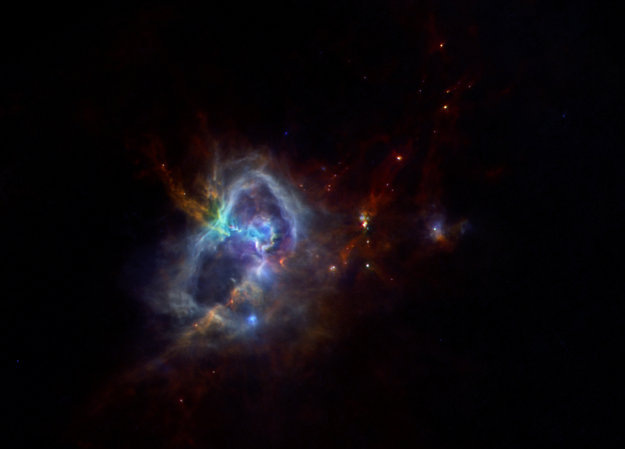
Los intrincados filamentos de polvo y gas que conforman esta guardería estelar albergan a más de 600 estrellas en formación. Esta región fue observada por primera vez por el observatorio espacial Herschel de la ESA.
La región nebulosa coloreada de azul, conocida como W40 o Sharpless 2-64, se encuentra a 1.000 años luz de nuestro planeta en dirección a la constelación del Águila, y tiene una extensión de unos 25 años luz.
Se trata de una inmensa nube de hidrógeno gaseoso, iluminada por la radiación emitida por al menos tres jóvenes estrellas ocultas en su interior.
Esta nebulosa se está expandiendo, comprimiendo a su paso el gas que la rodea, lo que desencadenará la formación de una segunda generación de estrellas.
Se estima que en el sector cubierto por esta imagen se encuentran unos 600 cúmulos de polvo y gas, la mayoría de los cuales terminará colapsando para formar nuevas estrellas.
Unas 150 protoestrellas ya han alcanzado las últimas fases de su proceso de formación. En cuanto se estabilicen las reacciones de fusión, se encenderán sus núcleos, convirtiéndose en estrellas adultas.
W40 forma parte de un gigantesco anillo de estrellas y nubes de formación de estrellas conocido como el ‘Cinturón de Gould’, que parece rodear el cielo nocturno. Sus guarderías estelares son uno de los objetivos clave de la misión Herschel, que pretende comparar la formación de estrellas en cada región para determinar cómo influye el entorno local en el proceso.
Esta es una imagen de archivo, elaborada a partir de los datos recogidos por los instrumentos PACS y SPIRE de Herschel el 24 de octubre de 2009, y publicada por primera vez en OSHI en el año 2011.
ESA
Guillermo Gonzalo Sánchez Achutegui
ayabaca@gmail.com
ayabaca@hotmail.com
ayabaca@yahoo.com
lunes, 7 de enero de 2013

ESA - Space science image of the week: A cradle of stars


(969.30 kB)
W40’s cradle of stars
A CRADLE OF STARS
Six hundred newly forming stars are crowded into intricate filaments of gas and dust that makes up this stellar nursery, seen for the first time by ESA’s Herschel space observatory.
The nebulous area coloured in blue, known as W40 or Sharpless 2-64, is roughly 1000 light-years away in the constellation Aquila, and is about 25 light-years across.
It is a vast cloud of hydrogen gas, illuminated by the radiation streaming out from at least three young massive stars embedded in the cloud.
The nebula is expanding into the surrounding medium, compressing the ambient gas on its way and triggering the formation of a second generation of even younger stars.
In total, around 600 condensations of dust and gas have been estimated in this field of view, the majority of which will eventually collapse to form stars.
Already about 150 objects are in the final stages of forming stars. Once nuclear fusion kicks in, their cores will ignite and they will become fully fledged stars.
W40 is part of a giant ring of stars and star-forming clouds known as Gould’s Belt that appears to circle the night sky. These stellar nurseries are key targets for Herschel, allowing astronomers to compare the differences in star formation from region to region and to identify the role of the local environment in the process.
This image is from our archives; it was created from observations by Herschel’s PACS and SPIRE instruments on 24 October 2009 and published on OSHI in 2011. 
 
ESA
Guillermo Gonzalo Sánchez Achutegui
ayabaca@gmail.com
ayabaca@hotmail.com
ayabaca@yahoo.com