Mostrando entradas con la etiqueta NASA's Hubble Space Telescope. Mostrar todas las entradas

domingo, 1 de febrero de 2015

NASA : El Telescopio Espacial Hubble Observa una Fusión Galáctica

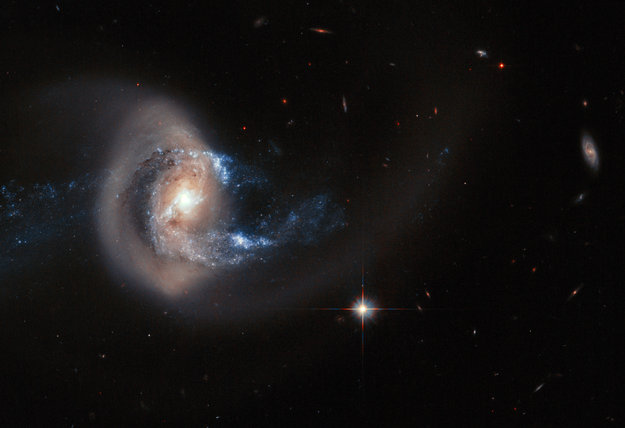
30.01.15.- El Telescopio Espacial NASA/ESA Hubble ha capturado esta impresionante vista de NGC 7714. Esta galaxia espiral se ha acercado demasiado a su vecina, y la dramática interacción entre las dos galaxias ha deformado sus brazos espirales, arrastrando corrientes de materia hacia el espacio y desencadenando brillantes brotes de formación estelar.
NGC 7714 es una galaxia espiral situada a 100 millones de años luz de la Tierra – una vecina relativamente cercana en términos cósmicos. 
Esta galaxia ha sufrido una serie de procesos dramáticos y violentos en su pasado más reciente. Las pruebas de esta brutalidad las podemos encontrar en la extraña forma de los brazos de NGC 7714 y en la neblina dorada que se extiende desde su centro galáctico. 
Impresionante vista de NGC 7714 captada por el Hubble.
Impresionante vista de NGC 7714 captada por el Hubble. Image Credit: NASA/ESA
 
Pero, ¿qué provocó estas deformaciones?. La culpable es una pequeña galaxia conocida como NGC 7715, situada fuera del encuadre de esta fotografía – aunque visible en la imagen de gran angular del DSS. Estas dos galaxias se acercaron demasiado hace unos 100 o 200 millones de años, y empezaron a deformarse mutuamente. 
Como consecuencia, se han formado un anillo y dos largas colas de estrellas que surgen de NGC 7714, tendiendo un puente entre las dos galaxias. Este puente actúa como un conducto, canalizando material de NGC 7715 hacia su compañera de mayor tamaño, y alimentando sus brotes de formación estelar. Se están formando nuevas estrellas por toda la galaxia, aunque la mayor actividad se concentra en el brillante centro galáctico. 
Los astrónomos han clasificado a NGC 7714 como una típica galaxia con brote estelar de Wolf-Rayet, debido a las estrellas que alberga. Una buena parte de sus estrellas son del tipo Wolf-Rayet – astros extremadamente calientes y brillantes que nacen con una masa docenas de veces superior a la de nuestro Sol, pero que pierden rápidamente a través de fuertes vientos estelares. 
Esta imagen del Hubble es una composición de los datos recogidos a diferentes longitudes de onda para desvelar la correlación entre las nubes de gas y las estrellas de la galaxia. Esta nueva imagen pone de manifiesto la compleja estructura de NGC 7714, pero también muestra un gran número de objetos en segundo plano. Estas galaxias más lejanas aparecen como débiles manchas de luz, y en algunas de ellas se puede reconocer una forma espiral.
NASA
Guillermo Gonzalo Sánchez Achutegui
ayabaca@gmail.com
ayabaca@yahoo.com
ayabaca@hotmail.com

sábado, 5 de abril de 2014

NASA: NASA Hubble Team Finds Monster 'El Gordo' Galaxy


NASA Hubble Team Finds Monster 'El Gordo' Galaxy
NASA's Hubble Space Telescope has weighed the largest known galaxy cluster in the distant universe, catalogued as ACT-CL J0102-4915, and found it definitely lives up to its nickname -- El Gordo (Spanish for "the fat one").
By measuring how much the cluster's gravity warps images of galaxies in the distant background, a team of astronomers has calculated the cluster's mass to be as much as 3 million billion times the mass of our sun. Hubble data show the galaxy cluster, which is 9.7 billion light-years away from Earth, is roughly 43 percent more massive than earlier estimates.
The team used Hubble to measure how strongly the mass of the cluster warped space. Hubble's high resolution allowed measurements of so-called "weak lensing," where the cluster's immense gravity subtly distorts space like a funhouse mirror and warps images of background galaxies. The greater the warping, the more mass is locked up in the cluster.
Image Credit: NASA/ESA
NASA
Guillermo Gonzalo Sánchez Achutegui

domingo, 15 de diciembre de 2013

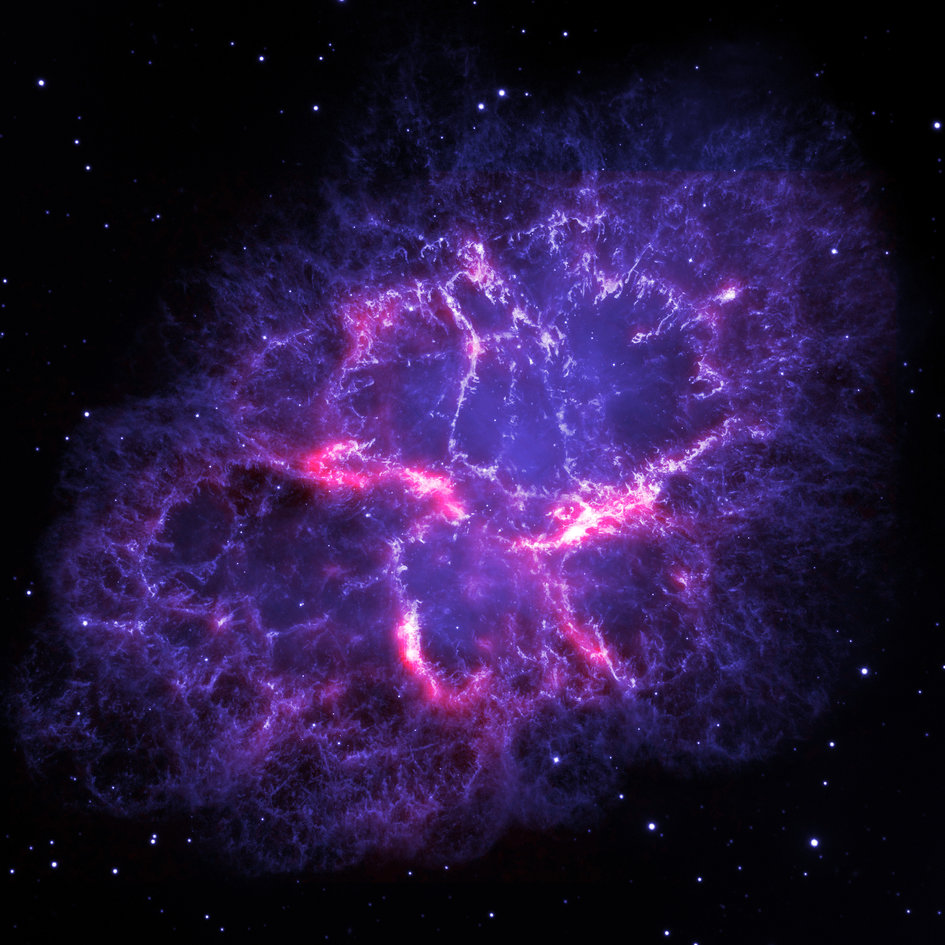
ESA: Crab Nebula


Crab Nebula  DOWNLOAD HI.RES    JPG    (2.94 MB)
Crab Nebula
Across the Universe, every ending is a new beginning. When a massive star dies, exploding as a spectacular supernova, huge amounts of matter and energy are ejected into surrounding space, and the remnant of the explosion itself remains a hub of fierce activity for thousands of years.
One of the most iconic supernova remnants is the Crab Nebula. A wispy and filamentary cloud of gas and dust, it originated with a supernova explosion that was seen by Chinese astronomers in the year 1054. A spinning neutron star – or pulsar – remains at its centre, releasing streams of highly energetic particles into the nebula.
This composite image combines a new infrared view of the Crab Nebula, obtained with ESA’s Herschel Space Observatory, with an optical image from the archives of the NASA/ESA Hubble Space Telescope.
Herschel’s observations are shown in red and reveal the glow from cosmic dust present in the nebula. Hubble’s view, in blue, traces oxygen and sulphur gas in the nebula.
A team of astronomers studying the nebula with Herschel has revealed that this supernova remnant contains much more dust than they had expected – about a quarter of the mass of the Sun.
The new observations also revealed the presence of molecules containing argon, the first time a noble gas-based molecule has been found in space.
Argon is produced in the nuclear reactions that take place during supernova explosions, and astronomers had already detected this element in the Crab Nebula. However, it is surprising that argon bonded with other elements, forming molecules that survived in the hostile environment of a supernova remnant, with hot gas still expanding at high speeds after the explosion.
Read more about this discovery:
Credits: ESA/Herschel/PACS/MESS Key Programme Supernova Remnant Team; NASA, ESA and Allison Loll/Jeff Hester (Arizona State University)
ESA
Guillermo Gonzalo Sánchez Achutegui
ayabaca@gmail.com
ayabaca@hotmail.com
ayabaca@yahoo.com

miércoles, 4 de diciembre de 2013

NASA : Hubble Traces Subtle Signals of Water on Hazy Worlds


Using the powerful­ eye of NASA's Hubble Space Telescope, two teams of scientists have found faint signatures of water in the atmospheres of five distant planets.
The presence of atmospheric water was reported previously on a few exoplanets orbiting stars beyond our solar system, but this is the first study to conclusively measure and compare the profiles and intensities of these signatures on multiple worlds.
Youtube Override:

Although exoplanets are too far away to be imaged, detailed studies of their size, composition and atmospheric makeup are possible. This video explains how researchers investigate those characteristics.
Image Credit: NASA Goddard/ESA/Hubble
Image Token:

The five planets -- WASP-17b, HD209458b, WASP-12b, WASP-19b and XO-1b -- orbit nearby stars. The strengths of their water signatures varied. WASP-17b, a planet with an especially puffed-up atmosphere, and HD209458b had the strongest signals. The signatures for the other three planets, WASP-12b, WASP-19b and XO-1b, also are consistent with water.
artist concept of a star's light illuminating the atmosphere of a planet
NASA scientists found faint signatures of water in the atmospheres of five distant planets orbiting three different stars. All five planets appear to be hazy. This illustration shows a star's light illuminating the atmosphere of a planet.
Image Credit: NASA's Goddard Space Flight Center
Image Token:
"We're very confident that we see a water signature for multiple planets," said Avi Mandell, a planetary scientist at NASA's Goddard Space Flight Center in Greenbelt, Md., and lead author of an Astrophysical Journal paper, published today, describing the findings for WASP-12b, WASP-17b and WASP-19b. "This work really opens the door for comparing how much water is present in atmospheres on different kinds of exoplanets, for example hotter versus cooler ones."
The studies were part of a census of exoplanet atmospheres led by L. Drake Deming of the University of Maryland in College Park. Both teams used Hubble's Wide Field Camera 3 to explore the details of absorption of light through the planets' atmospheres. The observations were made in a range of infrared wavelengths where the water signature, if present, would appear. The teams compared the shapes and intensities of the absorption profiles, and the consistency of the signatures gave them confidence they saw water. The observations demonstrate Hubble's continuing exemplary performance in exoplanet research.
"To actually detect the atmosphere of an exoplanet is extraordinarily difficult. But we were able to pull out a very clear signal, and it is water," said Deming, whose team reported results for HD209458b and XO-1b in a Sept. 10 paper in the same journal. Deming's team employed a new technique with longer exposure times, which increased the sensitivity of their measurements.
 
illustration depicting the atmosphere of a planet absorbing and transmitting different wavelengths of its star's light
To determine what’s in the atmosphere of an exoplanet, astronomers watch the planet pass in front of its host star and look at which wavelengths of light are transmitted and which are partially absorbed.
Image Credit:
NASA's Goddard Space Flight Center
Image Token:

The water signals were all less pronounced than expected, and the scientists suspect this is because a layer of haze or dust blankets each of the five planets. This haze can reduce the intensity of all signals from the atmosphere in the same way fog can make colors in a photograph appear muted. At the same time, haze alters the profiles of water signals and other important molecules in a distinctive way.
The five planets are hot Jupiters, massive worlds that orbit close to their host stars. The researchers were initially surprised that all five appeared to be hazy. But Deming and Mandell noted that other researchers are finding evidence of haze around exoplanets.
"These studies, combined with other Hubble observations, are showing us that there are a surprisingly large number of systems for which the signal of water is either attenuated or completely absent," said Heather Knutson of the California Institute of Technology, a co-author on Deming's paper. "This suggests that cloudy or hazy atmospheres may in fact be rather common for hot Jupiters."
Hubble's high-performance Wide Field Camera 3 is one of few capable of peering into the atmospheres of exoplanets many trillions of miles away. These exceptionally challenging studies can be done only if the planets are spotted while they are passing in front of their stars. Researchers can identify the gases in a planet's atmosphere by determining which wavelengths of the star's light are transmitted and which are partially absorbed.
Text issued as NASA Headquarters press release No. 13-324.

Hubble Traces Subtle Signals of Water on Hazy Worlds
Using the powerful eye of NASA's Hubble Space Telescope, two teams of scientists have found faint signatures of water in the atmospheres of five distant planets.
The presence of atmospheric water was reported previously on a few exoplanets orbiting stars beyond our solar system, but this is the first study to conclusively measure and compare the profiles and intensities of these signatures on multiple worlds.
The five planets -- WASP-17b, HD209458b, WASP-12b, WASP-19b and XO-1b -- orbit nearby stars. The strengths of their water signatures varied. WASP-17b, a planet with an especially puffed-up atmosphere, and HD209458b had the strongest signals. The signatures for the other three planets, WASP-12b, WASP-19b and XO-1b, also are consistent with water.
"We're very confident that we see a water signature for multiple planets," said Avi Mandell, a planetary scientist at NASA's Goddard Space Flight Center in Greenbelt, Md., and lead author of an Astrophysical Journal paper, published today, describing the findings for WASP-12b, WASP-17b and WASP-19b. "This work really opens the door for comparing how much water is present in atmospheres on different kinds of exoplanets, for example hotter versus cooler ones."
The studies were part of a census of exoplanet atmospheres led by L. Drake Deming of the University of Maryland in College Park. Both teams used Hubble's Wide Field Camera 3 to explore the details of absorption of light through the planets' atmospheres. The observations were made in a range of infrared wavelengths where the water signature, if present, would appear. The teams compared the shapes and intensities of the absorption profiles, and the consistency of the signatures gave them confidence they saw water. The observations demonstrate Hubble's continuing exemplary performance in exoplanet research.
"To actually detect the atmosphere of an exoplanet is extraordinarily difficult. But we were able to pull out a very clear signal, and it is water," said Deming, whose team reported results for HD209458b and XO-1b in a Sept. 10 paper in the same journal. Deming's team employed a new technique with longer exposure times, which increased the sensitivity of their measurements.
The water signals were all less pronounced than expected, and the scientists suspect this is because a layer of haze or dust blankets each of the five planets. This haze can reduce the intensity of all signals from the atmosphere in the same way fog can make colors in a photograph appear muted. At the same time, haze alters the profiles of water signals and other important molecules in a distinctive way.
The five planets are hot Jupiters, massive worlds that orbit close to their host stars. The researchers were initially surprised that all five appeared to be hazy. But Deming and Mandell noted that other researchers are finding evidence of haze around exoplanets.
"These studies, combined with other Hubble observations, are showing us that there are a surprisingly large number of systems for which the signal of water is either attenuated or completely absent," said Heather Knutson of the California Institute of Technology, a co-author on Deming's paper. "This suggests that cloudy or hazy atmospheres may in fact be rather common for hot Jupiters."
Hubble's high-performance Wide Field Camera 3 is one of few capable of peering into the atmospheres of exoplanets many trillions of miles away. These exceptionally challenging studies can be done only if the planets are spotted while they are passing in front of their stars. Researchers can identify the gases in a planet's atmosphere by determining which wavelengths of the star's light are transmitted and which are partially absorbed.
Please direct inquiries for the University of Maryland to Heather Dewar at 301-405-9267 or hdewar@umd.edu.
For images and more information about Hubble, visit:
and
 
NASA
Guillermo Gonzalo Sánchez Achutegui
ayabaca@gmail.com
ayabaca@hotmail.com
ayabaca@yahoo.com  

domingo, 1 de septiembre de 2013

NASA - Hubble Peers at a Cosmic Optical Illusion


Hubble Peers at a Cosmic Optical Illusion
At first glance, this Hubble picture appears to capture two space giants entangled in a fierce celestial battle, with two galaxies entwined and merging to form one. But this shows just how easy it is to misinterpret the jumble of sparkling stars and get the wrong impression — as it’s all down to a trick of perspective.
By chance, these galaxies appear to be aligned from our point of view. In the foreground, the irregular dwarf galaxy PGC 16389 — seen here as a cloud of stars — covers its neighboring galaxy APMBGC 252+125-117, which appears edge-on as a streak. This wide-field image also captures many other more distant galaxies, including a quite prominent face-on spiral towards the right of the picture.
Credit: ESA/Hubble & NASA, Acknowledgement: Luca Limatola
NASA
Guillermo Gonzalo Sánchez Achutegui
ayabaca@gmail.com
ayabaca@hotmail.com
ayabaca@yahoo.com

domingo, 21 de julio de 2013

NASA - NASA's Hubble Sees a Stranger in the Crowd


NASA's Hubble Sees a Stranger in the Crowd
The constellation of Virgo (The Virgin) is the largest of the Zodiac constellations, and the second largest overall after Hydra (The Water Snake). Its most appealing feature, however, is the sheer number of galaxies that lie within it. In this picture, among a crowd of face- and edge-on spiral, elliptical, and irregular galaxies, lies NGC 4866, a lenticular galaxy situated about 80 million light-years from Earth.
Lenticular galaxies are somewhere between spirals and ellipticals in terms of shape and properties. From the picture, we can appreciate the bright central bulge of NGC 4866, which contains primarily old stars, but no spiral arms are visible. The galaxy is seen from Earth as almost edge-on, meaning that the disc structure — a feature not present in elliptical galaxies — is clearly visible. Faint dust lanes trace across NGC 4866 in this image, obscuring part of the galaxy’s light.
To the right of the galaxy is a very bright star that appears to lie within NGC 4866’s halo. However, this star actually lies much closer to us; in front of the galaxy, along our line of sight. These kinds of perspective tricks are common when observing, and can initially deceive astronomers as to the true nature and position of objects such as galaxies, stars, and clusters.
This sharp image of NGC 4866 was captured by the Advanced Camera for Surveys, an instrument on the NASA/ESA Hubble Space Telescope.
Image Credit: European Space Agency
NASA
Guillermo Gonzalo Sánchez Achutegui

sábado, 8 de junio de 2013

NASA - Hubble Maps 3-D Structure of Ejected Material Around Erupting Star


STScI-PRC2013-21 

Screen-use options: These files are created for viewing on your monitor

Print-use download options: These files are designed to fit on letter-size paper

Hubble Maps 3-D Structure of Ejected Material Around Erupting Star.-
Back

Image: Flash of Light from Erupting Star Illuminates Debris Disk

Flash of Light from Erupting Star Illuminates Debris DiskSTScI-PRC2013-21

Screen-use options: These files are created for viewing on your monitor

Print-use download options: These files are designed to fit on letter-size paper


ABOUT THIS IMAGE:

These three images taken by NASA's Hubble Space Telescope reveal a disk of previously ejected material around an erupting star being illuminated by a torrent of light unleashed during a stellar outburst.
Hubble's Wide Field Camera 3 imaged the double-star system T Pyxidis, or T Pyx, over a four-month period. T Pyx is a recurrent nova, erupting every 12 to 50 years. T Pyx's latest outburst was in April 2011. The star is the white blob in the middle of each image.
Astronomers used Hubble to trace the path of the light emitted from the outburst as it lit up the disk and material from previous ejecta. The white ovals in each image highlight the areas being illuminated by the light. The disk is so vast, about a light-year across, that the nova's light cannot brighten all of the material at once. Instead, the light sweeps across the material, sequentially illuminating parts of the disk, a phenomenon called a light echo. The light reveals which parts of the disk are nearer to Earth and which ones are farther away. By tracing the light, the team assembled a 3-D map of the structure around the nova.
A nova erupts when a white dwarf, the burned-out core of a Sun-like star, has siphoned enough hydrogen off a companion star to trigger a thermonuclear runaway. As hydrogen builds up on the surface of the white dwarf, it becomes hotter and denser until it detonates like a colossal hydrogen bomb, leading to a 10,000-fold increase in brightness in a little more than one day.
T Pyx is located 15,600 light-years away in the southern constellation Pyxis, the Mariner's Compass. The images were taken Sept. 16, Nov. 16, and Dec. 10, 2011.
Object Names: T Pyx, T Pyxidis
Image Type: Astronomical/Illustration
Credit: NASA, ESA, A. Crotts, J. Sokoloski, and H. Uthas (Columbia University), and S. Lawrence (Hofstra University)

NEWS RELEASE IMAGES

The above montage includes these images:

T Pyxidis Sept. 19, 2011 Image Type: Astronomical T Pyxidis  Sept. 19, 2011 
  T Pyxidis Nov. 16, 2011 Image Type: Astronomical T Pyxidis  Nov. 16, 2011 
  T Pyxidis Dec. 10, 2011 Image Type: Astronomical T Pyxidis  Dec. 10, 2011

All images from this news release:

To access available information and downloadable versions of images in this news release, click on any of the images below:

NASA
Guillermo Gonzalo Sánchez Achutegui
ayabaca@gmail.com
ayabaca@hotmail.com
ayabaca@yahoo.com

miércoles, 22 de mayo de 2013

NASA - Herschel Space Observatory Finds Mega Merger of Galaxies

Herschel Space Observatory Finds Galaxy Mega Merger

 This simulation shows the merging of two massive galaxies, sped up to cover 1.5 billion years of time. The merging galaxies are split into two views: a visible-light view is on the left, in which blue shows young stars and red indicates older stars and dust. The view at right shows emission from dust, which is what infrared telescopes like the Herschel Space Observatory see. When the galaxies finally merge, the strong burst of star formation can be seen best in infrared views.    

The making of a giant galaxy 
Several telescopes have teamed up to discover a rare and massive merging of two galaxies that took place when the universe was just 3 billion years old (its current age is about 14 billion years). Image credit: ESA/NASA/JPL-Caltech/UC Irvine/STScI/Keck/NRAO/SAO
› Full image and caption

PASADENA, Calif. - A massive and rare merging of two galaxies has been spotted in images taken by the Herschel space observatory, a European Space Agency mission with important NASA participation.
Follow-up studies by several telescopes on the ground and in space, including NASA's Hubble Space Telescope and Spitzer Space Telescope, tell a tale of two faraway galaxies intertwined and furiously making stars. Eventually, the duo will settle down to form one super-giant elliptical galaxy.
The findings help explain a mystery in astronomy. Back when our universe was 3 billion to 4 billion years old, it was populated with large reddish elliptical-shaped galaxies made up of old stars. Scientists have wondered whether those galaxies built up slowly over time through the acquisitions of smaller galaxies, or formed more rapidly through powerful collisions between two large galaxies.
The new findings suggest massive mergers are responsible for the giant elliptical galaxies.
"We're looking at a younger phase in the life of these galaxies -- an adolescent burst of activity that won't last very long," said Hai Fu of the University of California at Irvine, who is lead author of a new study describing the results. The study is published in the May 22 online issue of Nature.
"These merging galaxies are bursting with new stars and completely hidden by dust," said co-author Asantha Cooray, also of the University of California at Irvine. "Without Herschel's far-infrared detectors, we wouldn't have been able to see through the dust to the action taking place behind."
Herschel, which operated for almost four years, was designed to see the longest-wavelength infrared light. As expected, it recently ran out of the liquid coolant needed to chill its delicate infrared instruments. While its mission in space is over, astronomers still are scrutinizing the data, and further discoveries are expected.
In the new study, Herschel was used to spot the colliding galaxies, called HXMM01, located about 11 billion light-years from Earth, during a time when our universe was about 3 billion years old. At first, astronomers thought the two galaxies were just warped, mirror images of one galaxy. Such lensed galaxies are fairly common in astronomy and occur when the gravity from a foreground galaxy bends the light from a more distant object. After a thorough investigation, the team realized they were actually looking at a massive galaxy merger.
Follow-up characterization revealed the merging galaxies are churning out the equivalent of 2,000 stars a year. By comparison, our Milky Way hatches about two to three stars a year. The total number of stars in both colliding galaxies averages out to about 400 billion.
Mergers are fairly common in the cosmos, but this particular event is unusual because of the prolific amounts of gas and star formation, and the sheer size of the merger at such a distant epoch.
The results go against the more popular model explaining how the biggest galaxies arise: through minor acquisitions of small galaxies. Instead, mega smash-ups may be doing the job.
NASA's Herschel Project Office is based at the agency's Jet Propulsion Laboratory in Pasadena, Calif., which contributed mission-enabling technology for two of Herschel's three science instruments. JPL is a division of the California Institute of Technology, Pasadena.
For more information about Herschel, 
 NASA
Guillermo Gonzalo Sánchez Achutegui
ayabaca@gmail.com
ayabaca@hotmail.com
ayabaca@yahoo.com

domingo, 17 de febrero de 2013

ESA - Week in Images


Hubble's


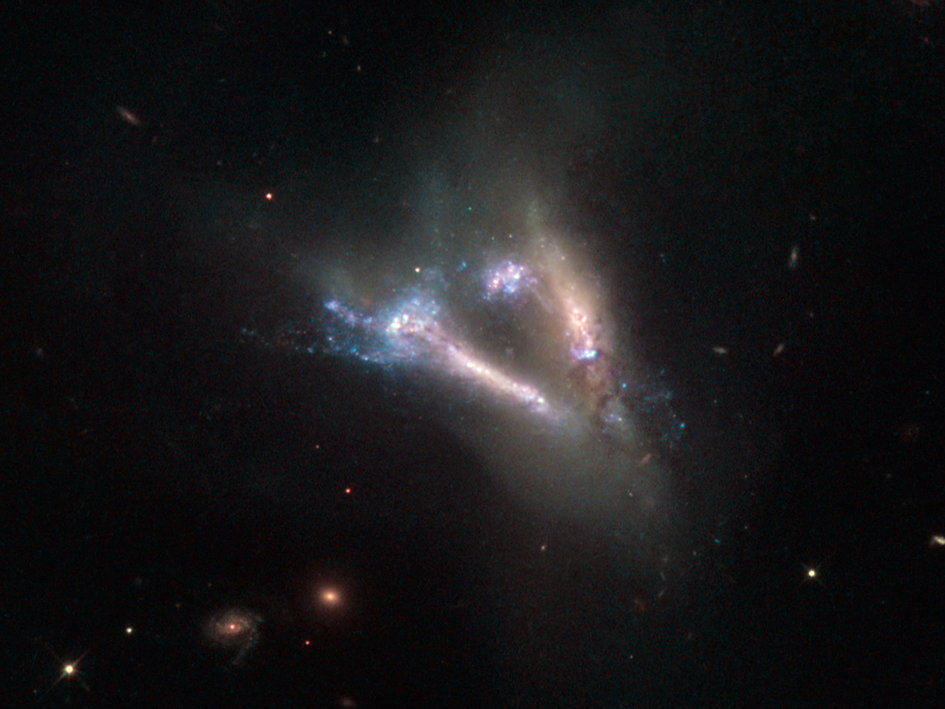
Hubble's "Flying V" This large “flying V” is actually two distinct objects — a pair of interacting galaxies known as IC 2184. Both the galaxies are seen almost edge-on in the large, faint northern constellation of Camelopardalis (The Giraffe), and can be seen as bright streaks of light surrounded by the ghostly shapes of their tidal tails.
These tidal tails are thin, elongated streams of gas, dust and stars that extend away from a galaxy into space. They occur when galaxies gravitationally interact with one another, and material is sheared from the outer edges of each body and flung out into space in opposite directions, forming two tails. They almost always appear curved, so when they are seen to be relatively straight, as in this image, it is clear that we are viewing the galaxies side-on.
Also visible in this image are bursts of bright blue, pinpointing hot regions where the stars from both galaxies have begun to crash together during the merger.
The image consists of visible and infrared observations from Hubble’s Wide Field and Planetary Camera 2.
Credits: ESA/Hubble & NASA
ESA


Guillermo Gonzalo Sánchez Achutegui
ayabaca@gmail.com
ayabaca@hotmail.com
ayabaca@yahoo.com

domingo, 3 de febrero de 2013

NASA - Galaxy 2MASX J09442693+0429569


Hubble watches the lights go outGalaxy 2MASX J09442693+0429569
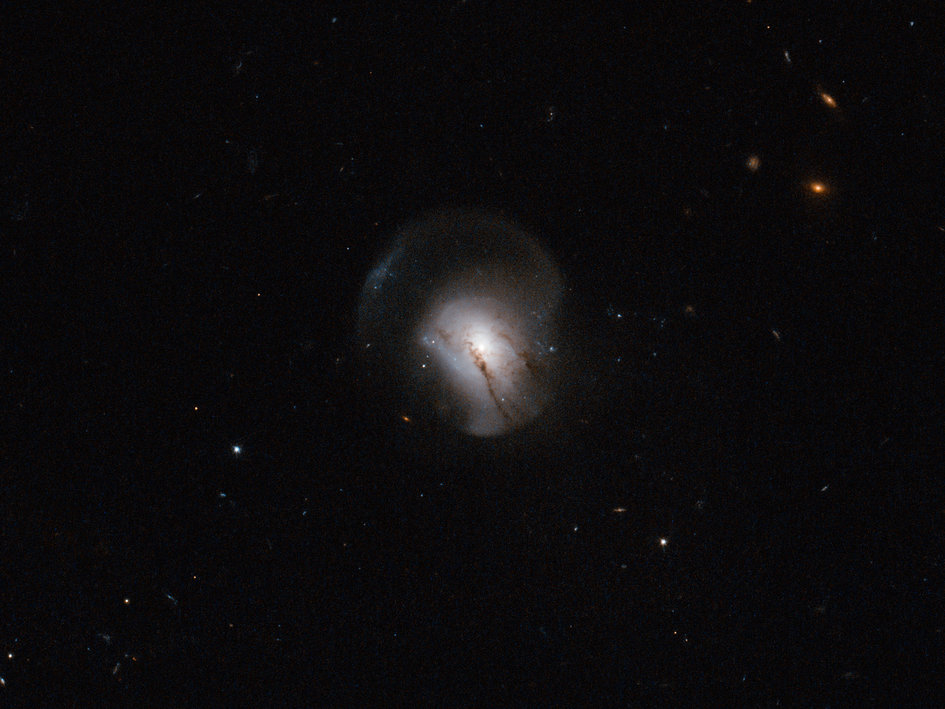
Hubble watches the lights go out Galaxy 2MASX J09442693+0429569 imaged by Hubble. This elliptical galaxy has entered a transitional phase from a young, star-forming galaxy to an older, larger, "red and dead" galaxy. Here, two galaxies have collided, exhausting the gases in the surrounding area and stopping the process of star birth. By contrast, as Hubble looks deeper into the Universe, galaxies show much more vigorous star birth. A merger is also predicted to happen between our own Milky Way Galaxy and neighbouring Andromeda in about four billion years.
Credits: ESA/Hubble & NASA, Acknowledgement: A. Zabludoff, N. Rose
ESA
Guillermo Gonzalo Sánchez Achutegui
ayabaca@gmail.com
ayabaca@hotmail.com
ayabaca@yahoo.com

domingo, 30 de septiembre de 2012

Astronomía: El Hubble retrata a una galaxia espiral cubierta de polvo


Download:
 HI-RES JPEG (Size: 1299 kb)  HI-RES TIFF (Size: 32 023 kb) Hubble image of NGC 4183.
Credits: ESA/Hubble & NASA

El Telescopio Espacial NASA/ESA Hubble nos vuelve a asombrar con una imagen de una galaxia cercana. Esta semana nos acerca a la NGC 4183, vista aquí sobre un hermoso telón de fondo salpicado por otras galaxias más lejanas.

Esta galaxia se encuentra a unos 55 millones de años luz de nuestro Sol y tiene una extensión de cerca de 80 000 años luz, un poco más pequeña que la Vía Láctea. La NGC 4183 pertenece al grupo de la Osa Mayor y se ubica en la constelación de Canes Venatici (‘Los Perros Cazadores’ o ‘Los Lebreles’).
La galaxia NGC 4183 presenta una estructura espiral abierta y un núcleo apenas perceptible. Desafortunadamente, desde la Tierra la vemos de canto, lo que nos impide apreciar sus brazos espirales en toda su magnitud. No obstante, esta imagen nos muestra su disco galáctico con un asombroso nivel de detalle.
Los discos de las galaxias están compuestos principalmente de polvo, gas y estrellas. En esta imagen podemos distinguir unos intrincados filamentos de polvo sobre el plano galáctico que bloquean parcialmente la luz emitida por el núcleo de la galaxia.
Recientemente se ha presentado una hipótesis que sugiere que la NGC 4183 podría tener una estructura barrada. Las ‘barras’ galácticas canalizan el gas desde los brazos espirales hacia el centro de la galaxia, acelerando la tasa de formación de estrellas en esta región.
La galaxia NGC 4183 fue observada por primera vez el 14 de enero de 1778 por el astrónomo británico William Herschel.
Esta fotografía es una composición de las imágenes tomadas en las bandas de la luz visible y del infrarrojo por el Canal de Gran Angular (WFC) de la Cámara Avanzada para Sondeos (ACS) del Telescopio Espacial Hubble. El campo de visión abarca unos 3.4 minutos de arco.
Esta foto también ha sido seleccionada como la  
ESA
Guillermo Gonzalo Sánchez Achutegui
ayabaca@gmail.com
ayabaca@hotmail.com
ayabaca@yahoo.com

domingo, 1 de julio de 2012

Astronomía: Descubren un planeta mayor que la Tierra

Hola mis amigos: AL  VUELO DE UN QUINDE EL BLOG., Un equipo de astrónomos ha descubierto una versión más grande de la Tierra próxima a otro planeta aún mayor y que orbita junto a él en torno a la misma estrella, a unos 1.200 años luz, según un artículo que publica hoy la revista Science Express.
La revista Science Express publica hoy que un equipo de astrónomos ha descubierto una versión más grande de la Tierra próxima a otro planeta aún mayor y que orbita junto a él en torno a la misma estrella, a unos 1.200 años luz. En la foto de archivo, sin fecha, tomada por el telescopio espacial Hubble de una pequeña región de la Nebulosa del Cisne, también conocida como M17.  EFE/Nasa.

 Washington, 26 jun (EFEverde).- Un equipo de astrónomos ha descubierto una versión más grande de la Tierra próxima a otro planeta aún mayor y que orbita junto a él en torno a la misma estrella, a unos 1.200 años luz, según un artículo que publica hoy la revista Science Express.

Los planetas ocupan casi el mismo plano orbital y cuando están más próximos la distancia entre ellos es de 1,95 millones de kilómetros, esto es cinco veces la distancia de la Tierra a la Luna y unas veinte veces menor que la distancia entre cualquiera de los planetas en el sistema solar.
Pero, según los astrónomos de las universidades de Washington (UW) y Harvard, los tiempos de sus órbitas determinan que jamás colisionarán.
"Estos son los dos planetas más cercanos uno al otro que hemos encontrado", dijo Eric Agol, profesor de astronomía en la UW y uno de los autores principales del artículo. "El planeta más grande empuja al más chico y por eso es más difícil encontrar al menor".
4,5 veces mayor que la Tierra
Los planetas, que orbitan la estrella Kepler-36a en la constelación del Cisne, se han designado como Kepler-36b y Kepler-36c.
El planeta b es un cuerpo rocoso como la Tierra aunque con una masa 4,5 veces mayor y un radio 1,5 veces más largo. Kepler-36c, que podría ser gaseoso como Júpiter o lleno de agua, es 8,1 veces más grande que la Tierra y tiene un radio 3,7 veces más extenso.
El planeta más grande fue descubierto originalmente en los datos provistos por el observatorio orbital Kepler, de la agencia espacial estadounidense NASA, que usa un fotómetro para medir la luz de los objetos celestes distantes.
Este instrumento permite detectar un planeta cuando transita entre la estrella en torno a la cual orbita y la Tierra, y reduce brevemente la luz que proviene de la estrella.
Tras ese primer descubrimiento los astrónomos se dedicaron a ver si el sistema contenía un segundo planeta, y Agol sugirió el uso de un algoritmo denominado detección de pulso cuasi periódica para el examen de los datos del Kepler.
Revisan los datos de Kepler
El otro coautor principal del artículo, Joshua Carter, quien trabaja con el observatorio Hubble en el Centro Harvard Smithsonian para Astrofísica, empleó el algoritmo para inspeccionar metódicamente los sistemas planetarios registrados en los datos del Kepler, y vio en el sistema Kepler-36a una señal clara.
"Encontramos ésta en un primer vistazo rápido", señaló Carter. "Ahora revisamos con más cuidado los datos del Kepler para ver si localizamos más planetas".
Los datos mostraron una leve atenuación cada 16 días de la luz que proviene de la estrella Kepler-36a y ése es el período de órbita del planeta Kepler-36c.
Por su parte Kepler-36b orbita la estrella siete veces por cada seis órbitas del 36c, pero inicialmente no se le había percibido debido a su tamaño pequeño y el empujón gravitacional de su compañero de órbita.
Cuando se aplicó el algoritmo, explicaron los científicos, la señal fue inconfundible.
Hierro, hidrógeno y agua
"Si uno observa el patrón de tiempo de tránsito del planeta mayor y el patrón de tiempo de tránsito del planeta menor son como imágenes reflejadas en un espejo", dijo Agol.
Los científicos creen que el 30 por ciento del planeta menor consiste en hierro, y que tiene una atmósfera en la cual menos del 1 por ciento es hidrógeno y helio y con no más de un 15 por ciento de agua.
En cambio, el planeta más grande probablemente tiene un núcleo rocoso rodeado por una cantidad sustancial de hidrógeno y helio atmosféricos. EFEverde
¡compártelo!
  • meneame
  • delicius
  • facebook
  • twitter
 Guillermo Gonzalo Sánchez Achutegui
 ayabaca@gmail.com
 ayabaca@hotmail.com
 ayabaca@yahoo.com 

lunes, 23 de abril de 2012

Astronomy: A New View of the Tarantula Nebula


Hi My Friends: AL VUELO DE UN QUINDE EL BLOG., To celebrate its 22nd anniversary in orbit, the Hubble Space Telescope released a dramatic new image of the star-forming region 30 Doradus, also known as the Tarantula Nebula because its glowing filaments resemble spider legs. A new image from all three of NASA's Great Observatories--Chandra, Hubble, and Spitzer--has also been created to mark the event.
The Tarantula Nebula

To celebrate its 22nd anniversary in orbit, the Hubble Space Telescope released a dramatic new image of the star-forming region 30 Doradus, also known as the Tarantula Nebula because its glowing filaments resemble spider legs. A new image from all three of NASA's Great Observatories--Chandra, Hubble, and Spitzer--has also been created to mark the event.

The nebula is located in the neighboring galaxy called the Large Magellanic Cloud, and is one of the largest star-forming regions located close to the Milky Way. At the center of 30 Doradus, thousands of massive stars are blowing off material and producing intense radiation along with powerful winds. The Chandra X-ray Observatory detects gas that has been heated to millions of degrees by these stellar winds and also by supernova explosions. These X-rays, colored blue in this composite image, come from shock fronts--similar to sonic booms--formed by this high-energy stellar activity.

The Hubble data in the composite image, colored green, reveals the light from these massive stars along with different stages of star birth, including embryonic stars a few thousand years old still wrapped in cocoons of dark gas. Infrared emission data from Spitzer, seen in red, shows cooler gas and dust that have giant bubbles carved into them. These bubbles are sculpted by the same searing radiation and strong winds that comes from the massive stars at the center of 30 Doradus.

Image Credits: X-ray: NASA/CXC/PSU/L.Townsley et al.; Optical: NASA/STScI; Infrared: NASA/JPL/PSU/L.Townsley et al.
Guillermo Gonzalo Sánchez Achutegui

domingo, 22 de abril de 2012

Astronomy: Tarantula Nebula


To celebrate its 22nd anniversary in orbit, the Hubble Space Telescope has released a dramatic new image of the star-forming region 30 Doradus, also known as the Tarantula Nebula because its glowing filaments resemble spider legs. A new image from all three of NASA's Great Observatories - Chandra, Hubble, and Spitzer - has also been created to mark the event.

30 Doradus is located in the neighboring galaxy called the Large Magellanic Cloud, and is one of the largest star-forming regions located close to the Milky Way . At the center of 30 Doradus, thousands of massive stars are blowing off material and producing intense radiation along with powerful winds. The Chandra X-ray Observatory detects gas that has been heated to millions of degrees by these stellar winds and also by supernova explosions. These X-rays, colored blue in this composite image, come from shock fronts -- similar to sonic booms -- formed by this high-energy stellar activity.

The Hubble data in the composite image, colored green, reveals the light from these massive stars along with different stages of star birth including embryonic stars a few thousand years old still wrapped in cocoons of dark gas. Infrared emission from Spitzer, seen in red, shows cooler gas and dust that have giant bubbles carved into them. These bubbles are sculpted by the same searing radiation and strong winds that comes from the massive stars at the center of 30 Doradus.

Credits: X-ray: NASA/CXC/PSU/L.Townsley et al.; Optical: NASA/STScI; Infrared: NASA/JPL/PSU/L.Townsley et al.
› Read more/access all images
Guillermo Gonzalo Sánchez Achutegui
ayabaca@gmail.com
ayabaca@hotmail.com
ayabaca@yahoo.com

domingo, 25 de marzo de 2012

Astronomy: Hubble Sees Glittering Jewels of Messier 9

Hi My Friends: AL VUELO DE UN QUINDE EL BLOG., The Hubble Space Telescope has produced the most detailed image so far of Messier 9, a globular star cluster located close to the center of the galaxy. This ball of stars is too faint to see with the naked eye, yet Hubble can see over 250,000 individual stars shining in it. Hubble Sees Glittering Jewels of Messier 9
The Hubble Space Telescope has produced the most detailed image so far of Messier 9, a globular star cluster located close to the center of the galaxy. This ball of stars is too faint to see with the naked eye, yet Hubble can see over 250,000 individual stars shining in it.

Messier 9, pictured here, is a globular cluster, a roughly spherical swarm of stars that lies around 25,000 light-years from Earth, near the center of the Milky Way, so close that the gravitational forces from the galactic center pull it slightly out of shape.

Globular clusters are thought to harbor some of the oldest stars in our galaxy, born when the universe was just a small fraction of its current age. As well as being far older than the sun -- around twice its age -- the stars of Messier 9 also have a markedly different composition, and are enriched with far fewer heavier elements than the sun.

In particular, the elements crucial to life on Earth, like oxygen and carbon, and the iron that makes up our planet’s core, are very scarce in Messier 9 and clusters like it. This is because the universe’s heavier elements were gradually formed in the cores of stars, and in supernova explosions. When the stars of Messier 9 formed, there were far smaller quantities of these elements in existence.

As well as showing the individual stars, Hubble’s image clearly shows the different colors of the stars. A star’s color is directly related to its temperature -- counter-intuitively, perhaps, the redder it is, the cooler it is; and the bluer it is, the hotter. The wide range of stellar temperatures here is clearly displayed by the broad palette of colors visible in this image.

Image Credit: NASA and ESA

Guillermo Gonzalo Sánchez Achutegui


domingo, 11 de marzo de 2012

Astronomy: Hubble Image of Galaxies' El Dorado

Hi My Friends: AL VUELO DE UN QUINDE EL BLOG., NASA's Hubble Space Telescope has produced this beautiful image of the galaxy NGC 1483. NGC 1483 is a barred spiral galaxy located in the southern constellation of Dorado — the dolphinfish (or Mahi-mahi fish) in Spanish. The nebulous galaxy features a bright central bulge and diffuse arms with distinct star-forming regions. In the background, many other distant galaxies can be seen. Hubble Image of Galaxies' El Dorado
NASA's Hubble Space Telescope has produced this beautiful image of the galaxy NGC 1483. NGC 1483 is a barred spiral galaxy located in the southern constellation of Dorado — the dolphinfish (or Mahi-mahi fish) in Spanish. The nebulous galaxy features a bright central bulge and diffuse arms with distinct star-forming regions. In the background, many other distant galaxies can be seen.

The constellation Dorado is home to the Dorado Group of galaxies, a loose group comprised of an estimated 70 galaxies and located some 62 million light-years away. The Dorado group is much larger than the Local Group that includes the Milky Way (and which contains around 30 galaxies) and approaches the size of a galaxy cluster. Galaxy clusters are the largest groupings of galaxies (and indeed the largest structures of any type) in the universe to be held together by their gravity.

Barred spiral galaxies are so named because of the prominent bar-shaped structures found in their center. They form about two thirds of all spiral galaxies, including the Milky Way. Recent studies suggest that bars may be a common stage in the formation of spiral galaxies, and may indicate that a galaxy has reached full maturity.

Image Credit: ESA/Hubble & NASA
Guillermo Gonzalo Sánchez Achutegui
ayabaca@gmail.com
ayabaca@hotmail.com
ayabaca@yahoo.com

domingo, 4 de marzo de 2012

Astronomy: Dark Matter Core Defies Explanation

Hi My Friends: AL VUELO DE UN QUINDE EL BLOG., Astronomers using data from NASA's Hubble Telescope have observed what appears to be a clump of dark matter left behind from a wreck between massive clusters of galaxies. The result could challenge current theories about dark matter that predict galaxies should be anchored to the invisible substance even during the shock of a collision.

Abell 520 is a gigantic merger of galaxy clusters located 2.4 billion light-years away. Dark matter is not visible, although its presence and distribution is found indirectly through its effects. Dark matter can act like a magnifying glass, bending and distorting light from galaxies and clusters behind it. Astronomers can use this effect, called gravitational lensing, to infer the presence of dark matter in massive galaxy clusters.

This technique revealed the dark matter in Abell 520 had collected into a "dark core," containing far fewer galaxies than would be expected if the dark matter and galaxies were anchored together. Most of the galaxies apparently have sailed far away from the collision. This composite image shows the distribution of dark matter, galaxies, and hot gas in the core of the merging galaxy cluster Abell 520, formed from a violent collision of massive galaxy clusters. The natural-color image of the galaxies was taken with NASA's Hubble Space Telescope and with the Canada-France-Hawaii Telescope in Hawaii. Superimposed on the image are "false-colored" maps showing the concentration of starlight, hot gas, and dark matter in the cluster. Starlight from galaxies, derived from observations by the Canada-France-Hawaii Telescope, is colored orange. The green-tinted regions show hot gas, as detected by NASA's Chandra X-ray Observatory. The gas is evidence that a collision took place. The blue-colored areas pinpoint the location of most of the mass in the cluster, which is dominated by dark matter. Dark matter is an invisible substance that makes up most of the universe's mass. The dark-matter map was derived from the Hubble Wide Field Planetary Camera 2 observations, by detecting how light from distant objects is distorted by the cluster galaxies, an effect called gravitational lensing.

The blend of blue and green in the center of the image reveals that a clump of dark matter resides near most of the hot gas, where very few galaxies are found. This finding confirms previous observations of a dark-matter core in the cluster. The result could present a challenge to basic theories of dark matter, which predict that galaxies should be anchored to dark matter, even during the shock of a collision. Abell 520 resides 2.4 billion light-years away.

Credit: NASA, ESA, CFHT, CXO, M.J. Jee (University of California, Davis), and A. Mahdavi (San Francisco State University)

"This result is a puzzle," said astronomer James Jee of the University of California in Davis, lead author of paper about the results available online in The Astrophysical Journal.

"Dark matter is not behaving as predicted, and it's not obviously clear what is going on. It is difficult to explain this Hubble observation with the current theories of galaxy formation and dark matter.

"Initial detections of dark matter in the cluster, made in 2007, were so unusual that astronomers shrugged them off as unreal, because of poor data. New results from NASA's Hubble Space Telescope confirm that dark matter and galaxies separated in Abell 520.

One way to study the overall properties of dark matter is by analyzing collisions between galaxy clusters, the largest structures in the universe. When galaxy clusters crash, astronomers expect galaxies to tag along with the dark matter, like a dog on a leash. Clouds of hot, X-ray emitting intergalactic gas, however, plow into one another, slow down, and lag behind the impact.

That theory was supported by visible-light and X-ray observations of a colossal collision between two galaxy clusters called the Bullet Cluster. The galactic grouping has become an example of how dark matter should behave.Studies of Abell 520 showed that dark matter's behavior may not be so simple.

Using the original observations, astronomers found the system's core was rich in dark matter and hot gas, but contained no luminous galaxies, which normally would be seen in the same location as the dark matter. NASA's Chandra X-ray Observatory was used to detect the hot gas. Astronomers used the Canada-France-Hawaii Telescope and Subaru Telescope atop Mauna Kea to infer the location of dark matter by measuring the gravitationally lensed light from more distant background galaxies.

The astronomers then turned to the Hubble's Wide Field Planetary Camera 2, which can detect subtle distortions in the images of background galaxies and use this information to map dark matter. To astronomers' surprise, the Hubble observations helped confirm the 2007 findings. "We know of maybe six examples of high-speed galaxy cluster collisions where the dark matter has been mapped," Jee said.

"But the Bullet Cluster and Abell 520 are the two that show the clearest evidence of recent mergers, and they are inconsistent with each other. No single theory explains the different behavior of dark matter in those two collisions. We need more examples."

The team proposed numerous explanations for the findings, but each is unsettling for astronomers. In one scenario, which would have staggering implications, some dark matter may be what astronomers call "sticky." Like two snowballs smashing together, normal matter slams together during a collision and slows down.

However, dark matter blobs are thought to pass through each other during an encounter without slowing down. This scenario proposes that some dark matter interacts with itself and stays behind during an encounter.

Another possible explanation for the discrepancy is that Abell 520 has resulted from a more complicated interaction than the Bullet Cluster encounter. Abell 520 may have formed from a collision between three galaxy clusters, instead of just two colliding systems in the case of the Bullet Cluster.

A third possibility is that the core contained many galaxies, but they were too dim to be seen, even by Hubble. Those galaxies would have to have formed dramatically fewer stars than other normal galaxies. Armed with the Hubble data, the group will try to create a computer simulation to reconstruct the collision and see if it yields some answers to dark matter's weird behavior.

The Hubble Space Telescope is a project of international cooperation between NASA and the European Space Agency. NASA's Goddard Space Flight Center in Greenbelt, Md., manages the telescope. The Space Telescope Science Institute (STScI) in Baltimore, Md., conducts Hubble science operations. STScI is operated by the Association of Universities for Research in Astronomy, Inc., in Washington, D.C.For images and more information about Abell 520’s dark core,


For more information about dark matter,
visit:http://go.nasa.gov/dJzOp1
Guillermo Gonzalo Sánchez Achutegui