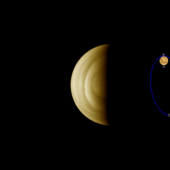
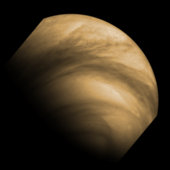
Artist’s impression of an active volcano on Venus. Results from a
long-term study of Venus find evidence of a clear injection of sulphur
dioxide into its upper atmosphere. One possible interpretation is that
volcanic activity increased the sulphur dioxide component of the upper
atmosphere, although an alternative is that a change in atmospheric
circulation dredged up the gas.
Six years of observations by ESA’s Venus Express have shown large
changes in the sulphur dioxide content of the planet’s atmosphere, and
one intriguing possible explanation is volcanic eruptions.
The thick atmosphere of Venus contains over a million times as much
sulphur dioxide as Earth’s, where almost all of the pungent, toxic gas
is generated by volcanic activity.
Most of the sulphur dioxide on Venus is hidden below the planet’s dense
upper cloud deck, because the gas is readily destroyed by sunlight.
That means any sulphur dioxide detected in Venus’ upper atmosphere above
the cloud deck must have been recently supplied from below.
Venus is covered in hundreds of volcanoes, but whether they remain
active today is much debated, providing an important scientific goal for
Venus Express.
The mission has already found clues pointing to volcanism on
geologically recent timescales, within the last few hundreds of
thousands to millions of years.
A previous analysis of infrared radiation from the surface pointed to
lava flows atop a volcano with a composition distinct from those of
their surroundings, suggesting that the volcano had erupted in the
planet’s recent past.
Now, an analysis of sulphur dioxide concentration in the upper atmosphere over six years provides another clue.

Rise and fall of sulphur dioxide
Immediately after arriving at Venus in 2006, the spacecraft recorded a
significant increase in the average density of sulphur dioxide in the
upper atmosphere, followed by a sharp decrease to values roughly ten
times lower by today.
A similar fall was also seen during NASA’s Pioneer Venus mission, which orbited the planet from 1978 to 1992.
At that time, the preferred explanation was an earlier injection of
sulphur dioxide from one or more volcanoes, with Pioneer Venus arriving
in time for the decline.
“If you see a sulphur dioxide increase in the upper atmosphere, you know
that something has brought it up recently, because individual molecules
are destroyed there by sunlight after just a couple of days,” says Dr
Emmanuel Marcq of Laboratoire Atmosphères, Milieux, Observations
Spatiales, France, and lead author of the paper published in Nature
Geoscience.
“A volcanic eruption could act like a piston to blast sulphur dioxide up
to these levels, but peculiarities in the circulation of the planet
that we don’t yet fully understand could also mix the gas to reproduce
the same result,” adds co-author Dr Jean-Loup Bertaux, Principal
Investigator for the instrument on Venus Express that made the
detections.
Venus has a ‘super-rotating’ atmosphere that whips around the planet in
just four Earth-days, much faster than the 243 days the planet takes to
complete one rotation about its axis.
Such rapid atmospheric circulation spreads the sulphur dioxide around,
making it difficult to isolate any individual points of origin for the
gas.
Dr Marcq’s team speculate that if volcanism was responsible for the
initial increase, then it could come from a relatively gentle increased
output of several active volcanoes rather than one dramatic eruption.
“Alternatively, and taking into account the similar trend observed by
Pioneer Venus, it’s possible that we are seeing decadal-scale
variability in the circulation of the atmosphere, which is turning out
to be even more complex than we could ever have imagined,” he notes.
“By following clues left by trace gases in the atmosphere, we are
uncovering the way Venus works, which could point us to the smoking gun
of active volcanism,” adds Håkan Svedhem, ESA’s Project Scientist for
Venus Express.

Comet-like ionosphere at Venus
The change in ionosphere of Venus during normal solar wind conditions
(left) and reduced solar wind activity (right), as observed by ESA’s
Venus Express spacecraft in August 2010. The yellow lines show a
projection of the solar magnetic field lines as they interact with the
ionosphere.
Venus Express follows an elliptical orbit around the
planet once every 24 hours, passing within 250 km of the north pole and
66 000 km over the south pole. The observations were made on the
nightside of the planet, when Venus Express was within 15 000 km of the
centre of the planet. Although the spacecraft only took measurements
within two Venus radii, the findings suggest that the ionosphere likely
extends to even greater distances during periods of reduced solar wind
intensity.
When a planet behaves like a comet.
ESA’s Venus Express has made unique observations of Venus during a
period of reduced solar wind pressure, discovering that the planet’s
ionosphere balloons out like a comet’s tail on its nightside.
The ionosphere is a region of weakly electrically charged gas high above
the main body of a planet’s atmosphere. Its shape and density are
partly controlled by the internal magnetic field of the planet.
For Earth, which has a strong magnetic field, the ionosphere is
relatively stable under a range of solar wind conditions. By comparison,
Venus does not have its own internal magnetic field and relies instead
on interactions with the solar wind to shape its ionosphere.
The extent to which this shaping depends on the strength of the solar
wind has been controversial, but new results from Venus Express reveal
for the first time the effect of a very low solar wind pressure on the
ionosphere of an unmagnetised planet.
The observations were made in August 2010 when NASA’s Stereo-B
spacecraft measured a drop in solar wind density to 0.1 particles per
cubic centimetre, around 50 times lower than normally observed; this
persisted for about 18 hours.
As this significantly reduced solar wind hit Venus, Venus Express saw
the planet’s ionosphere balloon outwards on the planet’s ‘downwind’
nightside, much like the shape of the ion tail seen streaming from a
comet under similar conditions.
“The teardrop-shaped ionosphere began forming within 30–60 minutes after
the normal high pressure solar wind diminished. Over two Earth days, it
had stretched to at least two Venus radii into space,” says Yong Wei of
the Max Planck Institute for Solar System Research in Germany, lead
author of the new findings.
The new observations settle a debate about how the strength of the solar
wind affects the way in which ionospheric plasma is transported from
the dayside to the nightside of Venus.
Usually, this material flows along a thin channel in the ionosphere, but
scientists were unsure what happens under low solar wind conditions.
Does the flow of plasma particles increase as the channel widens due to
the reduced confining pressure, or does it decrease because less force
is available to push plasma through the channel?
“We now finally know that the first effect outweighs the second, and
that the ionosphere expands significantly during low solar wind density
conditions,” says Markus Fraenz, also of the Max Planck Institute and
co-author on the paper.
A similar effect is also expected to occur around Mars, the other non-magnetised planet in our inner Solar System.
“We often talk about the effects of solar wind interaction with
planetary atmospheres during periods of intense solar activity, but
Venus Express has shown us that even when there is a reduced solar wind,
the Sun can still significantly influence the environment of our
planetary neighbours,” adds Håkan Svedhem, ESA’s Venus Express project
scientist.
ESA.
Guillermo Gonzalo Sánchez Achutegui
ayabaca@gmail.com
ayabaca@hotmail.com
ayabaca@yahoo.com

 (891.97 kB)
  (1.02 MB)