Mostrando entradas con la etiqueta The Ozone Hole. Mostrar todas las entradas

domingo, 27 de octubre de 2013

CURIOSIDADES: La NASA quiere más mujeres en la ciencia


La NASA quiere más mujeres en la ciencia
Mapa

La NASA quiere más mujeres en la ciencia
Por Agencia EFE – 22/11/2011 
Washington, 22 nov (EFE).- La NASA quiere más mujeres en la ciencia y con el fin de animar a las jóvenes estudiantes a que encaminen sus carreras hacia las ramas de ingeniería, matemáticas y tecnología ha creado una nueva web que fue presentada hoy.
La página women.nasa.gov/a2i/ contiene vídeos en los que pueden saber más sobre las mujeres que trabajan en la NASA, sus carreras, su formación y cómo comenzaron a trabajar para la agencia espacial estadounidense.
Como la matemática Carolina Restrepo, quien creció en Colombia y Bolivia, y a los 18 años no dudó en marcharse a Estados Unidos para estudiar ingeniería, con la ilusión de poder diseñar, construir y hacer volar un aeroplano radiocontrolado.
Fue lo que vio en la televisión sobre la NASA lo que le impulsó a querer trabajar en la agencia espacial. "Nunca había tenido la oportunidad de conocer o hablar con alguien que había trabajado en el campo del espacio, pero no me importó, me concentré para que cuando creciera sucediera", cuenta en su relato.
Pocas semanas después de comenzar su primer semestre en la Universidad de Texas A&M, leyó que la NASA estaba contratando gente de su edad y ese se convirtió en su nuevo objetivo. Un año más tarde estaba trabajando en el Centro Espacial Johnson de Houston algo que siempre ha disfrutado desde entonces.
Como estudiante trabajó en varios proyectos, pero cuenta que sus favoritos eran los que estaban relacionados con diseñar algoritmos sobre el vuelo de las naves espaciales, un trabajo que requirió una base sólida en Matemáticas y en Física para poder simular el vuelo del vehículo espacial.
Ahora forma parte del equipo de diseño de la cápsula Orion, el nuevo vehículo de la NASA con el que espera poder enviar al hombre a Marte.
"Trabajar en la NASA hace que todos esos años de trabajo duro y las largas noches de estudio hayan merecido la pena. No cambiaría esto por nada en el mundo", añadió.
Con esta herramienta "tenemos la oportunidad de llegar a la próxima generación e inspirar a las jóvenes de hoy a perseguir una carrera en la ciencia y la tecnología", señaló Rebecca Keiser, directora adjunta de políticas de integración y representante de la NASA ante la Casa Blanca del consejo de políticas para mujeres y niñas.
La web incluye cuatro cuentas de Twitter, una por cada uno de los temas, en las que las estudiantes pueden interactuar enviando sus preguntas a las científicas.
La NASA ya contaba con una página web women.nasa.gov, en la que se incluyen el testimonio de mujeres en puestos destacados en la agencia, entre otras, la subdirectora Lori Garver, con el mismo objetivo de llevar la ciencia a la nueva generación.
Según datos de la NASA, de los 18.544 empleados que tiene la agencia espacial en todos sus centros, 6.539 son mujeres, de las que 417 son hispanas.
EFE
 
Antarctic Ozone Hole Slightly Smaller than Average This Year
The Antarctic ozone hole reached its maximum single-day area for 2013 on Sept. 16, 2013.
The Antarctic ozone hole reached its maximum single-day area for 2013 on Sept. 16. The ozone hole (purple and blue) is the region over Antarctica with total ozone at or below 220 Dobson units (a common unit for measuring ozone concentration).
Image Credit: NASA's Goddard Space Flight Center
The ozone hole that forms each year in the stratosphere over Antarctica was slightly smaller in 2013 than average in recent decades, according to NASA satellite data.
The ozone hole is a seasonal phenomenon that starts to form during the Antarctic spring (August and September). The September-October 2013 average size of the hole was 8.1 million square miles (21 million square kilometers). For comparison, the average size measured since the mid-1990s when the annual maximum size stopped growing is 8.7 million square miles (22.5 million square kilometers). However, the size of the hole in any particular year is not enough information for scientists to determine whether a healing of the hole has begun.
"There was a lot of Antarctic ozone depletion in 2013, but because of above average temperatures in the Antarctic lower stratosphere, the ozone hole was a bit below average compared to ozone holes observed since 1990," said Paul Newman, an atmospheric scientist and ozone expert at NASA's Goddard Space Flight Center in Greenbelt, Md.
The ozone hole forms when the sun begins rising again after several months of winter darkness. Polar-circling winds keep cold air trapped above the continent, and sunlight-sparked reactions involving ice clouds and chlorine from manmade chemicals begin eating away at the ozone. Most years, the conditions for ozone depletion ease before early December when the seasonal hole closes.
Levels of most ozone-depleting chemicals in the atmosphere have gradually declined as the result of the 1987 Montreal Protocol, an international treaty to protect the ozone layer by phasing out production of ozone-depleting chemicals. As a result, the size of the hole has stabilized, with variation from year to year driven by changing meteorological conditions.
Youtube Override:
Daily images from Jul. 1 to Oct. 15 show the evolution of the 2013 ozone hole. The ozone hole maximum occurred on Sept. 16, 2013.
Image Credit: NASA/Robert Simmon/Ozone Hole Watch
Image Token:
 
The single-day maximum area this year was reached on Sept. 16 when the maximum area reached 9.3 million square miles (24 million square kilometers), about equal to the size of North America. The largest single-day ozone hole since the mid-1990s was 11.5 million square miles (29.9 million square kilometers) on Sept. 9, 2000.
Science teams from NASA and the National Oceanic and Atmospheric Administration (NOAA) have been monitoring the ozone layer from the ground and with a variety of instruments on satellites and balloons since the 1970s. These ozone instruments capture different aspects of ozone depletion. The independent analyses ensure that the international community understands the trends in this critical part of Earth's atmosphere. The resulting views of the ozone hole have differences in the computation of the size of the ozone hole, its depth, and record dates.
NASA observations of the ozone hole during 2013 were produced from data supplied by the Ozone Monitoring Instrument on NASA's Aura satellite and the Ozone Monitoring and Profiler Suite instrument on the NASA-NOAA Suomi National Polar-orbiting Partnership satellite. Long-term satellite ozone-monitoring instruments have included the Total Ozone Mapping Spectrometer, the second generation Solar Backscatter Ultraviolet Instrument, the Stratospheric Aerosol and Gas Experiment series of instruments, and the Microwave Limb Sounder.
Related Links:
 
NASA
Guillermo Gonzalo Sánchez Achutegui

domingo, 10 de febrero de 2013

ESA - Is the ozone layer on the road to recovery?


http://upload.wikimedia.org/wikipedia/commons/4/46/Future_ozone_layer_concentrations.gif
Full resolution(1,280 × 932 pixels, file size: 2.01 MB, MIME type: image/gif, looped, 6 frames, 18 s)
NASA projections of stratospheric ozone concentrations if chlorofluorocarbons had not been banned.

Regulation

In 1978, the United States, Canada and Norway enacted bans on CFC-containing aerosol sprays that are thought to damage the ozone layer. The European Community rejected an analogous proposal to do the same. In the U.S., chlorofluorocarbons continued to be used in other applications, such as refrigeration and industrial cleaning, until after the discovery of the Antarctic ozone hole in 1985. After negotiation of an international treaty (the Montreal Protocol), CFC production was sharply limited beginning in 1987 and phased out completely by 1996.[citation needed] Since that time, the treaty has been amended to ban CFC production after 1995 in the developed countries, and later in developing. Today, over 160 countries have signed the treaty. Beginning January 1, 1996, only recycled and stockpiled CFCs will be available for use in developed countries like the US. This production phaseout is possible because of efforts to ensure that there will be substitute chemicals and technologies for all CFC uses.[7]
On August 2, 2003, scientists announced that the depletion of the ozone layer may be slowing down due to the international ban on CFCs.[8] Three satellites and three ground stations confirmed that the upper atmosphere ozone depletion rate has slowed down significantly during the past decade. The study was organized by the American Geophysical Union. Some breakdown can be expected to continue due to CFCs used by nations which have not banned them, and due to gases which are already in the stratosphere. CFCs have very long atmospheric lifetimes, ranging from 50 to over 100 years. It has been estimated that the ozone layer may not recover until 2075.[9]
Compounds containing C–H bonds (such as hydrochlorofluorocarbons, or HCFCs) have been designed to replace the function of CFCs. These replacement compounds are more reactive and less likely to survive long enough in the atmosphere to reach the stratosphere where they could affect the ozone layer. While being less damaging than CFCs, HCFCs can have a negative impact on the ozone layer, so they are also being phased out.[10]
Wikipedia.
File:Ozone cycle.svgFull resolution(SVG file, nominally 1,052 × 744 pixels, file size: 420 KB)

The ozone layer is a layer in Earth's atmosphere containing relatively high concentrations of ozone (O3). However, "relatively high," in the case of ozone, is still very small with regard to ordinary oxygen, and is less than ten parts per million, with the average ozone concentration in Earth's atmosphere being only about 0.6 parts per million. The ozone layer is mainly found in the lower portion of the stratosphere from approximately 20 to 30 kilometres (12 to 19 mi) above Earth, though the thickness varies seasonally and geographically.[1]
The ozone layer was discovered in 1913 by the French physicists Charles Fabry and Henri Buisson. Its properties were explored in detail by the British meteorologist G. M. B. Dobson, who developed a simple spectrophotometer (the Dobsonmeter) that could be used to measure stratospheric ozone from the ground. Between 1928 and 1958 Dobson established a worldwide network of ozone monitoring stations, which continue to operate to this day. The "Dobson unit", a convenient measure of the columnar density of ozone overhead, is named in his honor.
The ozone layer absorbs 97–99% of the Sun's medium-frequency ultraviolet light (from about 200 nm to 315 nm wavelength), which potentially damages exposed life forms on Earth.[2]
Wikipedia.

8 February 2013 Satellites show that the recent ozone hole over Antarctica was the smallest seen in the past decade. Long-term observations also reveal that Earth’s ozone has been strengthening following international agreements to protect this vital layer of the atmosphere.
According to the ozone sensor on Europe’s MetOp weather satellite, the hole over Antarctica in 2012 was the smallest in the last 10 years.
The instrument continues the long-term monitoring of atmospheric ozone started by its predecessors on the ERS-2 and Envisat satellites.
Since the beginning of the 1980s, an ozone hole has developed over Antarctica during the southern spring – September to November – resulting in a decrease in ozone concentration of up to 70%.
South Pole ozone
Ozone depletion is more extreme in Antarctica than at the North Pole because high wind speeds cause a fast-rotating vortex of cold air, leading to extremely low temperatures. Under these conditions, human-made chlorofluorocarbons – CFCs – have a stronger effect on the ozone, depleting it and creating the infamous hole.
Over the Arctic, the effect is far less pronounced because the northern hemisphere’s irregular landmasses and mountains normally prevent the build-up of strong circumpolar winds.
Reduced ozone over the southern hemisphere means that people living there are more exposed to cancer-causing ultraviolet radiation.
International agreements on protecting the ozone layer – particularly the Montreal Protocol – have stopped the increase of CFC concentrations, and a drastic fall has been observed since the mid-1990s.
However, the long lifetimes of CFCs in the atmosphere mean it may take until the middle of this century for the stratosphere’s chlorine content to go back to values like those of the 1960s.
The evolution of the ozone layer is affected by the interplay between atmospheric chemistry and dynamics like wind and temperature.
If weather and atmospheric conditions show unusual behaviour, it can result in extreme ozone conditions – such as the record low observed in spring 2011 in the Arctic – or last year’s unusually small Antarctic ozone hole.
Total ozone
To understand these complex processes better, scientists rely on a long time series of data derived from observations and on results from numerical simulations based on complex atmospheric models.
Although ozone has been observed over several decades with multiple instruments, combining the existing observations from many different sensors to produce consistent and homogeneous data suitable for scientific analysis is a difficult task.
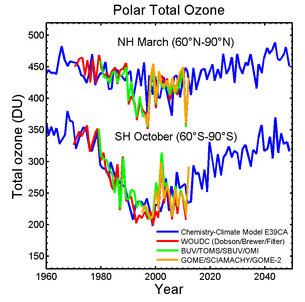
Within the ESA Climate Change Initiative, harmonised ozone climate data records are generated to document the variability of ozone changes better at different scales in space and time.
With this information, scientists can better estimate the timing of the ozone layer recovery, and in particular the closure of the ozone hole.
Chemistry climate models show that the ozone layer may be building up, and the hole over Antarctica will close in the next decades.
ESA
Guillermo Gonzalo Sánchez Achutegui
ayabaca@gmail.com
ayabaca@hotmail.com
ayabaca@yahoo.com