Mostrando entradas con la etiqueta Saturn. Mostrar todas las entradas

domingo, 21 de julio de 2013

NASA - NASA Interplanetary Probes to Take Pictures of Earth from Space

Wave at Saturn -- Introduction


Latest Updates July 18, 2013


Blog -- Timing is Everything – So Let's Do the Math
Press Release
Certificate -- Show you Waved at Saturn!
Blog -- Get an Advance Look
Cassini is Going to Compose a Special Portrait of Saturn … and You!

By Linda Spilker
June 18, 2013
One of the most exciting Cassini events in 2013 will be the unusual opportunity on July 19 to image the whole Saturn system as it is backlit by the sun. With Saturn covering the harsh light of the sun, we will be gathering unique ring science and also catching a glimpse of our very own home planet.
The main science goal for the mosaic we are making of the Saturn system is to look at the more diffuse rings that encircle Saturn and check for change over time. A previous mosaic of the Saturn system Cassini made in 2006 revealed that the dusty E ring, which is fed by the water-ice plume of the moon Enceladus, had unexpectedly large variations in brightness and color around its orbit. We'll want to see how that looks seven Earth years and a Saturnian season later, giving us clues to the forces at work in the Saturn system. We'll do this analysis by collecting data from our visual and infrared mapping spectrometer, composite infrared mapping spectrometer and ultraviolet imaging spectrograph in addition to the imaging cameras.
But one of the best parts of the mosaic we're making on July 19 is that we'll be able to take a picture of Earth – and all of you -- from about 898 million miles (1.44 billion kilometers) away. The Earth will appear to be just a pixel, but you can see in this simulated close-up what parts of it will be illuminated.
 
A computer simulated  view of Saturn from Cassini on July 19.
This simulated view from NASA's Cassini spacecraft shows the expected positions of Saturn and Earth on July 19, 2013, around the time Cassini will take Earth's picture. Cassini will be about 898 million miles (1.44 billion kilometers) away from Earth at the time. That distance is nearly 10 times the distance from the sun to Earth. Image credit: NASA/JPL-Caltech
Opportunities to image Earth from the outer solar system are few and far between and special care must be taken so we don't blind our cameras by looking in the direction of the sun, where Earth is. There have been only two images of Earth from the outer solar system in all the time humankind has been venturing out into space. The first and most distant was one was taken 23 years ago by NASA's Voyager 1 spacecraft from 4 billion miles (6 billion kilometers away), showing Earth as a pale blue dot . The other opportunity was Cassini's image in 2006 from 926 million miles (1.49 billion kilometers).
A computer simulated,  close-up view of Earth from Cassini on July 19.
North America and part of the Atlantic Ocean are expected to be illuminated when NASA's Cassini spacecraft takes a snapshot of Earth on July 19, 2013. This view is a close-up simulation. Image credit: NASA/JPL-Caltech
We think Cassini's July image is a special opportunity for Earthlings to wave at our photographer in the Saturn system and learn more about my favorite planet, its rings and moons. We hope you'll go outside, look in the direction of Saturn and send us pictures of yourselves waving. You can share your pictures by joining our Flickr group Wave at Saturn, adding them to our Wave at Saturn Facebook event page or tagging pictures on Twitter #waveatsaturn. We hope to make a special collage of all these images if we get enough of them.
The Cassini portrait session of Earth will last about 15 minutes from 2:27 to 2:42 p.m. PDT (21:27 to 21:42 UTC).
Another blog post by Jane Houston Jones, provides more information about where to look in the sky.


Linda Spilker is the Cassini project scientist, based at NASA's Jet Propulsion Laboratory, Pasadena, Calif.


Blend space exploration with reading and writing -- Reading, Writing & Rings!
Cassini Scientist for a Day -- Students get involved
Cassini Raw Images
    NASA
    NASA Interplanetary Probes to Take Pictures of Earth from Space
    WASHINGTON -- Two NASA spacecraft, one studying the Saturn system, the other observing Mercury, are maneuvering into place to take pictures of Earth on July 19 and 20.
    The image taken from the Saturn system by NASA's Cassini spacecraft will occur between 5:27 and 5:42 p.m. EDT (2:27 and 2:42 PDT or 21:27 and 21:47 UTC) Friday, July 19. Cassini will be nearly 900 million miles away from Earth. NASA is encouraging the public to look and wave in the direction of Saturn at the time of the portrait and share their pictures via the Internet.
    The Cassini Earth portrait is part of a more extensive mosaic -- or multi-image picture -- of the Saturn system as it is backlit by the sun. The viewing geometry highlights the tiniest of ring particles and will allow scientists to see patterns within Saturn's dusty rings. Processing of the Earth images is expected to take a few days and processing of the full Saturn system mosaic will likely take several weeks.
    Inspired in part by the Cassini team's plans to obtain a picture of Earth, scientists reexamined the planned observations of NASA's MESSENGER spacecraft in orbit around Mercury. They realized Earth is coincidentally expected to appear in some images taken in a search for natural satellites around Mercury on July 19 and 20. Those images will be taken at 7:49 a.m., 8:38 a.m. and 9:41 a.m. (11:49, 12:38 and 13:41 UTC) on both days. Parts of the Earth not illuminated in the Cassini images, including all of Europe, the Middle East and Central Asia, will appear illuminated in the MESSENGER images. MESSENGER's images also will take a few days to process prior to release.
    Details on how to find Saturn in the sky and participate in the event are available at:
    The public can share their pictures by using the hashtag #waveatsaturn on Twitter, or uploading pictures to the event's Flickr page at:
    The event's Facebook page is:
    Cassini mission scientists also will be participating in a live Ustream show on Friday from 5 to 5:30 p.m. EDT (2 to 2:30 p.m. PDT):
    For more information about the two NASA spacecraft, visit:
    and
     

domingo, 2 de diciembre de 2012

ESA Portal - Titan’s seasons make sharp turn


http://www.esa.int/images/Titan_vortex_H,0.jpg
Vortex on Titan close up
Download:
A true-colour image of the south pole vortex observed in Titan’s atmosphere at about 200–300 km altitude, as seen during a Cassini flyby of Saturn’s largest moon on 27 June 2012. Since equinox in August 2009, the seasons have been changing, becoming spring in the northern hemisphere and autumn in the southern hemisphere. The formation of the vortex over the south pole indicates the effect of the changing seasons on the circulation pattern in Titan’s atmosphere, specifically with cooler air sinking down from warmer, high altitudes. The images were obtained with the Cassini spacecraft narrow-angle camera at a distance of approximately 484,000 kilometres from Titan. 
Credits: NASA/JPL–Caltech/Space Science Institute

Scientists using the international Cassini spacecraft have studied the rapid change in seasons on Saturn’s moon Titan, following equinox in August 2009, which saw the formation of a swirling vortex and a build up of exotic gases at unexpectedly high altitudes.

Titan is the only other body in the Solar System with a thick nitrogen-rich atmosphere like Earth’s. Titan’s atmosphere also contains methane and hydrogen, with trace amounts of other gases including hydrocarbons that form at high altitudes as a result of reactions with sunlight.
These complex molecules filter down into the lower atmosphere and eventually combine to produce an orange smog.
A separate layer of haze is found at a much higher altitude of 400–500 km and can be seen at the limb of the moon, apparently detached from the rest of the atmosphere.
This haze was thought to represent the ceiling of Titan’s ‘middle atmosphere’ circulation which extends from pole to pole in one giant cell, but new results from Cassini suggest otherwise. 
http://esamultimedia.esa.int/images/Science/TitansSeasonalChange2_H1.jpg
Titan’s changing seasons
Download:
Artist’s impression of the change in observed atmospheric effects before, during and after equinox in 2009. The Titan globes also provide an impression of the detached haze layer that extends all around the moon (blue).
During the first years of Cassini’s exploration of the Saturnian system, Titan sported a ‘hood’ of dense organic gases (white) in a vortex above its north pole, along with a high-altitude ‘hot spot’ (red). During this time the north pole was pointed away from the Sun.
At equinox both hemispheres received equal heating from the Sun. Afterwards, the north pole tilted towards the Sun, signalling the arrival of spring, while the southern hemisphere tilted away from the Sun and moved into autumn.
After equinox and until 2011 there was still a significant build up of trace gases over the north pole, but the vortex winds had significantly reduced and the hot spot had almost disappeared. Instead, similar features began developing at the south pole, which are still present today.
These observations are interpreted as a large-scale reversal in the single pole-to-pole atmospheric circulation cell of Titan immediately after equinox, with an upwelling of gases in the summer hemisphere and a corresponding downwelling in the winter hemisphere.
This graphic is based on data from the Cassini mission, a partnership among NASA, ESA and the Italian Space Agency. 
Credits: ESA/AOES

 When Cassini arrived in the Saturn system in 2004, Titan sported a vortex with a ‘hood’ of enriched gas and dense haze high above its north, winter pole. After equinox in August 2009, spring arrived in the moon’s northern hemisphere while the southern hemisphere headed towards autumn.
The change in solar heating was reflected by a rapid reversal in circulation direction in Titan’s single pole-to-pole atmospheric cell, with an upwelling of gases in the summer hemisphere and downwelling in the winter hemisphere.
“Even though the amount of sunlight reaching the south pole was decreasing, the first thing we saw there during the six months after equinox was actually an increase in temperature at altitudes of 400–500 km, as atmospheric gases that had been lofted to these heights were compressed as they subsequently sank into a newly forming southern vortex,” says Dr Nick Teanby from the University of Bristol, UK, and lead author of the study reported in the journal Nature.
“This heating effect is the same one that causes compressed air in a bicycle pump to heat up, and provided the smoking gun that the change in seasons was underway.”
 
 In the months that followed, up to a hundred-fold increase in atmospheric gas concentration was measured over the south pole at the same high altitudes.
Cassini’s instruments found that these gas molecules were sinking through the atmosphere at a rate of 1–2 millimetres per second.
Dr Teanby’s team conclude that for the enrichment and motion to be seen throughout these altitudes, the actual source of the complex gas molecules must be higher still, and that the detached haze layer cannot signal the top of the atmospheric circulation cell.
The new observations instead suggest that these complex haze molecules are produced higher up, but that when they drop down to the 400–500 km level, a change in the character of the haze takes place, perhaps as individual particles clump together.
“It’s impressive to see such dramatic solar-driven seasonal changes on a world where the sunlight is nearly a hundred times weaker than it is on Earth,” adds Dr Teanby.
“Since a year on Titan is nearly 30 Earth years long, for the atmosphere to change over a period of just six months is extremely rapid.”
“Models have predicted this change in Titan’s atmospheric circulation for nearly 20 years, but Cassini has provided the first direct observations of it actually happening,” says Nicolas Altobelli, ESA’s Cassini project scientist.
Notes for Editors
ESA
Guillermo Gonzalo Sánchez Achutegui
ayabaca@gmail.com
ayabaca@hotmail.com
ayabaca@yahoo.com 

martes, 27 de noviembre de 2012

ESA - Space Science - Do missing Jupiters mean massive comet belts?


http://www.esa.int/images/GJ581_H3.jpg
Debris disc around GJ 581
Download:
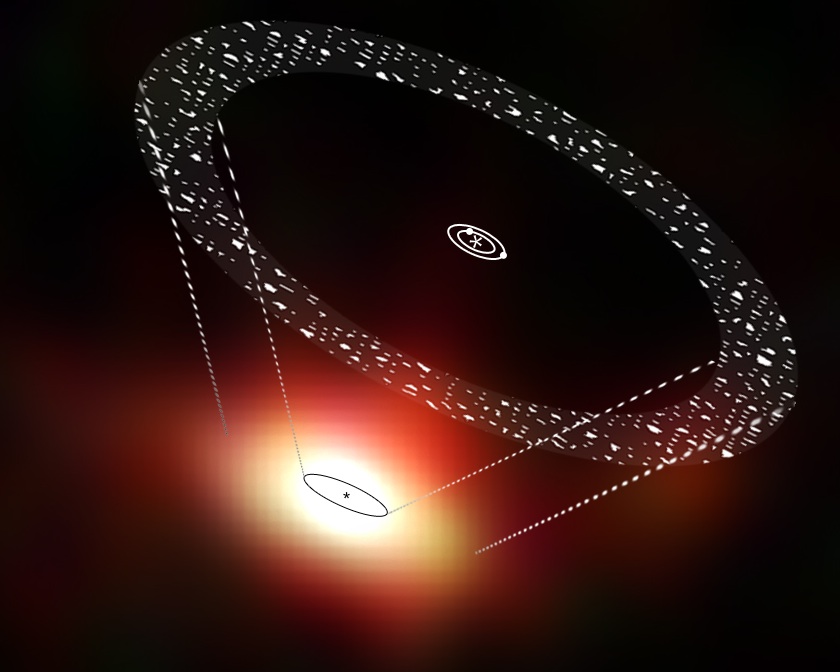
 Artist impression of the debris disc and planets around the star known as Gliese 581, superimposed on Herschel PACS images at 70, 100 and 160 micrometre wavelengths.
The line drawing superimposed on the Herschel image gives a schematic representation of the location and orientation of the star, planets and disc, albeit not to scale.
The black oval outline sketched onto the Herschel data represents the innermost boundary of the debris disc; the approximate location of the outermost boundary is represented by the outer set of dashed lines. It is not possible to identify the central star due to smearing of the Herschel data.
GJ 581’s planets have masses between 2 and 15 Earth masses and are all located within 0.22 Astronomical Units (AU, where 1 AU is the distance between Earth and our Sun) of the central star. A vast debris disc extends from approximately 25 AU to 60 AU.
Background galaxies are also visible in the Herschel field-of-view. 
Credits: ESA/AOES

Using ESA’s Herschel space observatory, astronomers have discovered vast comet belts surrounding two nearby planetary systems known to host only Earth-to-Neptune-mass worlds. The comet reservoirs could have delivered life-giving oceans to the innermost planets.

In a previous Herschel study, scientists found that the dusty belt surrounding nearby star Fomalhaut must be maintained by collisions between comets.
In the new Herschel study, two more nearby planetary systems – GJ 581 and 61 Vir – have been found to host vast amounts of cometary debris.
Herschel detected the signatures of cold dust at 200ºC below freezing, in quantities that mean these systems must have at least 10 times more comets than in our own Solar System’s Kuiper Belt.
GJ 581, or Gliese 581, is a low-mass M dwarf star, the most common type of star in the Galaxy. Earlier studies have shown that it hosts at least four planets, including one that resides in the ‘Goldilocks Zone’ – the distance from the central sun where liquid surface water could exist.
Two planets are confirmed around G-type star 61 Vir, which is just a little less massive than our Sun.
The planets in both systems are known as ‘super-Earths’, covering a range of masses between 2 and 18 times that of Earth.
Interestingly, however, there is no evidence for giant Jupiter- or Saturn-mass planets in either system. 
http://www.esa.int/images/61VIR_H3.jpg
 Debris disc around 61 Vir
Download:
 Artist’s impression of the debris disc and planets around the star 61 Vir, superimposed on Herschel PACS images at 70, 100 and 160 micrometre wavelengths.
The line drawing superimposed on the Herschel image gives a schematic representation of the location and orientation of the star, planets and disc, albeit not to scale.
The black oval outline sketched onto the Herschel data represents the innermost boundary of the debris disc; the approximate location of the outermost boundary is represented by the outer set of dashed lines. It is not possible to identify the central star due to smearing of the Herschel data.
The two planets around 61 Vir have masses between 5 and 18 Earth masses and are both located within 0.22 Astronomical Units (AU, where 1 AU is the distance between Earth and our Sun) of the central star. A vast debris disc extends from approximately 30 AU to 100 AU. 
Credits: ESA/AOES

The gravitational interplay between Jupiter and Saturn in our own Solar System is thought to have been responsible for disrupting a once highly populated Kuiper Belt, sending a deluge of comets towards the inner planets in a cataclysmic event that lasted several million years.
“The new observations are giving us a clue: they’re saying that in the Solar System we have giant planets and a relatively sparse Kuiper Belt, but systems with only low-mass planets often have much denser Kuiper belts,” says Dr Mark Wyatt from the University of Cambridge, lead author of the paper focusing on the debris disc around 61 Vir.
“We think that may be because the absence of a Jupiter in the low-mass planet systems allows them to avoid a dramatic heavy bombardment event, and instead experience a gradual rain of comets over billions of years.”
“For an older star like GJ 581, which is at least two billion years old, enough time has elapsed for such a gradual rain of comets to deliver a sizable amount of water to the innermost planets, which is of particular importance for the planet residing in the star’s habitable zone,” adds Dr Jean-Francois Lestrade of the Observatoire de Paris who led the work on GJ 581.
However, in order to produce the vast amount of dust seen by Herschel, collisions between the comets are needed, which could be triggered by a Neptune-sized planet residing close to the disc.
“Simulations show us that the known close-in planets in each of these systems cannot do the job, but a similarly-sized planet located much further from the star – currently beyond the reach of current detection campaigns – would be able to stir the disc to make it dusty and observable,” says Dr Lestrade.
“Herschel is finding a correlation between the presence of massive debris discs and planetary systems with no Jupiter-class planets, which offers a clue to our understanding of how planetary systems form and evolve,” says Göran Pilbratt, ESA’s Herschel project scientist.
 Notes for Editors
 ESA
Guillermo Gonzalo Sánchez Achutegui
ayabaca@gmail.com
ayabaca@hotmail.com
ayabaca@yahoo.com

miércoles, 18 de abril de 2012

Astronomy: Rings, Titan and Enceladus

Hi My Friends: AL VUELO DE UN QUINDE EL BLOG., Saturn’s icy moon Enceladus hangs below the gas giant’s rings while Titan lurks in the background, in this new image taken by the Cassini spacecraft. Saturn’s icy moon Enceladus hangs below the gas giant’s rings while Titan lurks in the background, in this new image taken by the Cassini spacecraft.

Faint detail of the tiger stripe markings can be seen on Enceladus’ surface, which is framed against Titan, Saturn’s largest moon. With jets of water ice and vapour streaming from Enceladus’ south pole, and liquid hydrocarbon lakes pooling beneath Titan’s thick atmosphere, these are two of Saturn’s most enigmatic moons.

The northern, sun-lit side of Saturn’s rings are seen from just above the ring plane in this image, which was taken in visible green light by Cassini’s narrow-angle camera on 12 March while it was approximately one million kilometres from Enceladus. The image scale is six kilometres per pixel on Enceladus.

Credits: NASA/JPL-Caltech/Space Science Institute
http://www.esa.int/SPECIALS/Cassini-Huygens/SEMNUCKWZ0H_0.html

Guillermo Gonzalo Sánchez Achutegui


miércoles, 15 de febrero de 2012

Astronomy: Rhea Before Titan

Hi My Friends: AL VUELO DE UN QUINDE EL BLOG., Craters appear well defined on icy Rhea in front of the hazy orb of the much larger moon Titan in this Cassini spacecraft view of these two Saturn moons. Craters appear well defined on icy Rhea in front of the hazy orb of the much larger moon Titan in this Cassini spacecraft view of these two Saturn moons.

Lit terrain seen here is on the leading hemispheres of Rhea and Titan. North on the moons is up and rotated 13 degrees to the left. The limb, or edge of the visible disk, of Rhea is slightly overexposed in this view.

The image was taken in visible green light with the Cassini spacecraft narrow-angle camera on Dec. 10, 2011. The view was acquired at a distance of approximately 1.2 million miles (2 million kilometers) from Titan and at a Sun-Titan-spacecraft, or phase, angle of 109 degrees. The view was acquired at a distance of approximately 810,000 miles (1.3 million kilometers) from Rhea and at a Sun-Rhea-spacecraft, or phase, angle of 109 degrees. Image scale is 8 miles (12 kilometers) per pixel on Titan and 5 miles (8 kilometers) per pixel on Rhea.

Image credit: NASA/JPL-Caltech/Space Science Institute .
Guillermo Gonzalo Sánchez Achutegui


viernes, 13 de enero de 2012

Astronomy: Welcome Disruption

Hi My Friends: AL VUELO DE UN QUINDE EL BLOG., The line of Saturn's rings disrupts the Cassini spacecraft's view of the moons Tethys and Titan. Welcome Disruption
The line of Saturn's rings disrupts the Cassini spacecraft's view of the moons Tethys and Titan.

Larger Titan (3,200 miles, or 5,150 kilometers across) is on the left. Tethys (660 miles, or 1,062 kilometers across) is near the center of the image. This view looks toward the Saturn-facing sides of Tethys and Titan. The angle also shows the northern, sunlit side of the rings from less than one degree above the ring plane. The image was taken in visible red light with the Cassini spacecraft narrow-angle camera on Dec. 7, 2011. The view was acquired at a distance of approximately 1.4 million miles (2.2 million kilometers) from Tethys and 1.9 million miles (3.1 million kilometers) from Titan. Image scale is 8 miles (13 kilometers) per pixel on Tethys and 12 miles (19 kilometers) on Titan.

The Cassini-Huygens mission is a cooperative project of NASA, the European Space Agency and the Italian Space Agency. The Jet Propulsion Laboratory, a division of the California Institute of Technology in Pasadena, manages the mission for NASA's Science Mission Directorate, Washington, D.C. The Cassini orbiter and its two on-board cameras were designed, developed and assembled at JPL. The imaging operations center is based at the Space Science Institute in Boulder, Colo.

Image credit: NASA/JPL-Caltech/Space Science Institute
Guillermo Gonzalo Sánchez Achutegui