Mostrando entradas con la etiqueta Mercury. Mostrar todas las entradas

domingo, 4 de agosto de 2013

NASA - Elliptical Crater on Mercury


Elliptical Crater on Mercury
This color image, taken on May 1, 2013 by the Wide Angle Camera (WAC) instrument aboard NASA's MESSENGER spacecraft orbiting Mercury, features Hovnatanian crater, named for Armenian painter Hakop Hovnatanian. The crater's elliptical shape and the bright rays' butterfly pattern indicate that a very oblique impact produced the crater. The brightness of the rays indicate that they are relatively young features on Mercury's surface.
This image was acquired as a targeted high-resolution 11-color image set. Acquiring 11-color targets is a new campaign that began in March, 2013 and that utilizes all of the camera's 11 narrow-band color filters. Because of the large data volume involved, only features of special scientific interest are targeted for imaging in all 11 colors.
The MESSENGER spacecraft is the first ever to orbit the planet Mercury, and the spacecraft's seven scientific instruments and radio science investigation are unraveling the history and evolution of the solar system's innermost planet. MESSENGER has acquired over 150,000 images and extensive other data sets, and is capable of continuing orbital operations until early 2015.
Image Credit: NASA/Johns Hopkins University Applied Physics Laboratory/Carnegie Institution of Washington
NASA
Guillermo Gonzalo Sánchez Achutegui
ayabaca@gmail.com
ayabaca@hotmail.com
ayabaca@yahoo.com

domingo, 21 de julio de 2013

NASA - NASA Interplanetary Probes to Take Pictures of Earth from Space

Wave at Saturn -- Introduction


Latest Updates July 18, 2013


Blog -- Timing is Everything – So Let's Do the Math
Press Release
Certificate -- Show you Waved at Saturn!
Blog -- Get an Advance Look
Cassini is Going to Compose a Special Portrait of Saturn … and You!

By Linda Spilker
June 18, 2013
One of the most exciting Cassini events in 2013 will be the unusual opportunity on July 19 to image the whole Saturn system as it is backlit by the sun. With Saturn covering the harsh light of the sun, we will be gathering unique ring science and also catching a glimpse of our very own home planet.
The main science goal for the mosaic we are making of the Saturn system is to look at the more diffuse rings that encircle Saturn and check for change over time. A previous mosaic of the Saturn system Cassini made in 2006 revealed that the dusty E ring, which is fed by the water-ice plume of the moon Enceladus, had unexpectedly large variations in brightness and color around its orbit. We'll want to see how that looks seven Earth years and a Saturnian season later, giving us clues to the forces at work in the Saturn system. We'll do this analysis by collecting data from our visual and infrared mapping spectrometer, composite infrared mapping spectrometer and ultraviolet imaging spectrograph in addition to the imaging cameras.
But one of the best parts of the mosaic we're making on July 19 is that we'll be able to take a picture of Earth – and all of you -- from about 898 million miles (1.44 billion kilometers) away. The Earth will appear to be just a pixel, but you can see in this simulated close-up what parts of it will be illuminated.
 
A computer simulated  view of Saturn from Cassini on July 19.
This simulated view from NASA's Cassini spacecraft shows the expected positions of Saturn and Earth on July 19, 2013, around the time Cassini will take Earth's picture. Cassini will be about 898 million miles (1.44 billion kilometers) away from Earth at the time. That distance is nearly 10 times the distance from the sun to Earth. Image credit: NASA/JPL-Caltech
Opportunities to image Earth from the outer solar system are few and far between and special care must be taken so we don't blind our cameras by looking in the direction of the sun, where Earth is. There have been only two images of Earth from the outer solar system in all the time humankind has been venturing out into space. The first and most distant was one was taken 23 years ago by NASA's Voyager 1 spacecraft from 4 billion miles (6 billion kilometers away), showing Earth as a pale blue dot . The other opportunity was Cassini's image in 2006 from 926 million miles (1.49 billion kilometers).
A computer simulated,  close-up view of Earth from Cassini on July 19.
North America and part of the Atlantic Ocean are expected to be illuminated when NASA's Cassini spacecraft takes a snapshot of Earth on July 19, 2013. This view is a close-up simulation. Image credit: NASA/JPL-Caltech
We think Cassini's July image is a special opportunity for Earthlings to wave at our photographer in the Saturn system and learn more about my favorite planet, its rings and moons. We hope you'll go outside, look in the direction of Saturn and send us pictures of yourselves waving. You can share your pictures by joining our Flickr group Wave at Saturn, adding them to our Wave at Saturn Facebook event page or tagging pictures on Twitter #waveatsaturn. We hope to make a special collage of all these images if we get enough of them.
The Cassini portrait session of Earth will last about 15 minutes from 2:27 to 2:42 p.m. PDT (21:27 to 21:42 UTC).
Another blog post by Jane Houston Jones, provides more information about where to look in the sky.


Linda Spilker is the Cassini project scientist, based at NASA's Jet Propulsion Laboratory, Pasadena, Calif.


Blend space exploration with reading and writing -- Reading, Writing & Rings!
Cassini Scientist for a Day -- Students get involved
Cassini Raw Images
    NASA
    NASA Interplanetary Probes to Take Pictures of Earth from Space
    WASHINGTON -- Two NASA spacecraft, one studying the Saturn system, the other observing Mercury, are maneuvering into place to take pictures of Earth on July 19 and 20.
    The image taken from the Saturn system by NASA's Cassini spacecraft will occur between 5:27 and 5:42 p.m. EDT (2:27 and 2:42 PDT or 21:27 and 21:47 UTC) Friday, July 19. Cassini will be nearly 900 million miles away from Earth. NASA is encouraging the public to look and wave in the direction of Saturn at the time of the portrait and share their pictures via the Internet.
    The Cassini Earth portrait is part of a more extensive mosaic -- or multi-image picture -- of the Saturn system as it is backlit by the sun. The viewing geometry highlights the tiniest of ring particles and will allow scientists to see patterns within Saturn's dusty rings. Processing of the Earth images is expected to take a few days and processing of the full Saturn system mosaic will likely take several weeks.
    Inspired in part by the Cassini team's plans to obtain a picture of Earth, scientists reexamined the planned observations of NASA's MESSENGER spacecraft in orbit around Mercury. They realized Earth is coincidentally expected to appear in some images taken in a search for natural satellites around Mercury on July 19 and 20. Those images will be taken at 7:49 a.m., 8:38 a.m. and 9:41 a.m. (11:49, 12:38 and 13:41 UTC) on both days. Parts of the Earth not illuminated in the Cassini images, including all of Europe, the Middle East and Central Asia, will appear illuminated in the MESSENGER images. MESSENGER's images also will take a few days to process prior to release.
    Details on how to find Saturn in the sky and participate in the event are available at:
    The public can share their pictures by using the hashtag #waveatsaturn on Twitter, or uploading pictures to the event's Flickr page at:
    The event's Facebook page is:
    Cassini mission scientists also will be participating in a live Ustream show on Friday from 5 to 5:30 p.m. EDT (2 to 2:30 p.m. PDT):
    For more information about the two NASA spacecraft, visit:
    and
     

domingo, 3 de marzo de 2013

ESA - How to cook a spacecraft


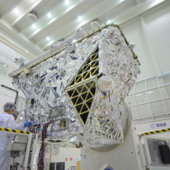
Mercury Planetary Orbiter being placed in Phenix thermal vacuum facility
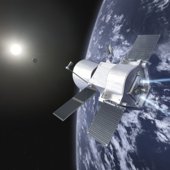
27 February 2013 The faint aroma of hot metal filled the surrounding cleanroom as the hatch to ESA’s newest test facility was slid aside, concluding a 23-day ‘bake-out’ of the largest segment of ESA’s mission to Mercury. 
Ending on the early hours of 14 February, this test ensured ESA’s Mercury Planetary Orbiter – MPO, part of the multi-module BepiColombo mission – was cleaned of potential contaminants in advance of its 2015 mission to the inner Solar System.
The bake-out took place at ESA’s technical heart, ESTEC in Noordwijk, the Netherlands, which includes a dedicated Test Centre equipped to simulate all aspects of the space environment.
MPO will fly to the innermost planet with Japan’s Mercury Magnetosphere Orbiter, riding together on ESA’s propulsion module. But not before getting cooked first.
“Being close to Mercury and experiencing high temperatures, the release of molecules from spacecraft materials is expected to occur at higher quantities than for normal satellites,” explains Jan van Casteren, BepiColombo Project Manager.
“Such molecules are a contamination threat if they condense on sensitive surfaces, so we need to minimise outgassing in order to protect our delicate scientific instrumentation on the spacecraft.”
So an initial bake-out of the various spacecraft segments is essential for cleaning purposes – in this case MPO’s ‘Proto-Flight Model’, incorporating its propulsion system and heat pipes that regulate its temperature.
A new test facility called Phenix hosted the bake-out, a 4.5 m-diameter stainless steel vacuum chamber 11.8 m long, with an inner box called the ‘thermal tent’ whose six copper walls can be heated up to 100°C or cooled via piped liquid nitrogen down to –190°C, all independent from each other.
“This test was different from more typical thermal vacuum testing because, while the sides and top of the chamber were kept heated to around 50°C, the underside remained cooled by liquid nitrogen throughout,” explains Mark Wagner, Head of ESTEC’s Test Facilities & Test Methods Section.
“This creates a ‘cold trap’ where the contaminants baked off from the satellite solidify for collection. But sustaining this environment required 1500 litres of liquid nitrogen per hour – on average three tankers were calling at ESTEC daily to top up our supply.”
The test was monitored 24 hours per day on a triple shift system, with care being taken to maintain the temperatures precisely and ensure a continuous flow of data.
Outgassing production was monitored throughout the test, and the bake-out results are now being analysed. A non-trivial amount of contaminants are expected to have been produced – ‘spoonfuls’ of material.
Now Phenix itself is being thoroughly cleaned, ready for its next customer.
BepiColombo MPO inside Phenix
“Phenix was put in place to extend the range of thermal vacuum test services on offer to ESTEC Test Centre customers,” explains Mark. “It is able to accommodate large subsystems or entire spacecraft.”
Phenix was cleared for use last December, after which preparations began immediately for BepiColombo testing.
“The chamber will be kept busy for much of the rest of this year accommodating a forthcoming batch of Galileo satellites,” Mark concludes.
“This will be more traditional testing – simulating the temperature extremes the Galileo satellites must endure throughout their 12-year working lifetimes.”
ESA
RELATED ARTICLES:
Guillermo Gonzalo Sánchez Achutegui
ayabaca@gmail.com
ayabaca@hotmail.com
ayabaca@yahoo.com

martes, 27 de noviembre de 2012

NASA - NASA Hosts Nov. 29 News Conference About Mercury Polar Regions


Image from Orbit of Mercury: Mercury South Polar Region

Download Image

› Full Size
MESSENGER Provides New Look at Mercury's surprising core and landscape curiosities
03.21.12
 
Image from Orbit or Mercury: Mercury's Topography from MLAMercury's Topography from MLA
Full Image and Caption

Image from Orbit of Mercury: Mercury South Polar RegionMercury's South Polar Region
Full Image and Caption

Mercury South Pole Mercury’s South Polar Region
View Animation
Since moving into orbit about Mercury a little over one year ago, NASA's MESSENGER spacecraft has captured nearly 100,000 images and returned data that have revealed new information about the planet, including its topography, the structure of its core, and areas of permanent shadow at the poles that host the mysterious polar deposits.  The latest findings are reported in two papers published online in Science Express, and in 57 papers presented this week at the 43rd Lunar and Planetary Science Conference in The Woodlands, Texas.

A Surprising Core

MESSENGER's radio tracking has allowed the scientific team to develop the first precise model of Mercury's gravity field which, when combined with topographic data and the planet's spin state, sheds light on the planet's internal structure, the thickness of its crust, the size and state of its core, and its tectonic and thermal history.

Mercury's core occupies a large fraction of the planet, about 85% of the planetary radius, even larger than previous estimates. Because of the planet's small size, at one time many scientists thought the interior should have cooled to the point that the core would be solid. However, subtle dynamical motions measured from Earth-based radar, combined with MESSENGER's newly measured parameters of the gravity field and the characteristics of Mercury's internal magnetic field that signify an active core dynamo, indicate that the planet's core is at least partially liquid.

Mercury's core is different from any other planetary core in the Solar System. Earth has a metallic, liquid outer core sitting above a solid inner core. Mercury appears to have a solid silicate crust and mantle overlying a solid, iron sulfide outer core layer, a deeper liquid core layer, and possibly a solid inner core. These results have implications for how Mercury's magnetic field is generated and for understanding how the planet evolved thermally.

Landscape Curiosities

A planet's topography can reveal fundamental information about its internal structure and its geological and thermal evolution. Ranging observations from MESSENGER's Mercury Laser Altimeter (MLA) have provided the first-ever precise topographic model of the planet's northern hemisphere and characterized slopes and surface roughness over a range of spatial scales. From MESSENGER's eccentric, near-polar orbit, the MLA illuminates surface areas as wide as 15 to 100 meters (50 -325 feet), spaced about 400 meters apart (1,300 feet).

The spread in elevations is considerably smaller than those of Mars or the Moon. The most prominent feature is an extensive area of lowlands at high northern latitudes that hosts the volcanic northern plains. Within this lowland region is a broad topographic rise that formed after the volcanic plains were emplaced.

At mid-latitudes, the interior plains of the Caloris impact basin — 1,550 kilometers (960 miles) in diameter — have been modified so that part of the basin floor now stands higher than the rim. The elevated portion appears to be part of a quasi-linear rise that extends for approximately half the planetary circumference at mid-latitudes. These features imply that large-scale changes to Mercury's topography occurred after the era of impact basin formation and large-scale emplacement of volcanic plains had ended.

Polar Shadows

A chief goal of MESSENGER's primary mission was to understand the nature of the radar-bright deposits at the poles of Mercury. The leading proposal since the deposits were discovered has been that radar-bright material consists dominantly of frozen water ice. Scientists have never had the imagery available before to see the surface where these radar-bright features are located. But images from MESSENGER's Mercury Dual Imaging System show that all the radar-bright features near Mercury's south pole are located in areas of permanent shadow, and near Mercury's north pole such deposits are also seen only in shadowed regions.

These results are consistent with the water-ice hypothesis but not definitive proof. But the MDIS images, combined with ongoing analysis of data from MESSENGER's Neutron Spectrometer and the MLA, will provide a more complete picture of the nature of the deposits.


For more information about the MESSENGER mission, 
 NASA
Guillermo Gonzalo Sánchez Achutegui
ayabaca@gmail.com
ayabaca@hotmail.com
ayabaca@yahoo.com