Mostrando entradas con la etiqueta ESA’s Mars Express. Mostrar todas las entradas

domingo, 13 de octubre de 2013

ESA : Cicatrices en Marte


Hebes Chasma

Cicatrices en Marte

11 octubre 2013
La garganta Hebes Chasma y la cadena de cañones que la rodean, producto de las fuerzas tectónicas, son una cicatriz abierta al pasado del Planeta Rojo.
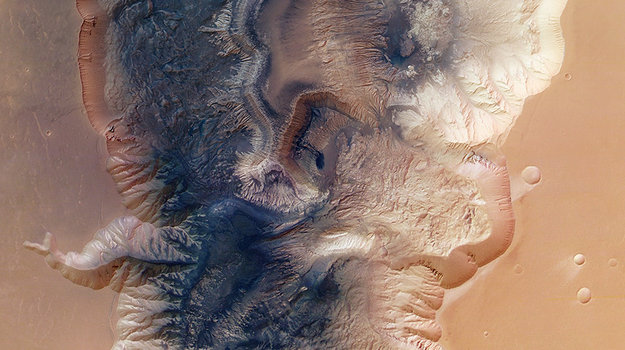
La sonda Mars Express de la ESA ha sobrevolado esta región de Marte en múltiples ocasiones. Este nuevo mosaico compuesto por ocho imágenes nos muestra Hebes Chasma en todo su esplendor, y con un nivel de detalle sin precedentes. (Haz clic en la imagen para acceder al mosaico completo).
 
Hebes Chasma es una garganta cerrada de casi 8 kilómetros de profundidad, que se extiende 315 km de
Entorno de Hebes Chasma
Este a oeste y 125 km de norte a sur en su punto más ancho. Está situada a unos 300 km al norte del gran complejo de cañones del Valles Marineris.
Los orígenes de Hebes Chasma y de los cañones que la rodean están ligados a la cercana región volcánica de Tharsis, donde se encuentra el volcán más grande del Sistema Solar, Olympus Mons.
Topografía de Hebes Chasma
A medida que el abultamiento de Tharsis se iba llenando de magma durante los primeros mil millones de años de la historia de Marte, la corteza se estiraba en sus inmediaciones, llegando a fracturarse y a colapsar en gigantescas gargantas como Hebes Chasma. Alrededor de la profunda depresión se pueden distinguir intrincados patrones de fallas – visibles más claramente en la imagen principal y en las imágenes tridimensionales.
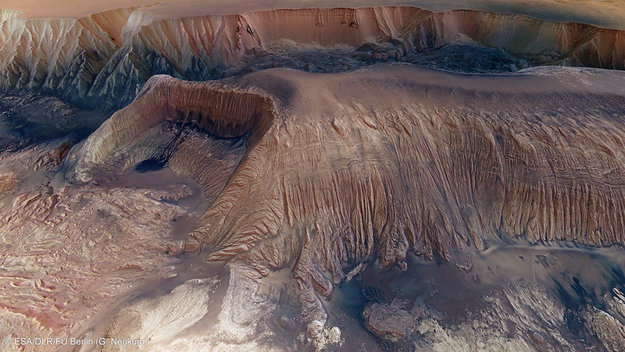
En el centro de Hebes Chasma se encuentra una ‘mesa’ plana que se eleva hasta el mismo nivel que las llanuras que rodean a la garganta. Las imágenes en perspectiva muestran esta formación desde distintos ángulos.
Este tipo de formación no se encuentra en ningún otro cañón de Marte, y sus orígenes no están del todo claros. Entre sus capas se encuentran materiales volcánicos – al igual que en las paredes del cañón principal – así como polvo arrastrado por el viento y sedimentos depositados por el agua con el paso del tiempo.
En un lado de la mesa hay una depresión con forma de herradura, como se puede observar más abajo, formada cuando el terreno se desplomó hasta el fondo de la garganta.
Hebes Chasma en 3D
En esta imagen también se puede distinguir una mancha oscura, que parece un charco de tinta acumulada sobre la pila de escombros, que puede ser el resultado de un corrimiento de tierras. Lo más probable es que esté formada por polvo suelto que se fue deslizando por los cauces tallados en la pared por las aguas del deshielo o de los manantiales, dándole su particular apariencia fluida. En el extremo opuesto del montículo se encuentra otra formación similar, como se puede ver en la imagen a todo color.
En el fondo de Hebes Chasma se pueden distinguir varios depósitos de escombros, muchos de ellos procedentes de las paredes del cañón principal. Las paredes de la mesa y de la garganta muestran un gran número de acanaladuras, que sugieren que están compuestas por materiales blandos y fáciles de erosionar.
 
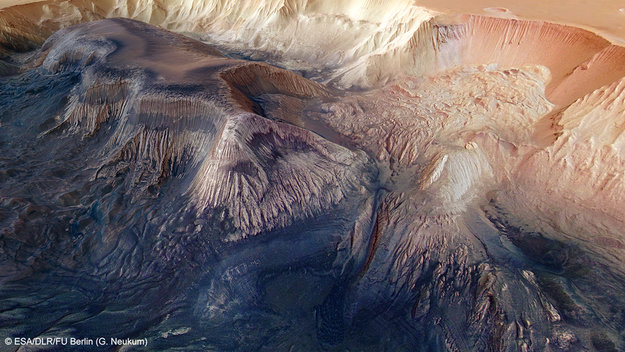
La segunda imagen en perspectiva revela una fina capa oscura rodeada por materiales más claros. Se piensa que está formada por el polvo que se deslizó desde la cima o que fue arrastrado por el viento. Alrededor de la base de la mesa también se pueden distinguir depósitos más oscuros, que pueden proceder de la erosión de los sedimentos de la cima o haber sido arrastrados por el viento o por el agua.
Las laderas de la mesa también presentan varias capas de sedimentos que pueden haber sido depositados por la acción del agua. Los datos de Mars Express y de la sonda MRO de la NASA indican que Hebes Chasma contiene minerales que sólo se forman en presencia de agua, lo que sugiere que en algún momento de su pasado este cañón pudo estar lleno de agua, formando un gran lago.
No obstante, los caóticos depósitos de escombros esparcidos por el fondo de la garganta dejan claro que
Deslizamientos y estratos en el interior de Hebes Chasma
 .La segunda imagen en perspectiva revela una fina capa oscura rodeada por materiales más claros. Se piensa que está formada por el polvo que se deslizó desde la cima o que fue arrastrado por el viento. Alrededor de la base de la mesa también se pueden distinguir depósitos más oscuros, que pueden proceder de la erosión de los sedimentos de la cima o haber sido arrastrados por el viento o por el agua.
Las laderas de la mesa también presentan varias capas de sedimentos que pueden haber sido depositados por la acción del agua. Los datos de Mars Express y de la sonda MRO de la NASA indican que Hebes Chasma contiene minerales que sólo se forman en presencia de agua, lo que sugiere que en algún momento de su pasado este cañón pudo estar lleno de agua, formando un gran lago.
No obstante, los caóticos depósitos de escombros esparcidos por el fondo de la garganta dejan claro que los corrimientos de tierras jugaron un papel fundamental a la hora de ampliar esta profunda cicatriz en la corteza de Marte.
Hebes Chasma en 3D
ESA


      Guillermo Gonzalo Sánchez Achutegui
      ayabaca@gmail.com
      ayabaca@hotmail.com
      ayabaca@yahoo.com

      martes, 24 de septiembre de 2013

      ESA - An icy visitor

      SocialSpace

      A Unique Hubble View of Comet ISON

      Preparing for Comet ISON

      23 September 2013
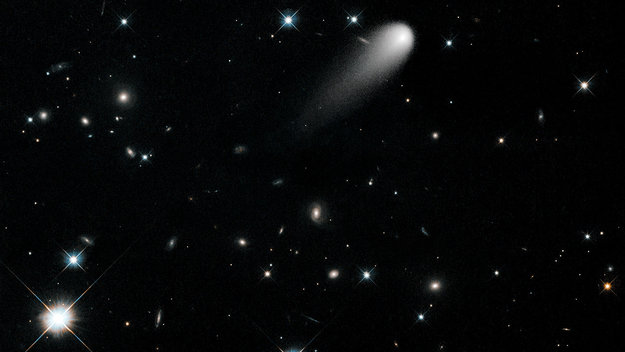
      ESA’s space missions are getting ready to observe an icy visitor to the inner Solar System: Comet ISON, which might also be visible in the night sky later this year as a naked eye object.
      The comet was discovered in images taken on 21 September 2012 by astronomers Artyom Novichonok and Vitali Nevski using a 40 cm-diameter telescope that is part of the International Scientific Optical Network, ISON.
      Originating from the Oort Cloud, a repository of icy bodies billions of kilometres from the Sun, ISON is on a path that will bring it within grazing distance – 1.2 million kilometres – above the Sun’s visible surface on 28 November.
      The NASA/ESA Hubble Space Telescope took detailed images earlier this year, such as the main image presented here from 30 April. In this composition, the comet is set against a separately imaged background of stars and galaxies.
      For some time the view of the comet from Earth was temporarily blocked by the Sun, but it was spotted again in August, by amateur astronomer Bruce Gary.
      Astronomers around the world are now eagerly watching as the comet draws closer, its coma – the tenuous atmosphere that surrounds the comet’s rock–ice nucleus – becoming more pronounced as its surface ices are heated by the Sun and transformed into gas. Dusty debris is suspended in the coma and swept into a tail, which will also become more prominent as the comet approaches the Sun.

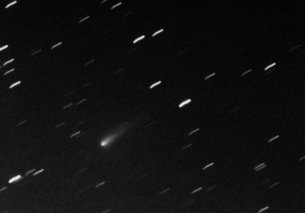
      Comet ISON on 15 September
      Astronomer Pete Lawrence from the UK imaged Comet ISON (shown right) on 15 September, as it passed through the constellation of Cancer en route to Leo. Pete used a 10 cm-diameter telescope with a CCD camera attached; the exposures totalled 40 minutes, with individual images stacked together to produce the final result.
      ESA and NASA space missions are also preparing to observe the comet. Tonight, ESA’s Mars Express starts its observation campaign, taking photos and analysing the composition of the comet’s coma over the next two weeks. The comet will be at its closest to Mars on 1 October – at a distance of 10.5 million kilometres – six times closer than it will approach Earth.
      The ESA/NASA SOHO mission will view the comet as it swings around the Sun at the end of November, and astronomers will be waiting to see if the comet survives its fiery encounter.
      ESA’s Venus Express and Proba-2 also plan to target the comet during November and December.
      The comet will be brightest in our skies just before and in the week after its encounter with the Sun, assuming it survives, but will likely have faded by the time it makes its closest approach to Earth on 26 December. It will pass Earth with no threat of impact.
      Since comets are unpredictable by nature, and planet-orbiting spacecraft are not primarily designed to observe distant comets, it is uncertain exactly what results are to be expected. But while we await the results from spacecraft, there is clearly much to be seen from the ground already.
      If you make any observations we would be delighted to share them on our Twitter and Flickr channels. Please contact us via Twitter at @esascience or by email at scicomm@esa.int.
      ESA
      Guillermo Gonzalo Sánchez Achutegui

      domingo, 14 de abril de 2013

      ESA - Explosive crater twins on Mars


      Arima twins
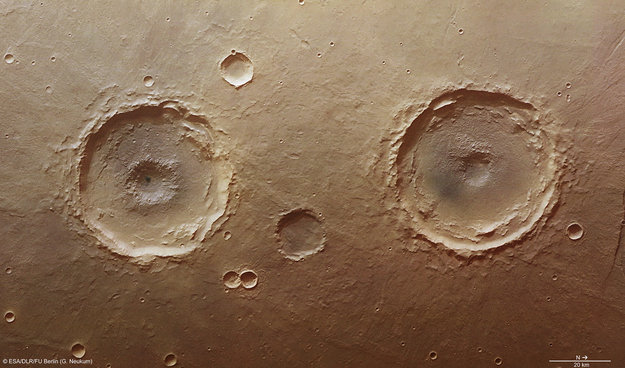
      11 April 2013 Dramatic underground explosions, perhaps involving ice, are responsible for the pits inside these two large martian impact craters, imaged by ESA’s Mars Express on 4 January.
      The ‘twin’ craters are in the Thaumasia Planum region, a large plateau that lies immediately to the south of Valles Marineris, the largest canyon in the Solar System.
      The northernmost (right) large crater in this scene was officially given the name Arima in early 2012, but the southernmost (left) crater remains unnamed. Both are just over 50 km wide and display intricate interior features.
      Inside a central pit crater
      The southernmost crater is also presented here in a perspective view, revealing its complex characteristics in detail.
      Multiple terraces slump from the crater walls onto a flat floor, but perhaps the most striking feature is the central pit, a feature it shares with Arima crater to its north.
      Arima twins in context
      Central pit craters are common on Mars, as well as on the icy moons orbiting the giant planets in our Solar System. But how did they form?
      When an asteroid hits the rocky surface of a planet, both it and the surface are compressed to high densities. Immediately after the impact, the compressed regions rapidly depressurise, exploding violently.  
      In low-energy impacts, a simple bowl-shaped crater results. In more dramatic events, larger craters are produced with more complex features, such as uplifted central peaks or sunken pits.
      One idea for central pit formation is that when rock or ice melted during the impact drains away through fractures beneath the crater, it leaves a pit.
      Another theory is that subsurface ice is rapidly heated, vapourising in an explosion. As a result, the rocky surface is excavated forming an explosive pit surrounded by rocky debris. The pit is in the centre of the main crater, where most of the impact energy was deposited.
      Arima twins topography
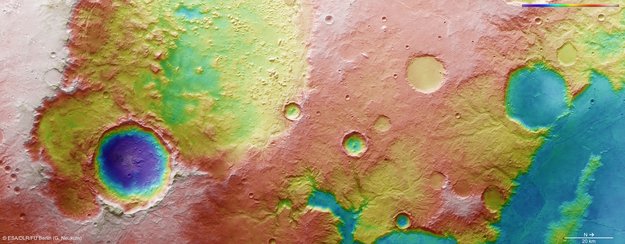
      Though the large craters in this scene have similar diameters, their central pits are rather different in size and depth, as is clearly evident in the topographical map. Compared to the Arima crater, perhaps more subsurface ice was present and more readily vapourised in the southern crater, punching through slightly thinner crust to leave a larger pit.
      Many neighbouring small impact craters also show evidence for subsurface water or ice at the time of impact as evidenced by their ‘rampart’ ejecta blankets.
      Ejecta blankets are debris deposits surrounding the crater, excavated from inside the crater during its formation. They have petal-like lobes around their edges: these result from liquid water bound up in the ejected material, allowing it to flow along the surface and giving it a fluid appearance.
      Arima twins in 3D
      Impact craters like these can thus provide windows into the past of a planet’s surface. In this case, they provide evidence for the Thaumasia Planum region having once hosted plentiful subsurface water or ice that was liberated during impact events both small and large.
      RELATED ARTICLES:
      Digging for hidden treasure on Mars25 March 2013 ESA’s Mars Express has spent nearly ten years imaging the Red Planet, and there are plenty of hidden treasures buried in the mission’s rich picture archive.
      Mapping Mars04 February 2013
      ESA
      Guillermo Gonzalo Sánchez Achutegui
      ayabaca@gmail.com
      ayabaca@hotmail.com
      ayabaca@yahoo.com
      domingo, 17 de febrero de 2013

      ESA - At the mouth of the red valley


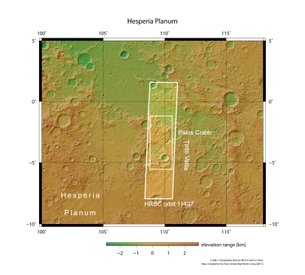
      High-Resolution Stereo Camera nadir and colour channel data taken during revolution 11497 on 13 January 2013 by ESA’s Mars Express have been combined to form a natural-colour view of the region southeast of Amenthes Planum and north of Hesperia Planum. The region imaged, which lies to the west of Tinto Vallis and Palos crater, is centred at around 3°S and 109°E, and has a ground resolution of about 22 m per pixel.
      The image features craters, lava channels and a valley from which water may have once flowed. Dark wind-blown sediments fill the valleys and the floors of the craters.

      ESA’s Mars Express took a high-resolution stereo image on 13 January of the southeast corner of the Amenthes Planum region on Mars, near to Palos crater and the mouth of a well-known sinuous valley, Tinto Vallis.
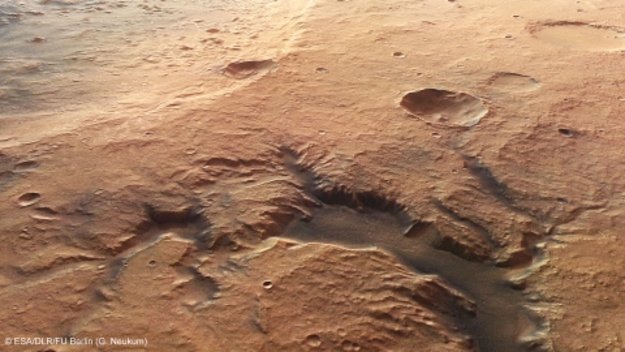
      At the bottom-centre of the full-colour image above, and up close in the first perspective image, is a nearby shorter and wider valley, which is fed by a number of tributaries before it joins the mouth of Tinto Vallis as both empty into Palos crater, just off the bottom of the image.
      The 190 km-long Tinto Vallis is seen in the context image and is named after the famous Rio Tinto river in the Andalucía region of Spain. It is believed to have formed around 3.7 billion years ago, during the early history of Mars.
      Valley feeding Palos Crater
       

      The network of shorter valleys shown in the first perspective image is thought to have formed through volcanic activity melting subsurface ice and liberating water to the martian surface via seeps and springs.
      If underground water emerges to the surface from the side of a slope – a process that planetary geologists call ‘groundwater sapping’ – it weakens the ground above it, causing it to collapse. Over time, this process may lead to the formation of steep-sided U-shaped valleys.
      Groundwater sapping is believed to be responsible for erosion seen in many of the valley networks on the Red Planet.
      Amenthes Planum in context
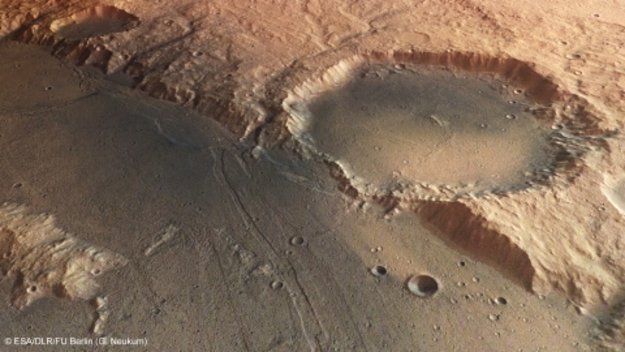
      Another eye-catching feature is the relatively deep 35 km-wide crater seen in the left-hand portion of the colour, topographic and 3D images. Spectacular landslides along the crater’s walls can be seen and are particularly evident along the broken southern (left) rim.
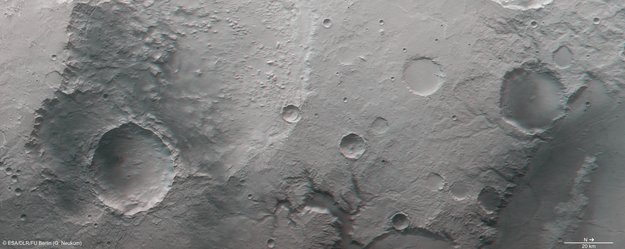
      This crater sits on top of at least three older craters, the largest of which is 100 km wide and dominates the whole top left half of the 2D and 3D anaglyph images. The western rim of this crater continues beyond the image frame, and can be more easily distinguished in the context image.
      Amenthes Planum topography
       

      The floor of this 100 km-wide crater is chaotic, with flat-topped geological features called mesas, and their smaller siblings, buttes, littering the floor. These are probably the result of the removal of subsurface water ice leading to the collapse of weaker material around them, leaving these more resistant high-sided features behind.
      On Earth, the desert regions in Utah are home to many examples of these types of formation.
      Trough feeding Amenthes Planum


      Toward the north (right) side of the 2D images, several smaller craters display very smooth and flat floors, from infilling by sediments.
      The darker regions to the far north and south shown most clearly in the first colour image are covered in wind-transported basaltic sands.
      The smooth low-lying region to the far right and shown in the second perspective image is a small trough that feeds into the broader lava field of Amenthes Planum. The trough has likely been modified by the outflow of material from the ancient lake that may have once existed in Palos crater, the rim of which can only just be seen at the bottom of the colour, topographic and 3D images.
      This smooth, channel-like feature brushes against the rim of a 30 km-wide crater, and both have been covered with dark wind-blown materials.
      Amenthes Planum in 3D


      With these recent images, Mars Express continues to show the similarities between regions on Mars with those on our home planet.
      ESA
      Guillermo Gonzalo Sánchez Achutegui
      ayabaca@gmail.com
      ayabaca@hotmail.com
      ayabaca@yahoo.com
      domingo, 20 de enero de 2013

      ESA - Reull Vallis: atravesado por un río en el pasado

      Reull Vallis


      Vista en perspectiva de Reull Vallis.
      18 enero 2013
      El año pasado, la sonda Mars Express de la ESA captó en imágenes, con su cámara estéreo de alta resolución, la impactante parte superior de la región marciana de Reull Vallis.
      Se cree que Reull Vallis, la estructura similar a un río que puede verse en estas imágenes, se formó cuando el agua fluía en Marte, en un pasado distante, cortando un canal de laderas empinadas que atraviesa las montañas de Promethei Terra, antes de perderse en el fondo de la vasta cuenca de Hellas. 
      La sinuosa estructura, que se prolonga durante casi 1.500 km sobre el paisaje marciano, está flanqueada por numerosos afluentes, uno de los cuales podemos ver claramente atravesando el valle hacia la parte superior (norte). 

      Perspective view of Reull Vallis


      Vista perspectiva de Reull Vallis.
       Las nuevas imágenes de la sonda europea Mars Express muestran una región de Reull Vallis en un punto en el que el canal tiene casi 7 km de ancho y una profundidad de 300 metros. 

      Topographic view of Reull Vallis


      Vista topográfica de Reull Vallis.
      En estas imágenes, los lados de Reull Vallis son particularmente escarpados y abruptos, con elementos paralelos longitudinales cubriendo el suelo del propio canal. Se cree que estas estructuras son el resultado del transcurso de hielo y escombros sueltos durante el periodo ‘Amazónico’ (que continúa actualmente) debido al flujo glacial a lo largo del canal.
      Las estructuras se formaron mucho después de haber sido esculpidas originalmente por el agua líquida en el periodo Hespérico, que se cree terminó hace entre 3.500 y 1.800 millones de años.
      En muchos de los cráteres de los alrededores, también pueden encontrarse estructuras lineales similares, las cuales se cree que tienen abundante hielo. 

      Reull Vallis in context


      Reull Vallis en contexto.
      En la imagen de contexto, más amplia, los afluentes que cortan el canal principal parecen formar parte de una bifurcación del valle principal en dos ramas distintas más extensas río arriba, antes de fundirse de nuevo en un único valle. 
      La parte derecha (norte) de la imagen principal está dominada por las montañas de Promethei Terra, con sus altas y redondeadas cimas que alcanzan alrededor de los 2.500 metros sobre los llanos de los alrededores.
      La perspectiva inferior muestra una de esas montañas con cercanos cráteres de impacto rellenos de sedimentos.  

      Perspective view of Reull Vallis


      Perspectiva de Reull Vallis.
       La morfología de esta región es sorprendentemente similar a la de regiones de la Tierra afectadas por la glaciación. Por ejemplo, podemos ver estructuras escalonadas circulares en los muros interiores del cráter relleno de sedimentos que puede verse al fondo, en segundo plano. Los expertos en ciencias planetarias creen que puede tratarse de antiguos niveles glaciales o de los límites creados por el agua, antes de que el hielo y el agua sublimaran o se evaporaran por etapas a lo largo de distintas épocas. 

      3D view of Reull Vallis


      Vista 3D de Reull Vallis.
       La morfología de Reull Vallis sugiere que ha tenido una historia variada y compleja, con analogías vistas en la actividad glacial de la Tierra. Estas analogías dan a los geólogos planetarios tentadores destellos de un pasado del Planeta Rojo no muy diferente a eventos de nuestro propio mundo en nuestros tiempos.
      ESA
      Guillermo Gonzalo Sánchez Achutegui
      ayabaca@gmail.com
      ayabaca@hotmail.com
      ayabaca@yahoo.com
      martes, 27 de noviembre de 2012

      ESA Portal - Spain - Ayudando a Curiosity: Mars Express retransmite las imágenes de una roca


      ESA's Mars Express relays Rocknest3 images from NASA Curiosity
       Imagen de Rocknest3 retransmitida por Mars Express
      Download:
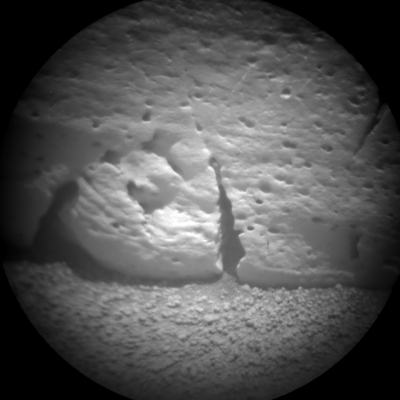
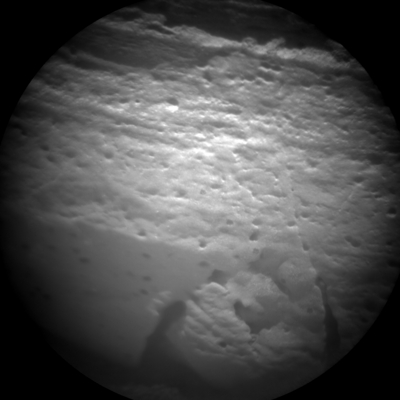
      This was taken on Sol 57 (4 October 2012) of target Rocknest3 using the ChemCam Remote Micro-Imager (RMI) on the NASA Curiosity rover at a distance of 3.7 m. The image was downlinked to Earth by ESA's Mars Express orbiter via the 35m deep space ESTRACK station in New Norcia, Australia. This image was taken before a series of five ChemCam Laser-Induced Breakdown Spectrometer (LIBS) observations. Rocknest is the name of the area where Curiosity stopped for a month to perform its first mobile laboratory analyses on soil scooped from a small sand dune. Rocknest3 was a convenient nearby target of which ChemCam made more than thirty observations overall consisting of 1,500 laser shots; it was also interrogated by the arm-mounted Alpha Particle X-ray Spectrometer (APXS) instrument. 
      Credits: NASA/JPL-Caltech/LANL/CNES/IRAP

      Por primera vez, la sonda europea Mars Express ha retransmitido los datos científicos generados por el vehículo Curiosity de la NASA, en la superficie de Marte. Estas imágenes de ‘Rocknest3’ fueron recibidas a través de la antena de espacio profundo de la ESA en Australia.

      Esta retransmisión marca un pequeño pero importante paso en la cooperación interplanetaria entre las dos agencias espaciales.
      El pasado día 6 de octubre, la sonda Mars Express de la ESA apuntó su Antena de Comunicaciones con el Módulo de Aterrizaje hacia la superficie de Marte para recibir la señal enviada por Curiosity.
      El vehículo de la NASA transmitió datos científicos al satélite de la ESA durante 15 minutos. Unas pocas horas más tarde, Mars Express maniobró para apuntar su antena de alta ganancia hacia la Tierra, y empezó a retransmitir la preciada información al Centro Europeo de Operaciones Espaciales en Darmstadt, Alemania, a través de la antena de 35 metros de diámetro que la ESA tiene en Nueva Norcia, Australia.  

      Los datos se pusieron inmediatamente a disposición del laboratorio JPL de la NASA en California, donde fueron procesados y analizados. Una vez más, ha quedado demostrado que el nuevo vehículo de la NASA es capaz de hablar con el veterano satélite europeo.
       

      El instrumento ChemCam de Curiosity estudia Rocknest3

      Entre los datos retransmitidos se encontraban dos imágenes extremadamente interesantes, tomadas el 4 de octubre por el instrumento ChemCam de Curiosity.
       

      ChemCam está compuesto por una cámara y por un espectrómetro de colapso inducido por láser, que dispara a un objetivo y analiza la composición química del material vaporizado.
      El láser es capaz de apuntar a objetivos de menos de 1 milímetro de diámetro, sobre la superficie de rocas o del suelo marciano. El análisis espectrométrico aporta información sobre la microestructura y los minerales presentes en la roca.
      ESA's Mars Express relays Rocknest3 images from NASA Curiosity
       Imagen de Rocknest3 retransmitida por Mars Express
      Download:
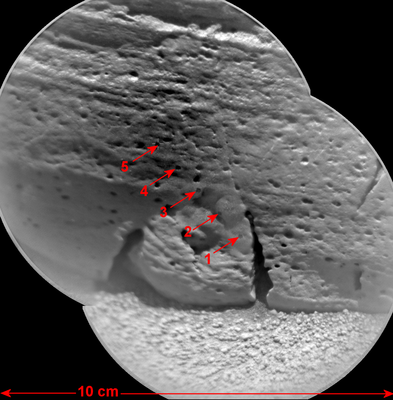
      This was taken on Sol 57 (4 October 2012) of target Rocknest3 using the ChemCam Remote Micro-Imager (RMI) on the NASA Curiosity rover at a distance of 3.7 m. The image was downlinked to Earth by ESA's Mars Express orbiter via the 35m deep space ESTRACK station in New Norcia, Australia. This image was taken after a series of five ChemCam Laser-Induced Breakdown Spectrometer (LIBS) observations. Rocknest is the name of the area where Curiosity stopped for a month to perform its first mobile laboratory analyses on soil scooped from a small sand dune. Rocknest3 was a convenient nearby target of which ChemCam made more than thirty observations overall consisting of 1,500 laser shots; it was also interrogated by the arm-mounted Alpha Particle X-ray Spectrometer (APXSI instrument. 
      Credits: NASA/JPL-Caltech/LANL/CNES/IRAP
       
      Una calidad de imagen excepcional

      La primera imagen (al comienzo de este artículo) fue tomada antes de que ChemCam realizase una ráfaga de cinco disparos, y la segunda (a la derecha) al concluir el análisis. La imagen está centrada en el quinto punto de observación.
      “La calidad de estas imágenes de ChemCam es excepcional; la combinación de las imágenes con los resultados del espectrómetro ha sido clave para la interpretación científica de los datos”, explica Sylvestre Maurice, Investigador Principal Adjunto de ChemCam en el Instituto Francés de Investigación en Astrofísica y Planetología (IRAP).
      “La combinación de imágenes con los resultados de los análisis ha demostrado tener un gran potencial para su implementación en futuras misiones”.
      ESA's Mars Express relays Rocknest3 images from NASA Curiosity
      Objetivos del laser sobre Rocknest3
      Download:
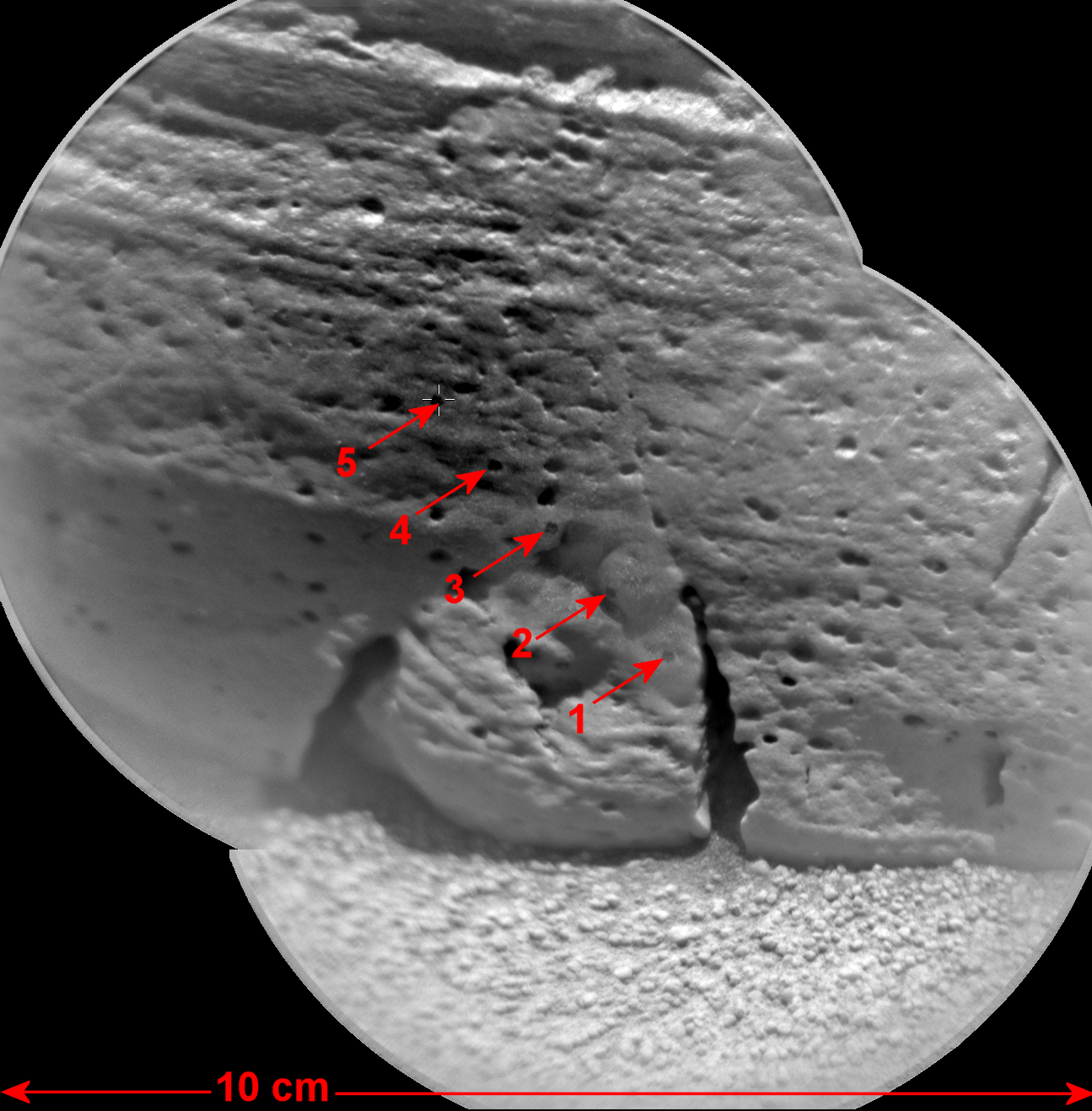
       This mosaic combines the multiple RMI images and indicates the locations of the LIBS laser observations. Credits: NASA/JPL–Caltech/LANL/CNES/IRAP/LPGN/CNRS
      Los objetivos de ChemCam

      Una tercera imagen, retransmitida de forma independiente por la NASA, muestra la ubicación de los objetivos de ChemCam sobre Rocknest3, vista desde la cámara RMI. El vehículo Curiosity se detuvo en el lugar bautizado como ‘Rocknest’ durante un mes para llevar a cabo sus primeros análisis de laboratorio sobre las muestras de terreno tomadas de una pequeña duna de arena. Rocknest3 era un objetivo adecuado para ChemCam, que realizó más de 30 mediciones disparando 1500 veces su láser.
       

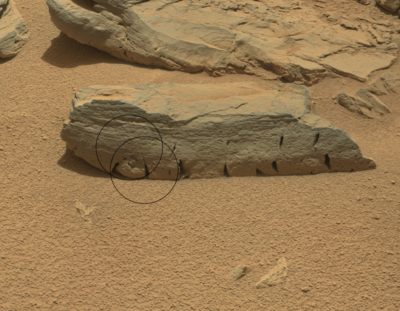
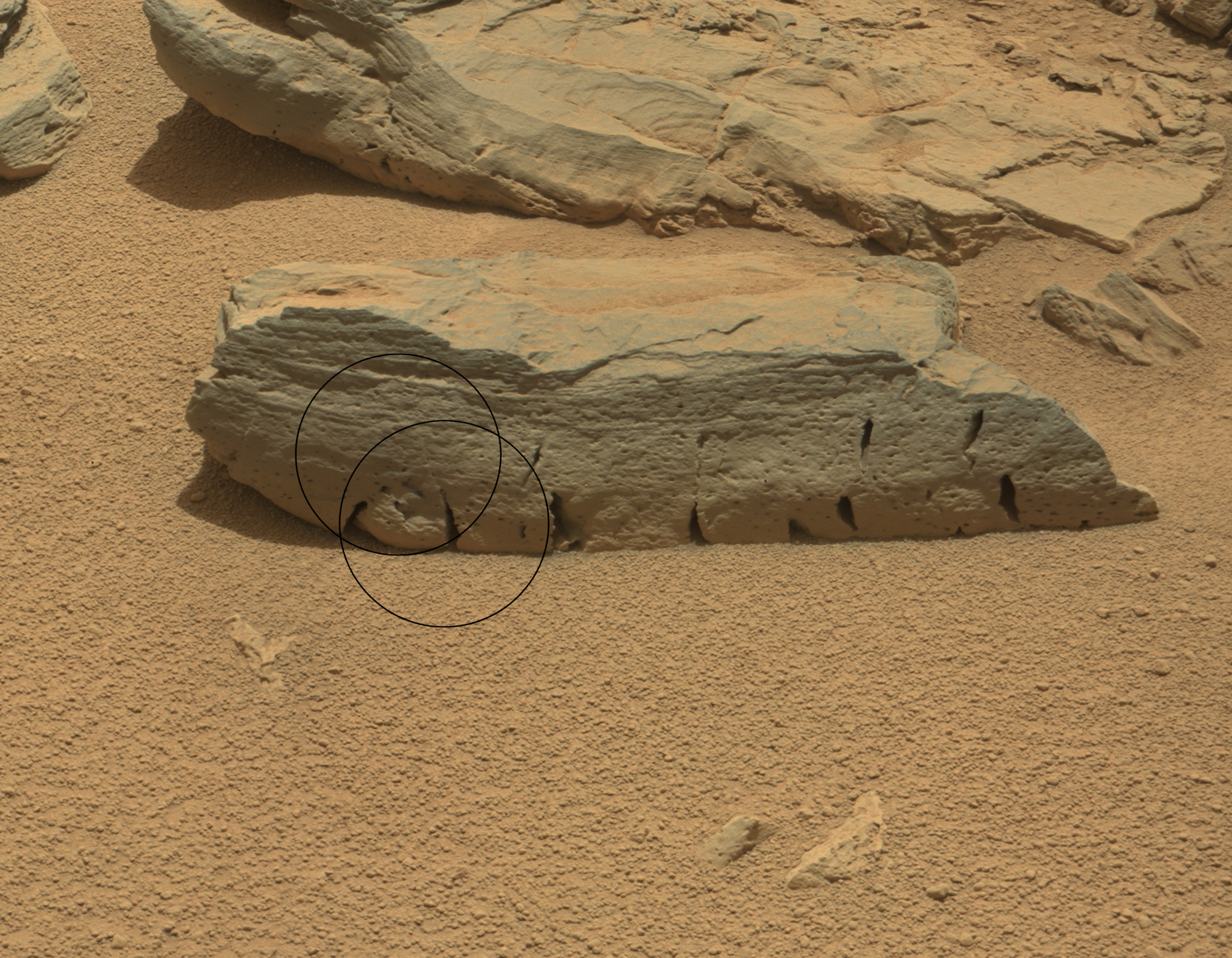
      La cámara MastCam de Curiosity tomó una imagen en gran angular para poner en contexto las observaciones de ChemCam. En ella se ve a Rocknest3, una roca de unos 10 x 40 centímetros, aproximadamente del tamaño de una caja de zapatos.
        Ayudando a Curiosity – y a otros
      ESA's Mars Express relays Rocknest3 images from NASA Curiosity
       Rocknest3
      Download:
      Context image: The Mastcam 100 colour image shows Rocknest3 targeted by ChemCam and later by APXS; the fields of view of the RMI images are indicated. Rocknest3 is approximately 10 x 40 cm or roughly the size of a shoebox. 
      Credits: NASA/JPL–Caltech/Malin Space Science Systems
       
      La sonda Mars Express de la ESA también retransmitió datos de las otras misiones de la NASA sobre la superficie de Marte – Phoenix, Spirit y Opportunity – y registró la señal de Curiosity durante su llegada a Marte el pasado mes de agosto.
      Durante la misión de Curiosity, está previsto que Mars Express retransmita su señal en más ocasiones, en paralelo con su propio programa de observaciones científicas, a través de un acuerdo de cooperación suscrito entre la ESA y la NASA.
      Mars Express también puede proporcionar servicios de retransmisión rápidamente si los satélites de la NASA no se encontrasen disponibles o si se detectase algún problema en el vehículo.
       

      Cooperación interplanetaria

      “La cooperación ESA-NASA en Marte sigue siendo todo un éxito, y es posible gracias a que ambas partes han estado trabajando durante años para definir los estándares técnicos e ingenieriles que hacen posible compartir datos entre los satélites y las estaciones de seguimiento”, explica Michel Denis, Responsable de las Operaciones del Satélite Mars Express.
      “La exploración de Marte es un gran reto. Para afrontarlo, las agencias espaciales están trabajando para impulsar la cooperación y el apoyo mutuo en las misiones actuales y venideras. Es como se hará en el futuro”. 
      ESA
      Guillermo Gonzalo Sánchez Achutegui
      ayabaca@gmail.com
      ayabaca@hotmail.com
      ayabaca@yahoo.com