domingo, 19 de mayo de 2013

NASA - Sierra Nevada Corporation Dream Chaser Testing Begins at NASA Dryden, Langley

SNC Dream Chaser Testing Begins at NASA's Dryden, Langley
05.15.13
 
SNC's Dream Chaser is packed for shipment to DrydenImage above: Sierra Nevada Corporation (SNC) Space Systems' Dream Chaser engineering test article is prepared for shipment at the company's facility in Louisville, Colo. Image credit: SNC › View Larger Image
Sierra Nevada Corporation's (SNC) Space Systems Dream Chaser flight vehicle arrived at NASA's Dryden Flight Research Center in Edwards, Calif., Wednesday to begin tests of its flight and runway landing systems.
 The tests are part of pre-negotiated, paid-for-performance milestones with NASA's Commercial Crew Program (CCP), which is facilitating U.S.-led companies' development of spacecraft and rockets that can launch from American soil. The overall goal of CCP is to achieve safe, reliable and cost-effective U.S. human access to and from the International Space Station and low-Earth orbit.
 Tests at Dryden will include tow, captive-carry and free-flight tests of the Dream Chaser. A truck will tow the craft down a runway to validate performance of the nose strut, brakes and tires. The captive-carry flights will further examine the loads it will encounter during flight as it is carried by an Erickson Skycrane helicopter. The free flight later this year will test Dream Chaser's aerodynamics through landing. 
 Meanwhile, on the east coast, several NASA astronauts will be at the agency's Langley Research Center in Hampton, Va., this week to fly simulations of a Dream Chaser approach and landing to help evaluate the spacecraft's subsonic handling. The test will measure how well the spacecraft would handle in a number of different atmospheric conditions and assess its guidance and navigation performance.
 "Unique public-private partnerships like the one between NASA and Sierra Nevada Corporation are creating an industry capable of building the next generation of rockets and spacecraft that will carry U.S. astronauts to the scientific proving ground of low-Earth orbit," said William Gerstenmaier, NASA's associate administrator for human exploration and operations in Washington. "NASA centers around the country paved the way for 50 years of American human spaceflight, and they're actively working with our partners to test innovative commercial space systems that will continue to ensure American leadership in exploration and discovery." 
 The Dream Chaser Space System is based on Langley's Horizontal Lander HL-20 lifting body design concept. The design builds on years of analysis and wind tunnel testing by Langley engineers during the 1980s and 1990s. Langley and SNC joined forces six years ago to update the HL-20 design in the Dream Chaser orbital crew vehicle. In those years, SNC worked with the center to refine the spacecraft design. SNC will continue to test models in Langley wind tunnels. Langley researchers also helped develop a cockpit simulator at SNC's facility in Louisville, Colo., and the flight simulations being assessed at the center. 
 NASA is partnered with SNC, Space Exploration Technologies (SpaceX) and The Boeing Company to meet CCP milestones for integrated crew transportation systems under the Commercial Crew Integrated Capability (CCiCap) initiative. Advances made by these companies under their funded Space Act Agreements ultimately are intended to lead to the availability of commercial human spaceflight services for government and commercial companies. 
 While NASA works with U.S. industry partners to develop commercial spaceflight capabilities, the agency also is developing the Orion spacecraft and the Space Launch System (SLS), a crew capsule and heavy-lift rocket to provide an entirely new capability for human exploration. Designed to be flexible for launching spacecraft for crew and cargo missions, SLS and Orion will expand human presence beyond low-Earth orbit and enable new missions of exploration in the solar system. For more information about NASA's Commercial Crew Program, visit:

SNC's Dream Chaser ready to leave Louisville, Colo.
Image above: With its wings and tail structure removed and shrouded in plastic wrap, SNC's Dream Chaser test flight craft is ready to depart Louisville, Colo., atop a flatbed truck and trailer. Image credit: SNC

› View Larger Image
SNC's Dream Chaser crosses the bed of Rogers Dry Lake Image above: SNC's Dream Chaser test flight craft is hauled across the bed of Rogers Dry Lake at Edwards Air Force Base, Calif., to NASA's Dryden Flight Research Center on May 15. Image credit: NASA/Tom Tschida
› View Larger Image
Dryden welcomes SNC's Dream ChaserImage above: NASA's Dryden Flight Research Center welcomes SNC's Dream Chaser engineering test article for a flight test program in collaboration with NASA's Commercial Crew Program this summer. Image credit: NASA/Tom Tschida
› View Larger Image
http://www.nasa.gov/commercialcrew
Candrea Thomas 
NASA's John F. Kennedy Space Center
Candrea.K.Thomas@nasa.gov

Sierra Nevada Corporation Dream Chaser Testing Begins at NASA Dryden, Langley
 
 
EDWARDS, Calif. -- Sierra Nevada Corporation's (SNC) Space Systems Dream Chaser flight vehicle arrived at NASA's Dryden Flight Research Center in Edwards, Calif., Wednesday to begin tests of its flight and runway landing systems.

The tests are part of pre-negotiated, paid-for-performance milestones with NASA's Commercial Crew Program (CCP), which is facilitating U.S.-led companies' development of spacecraft and rockets that can launch from American soil. The overall goal of CCP is to achieve safe, reliable and cost-effective U.S. human access to and from the International Space Station and low-Earth orbit.

Tests at Dryden will include tow, captive-carry and free-flight tests of the Dream Chaser. A truck will tow the craft down a runway to validate performance of the nose strut, brakes and tires. The captive-carry flights will further examine the loads it will encounter during flight as it is carried by an Erickson Skycrane helicopter. The free flight later this year will test Dream Chaser's aerodynamics through landing.

Meanwhile, on the east coast, several NASA astronauts will be at the agency's Langley Research Center in Hampton, Va., this week to fly simulations of a Dream Chaser approach and landing to help evaluate the spacecraft's subsonic handling. The test will measure how well the spacecraft would handle in a number of different atmospheric conditions and assess its guidance and navigation performance.

"Unique public-private partnerships like the one between NASA and Sierra Nevada Corporation are creating an industry capable of building the next generation of rockets and spacecraft that will carry U.S. astronauts to the scientific proving ground of low-Earth orbit," said William Gerstenmaier, NASA's associate administrator for human exploration and operations in Washington. "NASA centers around the country paved the way for 50 years of American human spaceflight, and they're actively working with our partners to test innovative commercial space systems that will continue to ensure American leadership in exploration and discovery."

The Dream Chaser Space System is based on Langley's Horizontal Lander HL-20 lifting body design concept. The design builds on years of analysis and wind tunnel testing by Langley engineers during the 1980s and 1990s. Langley and SNC joined forces six years ago to update the HL-20 design in the Dream Chaser orbital crew vehicle. In those years SNC has worked with the center to refine the spacecraft design. SNC will continue to test models in Langley wind tunnels. Langley researchers also helped develop a cockpit simulator at SNC's facility in Louisville, Colo., and the flight simulations being assessed at the center.

NASA is partnered with SNC, Space Exploration Technologies (SpaceX) and The Boeing Company to meet CCP milestones for integrated crew transportation systems under the Commercial Crew Integrated Capability (CCiCap) initiative. Advances made by these companies under their funded Space Act Agreements ultimately are intended to lead to the availability of commercial human spaceflight services for government and commercial companies.

While NASA works with U.S. industry partners to develop commercial spaceflight capabilities, the agency also is developing the Orion spacecraft and the Space Launch System (SLS), a crew capsule and heavy-lift rocket to provide an entirely new capability for human exploration. Designed to be flexible for launching spacecraft for crew and cargo missions, SLS and Orion will expand human presence beyond low-Earth orbit and enable new missions of exploration in the solar system.

For more information about NASA's Commercial Crew Program, visit:

For more information about Dream Chaser and Sierra Nevada Corp. Space Systems, visit:
 
NASA
Guillermo Gonzalo Sánchez Achutegui
ayabaca@gmail.com
ayabaca@hotmail.com
ayabaca@yahoo.com

NASA - NASA's Asteroid Sample Return Mission Moves into Development


NASA's first mission to sample an asteroid is moving ahead into development and testing in preparation for its launch in 2016.

The Origins-Spectral Interpretation Resource Identification Security Regolith Explorer (OSIRIS-REx) passed a confirmation review Wednesday called Key Decision Point (KDP)-C. NASA officials reviewed a series of detailed project assessments and authorized the spacecraft's continuation into the development phase.
This narrated video provides an overview of the OSIRIS-REx mission, which will observe asteroid Bennu, collect a sample and return it to Earth for study.
Credit: NASA's Goddard Space Flight Center
› Download video in HD formats

OSIRIS-REx will rendezvous with the asteroid Bennu in 2018 and return a sample of it to Earth in 2023.

"Successfully passing KDP-C is a major milestone for the project," said Mike Donnelly, OSIRIS-REx project manager at NASA's Goddard Space Flight Center in Greenbelt, Md. "This means NASA believes we have an executable plan to return a sample from Bennu. It now falls on the project and its development team members to execute that plan."

Bennu could hold clues to the origin of the solar system. OSIRIS-REx will map the asteroid's global properties, measure non-gravitational forces and provide observations that can be compared with data obtained by telescope observations from Earth. OSIRIS-REx will collect a minimum of 2 ounces (60 grams) of surface material.

"The entire OSIRIS-REx team has worked very hard to get to this point," said Dante Lauretta, OSIRIS-REx principal investigator at the University of Arizona in Tucson. "We have a long way to go before we arrive at Bennu, but I have every confidence when we do, we will have built a supremely capable system to return a sample of this primitive asteroid."

The mission will be a vital part of NASA's plans to find, study, capture and relocate an asteroid for exploration by astronauts. NASA recently announced an asteroid initiative proposing a strategy to leverage human and robotic activities for the first human mission to an asteroid while also accelerating efforts to improve detection and characterization of asteroids.

NASA's Goddard Space Flight Center in Greenbelt, Md., will provide overall mission management, systems engineering and safety and mission assurance. The University of Arizona in Tucson is the principal investigator institution. Lockheed Martin Space Systems of Denver will build the spacecraft. OSIRIS-REx is the third mission in NASA's New Frontiers Program. NASA's Marshall Space Flight Center in Huntsville, Ala., manages New Frontiers for NASA's Science Mission Directorate in Washington.

Related Links


Text issued as NASA Headquarters Release No. 13-144

miércoles, 15 de mayo de 2013

NASA - NASA Honors Sally Ride with a National Tribute at Kennedy Center

NASA Offers Condolences on the Passing of Pioneering Astronaut Sally Ride
07.23.12
 
S84-37256: Sally Ride 
Ride's official astronaut portrait. She joined the astronaut corps in 1978. 
Credit: NASA

 Ride floats alongside Challenger's middeck airlock hatch. 
 Ride floats on the shuttle Challenger's mid-deck during her historic STS-7 flight in 1983. 
Credit: NASA
›View Photo Gallery
 
In a space agency filled with trailblazers, Sally K. Ride was a pioneer of a different sort. The soft-spoken California physicist broke the gender barrier 29 years ago when she rode to orbit aboard space shuttle Challenger to become America’s first woman in space.

"Sally Ride broke barriers with grace and professionalism – and literally changed the face of America’s space program," said NASA Administrator Charles Bolden. "The nation has lost one of its finest leaders, teachers and explorers. Our thoughts and prayers are with Sally's family and the many she inspired. She will be missed, but her star will always shine brightly."

“Sally was a personal and professional role model to me and thousands of women around the world,” said NASA Deputy Administrator Lori Garver. “Her spirit and determination will continue to be an inspiration for women everywhere.”

Ride’s contribution to America’s space program continued right up until her death at age 61 this week. After two trips to orbit aboard the shuttle, she went on an award-winning academic career at the University of California, San Diego, where her expertise and wisdom were widely sought on matters related to space. She holds the distinction of being the only person to serve as a member of both investigation boards following NASA’s two space shuttle accidents. She also served as a member of the Review of U.S. Human Spaceflight Plans Committee, also known as the Augustine Committee, in 2009, which informed many of the decisions about NASA’s current human spaceflight programs.

"The selection of the 1978 Astronaut Class that included Sally and several other women, had a huge impact on my dream to become an astronaut. The success of those woman, with Sally paving the way, made my dream seem one step closer to becoming a reality," said Peggy Whitson, Chief of the NASA Astronaut Office.

However, Ride’s place in history was assured on June 18, 1983, when she rocketed into space on Challenger’s STS-7 mission with four male crewmates.

“The fact that I was going to be the first American woman to go into space carried huge expectations along with it,” Ride recalled in an interview for the 25th anniversary of her flight in 2008. “That was made pretty clear the day that I was told I was selected as a crew. I was taken up to Chris Kraft’s office. He wanted to have a chat with me and make sure I knew what I was getting into before I went on the crew. I was so dazzled to be on the crew and go into space I remembered very little of what he said.”

“On launch day, there was so much excitement and so much happening around us in crew quarters, even on the way to the launch pad,” Ride said. “I didn’t really think about it that much at the time . . . but I came to appreciate what an honor it was to be selected to be the first to get a chance to go into space.”

Ride joined NASA as part of the 1978 astronaut class, the first to include women. She and five other women, along with 29 men, were selected out of 8,000 applicants. The class became known as the “Thirty-Five New Guys” and reported to the Johnson Space Center the next summer to begin training. Ride trained for five years before she and three of her classmates were assigned to STS-7. The six-day mission deployed two communications satellites and performed a number of science experiments.

Watch Ride Talk About Looking At Earth During Her Two Shuttle Missions:

Following that historic flight, Ride returned to space on another shuttle mission, STS-41G in 1984. The 8-day mission deployed the Earth Radiation Budget Satellite, conducted scientific observations of Earth, and demonstrated potential satellite refueling techniques. She was assigned to a third flight, but transitioned to a role on the Rogers Commission that investigated the Challenger accident after that shuttle was lost in January 1986. When the investigation was completed, she accepted a job as a special assistant to the NASA administrator for long range and strategic planning.

Ride left NASA in August 1987 to join the faculty at the University of California, San Diego, as a professor of physics and director of the University of California’s California Space Institute. In 2001, she founded her own company, Sally Ride Science, to pursue her long-time passion of motivating girls and young women to pursue careers in science, math and technology.

A native of Los Angeles, Ride graduated from high school there in 1968 and enrolled at Stanford University. At Stanford, she earned four degrees, including a doctorate in physics in 1978. She also was an accomplished athlete who played varsity tennis at Stanford after being nationally ranked as a youth.

Ride received numerous honors and awards during the course of her career. Most notably, she was inducted into the National Women's Hall of Fame and the Astronaut Hall of Fame, and received the Jefferson Award for Public Service, the von Braun Award, the Lindbergh Eagle, and the NCAA’s Theodore Roosevelt Award.
 NASA Honors Sally Ride with a National Tribute at Kennedy Center
 
 WASHINGTON -- NASA and Sally Ride Science are inviting the general public and journalists to "Sally Ride: A Lifetime of Accomplishment, A Champion of Science Literacy," an educational tribute to America's first woman in space on Monday, May 20. The special event will be held at the John F. Kennedy Center for the Performing Arts, 2700 F Street, N.W., Washington, D.C., at 7 p.m. EDT.

The celebration will highlight Ride's contributions and her legacies. These include her long-time focus on education, and her passion for inspiring girls and under-represented minority students to become scientifically literate and consider pursuing careers in science, technology, engineering, and math (STEM).

The tribute will include the talents of Patti Austin, Damian Kulash of the band OK Go, Maria Shriver, Emil de Cou and Billie Jean King, with music by Tena Clark and choreography by Twyla Tharp. Talented students who will perform include the Maryland Classic Youth Orchestra, the Centreville High School Choral Union from Virginia and dancers from the University of North Carolina School of the Arts. NASA Administrator Charles Bolden, NASA Associate Administrator for Education Leland Melvin and former astronaut Pam Melroy will be among those speaking about Ride's lifetime accomplishments. The tribute is presented and sponsored by Sally Ride Science.

A limited number of tickets is available for the general public on a first-come, first-served basis. To attend the free event, complete this online RSVP Form by Wednesday, May 15. Please indicate if you need wheelchair access. Tickets for those who RSVP will be available at NASA's Will Call tables, which will be staffed in front of the Concert Hall (in the Grand Foyer) from 5 to 6:15 p.m. Monday, May 20.

Reporters, who would like to cover the event, must contact Cynthia Myers at Sally Ride Science at cindy.myers360@gmail.com or at 415-378-0294 or Allard Beutel at NASA by 3 p.m. on Friday, May 17.

The Smithsonian's National Air and Space Museum and Sally Ride Science are hosting a panel discussion as a salute to Women in Science. “Sally Ride: How Her Historic Mission Opened Doors for Women in Science” will be held in the museum's Moving Beyond Earth gallery at 10:30 a.m. Friday, May 17. The panel will be broadcast live on NASA Television and the agency's website. The panel includes NASA Johnson Space Center Director and former astronaut Ellen Ochoa, Dan Vergano of USA Today, Rene McCormick of the National Math and Science Initiative, and National Air and Space Museum curator Margaret Weitekamp. The discussion is hosted by NBC News' Tom Costello.

Media interested in covering the panel discussion should contact Cynthia Myers or Isabel Lara with National Air and Space Museum media relations at 202-633-2374 or LaraI@si.edu.

For more information about Sally Ride, visit:

http://go.nasa.gov/Ocn6h7

For more information about Sally Ride Science, visit:

http://www.sallyridescience.com

For more information about the Smithsonian National Air and Space Museum, visit:

http://www.airandspace.si.edu

For NASA TV streaming video, schedules and downlink information, visit:

http://www.nasa.gov/ntv
 
Sally K. Ride (Ph.D.)
NASA Astronaut (DECEASED)
PERSONAL DATA: Born May 26, 1951, in Los Angeles, California. Died on July 23, 2012. She is survived by Tam O'Shaughnessy, her partner of 27 years; her mother, Joyce Ride; her sister, Bear; her niece, Caitlin and her nephew, Whitney. Her father, Dale B. Ride, is deceased. She enjoyed tennis (having been an instructor and having achieved national ranking as a junior), running, volleyball, softball and stamp collecting.
EDUCATION: Graduated from Westlake High School, Los Angeles, California, in 1968; received from Stanford University a Bachelor of Science in Physics and a Bachelor of Arts in English in 1973 and a Master of Science and Doctorate in Physics in 1975 and 1978, respectively.
EXPERIENCE: Dr. Ride was selected as an astronaut candidate by NASA in January 1978. In August 1979, she completed a one-year training and evaluation period, making her eligible for assignment as a Mission Specialist on future space shuttle flight crews. She subsequently performed as an on-orbit Capsule Communicator (CAPCOM) on the STS-2 and STS-3 missions.
Dr. Ride was a Mission Specialist on STS-7, which launched from Kennedy Space Center, Florida, on June 18, 1983. She was accompanied by Captain Robert L. Crippen (spacecraft commander), Captain Frederick H. Hauck (pilot), and fellow Mission Specialists, Colonel John M. Fabian and Dr. Norman E. Thagard. This was the second flight for the orbiter Challenger and the first mission with a five-person crew. During the mission, the STS-7 crew deployed satellites for Canada (ANIK C-2) and Indonesia (PALAPA B-1); operated the Canadian-built Remote Manipulator System (RMS) to perform the first deployment and retrieval exercise with the Shuttle Pallet Satellite (SPAS-01); conducted the first formation flying of the orbiter with a free-flying satellite (SPAS-01); carried and operated the first U.S./German cooperative materials science payload (OSTA-2) and operated the Continuous Flow Electrophoresis System (CFES) and the Monodisperse Latex Reactor (MLR) experiments, in addition to activating seven Getaway Specials. Mission duration was 147 hours before landing on a lakebed runway at Edwards Air Force Base, California, on June 24, 1983.
Dr. Ride served as a Mission Specialist on STS 41-G, which launched from Kennedy Space Center on October 5, 1984. This was the largest crew to fly to date and included Captain Robert L. Crippen (spacecraft commander), Captain Jon A. McBride (pilot), fellow Mission Specialists, Dr. Kathryn D. Sullivan and Commander David C. Leestma, as well as two payloads specialists, Commander Marc Garneau and Paul Scully-Power. Their eight-day mission deployed the Earth Radiation Budget Satellite, conducted scientific observations of the Earth with the OSTS-3 pallet and Large Format Camera and as demonstrated potential satellite refueling with a spacewalk and associated hydrazine transfer. Mission duration was 197 hours and concluded with a landing at Kennedy Space Center on October 13, 1984.
In June 1985, Dr. Ride was assigned to the crew of STS 61-M. Mission training was terminated in January 1986 following the space shuttle Challenger accident. Dr. Ride served as a member of the Presidential Commission investigating the accident. Upon completion of the investigation, she was assigned to NASA Headquarters as Special Assistant to the Administrator for long-range and strategic planning.
In 1989, Dr. Ride joined the faculty at the University of California San Diego as a Professor of Physics and Director of the University of California's California Space Institute. In 2001, she founded her own company, Sally Ride Science to pursue her long-time passion of motivating girls and young women to pursue careers in science, math and technology. The company creates entertaining science programs and publications for upper elementary and middle school students and their parents and teachers.
A long-time advocate for improved science education, Dr. Ride has written five science books for children: To Space and Back; Voyager; The Third Planet; The Mystery of Mars and Exploring Our Solar System. She has also initiated and directed education projects designed to fuel middle school students' fascination with science.
Dr. Ride was a member of the President's Committee of Advisors on Science and Technology and the National Research Council's Space Studies Board and has served on the boards of the Congressional Office of Technology Assessment, the Carnegie Institution of Washington and the National Collegiate Athletic Association (NCAA) Foundation. Dr. Ride is a Fellow of the American Physical Society, a member of the Pacific Council on International Policy and served on the boards of the Aerospace Corporation and the California Institute of Technology. She is the only person to have served on the commissions investigating both the space shuttle Challenger and Columbia accidents.
Dr. Ride received numerous honors and awards. She was inducted into the National Women's Hall of Fame and the Astronaut Hall of Fame and has received the Jefferson Award for Public Service, the von Braun Award, the Lindbergh Eagle and the NCAA's Theodore Roosevelt Award. She has also twice been awarded the NASA Space Flight Medal.
JULY 2012
This is the only version available from NASA.
NASA
Guillermo Gonzalo Sanchez Achutegui
ayabaca@gmail.com
ayabaca@hotmail.com
ayabaca@yahoo.com

sábado, 11 de mayo de 2013

nsf.gov - National Science Foundation - Life on a Coral Reef: Insult Is (Sometimes) Added to Injury

Hola amigos: AL VUELO DE UN QUINDE EL BLOG., hemos recibido  información del National Science Foundation NSF, sobre la vida en un pequeño arrecife de Coral y como las esponjas de coral son sometidas a un predator que es  un pes llamado: the "yuk factor." en la Pequeña Isla Caymán.
Les invito a lEer la versión original en inglés del National Science Foundation NSF

Giant barrel sponges off Little Cayman Island in the Caribbean next to a researcher.
Giant barrel sponges off Little Cayman Island in the Caribbean dwarf researchers.
Credit: Joe Pawlik, UNCW
Download the high-resolution JPG version of the image. (4.5 MB)


Scientists research chemical defenses in tube sponges off Little Cayman Island.
Credit: Joe Pawlik, UNCW
Download the high-resolution JPG version of the image. (4.1 MB)

Close up of an orange sponge
Predatory fish prevent orange sponges from smothering corals.
Credit: Joe Pawlik, UNCW
Download the high-resolution JPG version of the image. (2.9 MB)
Sponge growth experiment underway on Conch Reef, Key Largo, Florida.
Credit: Joe Pawlik, UNCW
Download the high-resolution JPG version of the image. (6.1 MB)

Diver surveys a gray tube sponge with "bite marks" from angelfish
Gray tube sponge with "bite marks" from angelfish off Grand Cayman Island.
Credit: Joe Pawlik, UNCW
Download the high-resolution JPG version of the image. (3.8 MB)


Reef-building corals overgrown by orange sponges on an overfished reef off Martinique.
Credit: Joe Pawlik, UNCW
Download the high-resolution JPG version of the image. (5.5 MB)

When is insult added to injury for a Caribbean coral reef?
When overfishing removes predatory fish that feed on sponges, according to results reported this week in the journal PLOS ONE.
Using the undersea habitat Aquarius--moored on Conch Reef off Key Largo, Florida--marine scientist Joseph Pawlik of the University of North Carolina Wilmington (UNCW) and colleagues found that these predator-fish are the same brightly colored angelfish and parrotfish that attract scuba divers and glass-bottom boat tourists.
Pawlik is first author of the PLOS ONE paper; co-authors, all from UNCW, are Tse-Lynn Loh, Steven McMurray and Christopher Finelli.
Chemical warfare beneath the waves
The fish prey on sponges without chemical defenses--sponges missing what might be called the "yuk factor."
"Sponges that manufacture metabolites that are distasteful to fish are largely left alone," says Pawlik.
"That being said, when overfishing by humans removes these predatory fish, reefs shift toward faster-growing sponges that can out-compete reef corals for space.
"That further hinders corals' chances of recovery."
Coral cover on Caribbean reefs is at historic lows due to disease, heat stress from warming waters and waves from storms.
Undersea garden of sponges
"Coral reefs, especially in the Caribbean, have undergone many changes in the past few decades," says David Garrison, program director in the National Science Foundation's (NSF) Division of Ocean Sciences, which funded the research.
"With the decline of reef-building corals, sponges are becoming the main organisms on many reefs. These findings provide important information about interactions between sponges and predatory fish in coral reef communities."
Previous research showed that Caribbean sponge communities were primarily structured by the availability of plankton, or tiny floating plants and animals, rather than by predators.
But sponge growth experiments performed by Pawlik and colleagues--research that used cages to exclude predators--show the opposite.
"Overfished reefs that lack spongivores [sponge-eating fish] soon become dominated by faster-growing, chemically undefended sponge species, which better compete for space with reef-building corals," says Pawlik.
Endangered corals: threatened by 'new game in town'?
That has implications for fisheries management throughout the Caribbean.
"Some coral species are listed as critically endangered on the IUCN [International Union for Conservation of Nature] Red List, with four reef-building corals on the top ten list for risk of extinction."
Sponges are already overrunning certain coral reefs.
"As the effects of climate change and ocean acidification disrupt marine communities," says Pawlik, "it's likely that reef-building corals will suffer greater harm than sponges, which don't form at-risk limestone skeletons [as corals do]."
Hence, he believes, Caribbean reefs of the future are likely to be made up increasingly of sponges.
Scuba divers and glass-bottom boat tourists may visit not to view coral reefs, but to see the new game in town: the sponges.
--  Cheryl Dybas, NSF (703) 292-7734 cdybas@nsf.gov
Related Websites
NSF Discovery Article: Trouble in Paradise: Ocean Acidification This Way Comes: http://www.nsf.gov/discoveries/disc_summ.jsp?cntn_id=122642&org=NSF
 
Guillermo Gonzalo Sánchez Achutegui
ayabaca@gmail.com
ayabaca@hotmail.com
ayabaca@yahoo.com 

martes, 7 de mayo de 2013

ESA - International effort helps users get ready for Sentinel-1


Vancouver harbour, Canada


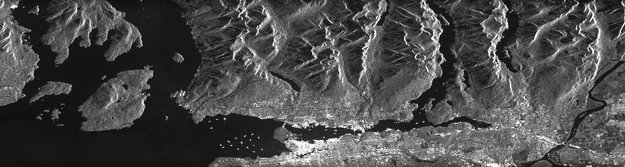
 This radar image of Vancouver harbour was acquired by Canada’s Radarsat-2. Owned and operated by McDonald, Dettwiler and Associates, Radarsat-2 was carefully reprogrammed to match the way Europe’s upcoming Sentinel-1satellite will image Earth and show the quality of images that can be expected.-
Those who need satellite data for a wide range of applications, from mapping sea ice and tracking maritime traffic to monitoring geohazards over land, are eagerly awaiting the launch of Sentinel-1. ESA is helping users get ahead of the game by offering test data and simulated images.

To be launched later this year, Sentinel-1 is the first of five satellite missions dedicated to supplying a stream of data for Europe’s Global Monitoring for Environment and Security ‘Copernicus’ programme. 
This particular satellite will provide timely high-quality radar images of our planet’s surface to support European operational services that use Earth observation data in areas such as emergency response, marine and land monitoring, civil security and climate studies.
Sentinel-1
Getting ready for using Sentinel data is a complex task. The new data format and information structure, the increased data volume, the expected data quality and sensor characteristics all mean that users have to develop or update processing facilities before the launch.
An important step forward in this respect is the availability of simulated products and documentation to users. ESA is responding to these needs in two ways.
Firstly, ESA has just released a sample of Sentinel-1 simulated user products and associated format and product definition documents to GMES users. In addition, the Agency is planning a further distribution to all potential users in the coming weeks.
Simulated Sentinel-1 data
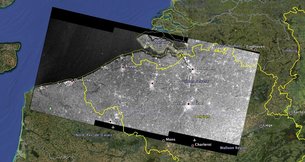
This first release contains a set of simulated radar intensity ‘Level-1’ products, covering all four Sentinel-1 imaging modes and different product types. An example is shown by way of the image of the Netherlands on the right.
Notably, these products were generated by a preliminary version of Sentinel-1’s operational Instrument Processing Facility.
Though they are not intended to reflect the final characteristics of the user products, the format and contents are representative of what the mission will offer.
This will evolve with new versions of the facility and may be slightly tuned following system qualification and inflight commissioning.

Joel Dorandeu from MyOcean said, “We very much welcome the efforts being made to help service providers such as us prepare for the new data from Sentinel-1.
“Considering the volumes of data we expect from Sentinel-1 along with its method of acquisition we have the challenge of developing new processing chains.
“We are now eager to start simulating our products."
To complement this initial release of test data, ESA is, in parallel, simulating Sentinel-1 acquisitions from space using Canada’s Radarsat-2 satellite.
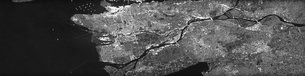
Vancouver radar image

This initiative is now starting to bear fruit following the first full simulation of a Sentinel-1 radar image as shown in picture at the top and here on the left.
Thanks to its owner and operator, McDonald, Dettwiler and Associates, Radarsat-2 was carefully reprogrammed to match the way Sentinel-1 will be operated. A remarkable achievement is the fact that Radarsat was able to emulate the way Sentinel-1 images Earth’s surface using a method called TOPS, thus providing a quality of image almost exactly the same as Sentinel-1.
The very first results are promising, as can be seen in the images acquired over Vancouver harbour on the west coast of Canada. The city is clearly visible, as are the ships docked in the harbour, the coastline and the nearby mountain ranges.
The acquisition of more images over specific test sites are planned to demonstrate the suitability of Sentinel-1 for classifying sea-ice, for applications using ocean winds and waves, and for detecting ships, thereby preparing users for the uptake of data.
Dedicated acquisitions of image pairs and data stacks suitable for measuring surface movements such as glacier dynamics and subsidence are also planned to take place in the coming months.
As for the current set of test data, the Radarsat-2 simulated images will also be processed and formatted using the Sentinel-1 Instrument Processing Facility and made available to users shortly.


Sentinel-1
The Sentinel-1 mission is a polar-orbiting satellite system for the continuation of Synthetic Aperture Radar (SAR) operational applications.
Sentinel-1 is a C-band imaging radar mission to provide an all-weather day-and-night supply of imagery for GMES user services. The first Sentinel-1 satellite is envisaged to launch in 2013 and will be followed by the second satellite a few years later.
Dedicated to GMES, Sentinel-1 will ensure the continuity of C-band SAR data, building on ESA’s and Canada’s heritage SAR systems on ERS-1, ERS-2, Envisat and Radarsat.
The SAR sensor will operate in two main modes: Interferometric Wide Swath and Wave. The first has a swath width of 250 km and a ground resolution of 5×20 m. These two modes will satisfy most of the envisaged service requirements. Two other mutually exclusive modes are provided for continuity with other SAR missions and to accommodate emerging user requirements.
Sentinel-1's revisit time, geographical coverage and rapid data dissemination are key to providing essential data for GMES. The Sentinel-1 pair is expected to provide coverage over Europe, Canada and main shipping routes in 1–3 days, regardless of weather conditions. Radar data will be delivered within an hour of acquisition – a big improvement over existing SAR systems.
Sentinel-1 will aid sea-ice monitoring
The mission will benefit numerous services. For example, services that relate to the monitoring of Arctic sea-ice extent, routine sea-ice mapping, surveillance of the marine environment, including oil-spill monitoring and ship detection for maritime security, monitoring land-surface for motion risks, mapping for forest, water and soil management and mapping to support humanitarian aid and crisis situations.
The design of the Sentinel-1 mission with its focus on reliability, operational stability, global coverage, consistent operations and quick data delivery is expected to enable the development of new applications and meet the evolving needs of GMES.
Sentinel-1 is being realised by an industrial consortium led by Thales Alenia Space Italy as Prime Contractor, with Astrium Germany responsible for the C-SAR payload incorporating the central radar electronics subsystem developed by Astrium UK.
Sentinel-1 will be launched on a Soyuz rocket from Europe's Spaceport in French Guiana.
ESA
Guillermo Gonzalo Sánchez Achutegui
ayabaca@gmail.com
ayabaca@hotmail.com
ayabaca@yahoo.com

NASA - Orion Crew Module at Kennedy Space Center


 Download Image 

› Full Size

 NASA
Guillermo Gonzalo Sánchez Achutegui
ayabaca@gmail.com
ayabaca@hotmail.com
ayabaca@yahoo.com

lunes, 29 de abril de 2013

ESA - Proba-V on Vega

Hi my Friends: AL VUELO DE UN QUINDE EL BLOG., ESA’s Vega VV02 rocket is now fully assembled on its launch pad, 22 April, 2013. Final preparations are in full swing for the rocket’s inaugural flight.

Fully assembled Vega VV02 on pad ESA’s Vega VV02 rocket is now fully assembled on its launch pad, 22 April, 2013. Final preparations are in full swing for the rocket’s flight.
Vega VV02 is the first of the five flights scheduled in ESA’s Vega Research and Technology Accompaniment – VERTA – programme, which aims to demonstrate the flexibility of the launch system. At a minimum rate of two launches per year, the programme will allow the smooth introduction of Vega for commercial exploitation.
VV02 will loft Proba-V, the first of four ESA missions, into space. Proba-V carries a reduced version of the Vegetation instrument currently flying on the Spot satellites to provide a daily overview of global vegetation growth.
This first VERTA flight will also demonstrate Vega's capability to launch multiple payloads. The second payload is the Vietnam Natural Resources, Environment and Disaster Monitoring Satellite (VNREDSAT) built by Astrium for the Vietnamese government.
Vega VV02 is scheduled for liftoff from the Spaceport on 4 May, 2013 (GMT).
Credits: ESA–S. Corvaja, 2013


25 April 2013 ESA’s Proba-V and its two companion satellites are sitting on top of their Vega rocket on the launch pad, ready for a flight rescheduled to the night of 3/4 May.
To carry out additional checks on the mobile gantry used at the Vega complex at Europe’s Spaceport in Kourou, French Guiana, ESA and Arianespace have decided to postpone flight VV02 for 24 hours.
Last glimpse of Proba-V
Liftoff is now scheduled for the night of 3/4 May at 02:06:31 GMT on 4 May (04:06:31 CEST 4 May; 23:06:31 local time 3 May).
On 15 April Proba-V was fixed to the Vespa secondary payload adapter, above Vietnam’s VNREDSat-1 Earth observation satellite and the ESTCube-1 Estonian student nanosatellite.
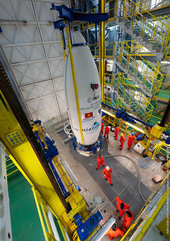
Two days later this entire stack was enclosed within Vega’s protective fairing. On 19 April the ‘upper composite’ was transported to the mobile launch tower, where it was hoisted up to the top platform.
The assembly was attached to Vega the following day, sitting above the reignitable upper stage that will steer the trio of satellites to their various orbits.
The mobile launch tower was retracted on Tuesday, leaving the completed rocket in place on the pad ready for a full checkout.
Upper composite installed atop Vega
Proba-V will be the first of the three satellites deployed from the upper stage. Occupying less than a cubic metre, it is a miniaturised ESA satellite tasked with a full-scale mission: to map land cover and vegetation across the entire planet every two days.
This new, advanced version of the Vegetation camera is the latest in a series already in service on France’s full-sized Spot-4 and Spot-5 satellites, which have been observing Earth since 1998.
The minisatellite will provide data to the camera’s worldwide user community of scientists and service providers as soon as it is commissioned in orbit.
This second flight marks the start of the Vega Research and Technology Accompaniment programme, or VERTA, to demonstrate the flexibility and versatility of the vehicle. At a planned minimum of two launches per year, the programme will allow the smooth transition of Vega into commercial exploitation.
ESA
Guillermo Gonzalo Sánchez Achutegui
ayabaca@gmail.com
ayabaca@hotmail.com
ayabaca@yahoo.com