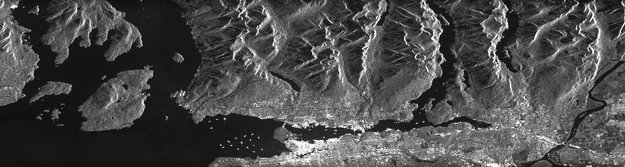
Vancouver harbour, Canada
This radar image of Vancouver harbour was acquired by Canada’s
Radarsat-2. Owned and operated by McDonald, Dettwiler and Associates,
Radarsat-2 was carefully reprogrammed to match the way Europe’s upcoming
Sentinel-1satellite will image Earth and show the quality of images
that can be expected.-
Those who need satellite data for a wide range of applications, from
mapping sea ice and tracking maritime traffic to monitoring geohazards
over land, are eagerly awaiting the launch of Sentinel-1. ESA is helping
users get ahead of the game by offering test data and simulated images.
To be launched later this year, Sentinel-1 is the first of five
satellite missions dedicated to supplying a stream of data for Europe’s
Global Monitoring for Environment and Security ‘Copernicus’ programme.
This particular satellite will provide timely high-quality radar images
of our planet’s surface to support European operational services that
use Earth observation data in areas such as emergency response, marine
and land monitoring, civil security and climate studies.

Sentinel-1
Getting ready for using Sentinel data is a complex task. The new data
format and information structure, the increased data volume, the
expected data quality and sensor characteristics all mean that users
have to develop or update processing facilities before the launch.
An important step forward in this respect is the availability of
simulated products and documentation to users. ESA is responding to
these needs in two ways.
Firstly, ESA has just released a sample of
Sentinel-1 simulated user products
and associated format and product definition documents to GMES users.
In addition, the Agency is planning a further distribution to all
potential users in the coming weeks.
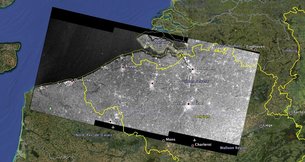
Simulated Sentinel-1 data
This first release contains a set of simulated radar intensity ‘Level-1’
products, covering all four Sentinel-1 imaging modes and different
product types. An example is shown by way of the image of the
Netherlands on the right.
Notably, these products were generated by a preliminary version of Sentinel-1’s operational Instrument Processing Facility.
Though they are not intended to reflect the final characteristics of the
user products, the format and contents are representative of what the
mission will offer.
This will evolve with new versions of the facility and may be slightly
tuned following system qualification and inflight commissioning.
Joel Dorandeu from MyOcean said, “We very much welcome the efforts being
made to help service providers such as us prepare for the new data from
Sentinel-1.
“Considering the volumes of data we expect from Sentinel-1 along with
its method of acquisition we have the challenge of developing new
processing chains.
“We are now eager to start simulating our products."
To complement this initial release of test data, ESA is, in parallel,
simulating Sentinel-1 acquisitions from space using Canada’s Radarsat-2
satellite.
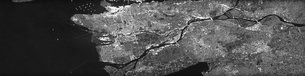
Vancouver radar image
This initiative is now starting to bear fruit following the first full
simulation of a Sentinel-1 radar image as shown in picture at the top
and here on the left.
Thanks to its owner and operator, McDonald, Dettwiler and Associates,
Radarsat-2 was carefully reprogrammed to match the way Sentinel-1 will
be operated. A remarkable achievement is the fact that Radarsat was able
to emulate the way Sentinel-1 images Earth’s surface using a method
called TOPS, thus providing a quality of image almost exactly the same
as Sentinel-1.
The very first results are promising, as can be seen in the images
acquired over Vancouver harbour on the west coast of Canada. The city is
clearly visible, as are the ships docked in the harbour, the coastline
and the nearby mountain ranges.
The acquisition of more images over specific test sites are planned to
demonstrate the suitability of Sentinel-1 for classifying sea-ice, for
applications using ocean winds and waves, and for detecting ships,
thereby preparing users for the uptake of data.
Dedicated acquisitions of image pairs and data stacks suitable for
measuring surface movements such as glacier dynamics and subsidence are
also planned to take place in the coming months.
As for the current set of test data, the Radarsat-2 simulated images
will also be processed and formatted using the Sentinel-1 Instrument
Processing Facility and made available to users shortly.
The Sentinel-1 mission is a polar-orbiting satellite system for the
continuation of Synthetic Aperture Radar (SAR) operational applications.
Sentinel-1 is a C-band imaging radar mission to provide an all-weather
day-and-night supply of imagery for GMES user services. The first
Sentinel-1 satellite is envisaged to launch in 2013 and will be followed
by the second satellite a few years later.
Dedicated to GMES, Sentinel-1 will ensure the continuity of C-band SAR
data, building on ESA’s and Canada’s heritage SAR systems on ERS-1,
ERS-2, Envisat and Radarsat.
The SAR sensor will operate in two main modes: Interferometric Wide
Swath and Wave. The first has a swath width of 250 km and a ground
resolution of 5×20 m. These two modes will satisfy most of the envisaged
service requirements. Two other mutually exclusive modes are provided
for continuity with other SAR missions and to accommodate emerging user
requirements.
Sentinel-1's revisit time, geographical coverage and rapid data
dissemination are key to providing essential data for GMES. The
Sentinel-1 pair is expected to provide coverage over Europe, Canada and
main shipping routes in 1–3 days, regardless of weather conditions.
Radar data will be delivered within an hour of acquisition – a big
improvement over existing SAR systems.
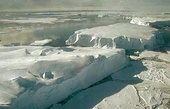
Sentinel-1 will aid sea-ice monitoring
The mission will benefit numerous services. For example, services that
relate to the monitoring of Arctic sea-ice extent, routine sea-ice
mapping, surveillance of the marine environment, including oil-spill
monitoring and ship detection for maritime security, monitoring
land-surface for motion risks, mapping for forest, water and soil
management and mapping to support humanitarian aid and crisis
situations.
The design of the Sentinel-1 mission with its focus on reliability,
operational stability, global coverage, consistent operations and quick
data delivery is expected to enable the development of new applications
and meet the evolving needs of GMES.
Sentinel-1 is being realised by an industrial consortium led by Thales
Alenia Space Italy as Prime Contractor, with Astrium Germany responsible
for the C-SAR payload incorporating the central radar electronics
subsystem developed by Astrium UK.
Sentinel-1 will be launched on a Soyuz rocket from Europe's Spaceport in French Guiana.
ESA
Guillermo Gonzalo Sánchez Achutegui
ayabaca@gmail.com
ayabaca@hotmail.com
ayabaca@yahoo.com


 (868.02 kB