domingo, 10 de marzo de 2013

ESA - Herschel to finish observing soon


Herschel operating at the second Lagrange point (L2)
Herschel will be stationed at the second Sun-Earth Lagrange point (L2), 1.5 million km from Earth. This point is theoretically stationary in space with respect to the Earth and Sun, which means that for Herschel, Earth and the Sun will always be in the same general direction.
This provides a stable thermal environment and a good view of the sky. Since the Earth is far away, Herschel is not disturbed by its radiation belts.
At the same time, the spacecraft's position in space and the resulting temperature extremes make the task of optimising the work environment for the instruments a challenge.
The Herschel spacecraft has heritage from the successful ESA Infrared Space Observatory (ISO). It has been improved and optimized for a more distant and more favourable orbit and its complement of instruments.
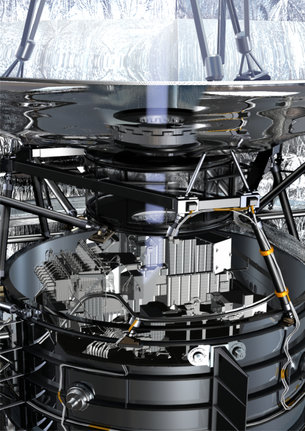
Inside Herschel
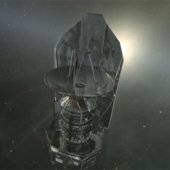
The Herschel satellite is composed of three sections.
First is the telescope, which has a 3.5 m-diameter primary mirror protected by a sunshade. The telescope focuses light onto three scientific instruments; their detectors are housed in a giant thermos flask, known as a cryostat.
The cryostat provides the interface and cryogenic environment for the instrument focal plane units, and supports the telescope, the solar array and telescope sunshade, and a unit of the Heterodyne Instrument for the Far Infrared.
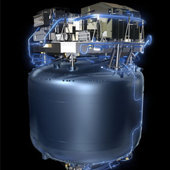
Herschel’s cooling system
Herschel’s sophisticated cooling system
Inside the cryostat, Herschel's detectors are kept at very low and stable temperatures, necessary for the instruments to operate. The cryostat contains liquid superfluid helium at temperatures lower than –271°C, which makes the instruments as sensitive as possible. The instruments detectors and the cryostat make up the second section, the payload module.
The infrared detectors must be cooled to extremely low temperatures in order to work, in fact close to absolute zero (–273.15°C or 0 K).
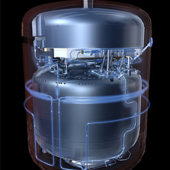
Herschel’scooling system
Herschel’s sophisticated cooling system
All three Herschel instruments will be housed inside and cooled by the cryostat which is filled at launch with more than 2300 litres of superfluid helium kept at 1.65 K, i.e. –271.5°C. Further cooling – down to 0.3 K – is required for the SPIRE and PACS bolometeric detectors. The role of the cryostat is fundamental because it determines the lifetime of the observatory.
The superfluid helium evaporates at a constant rate, gradually emptying the tank. It is expected to evaporate completely about four years after launch.
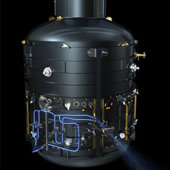
Herschel’s cooling system
Herschel’s sophisticated cooling system
When it has all gone, the temperature of the instruments will start to rise and Herschel will no longer be able to perform observations. However, the data that Herschel will have supplied will keep astronomers busy for decades.
The third element of the satellite is the service module located below the payload module. It houses the instrument electronics and the components responsible for satellite function, such as the communication hardware. The service module houses the payload electronics that do not need cooling, and provides the necessary subsystems: power, attitude and orbit control, on-board data handling, thermal control and command execution, communication, and safety.
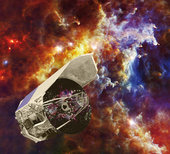
Herschel and Rosette Nebula
5 March 2013 ESA’s Herschel space observatory is expected to exhaust its supply of liquid helium coolant in the coming weeks after spending more than three exciting years studying the cool Universe. 
Herschel was launched on 14 May 2009 and, with a main mirror 3.5 m across, it is the largest, most powerful infrared telescope ever flown in space.
A pioneering mission, it is the first to cover the entire wavelength range from the far-infrared to submillimetre, making it possible to study previously invisible cool regions of gas and dust in the cosmos, and providing new insights into the origin and evolution of stars and galaxies.
In order to make such sensitive far-infrared observations, the detectors of the three science instruments – two cameras/imaging spectrometers and a very high-resolution spectrometer – must be cooled to a frigid –271°C, close to absolute zero. They sit on top of a tank filled with superfluid liquid helium, inside a giant thermos flask known as a cryostat.
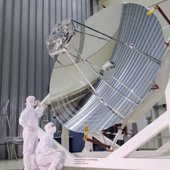
Herschel’s cryostat vacuum vessel
The superfluid helium evaporates over time, gradually emptying the tank and determining Herschel’s scientific life. At launch, the cryostat was filled to the brim with over 2300 litres of liquid helium, weighing 335 kg, for 3.5 years of operations in space.
Indeed, Herschel has made extraordinary discoveries across a wide range of topics, from starburst galaxies in the distant Universe to newly forming planetary systems orbiting nearby young stars.
However, all good things must come to an end and engineers believe that almost all of the liquid helium has now gone.
It is not possible to predict the exact day the helium will finally run out, but confirmation will come when Herschel begins its next daily 3-hour communication period with ground stations on Earth.
“It is no surprise that this will happen, and when it does we will see the temperatures of all the instruments rise by several degrees within just a few hours,” says Micha Schmidt, the Herschel Mission Operations Manager at ESA’s European Space Operations Centre in Darmstadt, Germany.
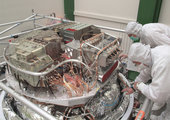
Integrating the instruments
The science observing programme was carefully planned to take full advantage of the lifetime of the mission, with all of the highest-priority observations already completed.
In addition, Herschel is performing numerous other interesting observations specifically chosen to exploit every last drop of helium.
“When observing comes to an end, we expect to have performed over 22 000 hours of science observations, 10% more than we had originally planned, so the mission has already exceeded expectations,” says Leo Metcalfe, the Herschel Science Operations and Mission Manager at ESA’s European Space Astronomy Centre in Madrid, Spain.
Herschel
“We will finish observing soon, but Herschel data will enable a vast amount of exciting science to be done for many years to come,” says Göran Pilbratt, ESA’s Herschel Project Scientist at ESA’s European Space Research and Technology Centre in Noordwijk, the Netherlands.
“In fact, the peak of scientific productivity is still ahead of us, and the task now is to make the treasure trove of Herschel data as valuable as possible for now and for the future.”
Herschel will continue communicating with its ground stations for some time after the helium is exhausted, allowing a range of technical tests. Finally, in early May, it will be propelled into its long-term stable parking orbit around the Sun. 
RELATED ARTICLES:

Spanish:
LAS OBSERVACIONES DE HERSCHE PRONTO LLEGARÁN A SU FIN:
Herschel and Rosette Nebula
5 marzo 2013 Tras pasar más de tres emocionantes años estudiando el universo frío, se estima que, en las próximas semanas, se agotará el suministro de helio liquido refrigerante del observatorio espacial Herschel de la ESA. 
Herschel fue lanzado el 14 de mayo de 2009 y, con un espejo primario de 3,5 m, es el telescopio infrarrojo más grande y potente jamás lanzado al espacio. 
Esta misión pionera ha sido la primera en cubrir todo el rango en la longitud de onda que va desde el infrarrojo lejano hasta el submilimétrico,  haciendo posible el estudio de regiones frías de gas y polvo del cosmos antes invisibles, y proporcionando nuevos conocimientos sobre el origen y la evolución de las estrellas y las galaxias.
Con la finalidad de poder llevar a cabo este tipo de observaciones tan sensibles en el infrarrojo lejano, los detectores de los tres instrumentos científicos –dos cámaras/espectrómetro de imagen y un espectrómetro de muy alta resolución  – deben enfriarse a una temperatura de –271°C, cerca del cero absoluto. Están en el extremo superior de un tanque lleno de helio superfluido líquido, dentro de un enorme tanque conocido como criostato.
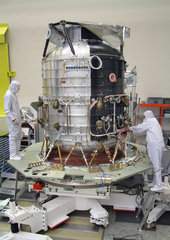
Herschel’s cryostat vacuum vessel
El helio superfluido se evapora con el tiempo, vaciando el tanque gradualmente y determinando el periodo de vida científica de Herschel. Al lanzarlo, el criostato estaba lleno hasta los bordes con cerca de 2.300 litros de helio líquido (335 kg) lo que garantizaba 3,5 años de operaciones en el espacio. 
De hecho, Herschel ha hecho extraordinarios descubrimientos en un amplio rango de temas, desde galaxias con estallidos de formación estelar en el universo distante hasta nuevos sistemas planetarios en formación orbitando jóvenes estrellas cercanas. 
Sin embargo, todo lo bueno llega a su fin, y los ingenieros creen que casi todo el helio líquido se ha gastado. 
No es posible predecir el día exacto en el que el helio se agotará por completo, pero la confirmación llegará cuando Herschel empiece su próximo periodo de comunicación diario de 3 horas con las estaciones terrestres. 
“No debe sorprendernos cuando ocurra, y cuando pase veremos la temperatura de todos los instrumentos elevarse varios grados en tan solo unas horas”, afirma Micha Schmidt, el Jefe de Operaciones de Misiones de Herschel en ESOC (European Space Operations Centre) de la ESA, en Darmstadt, Alemania.
Integrating the instruments
El programa de observación científica fue planeado minuciosamente con el fin de sacar el máximo partido del periodo de vida de la misión, y todas las observaciones de alta prioridad ya se han llevado a cabo. 
Además, Herschel está llevando a cabo numerosas observaciones de gran interés elegidas específicamente con la finalidad de explotar hasta la última gota de helio. 
“Cuando finalicen las observaciones, esperamos haber llevado a cabo 22.000 horas de observaciones científicas, un 10% más de lo planificado en un principio, por lo que la misión ya ha superado sus expectativas”, afirma Leo Metcalfe, Jefe de la Misión y Jefe de Operaciones Científicas de Herschel de la ESA en ESAC (Centro Europeo de Astronomía Espacial) en Madrid, España.
Herschel
“Pronto las observaciones llegarán a su fin, pero los datos de Herschel permitirán que se haga una enorme cantidad de ciencia emocionante durante muchos años”, señala Göran Pilbratt, Jefe Científico del Proyecto Herschel de la ESA en ESTEC (European Space Research and Technology Centre) en Noordwijk, Países Bajos. 
“De hecho, el pico de productividad científica aún está por llegar, y ahora nuestro trabajo consiste en poner en valor los datos de Herschel tanto como nos sea posible, tanto por la ciencia actual como por la futura”. 
Herschel seguirá comunicándose con las estaciones terrestres durante un tiempo después de que se haya agotado el helio, permitiendo una serie de comprobaciones técnicas. Finalmente, a principios de mayo, será impulsado hacia una órbita estable a largo plazo alrededor del Sol.
ESA


Guillermo Gonzalo Sánchez Achutegui

ayabaca@gmail.com
ayabaca@hotmail.com
ayabaca@yahoo.com

domingo, 3 de marzo de 2013

ESA - The New Caledonia archipelago


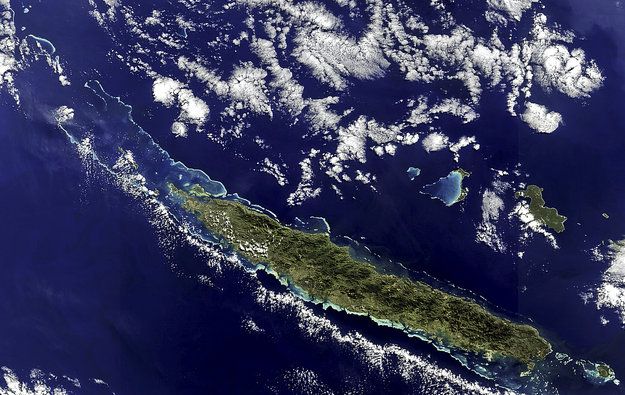
The New Caledonia archipelago, 1210 km east of Australia, is captured in this Envisat image.
Caledonia was the Roman name for today’s northern Scotland. When British explorer James Cook saw the archipelago’s main island in the 1770s, he named it ‘New Caledonia’ because of the similarities he noticed between the Scottish highlands and the island’s terrain.
The name was later applied to the surrounding islands as well.
Today, New Caledonia is a self-governing French territory, but an independence referendum is expected in the coming years.
The main island, Grande Terre, dominates the image, stretching 350 km long from northwest to southeast. A mountain range runs the length of the island – its highest point reaching over 1620 m – and divides the land’s lush east from the savannahs in the west. 
A coral reef surrounds the main island and stretches into the Coral Sea to the northwest. The reef provides an important nesting site for green sea turtles and is home to endangered dugongs.
New Caledonia is a biodiversity hot spot, because the central mountain range provides a variety of niches, landforms and micro-climates.
The territory has about 25% of the world’s nickel resources. Although the recent global economic recession greatly affected this industry, the recovery of prices has brightened the future for New Caledonia’s economy.
This image was acquired by Envisat’s MERIS instrument on 5 July 2011 and it is featured on the Earth from Space video programme.
ESA
Guillermo Gonzalo Sánchez Achutegui
ayabaca@gmail.com
ayabaca@hotmail.com
ayabaca@yahoo.com
ESA - How to cook a spacecraft


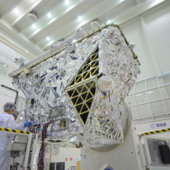
Mercury Planetary Orbiter being placed in Phenix thermal vacuum facility
27 February 2013 The faint aroma of hot metal filled the surrounding cleanroom as the hatch to ESA’s newest test facility was slid aside, concluding a 23-day ‘bake-out’ of the largest segment of ESA’s mission to Mercury. 
Ending on the early hours of 14 February, this test ensured ESA’s Mercury Planetary Orbiter – MPO, part of the multi-module BepiColombo mission – was cleaned of potential contaminants in advance of its 2015 mission to the inner Solar System.
The bake-out took place at ESA’s technical heart, ESTEC in Noordwijk, the Netherlands, which includes a dedicated Test Centre equipped to simulate all aspects of the space environment.
MPO will fly to the innermost planet with Japan’s Mercury Magnetosphere Orbiter, riding together on ESA’s propulsion module. But not before getting cooked first.
“Being close to Mercury and experiencing high temperatures, the release of molecules from spacecraft materials is expected to occur at higher quantities than for normal satellites,” explains Jan van Casteren, BepiColombo Project Manager.
“Such molecules are a contamination threat if they condense on sensitive surfaces, so we need to minimise outgassing in order to protect our delicate scientific instrumentation on the spacecraft.”
So an initial bake-out of the various spacecraft segments is essential for cleaning purposes – in this case MPO’s ‘Proto-Flight Model’, incorporating its propulsion system and heat pipes that regulate its temperature.
A new test facility called Phenix hosted the bake-out, a 4.5 m-diameter stainless steel vacuum chamber 11.8 m long, with an inner box called the ‘thermal tent’ whose six copper walls can be heated up to 100°C or cooled via piped liquid nitrogen down to –190°C, all independent from each other.
“This test was different from more typical thermal vacuum testing because, while the sides and top of the chamber were kept heated to around 50°C, the underside remained cooled by liquid nitrogen throughout,” explains Mark Wagner, Head of ESTEC’s Test Facilities & Test Methods Section.
“This creates a ‘cold trap’ where the contaminants baked off from the satellite solidify for collection. But sustaining this environment required 1500 litres of liquid nitrogen per hour – on average three tankers were calling at ESTEC daily to top up our supply.”
The test was monitored 24 hours per day on a triple shift system, with care being taken to maintain the temperatures precisely and ensure a continuous flow of data.
Outgassing production was monitored throughout the test, and the bake-out results are now being analysed. A non-trivial amount of contaminants are expected to have been produced – ‘spoonfuls’ of material.
Now Phenix itself is being thoroughly cleaned, ready for its next customer.
BepiColombo MPO inside Phenix
“Phenix was put in place to extend the range of thermal vacuum test services on offer to ESTEC Test Centre customers,” explains Mark. “It is able to accommodate large subsystems or entire spacecraft.”
Phenix was cleared for use last December, after which preparations began immediately for BepiColombo testing.
“The chamber will be kept busy for much of the rest of this year accommodating a forthcoming batch of Galileo satellites,” Mark concludes.
“This will be more traditional testing – simulating the temperature extremes the Galileo satellites must endure throughout their 12-year working lifetimes.”
ESA
RELATED ARTICLES:
Guillermo Gonzalo Sánchez Achutegui
ayabaca@gmail.com
ayabaca@hotmail.com
ayabaca@yahoo.com

ESA - Un sudario de polvo y gas


La nebulosa planetaria ESO 456-67

Este ardiente remolino podría parecer sacado deEl Señor de los Anillos, pero se trata en realidad de la nebulosa planetaria ESO 456-67. Esta espectacular formación se encuentra en la constelación de Sagitario (El Arquero).
A pesar de su nombre, estas etéreas estructuras no tienen nada que ver con los planetas. El término fue acuñado hace más de un siglo, cuando los astrónomos de la época descubrieron unos objetos pequeños y compactos, de apariencia similar a los planetas, a través de sus rudimentarios telescopios. 
Cuando una estrella como nuestro Sol llega al final de su vida, expulsa materia al espacio, rodeándose de una serie de capas de polvo y gas que forman lo que conocemos como una nebulosa planetaria. En el centro de esta intrincada estructura se encuentran los restos de la estrella original, ahora convertida en una pequeña y densa enana blanca. 
En esta imagen de ESO 456-67 tomada por el Telescopio Espacial Hubble se pueden distinguir las distintas bocanadas expulsadas por la estrella. Cada una se muestra en un tono diferente – franjas concéntricas de gas tintado de rojo, naranja, amarillo y verde, con una amplia zona despejada en el corazón de la nebulosa. 
Todavía no sabemos por qué las nebulosas planetarias adoptan tal variedad de formas y estructuras. Algunas parecen esféricas, otras elípticas, las hay que lanzan materia desde sus regiones polares, con forma de ocho o de reloj de arena, y otras parecen caóticas explosiones estelares, por describir algunas de las más comunes.
Una versión de esta imagen fue enviada a la competición Los tesoros Ocultos del Hubble por Jean-Christophe Lambry.
ESA
ARTÍCULOS RELACIONADOS:
X-raying the Eskimo11 febrero 2013
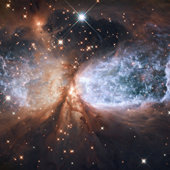
Hubble view of star-forming region S106
A Christmas snow angel21 diciembre 2012
Glitter galaxy03 diciembre 2012
Guillermo Gonzalo Sánchez Achutegui
ayabaca@gmail.com
ayabaca@hotmail.com
ayabaca@yahoo.com

ESA - Tracking trains with satellite precision


25 February 2013 Taking a cue from how ESA controls satellites, Spanish railways now have their own high-tech upgrade to keep travellers abreast of when the next train is going to pull into the station.
Drawing on sophisticated software that keeps satellites on track, the system was developed by a group of Elecnor Deimos engineers who had worked extensively on ESA projects.
The outcome of this technology transfer is that up-to-date train schedules are now displayed at over 400 Spanish stations.
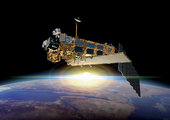
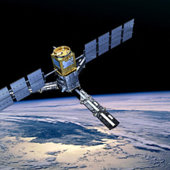
Envisat
“This came about as a result of the team’s work with ESA’s largest satellite, Envisat,” said Carlos Fernández de la Peña, Director of Systems and Networks at Deimos.


For Envisat, they created a software system designed to cope with the vast complexity of planning the satellite’s operations: “It had to be robust, reliable and work 24/7. There is no room for error when it comes to satellites.”

For instance, Envisat operators had to monitor 20 000 readings continuously to operate and control the satellite.
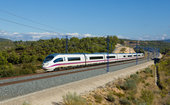
Train near Vinaixa in Spain
Since its creation in 2001, Deimos Space, now part of Elecnor Deimos, has been spinning off the space technologies and techniques acquired by its involvement in space projects
“What we’ve done is take the experience of working with large, distributed, reliable, computer-based satellite control systems and apply it to non-space fields.”
ESA’s Technology Transfer Programme technology broker for Spain, Tecnalia, collaborates closely with Elecnor Deimos, through ProEspacio, the Spanish Association for Space Technologies, to develop ‘spin-off’ opportunities. 
Tecnalia’s Richard Seddon explained, “We help in the search for clients for their often leading-edge and intelligent spin-offs from the technologies and expertise developed for space missions.” 
“Matching these spin-offs with identified needs in non-space industries, in this case, resulted in a successful contact with Adif, the company managing Spain’s railroad infrastructure and rail traffic. 
“Adif were faced with serious problems tracking all the trains within their system, and we thought this is very much like the tracking requirements for satellites.”
Satellite control
To know where all the trains are at any time, the Deimos engineers drew on their space experience, noted Mr Fernández de la Peña: “For Adif, we have created a computer system similar to the monitoring and control system of a satellite.”
“The first thing we did was get railway traffic information in real time. From there, there were more questions to answer. Are the rails ready? Which trains are using the rails in which direction? Is there a delay? What are the destination platforms? Is there any problem at a station a train is going to pass through? This looks easy, but it is not.”
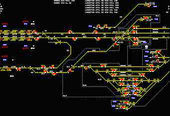
Deimos screen
The challenge was to take “millions of chunks of data received in real time – this train is here, this train is not, there is a green light, there is a red light” and create an artificial intelligence engine that can process this information, then relay the important facts to travellers.
Deimos used software routines similar to those used for Envisat: “This way, we can process lots of data in real time. It’s like a small ground system for the railway system,” said Mr Fernández de la Peña.
Now, with hundreds of stations in Spain using their system, they have created an information centre that tracks how things are moving and what situations are developing in the network. Exact information is then broadcast to the travellers.
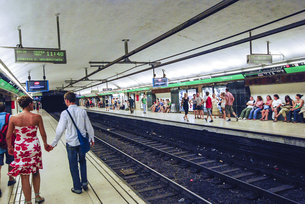
Arrival time displayed at station
In addition, Deimos introduced a set of protocols similar to those used by ESA. Previously, a patchwork of software systems from different providers was used. The problem with that is that, “If several different companies are processing the same information in different ways, you can come up with different results. Then, you end up giving information that is not accurate or consistent.”
To correct this, they created Elcano, a streamlined platform for Adif: “We designed and implemented the standards used at ESA.”
Valentin Gonzalez, Deputy Director of Operating Systems and ICT in Adif, confirms that, “During the last years we have made a significant effort in upgrading Adif’s information technology infrastructure and technology, aiming at creating a system of open and interoperable protocols and services for internal use.  
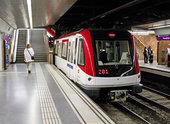
Train arriving at Barcelona station
“Elcano is the response for standardising the way information is being provided to passengers, as well as managing the sometimes-complex infrastructure of railway stations throughout Spain.”
“From ESA, we had experience of working in large, complex operating systems,” Mr Fernández de la Peña noted. “Now, we’re using this experience and credibility to create this well-performing transportation platform.”
More on ESA's Technology Transfer Programme here
ESA
Guillermo Gonzalo Sánchez Achutegui
ayabaca@gmail.com
ayabaca@hotmail.com
ayabaca@yahoo.com

ESA - SMOS – la historia de éxito global continúa


Salinidad de la superficie del mar y de las corrientes
22 febrero 2013 La misión del agua de la ESA arroja luz sobre la evolución de la serpenteante Corriente del Golfo. Este es tan solo uno de los muchos logros del satélite SMOS que se han presentado hoy en un encuentro celebrado en ESAC, Madrid.
Lanzado en 2009, el satélite SMOS de la ESA para el estudio de la humedad del suelo y la salinidad de los océanos (Soil Moisture and Ocean Salinity) nos está ayudando a comprender el  ciclo del agua.
A lo largo de los últimos tres años la misión ha estado proporcionando datos globales más precisos sobre la humedad de los suelos y la salinidad de los océanos, utilizados para estudiar nuestro ciclo del agua. 

Disminución de la humedad de los suelos de Europa
Se han adquirido nuevos conocimientos sobre el movimiento de la Corriente del Golfo – uno de los sistemas de corrientes más estudiados. 
Esta corriente, que se origina en el Caribe y fluye hacia el Atlántico Norte, juega un importante papel en la trasferencia de calor y sal, influyendo en el clima de la costa este de Norte América y la costa oeste de Europa. 
Los datos sobre salinidad de SMOS muestran que el agua caliente y salada impulsada hacia el norte por la Corriente del Golfo converge con aguas más frías y menos saladas, transportadas hacia el sur a lo largo de la costa este de Norte América por la Corriente del Labrador. Esta convergencia causa fuertes gradientes laterales que llevan a procesos de mezcla entre las masas de agua más allá del Cabo Hatteras. 
Las observaciones de SMOS pueden delimitar y monitorizar los remolinos resultantes que han sido ‘arrancados’ de la corriente, formando pequeñas áreas de agua caliente y salada en la Corriente del Labrador, y zonas de agua más fresca y fría en la Corriente del Golfo. SMOS puede monitorizar la dinámica de este proceso gracias a su alta resolución y su frecuencia de renovación de datos.
SMOS in orbit
SMOS en órbita
Esto está proporcionando a los científicos nueva información sobre cómo se mueve la sal entre los limites de las corrientes – una clave para comprender mejor el 'cinturón de convección' de la circulación oceánica global. 
Este y otros logros científicos alcanzados durante los tres años de funcionamiento de la misión SMOS han sido presentados durante una conferencia llevada a cabo hoy en ESAC (European Space Astronomy Centre), centro de la ESA situado en Villanueva de la Cañada, cerca de Madrid (España). 
Tras un discurso de bienvenida de Álvaro Giménez, Director de ESAC, Luis Valero, Secretario General de Industria y PYMEs, habló sobre el futuro de la tecnología espacial en España. 
El Director de los Programas de Observación de la Tierra de ESA, Volker Liebig, presentó cuáles serán los siguientes pasos que se darán dentro del programa de observación de la Tierra de la ESA y en las misiones de Exploración de la Tierra.

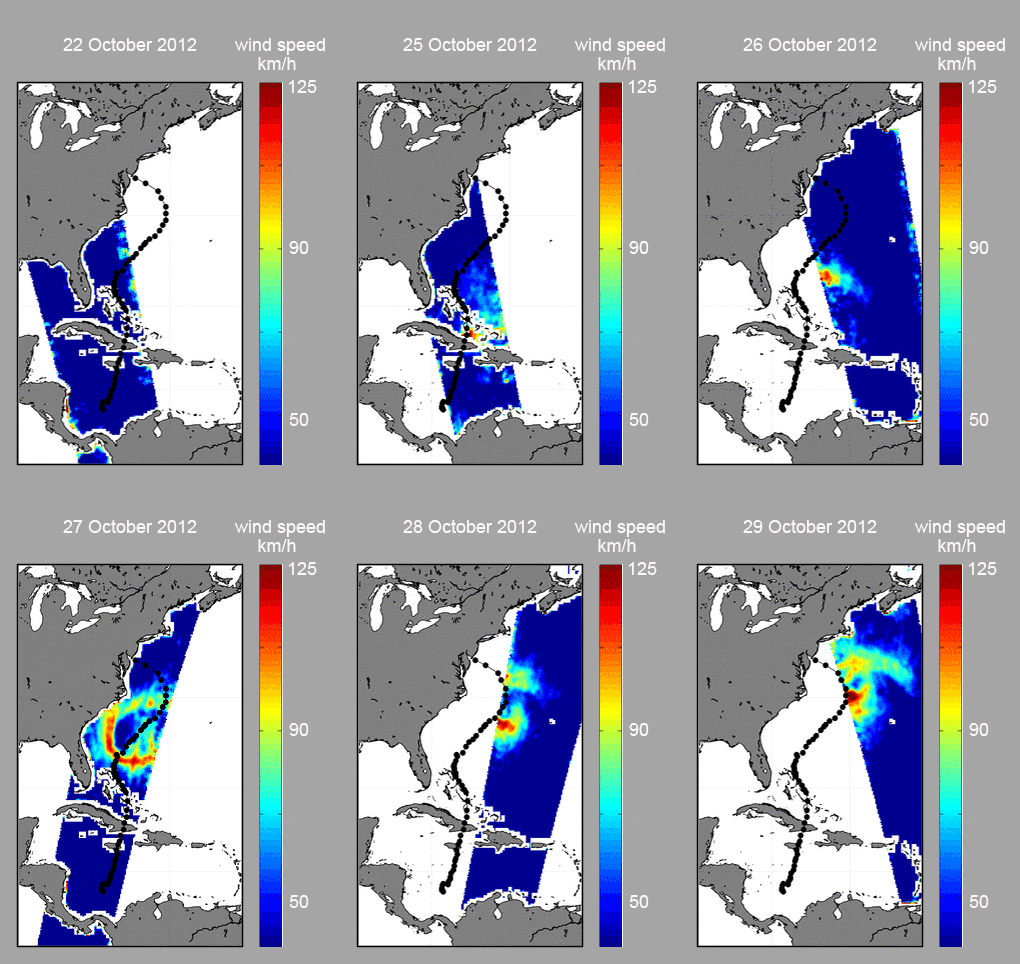
El Huracán Sandy visto por SMOS
“SMOS es el segundo Explorador de la Tierra que hemos puesto en órbita – y está proporcionando nueva información muy importante sobre la humedad de los suelos y la salinidad de los océanos desde un punto de vista global, información que está disponible para un amplio rango de aplicaciones”, afirmó Volker Liebig. 
SMOS ha sido llevado a cabo con contribuciones especiales por parte de Francia y España. 
Los investigadores que lideran la misión, Yann Kerr y Jordi Font, son el punto de referencia para la investigación científica de la misión y lideran las discusiones sobre los descubrimientos relacionados con la humedad de los suelos y la salinidad de los océanos. 
Nicolás Reul, de Ifremer, también destacó resultados inesperados que demuestran la versatilidad de esta misión europea de colaboración, como los descubrimientos sobre la Corriente del Golfo.
Los datos de SMOS, que han sobrepasado cualquier expectativa, se están utilizando para monitorizar la extensión y el grosor de los hielos del mar Ártico, proporcionando cobertura diaria del Océano Ártico. 
Además, el satélite puede determinar la velocidad de los vientos durante un huracán – tal y como sucedió el año pasado con el Huracán Sandy, que devastó zonas de la costa este de los Estados Unidos – midiendo la radiación de microondas emitida por los mares revueltos. 
ARTÍCULOS RELACIONADOS:
ESA
Guillermo Gonzalo Sánchez Achutegui
ayabaca@gmail.com
ayabaca@hotmail.com
ayabaca@yahoo.com

ESA - Cotmeana


KOMPSAT2_AutoB
KOMPSAT-2 (Korea Multi-Purpose Satellite-2) / Arirang-2
KOMPSAT-2 (also referred to as Arirang-2 by South Korea) is being developed by KARI (Korea Aerospace Research Institute) to continue the observation program of the KOMPSAT-1 mission. The main mission objectives of the KOMPSAT-2 are to provide a surveillance capability for large-scale disasters by acquiring high-resolution imagery for GIS (Geographic Information Systems) applications. 1) 2) 3) 4) 5) 6)
eoPortal Directory - database of earth observation resources


Korea’s Kompsat-2 satellite captured this image of southern central Romania in January.
The area pictured is part of a geographic transitional region between the Southern Carpathians to the north and the lowland plains to the south.
Bucharest is some 110 km to the southeast, Bulgaria is about 120 km to the south, and Serbia about 160 km to the west.
The tree branch-like pattern is the result of erosion along rivers and streams. Running down the centre of the image is the Cotmeana river.
Zooming in, we can see that large areas have been divided into hundreds of small agricultural plots.
During communist rule, this area’s arable land was divided into large plots for state-owned, large-scale farming. But following the downfall of communism in Romania in 1989 and the subsequent privatisation of land, these plots were fragmented.
Romania became an ESA Member State on 22 December 2011.
The Korea Multi-purpose Satellite (Kompsat-2) of the Korea Aerospace Research Institute acquired this image on 2 January 2013. Launched in 2006, it was developed to ensure continuity with its predecessor, Kompsat-1.
ESA supports Kompsat as a Third Party Mission, meaning it uses its ground infrastructure and expertise to acquire, process and distribute data to users. 
This image is featured on the Earth from Space video programme.
ESA
Guillermo Gonzalo Sánchez Achutegui
ayabaca@gmail.com
ayabaca@hotmail.com
ayabaca@yahoo.com