
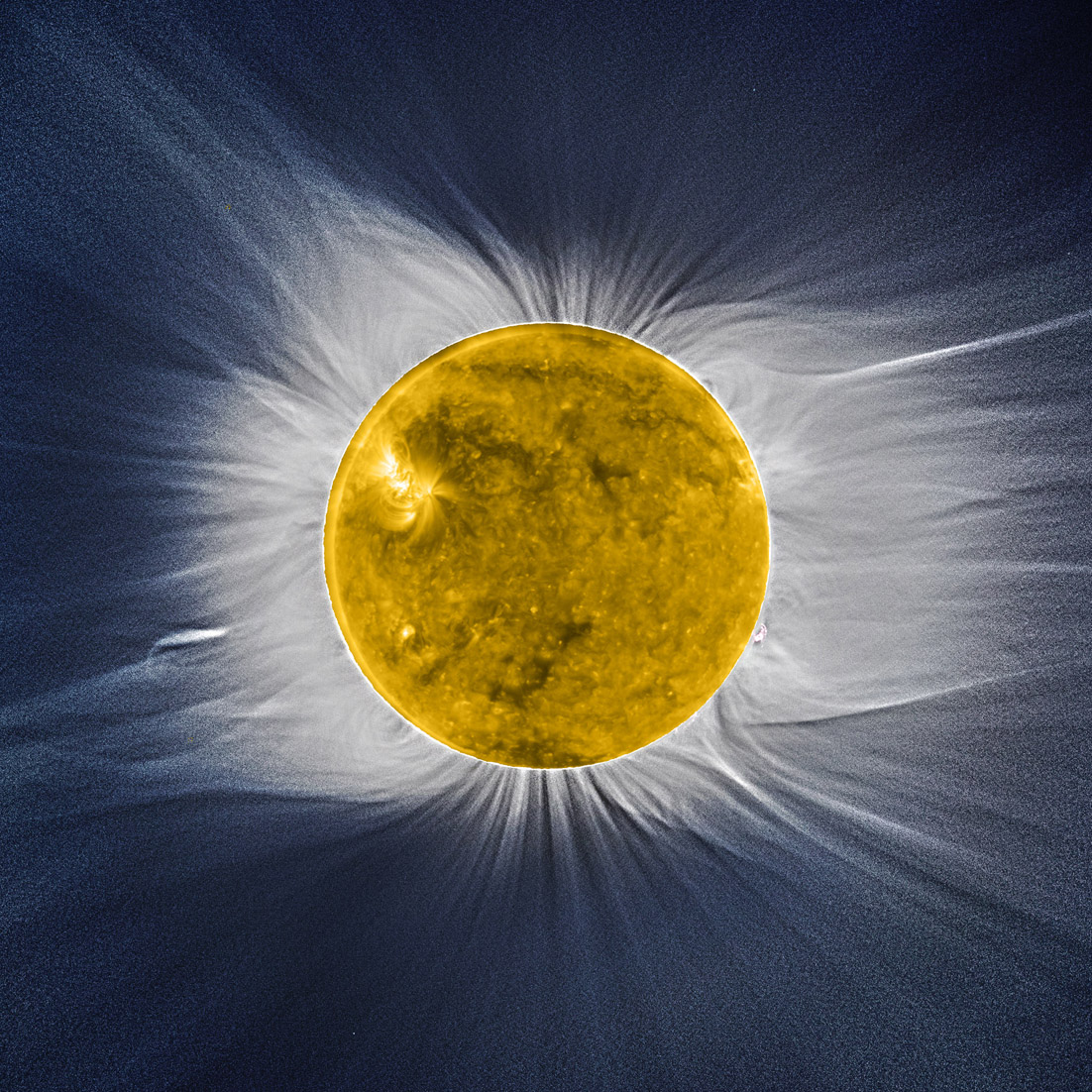
Corona solar durante un eclipse
Download:
 HI-RES JPEG (Size:
Composite image from Proba-2’s SWAP imager (with 174Å filter) showing
the Sun’s disc, with a reconstructed white-light image of the extended
corona taken at exactly the same time from the ground, during the total
solar eclipse observed in July 2010 in Atoll Hao, French Polynesia.
Credits: ESA/Proba-2 consortium/SWAP team/Institut d’Astrophysique de Paris (CNRS & UPMC), S. Koutchmy/J. Mouette
El eclipse solar de mañana solo será visible en su totalidad para
observadores basados en tierra que se encuentren en el norte de
Australia, pero el satélite de observación solar de la ESA, Proba-2,
tendrá un asiento de primera fila desde su órbita alrededor de la
Tierra.
Durante un eclipse total de Sol, la Luna se mueve entre el Sol y la Tierra. Su separación y alineamiento hacen que la Luna parezca lo suficientemente grande como para bloquear temporalmente la luz del Sol.
Durante un eclipse total de Sol, la Luna se mueve entre el Sol y la Tierra. Su separación y alineamiento hacen que la Luna parezca lo suficientemente grande como para bloquear temporalmente la luz del Sol.
Una luz fantasmagórica se cierne sobre los observadores a medida que el
imponente y oscuro disco de la Luna reemplaza brevemente la brillante
cara del Sol.
La totalidad – cuando el Sol está completamente oscurecido – tundra
lugar mañana a las 22:11:48 GMT sobre el Pacífico Sur durante cuatro
minutos y dos segundos.
Los observadores de la costa este de Queensland, Australia, serán de los
pocos afortunados que podrán ver el eclipse total, disfrutando la
totalidad durante unos dos minutos, ya que el Sol se encuentra a unos 14
grados sobre horizonte.
Durante la totalidad, el Sol parece tener un halo blanco – una fugaz y
extraña visión de la atmósfera de plasma –la corona- a millones de
grados de temperatura, algo que normalmente suele estar oculto por el
propio brillo del Sol a los ojos de un observador.
En la imagen mostrada, obtenida por el satélite Proba-2, vemos el disco
solar durante el eclipse total de Julio de 2010, combinada con imágenes
tomadas desde tierra y obtenidas en el mismo instante con el fin de
revelar detalles muy precisos de la corona solar.
Una instantánea del siempre cambiante entorno del campo magnético del
Sol expuesto momentáneamente con torrentes de plasma lanzados al
espacio, junto con prominencias solares vistas muy cerca del extremo del
disco solar.
Durante el evento de mañana, Proba-2 cruzará la sombra de la Luna varias
veces, obteniendo tres eclipses solares parciales y sus órbitas
alrededor de la Tierra. En el momento del eclipse total visto desde
Australia, sin embargo, Proba-2 verá el disco solar completo, ofreciendo
una oportunidad idónea para comparar la corona solar vista desde tierra
con observaciones del Sol desde el espacio.
El instrumento SWAP instalado en el satélite monitorizará el Sol en luz
ultravioleta, mientras que el instrumento LYRA medirá la energía emitida
por el Sol, que será menos intensa a medida que el sol se vaya
oscureciendo.
Por favor, tengan cuidado si tienen la suerte de poder observar este
eclipse: mirar al Sol sin protección en los ojos es extremadamente
peligroso y puede causar ceguera permanente. Utilicen equipos que hayan
sido certificados, como gafas para eclipses de Sol, o telescopios
solares bajo supervisión profesional
ESA
Guillermo Gonzalo Sánchez Achutegui
ayabaca@gmail.com
ayabaca@hotmail.com
ayabaca@yahoo.com


