domingo, 3 de noviembre de 2013

NASA : Three Space Station Crews Answer Media Questions from Orbit


Soyuz TMA-09M
The Soyuz TMA-09M under the command of Expedition 37 Commander Fyodor Yurchikhin backs away from the International Space Station's Rassvet module for a flyaround to the aft port of the Zvezda service module. .
Image Credit: NASA TV
Image Token:
Youtube Override:
The Russian Soyuz TMA-09M spacecraft, with Commander Fyodor Yurchikhin and Flight Engineers Karen Nyberg and Luca Parmitano aboard, changes parking spaces at the International Space Station Nov. 1.
Image Token:
Three International Space Station crew members took their Soyuz for a spin around the block Friday as they prepare for the extremely busy final week of Expedition 37.

Commander Fyodor Yurchikhin and Flight Engineers Karen Nyberg and Luca Parmitano undocked their Soyuz TMA-09M spacecraft from the Rassvet module on the Earth-facing side of the station at 4:33 a.m. EDT Friday. After backing the vehicle a safe distance away, Soyuz Commander Yurchikhin rotated the Soyuz and began the flyaround to the rear of the station. Carefully aligning the spacecraft with the docking port on the aft end of the Zvezda service module, which was vacated by the European Space Agency’s fourth Automated Transfer Vehicle (ATV) on Monday, Yurchikhin guided the spacecraft in for its docking at 4:54 a.m.
Coincidentally, Yurchikhin was at the helm for the last Soyuz relocation at the station in June 2010 when he piloted the Expedition 24 crew’s Soyuz TMA-19 vehicle from Zvezda to the then newly installed Rassvet module.
Friday’s Soyuz move sets the stage for the launch and arrival of a trio of new station crew members -- NASA astronaut Rick Mastracchio, Japan Aerospace Exploration Agency astronaut Koichi Wakata and Soyuz Commander Mikhail Tyurin of the Russian Federal Space Agency – who will dock their Soyuz TMA-11M spacecraft to Rassvet on Nov. 7 about six hours after their launch from the Baikonur Cosmodrome in Kazakhstan.
The arrival of Mastracchio, Wakata and Tyurin will mark the first time since October 2009 that nine people have served together aboard the station without the presence of a space shuttle.
Also arriving to the station aboard the Soyuz TMA-11M will be the Olympic torch, which is making the longest leg of its relay leading up to the 2014 Winter Olympics in Sochi, Russian. Flight Engineers Oleg Kotov and Sergey Ryazanskiy will take the Olympic torch outside the station during a symbolic spacewalk.
While their crewmates relocated the Soyuz spacecraft Friday, Kotov and Ryazanskiy consolidated their tool caddies for the upcoming spacewalk. Their excursion, which is slated to begin on Nov. 9 at 9:30 a.m. EST, will air live on NASA TV.
The torch will return to Earth along with Yurchikhin, Nyberg and Parmitano on Nov. 10 when they board their Soyuz for the journey home after more than five months in space.
The final departure of Yurchikhin, Nyberg and Parmitano will free the Zvezda port for the docking of a new Progress resupply vehicle in late November. Program managers prefer to have a Progress or ATV cargo ship docked at Zvezda so it can help reboost the station and adjust its attitude.
Astronaut Mike Hopkins
NASA astronaut Michael Hopkins, Expedition 37 flight engineer, enters data in a computer in the Harmony node of the International Space Station.
Image Credit: NASA
Image Token:
Flight Engineer Mike Hopkins meanwhile spent much of his Friday morning setting up the Advanced Biological Research System (ABRS). The NASA astronaut assembled a reference grid, flushed the system’s cooling loop, installed two new memory cards and powered up the system for a ground-based checkout of telemetry. The ABRS contains two temperature-controlled chambers that can be used to grow plants, microorganisms and small arthropods, such as insects or spiders.

Hopkins also recharged batteries for an upcoming session with a set of soccer-ball-sized, free-flying satellites known as Synchronized Position Hold, Engage, Reorient, Experimental Satellites, or SPHERES. Surrounding each SPHERES mini-satellite for this next test will be ring-shaped hardware known as the Resonant Inductive Near-field Generation System, or RINGS, which will be used to demonstrate how power can be transferred between satellites without physical contact.
Over the weekend, all six station residents will get a chance to recharge their own batteries as they enjoy some free time, take care of housekeeping tasks throughout the station and get ready for the final week of Expedition 37.
 
Three Space Station Crews Answer Media Questions from Orbit
Nine International Space Station crew members will discuss their mission with reporters from around the world during a joint crew news conference to be broadcast live on NASA Television at 8:50 a.m. EST Friday, Nov. 8.
This is the first time since October 2009 that nine people will be aboard the space station at the same time without a space shuttle present. The crew members are together for only four days as one expedition ends and another begins.
The nine crew members represent three space station expeditions:
• Expedition 36/37: Karen Nyberg of NASA, Fyodor Yurchikhin of the Russian Federal Space Agency (Roscosmos) and Luca Parmitano of the European Space Agency;
• Expedition 37/38: Michael Hopkins of NASA and Oleg Kotov and Sergey Ryazanskiy of Roscosmos; and
• Expedition 37/38/39: Rick Mastracchio of NASA, Koichi Wakata of the Japan Aerospace Exploration Agency and Mikhail Tyurin of Roscosmos.
The joint news conference, which was arranged in coordination with NASA's international partner agencies, will last 40 minutes and will feature questions from U.S., Russian, European and Japanese media. Each partner agency will have 10 minutes for questions. Because of the limited time available, all U.S. media will be required to ask their questions via a phone bridge managed at NASA's Johnson Space Center in Houston. To use the phone bridge, journalists must call Johnson's newsroom at 281-483-5111 by 8:30 a.m. EST Nov. 8.
Topics for discussion include the upcoming 15th anniversary of space station construction, the crew members' support for research inside the orbiting laboratory, and plans for a Nov. 9 spacewalk with the Olympic torch that will light the flame at the opening of the 2014 Winter Olympic Games in Sochi, Russia.
Mastracchio, Tyurin and Wakata will launch aboard a Soyuz rocket Nov. 6 from the Baikonur Cosmodrome in Kazakhstan with the torch stowed aboard and dock their Soyuz capsule to the space station that same day, bringing the onboard complement to nine.
Kotov and Ryazanskiy will venture outside the space station with the torch as part of a 6-hour spacewalk before the torch's scheduled Nov. 10 return to Earth with Nyberg, Yurchikhin and Parmitano.
All the times of International Space Station programming, key Soyuz event coverage and other NASA Television programming are available at:
For more information about the space station, onboard research and crew members, visit:
 
NASA
GuillermoGonzalo Sánchez Achutegui

nsf.gov - National Science Foundation - Making room for science at Oklahoma's tribal colleges

Partnership with the state's Experimental Program to Stimulate Competitive Research opens doors for tribal college students
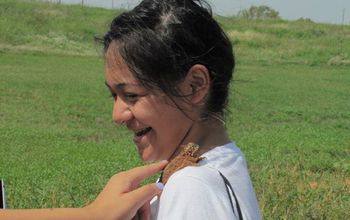
Student with a haorned toad on her shoulder
Students learning about horned toads at a summer camp hosted by Comanche Nation College.
Credit and Larger Version
November 1, 2013
More than three centuries ago, when the Comanches ruled America's southern plains, they sought horned toads. Squat, spiked and a tad imposing, the toad--which is actually a lizard--was believed to lead Comanches to buffalo, the tribe's sustenance. Comanches would ask, "Where are the buffalo?" and follow whatever direction the lizard pointed.
More than two months ago, a group of Comanches once again sought horned toads. This time, however, the quest was for science.
The Comanches were a group of high school students in a summer camp hosted by Comanche Nation College (CNC), a tribal college in Lawton, a city in southwest Oklahoma. Led by a biologist from CNC and zoologists from Oklahoma State University, the students conducted fieldwork on the endangered lizard.
Comanche students from rural schools "don't have as many opportunities to be around the biological sciences," said Gene Pekah, dean of student services at CNC. "So we're going to create those opportunities for them and hopefully create an interest."
The horned toad camp was one such opportunity. A partnership with the state's Experimental Program to Stimulate Competitive Research (EPSCoR) funded similar camps hosted by CNC.
Funded by the National Science Foundation (NSF), EPSCoR promotes development of a state's science and technology resources, boosting competitiveness through collaborations among academia, government and the private sector. Currently, 31 U.S. states and territories have an EPSCoR project.
The program is all about broadening participation in state-of-the-art science, said James Wicksted, associate director of Oklahoma's EPSCoR program and a professor at Oklahoma State University. According to Wicksted, it made complete sense to partner with the state's tribal colleges because Oklahoma has a large American Indian population, and the state's colleges and universities graduate many American Indian students.
Nationwide, however, American Indian students lag far behind in higher education. According to the National Center for Science and Engineering Statistics, less than 1 percent of all science and engineering degrees--bachelor's, master's and doctorates--are awarded to American Indians or Alaskan Natives. Less than 1 percent of American Indian and Alaskan Native students make up the entire U.S. college-age population.
"It's a percent of a percent of a percent type thing," Pekah said.
 
Weaving science with culture
Oklahoma EPSCoR enriched its tribal outreach after developing summer research programs. The staff wanted to expand the program to tribal students--allowing them to spend part of the summer in labs at the state's main universities, learning sophisticated science--but realized those students often didn't have a solid science background due to a lack of science resources at tribal schools.
"For the students to use the science they learned during these summer programs, they had to know some of the basics," Wicksted said.
So, Oklahoma's EPSCoR, which also partnered with the College of Muscogee Nation (CMN), another tribal college in Okmulgee, due east of Oklahoma City, helped both schools upgrade their facilities with new computers, smart classroom technologies, IT experts, and faster networking. The upgrades gave many students their first-ever email address.
Both CNC and CMN are relatively young schools--founded in 2002 and, 2004, respectively--and offer associates degrees. Full-time enrollment at CNC is less than 100 students, while that of CMN is about 200 students. Though many students are tribal members, the colleges serve the entire community. Classes on the language, history and culture of the Comanche and Muscogee tribes are mandatory.
CNC has hosted a variety of summer science camps, some funded through EPSCoR and others through different federal programs. CNC also has an undergraduate research and mentoring program between the college and Oklahoma State University, funded through grants from NSF's Division of Biological Infrastructure.
Meanwhile, CMN is creating the school's first-ever science course, teaching biology, human anatomy and physical science.
"There's a lot of enthusiasm" on campus for the classes, said Cynthia Sanders, CMN's new science instructor.
There also are a lot of challenges. Sanders will teach a wide range of students--some with extensive high school experience and some who will set foot in a lab for the very first time at CMN.
"I want them to get the idea that they can be challenged, and they cannot be overwhelmed," she said.
At both schools, great effort has been made to ensure the science is relevant. The horned toad camp blended population studies and DNA analysis with lessons on Comanche culture. A unit on measurement relates to Muscogee words for measuring and their discovery of the concept of zero. Engineering is taught through Comanche teepee structure.
"Taking a science class and integrating it with lessons on history helps students understand their culture and themselves," said CNC President Consuelo Lopez.
Valuing American Indian culture--weaving it within the school curriculum--also helps academics.
"We understand where our students are coming from," said CMN President Robert Bible. As a public school teacher, Bible saw many bright American Indian students lose interest in school, with lessons and teachers disconnected from their heritage.
"[At CMN], we understand the culture, we understand the language," he said. The majority of the staff is Muscogee, and many live within the tribe's boundaries. "That's made a big difference."
Leaders at both CNC and CMN say they want to create opportunities beyond the tribal college.
"They have an understanding that success comes from more than just one class," said Denise Barnes, who heads the EPSCoR program at NSF. Students need flexibility, cultural awareness and experience with the faculty and logistics of four-year schools if they are to advance their education, she said. "Total support has to be there."
CNC and CMN are working hard to ensure that it is. The EPSCoR partnership allows Comanche and Muscogee students to visit Oklahoma's four-year institutions. It gives tribal college students a chance to see firsthand labs, research and life at a major university. "They see that it's possible," Bible said.
Lopez remembers one student who arrived at CNC knowing he wanted a GED diploma, but not much else. Some science and math classes later, he was hooked. "Now a science major, he has moved on to a bigger school, though he still comes to CNC for classes," she said. "He already has plans to be a scientist."
-- Jessica Arriens, (703) 292-2243 jarriens@nsf.gov
Investigators Gene Pekah
Kristen Baum
Donald French
James Wicksted
Alicia Knoedler
Related Institutions/Organizations Comanche Nation College
Oklahoma State University
Locations Oklahoma
Total Grants $5,000,000
 
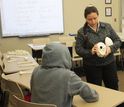
Photo of professor teaching parts of  a skull to a student
College of Muscogee Nation science instructor Cynthia Sanders lectures on parts of the skeleton.
Credit and Larger Version
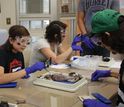
CMN students in a lab doing a cat dissection
Human anatomy students at the College of Muscogee Nation study posterior muscles.
Credit and Larger Version
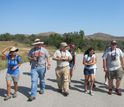
Students and professors walking on a road between hills
Students and professors head out in search of horned toads during a summer camp.
Credit and Larger Version
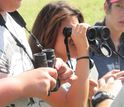
Students with binoculars at horned toad camp in Oklahoma
Comanche high school students search for horned toads during a summer science camp.
Credit and Larger Version
 
the National Science Foundation (NSF)
Guillermo Gonzalo Sánchez Achutegui

NASA : NASA TV Airs Discussion on Removing Barriers to Deep Space Exploration


Attached to the Harmony node, the first Cygnus commercial cargo spacecraft built by Orbital Sciences Corp., in the grasp of the Canadarm2, is photographed by an Expedition 37 crew member on the International Space Station.
The first Cygnus commercial cargo spacecraft built by Orbital Sciences Corp., seen here attached to the International Space Station's Harmony node, will leave the orbital outpost this week.
Image Credit: NASA
Image Token:
NASA is once again open for business in a big way. While we were out, several of our on-going missions achieved significant milestones, and although it will take a little time to fully assess the impacts of the government shut down on our other operations, this week will make clear we’re back to our core mission implementing America’s ambitious space program.
Our latest moon mission, the Lunar Atmosphere and Dust Environment Explorer, or LADEE, entered lunar orbit on Oct. 6th, and now is preparing to begin its study of the moon’s atmosphere. We also are pleased that the Lunar Laser Communication Demonstration currently orbiting the moon with LADEE achieved an error-free laser communication downlink with a data rate in excess of 300 megabits-per-second. This new NASA-developed, laser-based space communication system will enable higher rates of satellite communications, similar to the high-speed fiber optic networks we have here on Earth. This will dramatically improve space communication, especially during future human missions to an asteroid and Mars.
 
Expedition 38 crew
Left to right: Expedition 38 Flight Engineer Koichi Wakata, Soyuz Commander Mikhail Tyurin and NASA Flight Engineer Rick Mastracchio clasp hands in front of a Soyuz simulator during final qualification exams ahead of their Nov. 7 launch to the space station.
Image Credit: NASA
Image Token:
 
Earth from Juno
Earth as seen from the Juno spacecraft during the gravity assist flyby on Oct. 9.
Image Credit: NASA
Image Token:
Feature Link:
On Oct. 9th, our Juno spacecraft, launched in 2011 on a five-year journey to Jupiter, made its closest approach to Earth. This gave Juno a chance to take some stunning pictures of our planet and it gave us the opportunity to confirm that the spacecraft is operating as expected with a current trajectory that is “near perfect.”

Looking ahead for this week, the Orbital Sciences' Cygnus cargo spacecraft that was launched from NASA’s Wallops Flight Facility on Sept.18, will complete its successful maiden cargo mission on Tuesday when it un-berths from the International Space Station and burns up harmlessly in Earth’s atmosphere during re-entry the following day. Orbital joins SpaceX as NASA’s second American commercial partner capable of successful resupply missions to the ISS. Sierra Nevada Corp. is poised to resume testing of its Dream Chaser spacecraft at NASA's Dryden Flight Research Center in California. Sierra Nevada Corp., Boeing and SpaceX are among the U.S. companies working with NASA to develop commercial crew transportation vehicles. Our commitment to launching astronauts from American soil again soon is moving forward.
Things are getting busy at the International Space Station, humanity's home away from Earth for almost 13 years now. The European Space Agency’s Automated Transfer Vehicle-4 is set to undock on Oct. 28 after more than four months at the station. Then, on Nov. 1, Expedition 37 crewmates Karen Nyberg, Luca Parmitano and Fyodor Yurchikhin will relocate their Soyuz 35 from one station docking port to another.
Less than a week later on Nov. 7, three new station crew members -- NASA astronaut Rick Mastracchio, Japan Aerospace Exploration Agency astronaut Koichi Wakata and Soyuz commander Mikhail Tyurin of the Russian Federal Space Agency – will launch aboard their Soyuz 37 spacecraft from the Baikonur Cosmodrome and dock to the station about six hours later.
For four days, nine astronauts and cosmonauts will live and work together aboard the station before Yurchikhin, Nyberg and Parmitano return to Earth after more than five months in space.
Meanwhile, the Mars Atmosphere and Volatile Evolution (MAVEN) spacecraft remains on track for a Nov.18th launch from Cape Canaveral Air Force Station in Florida. MAVEN is the first spacecraft devoted to exploring and understanding the Martian upper atmosphere. It will orbit the planet in an elliptical orbit that allows it to pass through and sample the entire upper atmosphere on every orbit. The spacecraft will investigate how the loss of Mars’ atmosphere to space determined the history of water on the surface.
Finally, on a sad note, on Oct.10, in the midst of the shutdown, we learned of the passing of Scott Carpenter, who in 1962 became the second American to orbit Earth. Scott was one of the original Mercury 7 astronauts who helped set the stage for more than a half-century of American leadership in space. We will miss his passion, his talent and his life-long commitment to exploration.
As we power back up, we draw inspiration from the legacy of Carpenter and so many others who overcame every obstacle to keep NASA flying high.
 
NASA TV Airs Discussion on Removing Barriers to Deep Space Exploration
NASA Television will air a roundtable discussion with aerospace industry leaders at 9 a.m. EST Tuesday, Nov. 12 about the progress being made toward sending humans into deep space.
The live broadcast will take place at the Newseum, 555 Pennsylvania Ave. NW, in Washington, and is open to visitors with paid admission.
Panelists representing NASA and its prime contractors will discuss the work being done on the agency's Orion spacecraft and Space Launch System rocket, which will carry humans farther into space than ever before. The participants are:
-- William Gerstenmaier, associate administrator for human exploration and operations, NASA
-- Julie Van Kleek, vice president, advanced space and launch programs, Aerojet Rocketdyne
-- Charlie Precourt, vice president and general manager, ATK Space Launch Division
-- John Elbon, vice president and general manager, Boeing Space Exploration
-- Jim Crocker, vice president and general manager, civil space, Lockheed Martin Space Systems
Orion and the Space Launch System will provide the United States an entirely new human space exploration capability, a flexible system that can extend human presence beyond low-Earth orbit and enable new missions of exploration in our solar system.
The discussion is sponsored by TechAmerica's Space Enterprise Council in partnership with the George Marshall Institute and the Coalition for Space Exploration.
There will be time for media to ask questions following the discussion. Media wanting to attend the broadcast must contact Sean Wilson at 832-864-3518 or
 sean@griffincg.com
by 5 p.m. Friday, Nov. 8.
For more information on NASA's human deep space exploration, visit:
For NASA TV streaming video, downlink and scheduling information, visit:
 
NASA
Guillermo Gonzalo Sánchez Achutegui

NASA : NASA Astronaut Karen Nyberg Invites Quilters to Contribute a Star Block


high res (6.0 M) low res (76 K)

STS-124 Shuttle Mission Imagery
JSC2007-E-097869 (26 Sept. 2007) --- Astronaut Karen L. Nyberg, mission specialist

Biographical Data


Karen L. Nyberg (Ph.D.)
NASA Astronaut
PERSONAL DATA: Born on October 7, 1969. Her hometown is Vining, Minnesota. Married. One child. Recreational interests include running, sewing, drawing and painting, backpacking, piano, and spending time with her family. Dr. Nyberg’s parents, Kenneth and Phyllis Nyberg, still reside in Vining.
EDUCATION: Graduated from Henning Public High School, Henning, Minnesota, 1988. Bachelor of Science in Mechanical Engineering, Summa Cum Laude, University of North Dakota, 1994. Master of Science in Mechanical Engineering, University of Texas at Austin, 1996. Doctorate in Mechanical Engineering, University of Texas at Austin, 1998.
SPECIAL HONORS/AWARDS: University of North Dakota Sioux Award (2009); University of Texas Outstanding Young Engineering Graduate Award (2009); University of Texas Outstanding Young Mechanical Engineer Award (2008); University of North Dakota Young Alumni Achievement Award (2004); Space Act Award (1993); NASA JSC Patent Application Award (1993); NASA Tech Briefs Award (1993); NASA JSC Cooperative Education Special Achievement Award (1994); Joyce Medalen Society of Women Engineers Award (1993-94); D.J. Robertson Award of Academic Achievement (1992); University of North Dakota School of Engineering and Mines Meritorious Service Award (1991-1992). Recipient of numerous scholarships and other awards.
EXPERIENCE: Graduate research was completed at The University of Texas at Austin BioHeat Transfer Laboratory where she investigated human thermoregulation and experimental metabolic testing and control, specifically related to the control of thermal neutrality in space suits.
NASA EXPERIENCE: Co-op at Johnson Space Center from 1991-1995, working in a variety of areas. She received a patent for work done in 1991 on Robot Friendly Probe and Socket Assembly. In 1998, on completing her doctorate, she accepted a position with the Crew and Thermal Systems Division, working as an Environmental Control Systems Engineer.
Selected as a mission specialist by NASA in July 2000, Dr. Nyberg reported for training in August 2000. Following the completion of two years of training and evaluation, she was assigned technical duties in the Astronaut Office Station Operations branch where she served as Crew Support astronaut for the Expedition 6 crew during their six-month mission aboard the International Space Station. Dr. Nyberg has since served in the Space Shuttle branch, the Exploration branch, and as Chief of the Robotics branch. She completed her first spaceflight in 2008 on STS-124, and logged more than 13 days in space. Dr. Nyberg is currently serving as a flight engineer aboard the station for Expediton 36.
SPACE FLIGHT EXPERIENCE: STS-124 Discovery (May 31 to June 14, 2008) was the 123rd space shuttle flight, and the 26th shuttle flight to the International Space Station. STS-124 was launched from the Kennedy Space Center, Florida, and docked with the space station on June 2 to deliver the Japanese Experiment Module-Pressurized Module (JEM-PM) and the Japanese Remote Manipulator System. STS-124 shuttle astronauts delivered the 37-foot (11-meter) Kibo lab, added its rooftop storage room and conducted three spacewalks to maintain the station and to prime the new Japanese module's robotic arm for work during nine days docked at the orbiting laboratory. STS-124 also delivered a new station crew member, Expedition 17 Flight Engineer Greg Chamitoff. He replaced Expedition 16 Flight Engineer Garrett Riesman, who returned to Earth with the STS-124 crew. The STS-124 mission was completed in 218 orbits, traveling 5,735.643 miles in 13 days, 18 hours, 13 minutes and 7 seconds.
Expedition 35/36 to the International Space Station - On May 28, 2013, Dr. Nyberg launched aboard the Soyuz TMA-09M from the Baikonur Cosmodrome in Kazakhstan to the International Space Station along with Russian cosmonaut Fyodor Yurchikhin and European Space Agency (ESA) astronaut Luca Parmitano. They are only the second crew ever to dock to the space station the same day they left Earth. They were welcomed aboard by Expedition 35 Commander Pavel Vinogradov and Flight Engineers Alexander Misurkin of Roscosmos and NASA astronaut Chris Cassidy.
MAY 2013
 
NASA Astronaut Karen Nyberg Invites Quilters to Contribute a Star Block
International Space Station Expedition 37 Flight Engineer Karen Nyberg of NASA, a lifelong lover of sewing, is inviting fellow crafters to join her in stitching together a global community space quilt.
Nyberg, who is in the final weeks of her mission aboard the orbiting laboratory, recently shared a star-themed quilt block she was able to complete during her limited free time in space. She is now inviting quilters from the public to create their own star-themed quilt blocks to help celebrate her mission and passion for the quilting arts.
"Now that I've tried my hand sewing in space, I can say one thing with certainty: it's tricky," Nyberg said in a video sent down from the space station. "This is what I've made. It's far from being a masterpiece, but it was made in space. I'm inviting all of you to create your own star-themed quilt block. We'll be combining them with my block to create a quilt for next year's 40th anniversary International Quilt Festival in Houston. I can't wait to see what we make together."
Nyberg's complete video and other video clips of her quilting aboard the space station will be featured in a NASA exhibit at the 39th annual International Quilt Festival Thursday through Sunday, Nov. 3 at the George R. Brown Convention Center in Houston. Sewing and quilting include many of the principles and technical skills used in developing equipment for spaceflight missions. The exhibit will include sewn samples from spacesuits and parachutes, a cargo transfer bag and other soft goods from NASA's Johnson Space Center in Houston.
The deadline for submitting a block for the quilt is Aug. 1, 2014. For more information about where to send your block, visit:
Nyberg and The International Quilt Festival will collaborate on having the squares stitched together for display at the 40th annual International Quilt Festival in 2014 and at other public displays. The Houston festival is the largest annual quilt festival in the world, attracting more than 60,000 guests annually.
Nyberg arrived at the space station with Fyodor Yurchikhin of the Russian Federal Space Agency and Luca Parmitano of the European Space Agency in May. The trio is scheduled to return to Earth Nov. 10.
For Nyberg's complete biography, visit:
For more information about Nyberg's personal sewing hobbies visit:
To see video of Karen describing sewing in space and showing the quilt square in space, visit:
For more about the 39th annual International Quilt Festival, visit:
For more information about the International Space Station, onboard research and crew members, visit:
 
NASA
Guillermo Gonzalo Sánchez Achutegui

viernes, 1 de noviembre de 2013

NASA: NASA Begins Airborne Campaign to Map Greenland Ice Sheet Summer Melt


What's New?

We have a ride to space!

Read more...
Delta-II image

Get Involved!

Calling all high school age students: New video contest communicating NASA Earth Science features ICESat-2.
REEL Science
Click here for details.

Applications Announcements

  • The Early Adopter Program deadline has been extended to October 24, 2013. Read more...
  • Joint Vegetation Tutorial with Landsat 8, May 7-8, 2014. Read more...

MABEL takes flight for summer campaign!
From its new berth beneath the high-flying Proteus aircraft, MABEL - the Multiple Altimeter Beam Experimental Lidar - kicked off a campaign this week along the U.S. Eastern Seaboard, measuring the height of tree canopies, buildings and other features with several flights from NASA's Langley Research Center in Hampton, Va.
MABEL takes these elevations by pulsing a laser 5,000 times a second. Each pulse contains millions of photons that travel from the aircraft, reflect off Earth's surface and return to the satellite. Only a handful of photons actually make it back to MABEL, but the instrument is sensitive enough to detect single photons. By combining the photon's precisely timed arrival and the instrument's GPS position, programs can calculate the distance the light travelled and the elevation of the surface below.
One of MABEL's goals is to help engineers working on the upcoming ICESat-2 satellite mission test models for that satellite's laser altimeter, said instrument lead scientist Bill Cook. MABEL will also gather data to enable scientists develop algorithms for ICESat-2's measurements of vegetation canopy height and inland water levels.
The test flight on Wednesday and the science flight on Thursday is showing great initial data. The next flight is planned for this evening, September 20, 2013.
Proteus image
We passed!
On Sept. 5, 2013, ICESat-2 passed its Ground Systems Critical Design Review, or CDR. An independent review board met Sept. 3-5 at Goddard Space Flight Center in Greenbelt, Md., to examine details of the entire design of the mission's ground system, including the Mission Operations Center, the Instrument Support Facility, and the Science Investigator-led Processing System.
These play key roles in the mission, including receiving data from the satellite and processing it so researchers can measure the height of ice sheets, tree canopies, glaciers and more. With this successful CDR, the ground systems team can start implementing its plans.
Latest satellite image
ICESat-2 image

Credits: Satellite image courtesy of Orbital
Earth image illustrating AMSR-E sea ice courtesy of the NASA Scientific Visualization Studio


NASA Begins Airborne Campaign to Map Greenland Ice Sheet Summer Melt
For the first time, a NASA airborne campaign will measure changes in the height of the Greenland Ice Sheet and surrounding Arctic sea ice produced by a single season of summer melt.
NASA's C-130 research aircraft flew from the Wallops Flight Facility in Wallops Island, Va., to Greenland Wednesday where they will conduct survey flights to collect data that will improve our understanding of seasonal melt and provide baseline measurements for future satellite missions. Flights are scheduled to continue through Nov. 16.
The land and sea ice data gathered during this campaign will give researchers a more comprehensive view of seasonal changes and provide context for measurements that will be gathered during NASA's ICESat-2 mission, which is scheduled for launch in 2016.
"The more ground we cover the more comparison points we'll have for ICESat-2," said Bryan Blair of Goddard Space Flight Center in Greenbelt, Md., principal investigator for the Land, Vegetation and Ice Sensor, or LVIS.
Warm summer temperatures lead to a decline in ice sheet elevation that often can be significant in low-lying areas along the Greenland coast. In past years, the Jakobshavn Glacier, located in the lower elevations of western Greenland, has experienced declines of nearly 100 feet in elevation over a single summer. Higher elevations farther inland see less dramatic changes, usually only a few inches, caused by pockets of air in the snowpack that shrink as temperatures warm.
"Surface melt is more than half of the story for Greenland's mass loss," said Ben Smith, senior physicist at the University of Washington's Advanced Physics Laboratory, Seattle, and member of the science team that selected flight lines for this campaign. The rest of Greenland's mass loss comes from ice flowing downhill into the ocean, often breaking off to form icebergs, and from melting at the base of the ice sheet.
Researchers will measure ice elevation using the LVIS laser altimeter and the LVIS-GH, a new, smaller version designed to fly on NASA's Global Hawk unmanned aerial vehicle. LVIS and LVIS-GH will measure separate but overlapping swaths of the ice from an altitude of 28,000 feet.
The C-130 carrying both instruments will fly out of Thule and Kangerlussuaq, Greenland, allowing researchers to sample both high- and low-elevation ice and a variety of geographic areas.
"We plan to concentrate our flights on areas northwest, southeast and southwest Greenland and the Arctic Ocean," said Michelle Hofton, LVIS mission scientist at Goddard and the University of Maryland, College Park. "The measurements we collect along lines sampled in IceBridge's spring 2013 Arctic campaign will allow scientists to assess changes over the summer."
Flying from Thule also will allow mission scientists to gather data on Arctic sea ice shortly after it reaches its annual minimum extent. This will help researchers get a clearer picture of what happens over the summer. It also will help researchers gather new data on snow covering sea ice when combined with information collected by the European Space Agency's CryoSat-2 polar-monitoring satellite. LVIS detects the snow surface while CryoSat's radar sees through snow to find the top of the ice. Researchers can combine these measurements to calculate snow depth.
"This will be crucial for assessing the snow cover on sea ice during a very different time of year," said Nathan Kurtz, sea ice scientist at Goddard.
For more information about NASA's IceSat-2 satellite, visit:
 
NASA:
Guillermo Gonzalo Sánchez Achutegui

NASA : 3C353: Giant Plumes of Radiation


Jets generated by supermassive black holes at the centers of galaxies can transport huge amounts of energy across great distances. 3C353 is a wide, double-lobed source where the galaxy is the tiny point in the center and giant plumes of radiation can be seen in X-rays from Chandra (purple) and radio data from the Very Large Array (orange).
Image credit: X-ray: NASA/CXC/Tokyo Institute of Technology/J.Kataoka et al, Radio: NRAO/VLA
NASA
Guillermo Gonzalo Sánchez Achutegui
ayabaca@gmail.com
ayabaca@hotmail.com
ayabaca@yahoo.com

NASA: Media Invited to View New Earth Science Satellite before Shipment to Japan


Conceptual image of GPM.
Image Credit: NASA
Media Invited to View New Earth Science Satellite before Shipment to Japan
Media have the opportunity Friday, Nov. 15, to get a closer look at NASA's Global Precipitation Measurement (GPM) Core Observatory satellite before it is shipped to Japan for launch in early 2014.
Media will meet at the Visitors Center at NASA's Goddard Space Flight Center in Greenbelt, Md., at 9:30 a.m. EST, where they will be briefed on the mission and speak with mission scientists. This will be followed by a tour of the spacecraft clean room and opportunities to interview the engineers who built the satellite.
Reporters also will have time to speak with scientists at Goddard's 15-screen Hyperwall about the applications of GPM data, including how rainfall data fit into climate models and contribute to understanding of the entire Earth system. All speakers will be available for interviews.
GPM, scheduled for shipment to the Tanegashima Space Center in November, is an international satellite mission led by NASA and the Japan Aerospace Exploration Agency. It will provide next-generation observations of rain and snow worldwide every three hours, as well as unprecedented 3-D views of hurricanes and snowstorms. GPM data will contribute to the monitoring and forecasting of weather events such as droughts, floods and hurricanes.
To attend, media must register by contacting Ellen Gray at 301-286-1950 or
no later than Nov. 7. Social media registration is closed.
For more information about the GPM mission, visit:
NASA
Guillermo Gonzalo Sánchez Achutegui
ayabaca@gmail.com
ayabaca@hotmail.com
ayabaca@yahoo.com