Mostrando entradas con la etiqueta Greenland. Mostrar todas las entradas

domingo, 7 de septiembre de 2014

NASA : NASA to Investigate Climate Impacts of Arctic Sea Ice Loss


Youtube Override: 
Image Credit: 
NASA's Goddard Space Flight Center/J. Beck
 
A new NASA field campaign will begin flights over the Arctic this summer to study the effect of sea ice retreat on Arctic climate. The Arctic Radiation IceBridge Sea and Ice Experiment (ARISE) will conduct research flights Aug. 28 through Oct. 1, covering the peak of summer sea ice melt.
ARISE is NASA's first Arctic airborne campaign designed to take simultaneous measurements of ice, clouds and the levels of incoming and outgoing radiation, the balance of which determines the degree of climate warming. The campaign team will fly aboard NASA’s C-130 aircraft from Thule Air Base in northern Greenland the first week and from Eielson Air Force Base near Fairbanks, Alaska, through the remainder of the campaign.
In recent years the Arctic has experienced increased summer sea ice loss. Scientists expect the exposure of more open water to sunlight could enhance warming in the region and cause the release of more moisture to the atmosphere. Additional moisture could affect cloud formation and the exchange of heat from Earth’s surface to space. Researchers are grappling with how these changes in the Arctic affect global climate.
NASA’s C-130
NASA’s C-130 aircraft will carry scientists over the Arctic starting this month from northern Greenland and Fairbanks, Alaska.
Image Credit: 
NASA
 
"A wild card in what's happening in the Arctic is clouds and how changes in clouds, due to changing sea-ice conditions, enhance or offset warming," said Bill Smith, ARISE principal investigator at NASA's Langley Research Center in Hampton, Virginia.
ARISE was planned over the last year to take advantage of NASA’s existing capabilities for gathering data about ongoing changes in the Arctic. Satellites provided some information about clouds and the energy balance in the Arctic, but the multiple instruments flown during ARISE should provide further insight.
"The clouds and surface conditions over the Arctic as we observe them from satellites are very complex," Smith said. "We need more information to understand how to better interpret the satellite measurements, and an aircraft can help with that."
The array of instruments on ARISE should help scientists better observe how sea ice loss is affecting Arctic cloud formation and therefore the balance of incoming and outgoing radiation. Low-level clouds typically reflect more sunlight and offset warming, while higher clouds are typically less reflective and act to trap more heat in the atmosphere.
“It’s a complex business, but it depends on a lot of things we can, in fact, measure,” said Hal Maring, program manager for radiation sciences in the Earth Science Division at NASA Headquarters in Washington.
ARISE researchers will fly survey missions that target different cloud types and surface conditions, such as open water, land ice and sea ice. The missions will be timed to fly under the orbit paths of key satellite instruments, such as the Clouds and the Earth’s Radiant Energy Systems (CERES) instruments on multiple NASA satellites. Each morning, mission planners will look at satellite timings and weather forecasts to design flight plans that meet the most objectives of the campaign.
The NASA C-130, based at the Wallops Flight Facility in Virginia, will carry instruments that measure solar (incoming) and infrared (outgoing) radiation, ice surface elevation and cloud properties such as cloud particle size. This will be the first time that many of these instruments, including the mission's laser altimeter, have flown together.
The ARISE campaign is a joint effort of the Radiation Sciences, Cryospheric Sciences and Airborne Sciences programs of the Earth Science Division in NASA's Science Mission Directorate in Washington.
NASA monitors Earth's vital signs from land, air and space with a fleet of satellites and ambitious airborne and ground-based observation campaigns. NASA develops new ways to observe and study Earth's interconnected natural systems with long-term data records and computer analysis tools to better see how our planet is changing. The agency shares this unique knowledge with the global community and works with institutions in the United States and around the world that contribute to understanding and protecting our home planet.
To learn more about NASA's Earth science activities in 2014, visit:
NASA
Guillermo Gonzalo Sánchez Achutegui

viernes, 1 de noviembre de 2013

NASA: NASA Begins Airborne Campaign to Map Greenland Ice Sheet Summer Melt


What's New?

We have a ride to space!

Read more...
Delta-II image

Get Involved!

Calling all high school age students: New video contest communicating NASA Earth Science features ICESat-2.
REEL Science
Click here for details.

Applications Announcements

  • The Early Adopter Program deadline has been extended to October 24, 2013. Read more...
  • Joint Vegetation Tutorial with Landsat 8, May 7-8, 2014. Read more...

MABEL takes flight for summer campaign!
From its new berth beneath the high-flying Proteus aircraft, MABEL - the Multiple Altimeter Beam Experimental Lidar - kicked off a campaign this week along the U.S. Eastern Seaboard, measuring the height of tree canopies, buildings and other features with several flights from NASA's Langley Research Center in Hampton, Va.
MABEL takes these elevations by pulsing a laser 5,000 times a second. Each pulse contains millions of photons that travel from the aircraft, reflect off Earth's surface and return to the satellite. Only a handful of photons actually make it back to MABEL, but the instrument is sensitive enough to detect single photons. By combining the photon's precisely timed arrival and the instrument's GPS position, programs can calculate the distance the light travelled and the elevation of the surface below.
One of MABEL's goals is to help engineers working on the upcoming ICESat-2 satellite mission test models for that satellite's laser altimeter, said instrument lead scientist Bill Cook. MABEL will also gather data to enable scientists develop algorithms for ICESat-2's measurements of vegetation canopy height and inland water levels.
The test flight on Wednesday and the science flight on Thursday is showing great initial data. The next flight is planned for this evening, September 20, 2013.
Proteus image
We passed!
On Sept. 5, 2013, ICESat-2 passed its Ground Systems Critical Design Review, or CDR. An independent review board met Sept. 3-5 at Goddard Space Flight Center in Greenbelt, Md., to examine details of the entire design of the mission's ground system, including the Mission Operations Center, the Instrument Support Facility, and the Science Investigator-led Processing System.
These play key roles in the mission, including receiving data from the satellite and processing it so researchers can measure the height of ice sheets, tree canopies, glaciers and more. With this successful CDR, the ground systems team can start implementing its plans.
Latest satellite image
ICESat-2 image

Credits: Satellite image courtesy of Orbital
Earth image illustrating AMSR-E sea ice courtesy of the NASA Scientific Visualization Studio


NASA Begins Airborne Campaign to Map Greenland Ice Sheet Summer Melt
For the first time, a NASA airborne campaign will measure changes in the height of the Greenland Ice Sheet and surrounding Arctic sea ice produced by a single season of summer melt.
NASA's C-130 research aircraft flew from the Wallops Flight Facility in Wallops Island, Va., to Greenland Wednesday where they will conduct survey flights to collect data that will improve our understanding of seasonal melt and provide baseline measurements for future satellite missions. Flights are scheduled to continue through Nov. 16.
The land and sea ice data gathered during this campaign will give researchers a more comprehensive view of seasonal changes and provide context for measurements that will be gathered during NASA's ICESat-2 mission, which is scheduled for launch in 2016.
"The more ground we cover the more comparison points we'll have for ICESat-2," said Bryan Blair of Goddard Space Flight Center in Greenbelt, Md., principal investigator for the Land, Vegetation and Ice Sensor, or LVIS.
Warm summer temperatures lead to a decline in ice sheet elevation that often can be significant in low-lying areas along the Greenland coast. In past years, the Jakobshavn Glacier, located in the lower elevations of western Greenland, has experienced declines of nearly 100 feet in elevation over a single summer. Higher elevations farther inland see less dramatic changes, usually only a few inches, caused by pockets of air in the snowpack that shrink as temperatures warm.
"Surface melt is more than half of the story for Greenland's mass loss," said Ben Smith, senior physicist at the University of Washington's Advanced Physics Laboratory, Seattle, and member of the science team that selected flight lines for this campaign. The rest of Greenland's mass loss comes from ice flowing downhill into the ocean, often breaking off to form icebergs, and from melting at the base of the ice sheet.
Researchers will measure ice elevation using the LVIS laser altimeter and the LVIS-GH, a new, smaller version designed to fly on NASA's Global Hawk unmanned aerial vehicle. LVIS and LVIS-GH will measure separate but overlapping swaths of the ice from an altitude of 28,000 feet.
The C-130 carrying both instruments will fly out of Thule and Kangerlussuaq, Greenland, allowing researchers to sample both high- and low-elevation ice and a variety of geographic areas.
"We plan to concentrate our flights on areas northwest, southeast and southwest Greenland and the Arctic Ocean," said Michelle Hofton, LVIS mission scientist at Goddard and the University of Maryland, College Park. "The measurements we collect along lines sampled in IceBridge's spring 2013 Arctic campaign will allow scientists to assess changes over the summer."
Flying from Thule also will allow mission scientists to gather data on Arctic sea ice shortly after it reaches its annual minimum extent. This will help researchers get a clearer picture of what happens over the summer. It also will help researchers gather new data on snow covering sea ice when combined with information collected by the European Space Agency's CryoSat-2 polar-monitoring satellite. LVIS detects the snow surface while CryoSat's radar sees through snow to find the top of the ice. Researchers can combine these measurements to calculate snow depth.
"This will be crucial for assessing the snow cover on sea ice during a very different time of year," said Nathan Kurtz, sea ice scientist at Goddard.
For more information about NASA's IceSat-2 satellite, visit:
 
NASA:
Guillermo Gonzalo Sánchez Achutegui

domingo, 1 de septiembre de 2013

NASA - NASA Data Reveals Mega-Canyon under Greenland Ice Sheet


Youtube Override:
Hidden for all of human history, a 460 mile long canyon has been discovered below Greenland's ice sheet. Using radar data from NASA's Operation IceBridge, scientists found the canyon runs from near the center of the island northward to the fjord of the Petermann Glacier.
Image Token:

Data from a NASA airborne science mission reveals evidence of a large and previously unknown canyon hidden under a mile of Greenland ice.
The canyon has the characteristics of a winding river channel and is at least 460 miles (750 kilometers) long, making it longer than the Grand Canyon. In some places, it is as deep as 2,600 feet (800 meters), on scale with segments of the Grand Canyon. This immense feature is thought to predate the ice sheet that has covered Greenland for the last few million years.
"One might assume that the landscape of the Earth has been fully explored and mapped," said Jonathan Bamber, professor of physical geography at the University of Bristol in the United Kingdom, and lead author of the study. "Our research shows there's still a lot left to discover."
Bamber's team published its findings Thursday in the journal Science.
The scientists used thousands of miles of airborne radar data, collected by NASA and researchers from the United Kingdom and Germany over several decades, to piece together the landscape lying beneath the Greenland ice sheet.
A large portion of this data was collected from 2009 through 2012 by NASA's Operation IceBridge, an airborne science campaign that studies polar ice. One of IceBridge's scientific instruments, the Multichannel Coherent Radar Depth Sounder, operated by the Center for the Remote Sensing of Ice Sheets at the University of Kansas, can see through vast layers of ice to measure its thickness and the shape of bedrock below.
In their analysis of the radar data, the team discovered a continuous bedrock canyon that extends from almost the center of the island and ends beneath the Petermann Glacier fjord in northern Greenland.
At certain frequencies, radio waves can travel through the ice and bounce off the bedrock underneath. The amount of times the radio waves took to bounce back helped researchers determine the depth of the canyon. The longer it took, the deeper the bedrock feature.
"Two things helped lead to this discovery," said Michael Studinger, IceBridge project scientist at NASA's Goddard Space Flight Center in Greenbelt, Md. "It was the enormous amount of data collected by IceBridge and the work of combining it with other datasets into a Greenland-wide compilation of all existing data that makes this feature appear in front of our eyes."
The researchers believe the canyon plays an important role in transporting sub-glacial meltwater from the interior of Greenland to the edge of the ice sheet into the ocean. Evidence suggests that before the presence of the ice sheet, as much as 4 million years ago, water flowed in the canyon from the interior to the coast and was a major river system.
"It is quite remarkable that a channel the size of the Grand Canyon is discovered in the 21st century below the Greenland ice sheet," said Studinger. "It shows how little we still know about the bedrock below large continental ice sheets."
The IceBridge campaign will return to Greenland in March 2014 to continue collecting data on land and sea ice in the Arctic using a suite of instruments that includes ice-penetrating radar.
For more information about NASA's Operation IceBridge, visit:


 NASA
Guillermo Gonzalo Sánchez Achutegui
ayabaca@gmail.com
ayabaca@hotmail.com
ayabaca@yahoo.com

domingo, 19 de mayo de 2013

NASA - NASA Satellite Data Help Pinpoint Glaciers' Role in Sea Level Rise


› View larger
The Aletsch Glacier in Switzerland is the largest valley glacier in the Alps and it has been losing mass since the mid-19th century. A new study using data from two NASA satellites found that glaciers like this one lost an average of 571 trillion pounds of ice per year from 2003 to 2009, which contributed to about 30 percent of the total observed global sea level rise during the same period. Credit: Frank Paul, University of Zurich.

A new study of glaciers worldwide using observations from two NASA satellites has helped resolve differences in estimates of how fast glaciers are disappearing and contributing to sea level rise.

The new research found glaciers outside of the Greenland and Antarctic ice sheets, repositories of 1 percent of all land ice, lost an average of 571 trillion pounds (259 trillion kilograms) of mass every year during the six-year study period, making the oceans rise 0.03 inches (0.7 mm) per year. This is equal to about 30 percent of the total observed global sea level rise during the same period and matches the combined contribution to sea level from the Greenland and Antarctica ice sheets.

The study compares traditional ground measurements to satellite data from NASA's Ice, Cloud, and Land Elevation Satellite (ICESat) and Gravity Recovery and Climate Experiment (GRACE) missions to estimate ice loss for glaciers in all regions of the planet. The study period spans 2003 to 2009, the years when the two missions overlapped.

"For the first time, we have been able to very precisely constrain how much these glaciers as a whole are contributing to sea level rise," said Alex Gardner, Earth scientist at Clark University in Worcester, Mass., and lead author of the study. "These smaller ice bodies are currently losing about as much mass as the ice sheets."

The study was published Thursday in the journal Science.

NASA Satellite Data Help Pinpoint Glaciers' Role in Sea Level Rise
 
 WASHINGTON -- A new study of glaciers worldwide using observations from two NASA satellites has helped resolve differences in estimates of how fast glaciers are disappearing and contributing to sea level rise.

The new research found glaciers outside of the Greenland and Antarctic ice sheets, repositories of 1 percent of all land ice, lost an average of 571 trillion pounds (259 trillion kilograms) of mass every year during the six-year study period, making the oceans rise 0.03 inches (0.7 mm) per year. This is equal to about 30 percent of the total observed global sea level rise during the same period and matches the combined contribution to sea level from the Greenland and Antarctica ice sheets.

The study compares traditional ground measurements to satellite data from NASA's Ice, Cloud, and Land Elevation Satellite (ICESat) and Gravity Recovery and Climate Experiment (GRACE) missions to estimate ice loss for glaciers in all regions of the planet. The study period spans 2003 to 2009, the years when the two missions overlapped.

"For the first time, we have been able to very precisely constrain how much these glaciers as a whole are contributing to sea level rise," said Alex Gardner, Earth scientist at Clark University in Worcester, Mass., and lead author of the study. "These smaller ice bodies are currently losing about as much mass as the ice sheets."

The study was published Thursday in the journal Science.

ICESat, which stopped operating in 2009, measured glacier change through laser altimetry, which bounces lasers pulses off the ice surface to inform the satellite of changes in the height of the ice cover. ICESat's successor, ICESat-2, is scheduled to launch in 2016. GRACE, still operational, detects variations in Earth's gravity field resulting from changes in the planet's mass distribution, including ice displacements.

The new research found all glacial regions lost mass from 2003 to 2009, with the biggest ice losses occurring in Arctic Canada, Alaska, coastal Greenland, the southern Andes and the Himalayas. In contrast, Antarctica's peripheral glaciers -- small ice bodies not connected to the main ice sheet -- contributed little to sea level rise during that period. The study builds on a 2012 study using only GRACE data that also found glacier ice loss was less than estimates derived from ground-based measurements.

Current estimates predict all the glaciers in the world contain enough water to raise sea level by as much as 24 inches (about 60 centimeters). In comparison, the entire Greenland ice sheet has the potential to contribute about 20 feet (about 6 meters) to sea level rise and the Antarctic ice sheet just less than 200 feet (about 60 meters).

"Because the global glacier ice mass is relatively small in comparison with the huge ice sheets covering Greenland and Antarctica, people tend to not worry about it," said study co-author Tad Pfeffer, a glaciologist at the University of Colorado in Boulder. "But it's like a little bucket with a huge hole in the bottom: it may not last for very long, just a century or two, but while there's ice in those glaciers, it's a major contributor to sea level rise."

To make ground-based estimates of glacier mass changes, glaciologists perform on-site measurements along a line from a glacier's summit to its edge. Scientists extrapolate these measurements to the entire glacier area and carry them out for several years to estimate the glacier's overall mass change over time. While this type of measurement does well for small, individual glaciers, it tends to overestimate ice loss when the findings are extrapolated to larger regions, such as entire mountain ranges.

"Ground observations often can only be collected for the more accessible glaciers, where it turns out thinning is occurring more rapidly than the regional averages," Gardner said. "That means when those measurements are used to estimate the mass change of the entire region, you end up with regional losses that are too great."

GRACE does not have fine enough resolution and ICESat does not have sufficient sampling density to study small glaciers, but the two satellites' estimates of mass change for large glaciered regions agree well, the study concluded.

"We now have a lot more data for the glacier-covered regions because of GRACE and ICESat," said Gardner. "Without having these independent observations, there was no way to tell that the ground observations were biased."

The research involved 16 researchers from 10 countries, with major contributions from Clark University, the University of Michigan, Scripps Institution of Oceanography in San Diego, Trent University in Ontario, the University of Colorado at Boulder and the University of Alaska Fairbanks.

For images of glaciers studied for this paper, visit:

For information about NASA and agency programs, visit:

NASA
Guillermo Gonzalo Sánchez Achutegui
ayabaca@gmail.com
ayabaca@hotmail.com
ayabaca@yahoo.com

domingo, 17 de febrero de 2013

ESA - CryoSat reveals major loss of Arctic sea ice


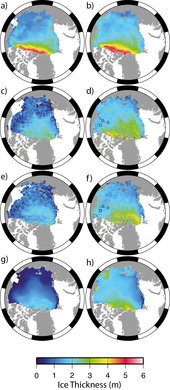
13 February 2013 An international team of scientists using new measurements from ESA’s ice mission has discovered that the volume of Arctic sea ice has declined by 36% during autumn and 9% during winter between 2003 and 2012.
Satellite records show a constant downward trend in the area covered by Arctic sea ice during all seasons, but in particular in summer. The past six years have seen the lowest summer ice extent in three decades, reaching the lowest last September at about 3.61 million sq km.
A team of scientists led by University College London has now generated estimates of the sea-ice volume for the 2010–11 and 2011–12 winters over the Arctic basin using data from ESA’s CryoSat satellite.
This study has confirmed, for the first time, that the decline in sea ice coverage in the polar region has been accompanied by a substantial decline in ice volume.
The new CryoSat dataset shows the volume’s continuing decline observed from 2003 to 2008 by NASA’s ICESat satellite.
Sea ice thickness


Since 2008, the Arctic has lost about 4300 cubic km of ice during the autumn period and about 1500 cubic km in winter.
The team confirmed CryoSat estimates using independent ground and airborne measurements carried out by ESA and international scientists during the last two years in the polar region, as well as by comparing measurements from 

“The data reveal that thick sea ice has disappeared from a region to the north of Greenland, the Canadian Archipelago and to the northeast of Svalbard,”  said Katharine Giles, co-author of the study ‘CryoSat-2 estimates of Arctic sea ice thickness and volume’, recently published online in Geophysical Research Letters.
“Other satellites have already shown drops in the area covered by Arctic sea ice as the climate has warmed, but CryoSat allows scientists to estimate the volume of sea ice – a much more accurate indicator of the changes taking place in the Arctic,” added Tommaso Parrinello, CryoSat Mission Manager.
To do this, CryoSat’s high-resolution radar altimeter sends pulses of microwave energy down towards the ice.
The energy bounces off both the top sections of ice and the water in the cracks between. The difference in height between these two surfaces allows scientists to calculate the ‘freeboard’ – the height of ice above the water – and, as a result, volume of the ice cover.
While the researchers say two years of CryoSat data aren’t indicative of a long-term change, they speculate that the lower ice thickness and volume in the winter of 2012, compared to the winter of 2011, may have contributed to the record minimum ice extent during the 2012 autumn.

ESA's ice mission
ESA’s Earth Explorer CryoSat mission is dedicated to precise monitoring of changes in the thickness of marine ice floating in the polar oceans and variations in the thickness of the vast ice sheets that blanket Greenland and Antarctica.

The findings are the result of an international collaboration between teams from University College London (UCL), ESA, the Jet Propulsion Laboratory, the University of Washington, York University, Alfred Wegener Institute for Polar and Marine Research, Woods Hole Oceanographic Institution, Morgan State University and the University of Maryland
The research was funded by the Natural Environment Research Council, ESA, the DLR German Aerospace Center, Alberta Ingenuity, the National Science Foundation, NASA and Office of Naval Research.
The lead author of this study was Professor Seymour Laxon, who passed away in early January.
Prof. Laxon was the Director of the Centre for Polar Observation and Modelling at UCL and a Principal Scientist for several ESA missions. He was part of the UCL team that proposed CryoSat to ESA in 1999, and was a key figure during the development and operational phases of the mission.
This was his first eagerly anticipated published work on CryoSat-derived sea ice record.
ESA
Guillermo Gonzalo Sánchez Achutegui
ayabaca@gmail.com
ayabaca@hotmail.com
ayabaca@yahoo.com

domingo, 2 de diciembre de 2012

ESA - Observing the Earth - Clearest evidence yet of polar ice losses


http://www.esa.int/images/glacier-ERS1-2_1992-2011_H,0.gif

 Retreating ice stream
Download:
 HI-RES GIF (Size: 3598 kb 
Images of the Kangerdlugssuaq glacier in eastern Greenland from 1992 and 2011 from the ERS mission. The ice stream’s calving front retreated by five kilometres over 19 years. Thinning in the ice steam and surrounding ice sheet is also evident. 
Credits: ESA

After two decades of satellite observations, an international team of experts brought together by ESA and NASA has produced the most accurate assessment of ice losses from Antarctica and Greenland to date. This study finds that the combined rate of ice sheet melting is increasing.

The new research shows that melting of the Antarctic and Greenland ice sheets has added 11.1 mm to global sea levels since 1992. This amounts to about 20% of all sea-level rise over the survey period.
About two thirds of the ice loss was from Greenland, and the remainder was from Antarctica.
Although the ice sheet losses fall within the range reported by the Intergovernmental Panel on Climate Change in 2007, the spread of the estimate at that time was so broad that it was not clear whether Antarctica was growing or shrinking.
The new estimates are a vast improvement – more than twice as accurate – thanks to the inclusion of more satellite data, and confirm that both Antarctica and Greenland are losing ice.
The study also shows that the combined rate of ice sheet melting has increased over time and, altogether, Greenland and Antarctica are now losing more than three times as much ice, equivalent to 0.95 mm of sea-level rise per year, as they were in the 1990s, equivalent to 0.27 mm of sea level rise per year. 
The 47 experts combined observations from 10 different satellite missions to reconcile the differences between dozens of earlier ice sheet studies and produce the first consistent measurement of polar ice sheet changes.
Earth observation satellites are key to monitoring the polar ice because they carry instruments that measure changes in the thickness of the ice sheets, fluctuations in the speed of the outlet glaciers and even small changes in Earth’s gravity field caused by melting ice.
As outlined in the paper ‘A Reconciled Estimate of Ice Sheet Mass Balance’ published today in Science, the researchers carefully matched time periods and survey areas, and combined measurements from European, Canadian, American and Japanese satellites.
The measurement were acquired by instruments such as the radar altimeters and synthetic aperture radars flown on ESA’s ERS-1, ERS-2 and Envisat missions from 1991.
“The success of this venture is due to the cooperation of the international scientific community, and to the provision of precise satellite sensors by our space agencies,” said Professor Andrew Shepherd from the University of Leeds and one of the leaders of the study.
“Without these efforts, we would not be in a position to tell people with confidence how Earth’s ice sheets have changed, and to end the uncertainty that has existed for many years.”


 Ice loss and sea level rise
Cumulative changes in the mass of the Antarctic ice sheet (pink) and the Greenland ice sheet (blue) from 1992 to 2011 determined from a reconciliation of measurements acquired by satellite radar altimetry, the input-output method, satellite gravimetry and satellite laser altimetry. Also shown is the equivalent global sea level contribution, calculated assuming that 360 gigatonnes of ice corresponds to 1 mm of sea level rise. Credits: Shepherd, Ivins et al.

The study also found variations in the pace of ice sheet change in Antarctica and Greenland.
“The rate of ice loss from Greenland has increased almost five-fold since the mid-1990s.
“In contrast, while the regional changes in Antarctic ice over time are sometimes quite striking, the overall balance has remained fairly constant – at least within the certainty of the satellite measurements we have to hand,” said co-leader of the study Dr Erik Ivins from NASA’s Jet Propulsion Laboratory.
The Ice Sheet Mass Balance Inter-comparison Exercise is a collaboration between 47 researchers from 26 laboratories, supported by ESA and NASA.
Europe’s Global Monitoring for Environment and Security programme will continue to monitor changes in the polar ice sheets during the coming decades, with the SAR and radar altimeter sensors on the Sentinel-1 and Sentinel-3 satellite series, scheduled to be launched from 2013 onwards.
http://www.esa.int/images/change_in_icesheet_H.jpg
Change in ice sheet thickness per year
Download:
 HI-RES JPEG (Size: 1730 kb)
Change in ice sheet thickness per year in Greenland (left) and Antarctica (right). Dark red depicts a thinning of about 50 cm per year, while purple areas experience a thickening of about 20 cm per year. 
Credits: Planetary Visions, DTU (Greenland), UCL (Antarctica)
ESA
Guillermo Gonzalo Sánchez Achutegui
ayabaca@gmail.com
ayabaca@hotmail.com
ayabaca@yahoo.com