Mostrando entradas con la etiqueta the International Space Station(ISS). Mostrar todas las entradas

jueves, 17 de abril de 2014

NASA : Grand Canyon Geology Lessons on View


Grand Canyon Geology Lessons on View
The Grand Canyon in northern Arizona is a favorite for astronauts shooting photos from the International Space Station, as well as one of the best-known tourist attractions in the world. The steep walls of the Colorado River canyon and its many side canyons make an intricate landscape that contrasts with the dark green, forested plateau to the north and south.
The Colorado River has done all the erosional work of carving away cubic kilometers of rock in a geologically short period of time. Visible as a darker line snaking along the bottom of the canyon, the river lies at an altitude of 715 meters (2,345 feet), thousands of meters below the North and South Rims. Temperatures are furnace-like on the river banks in the summer. But Grand Canyon Village, the classic outlook point for visitors, enjoys a milder climate at an altitude of 2,100 meters (6,890 feet).
The Grand Canyon has become a geologic icon—a place where you can almost sense the invisible tectonic forces within the Earth. The North and South Rims are part of the Kaibab Plateau, a gentle tectonic swell in the landscape. The uplift of the plateau had two pronounced effects on the landscape that show up in this image. First, in drier parts of the world, forests usually indicate higher places; higher altitudes are cooler and wetter, conditions that allow trees to grow. The other geologic lesson on view is the canyon itself. Geologists now know that a river can cut a canyon only if the Earth surface rises vertically. If such uplift is not rapid, a river can maintain its course by eroding huge quantities of rock and forming a canyon.
This astronaut photograph (ISS039-E-5258) was taken on March 25, 2014 by the Expedition 39 crew, with a Nikon D3S digital camera using a 180 millimeter lens, and is provided by the ISS Crew Earth Observations Facility and the Earth Science and Remote Sensing Unit, Johnson Space Center. It has been cropped and enhanced to improve contrast, and lens artifacts have been removed.
Image Credit: NASA
Caption: M. Justin Wilkinson, Jacobs at NASA-JSC
NASA
Guillermo Gonzalo Sánchez Achutegui
ayabaca@gmail.com
ayabaca@hotmail.com
ayabaca@yahoo.com

domingo, 4 de agosto de 2013

NASA - NASA TV Coverage Set for Japanese Cargo Ship Destined for Space Station

Japanese Space Freighter Heading to Station

The H-II Transfer Vehicle launch
The H-II Transfer Vehicle launches atop an H-IIB launch vehicle from the Tanegashima Space Center in southern Japan at 3:48 p.m. EDT Saturday (4:48 a.m. Sunday, Japan time).
Image Token:
The H-II Transfer Vehicle-4 separates from the H-IIB launch vehicle second stage.
Image Credit:  NASA TV
 
The fourth Japan Aerospace Exploration Agency (JAXA) H-II Transfer Vehicle, or HTV-4, launched aboard an H-IIB launch vehicle from the Tanegashima Space Center in southern Japan at 3:48 p.m. EDT Saturday (4:48 a.m. Sunday, Japan time) to begin a weeklong journey to the International Space Station. Also known as Kounotori, or “white stork,” because it is emblematic of an important delivery, HTV-4 is carrying more than 3.5 tons of supplies, food and experiment hardware for the station’s Expedition 36 crew. At the time of launch, the station was flying 260 statute miles over southwest Russia near the border of Kazakhstan.
 
On Friday, Aug. 9, the HTV-4 will approach the station from below and inch its way slowly toward a holding position about 40 feet from the complex. While Flight Engineer Luca Parmitano monitors the systems of the Japanese space freighter, Flight Engineers Karen Nyberg and Chris Cassidy of NASA will use Canadarm2, the station's Canadian Space Agency-provided robotic arm, to reach out and capture the vehicle at 7:29 a.m. With HTV-4 securely grappled, the robotics team at Houston’s Mission Control Center will command the arm to install the vehicle to its docking port on the Earth-facing side of the Harmony node beginning around 9:30 a.m.
HTV-4 is a 33-foot-long, 13-foot-diameter (10 meter by 4 meter) unmanned cargo transfer spacecraft with both pressurized and unpressurized sections to deliver supplies destined for inside and outside the station.
Among the items within Kounotori’s pressurized logistics carrier are test samples for research experiments inside the Kibo laboratory, a new freezer capable of preserving materials at temperatures below -90 F, four small CubeSat satellites to be deployed from Kibo’s airlock as well as food, water and other supplies for the station’s crew. The pressurized section also is delivering new hardware for the Robotic Refueling Mission to demonstrate robotic satellite-servicing tools, technologies and techniques.
The HTV-4’s unpressurized section is delivering two orbital replacement units (ORUs) – a spare Main Bus Switching Unit (MBSU) and a spare Utility Transfer Assembly (UTA) – to keep the space station’s electrical system operating smoothly. The UTA maintains electrical continuity through the Solar Alpha Rotary Joint, passing electrical power generated by the complex’s huge solar arrays to station elements and payloads, while the MBSU provides switching capabilities for the various power channels and sources. ORUs are modular station components designed to be replaced periodically.
Also inside HTV’s unpressurized cargo hold is the Space Test Program – Houston 4 (STP-H4) payload, which is a suite of seven experiments for investigating space communications, Earth monitoring and materials science. Its predecessor, STP-H3, which was delivered to the station during the final flight of space shuttle Endeavour in May 2011, will be placed inside Kounotori’s unpressurized section for disposal when the cargo craft departs in September and descends to a destructive re-entry over the Pacific Ocean.

NASA TV Coverage Set for Japanese Cargo Ship Destined for Space Station
The launch of a Japanese cargo spacecraft to the International Space Station and its arrival at the orbiting laboratory will be broadcast on NASA Television Aug. 3 and Aug. 9.
The Japan Aerospace Exploration Agency is scheduled to launch its H-II Transport Vehicle (HTV)-4 at 3:48 p.m. EDT Saturday, Aug. 3 (4:48 a.m. Japanese time Sunday, Aug. 4), from the Tanegashima Space Center in southern Japan. NASA TV coverage will begin at 3 p.m.
Loaded with more than 3.5 tons of supplies, water, spare parts and experiment hardware for the six-person station crew, the unpiloted cargo craft, named Kounotori, the Japanese word for white stork, will embark on a six-day flight to the station.
On Friday, Aug. 9, the HTV-4 will approach the station from below and inch its way slowly toward the complex. Expedition 36 Flight Engineers Karen Nyberg and Chris Cassidy of NASA will operate the station's robot arm to reach out and capture the 12-ton spacecraft and install it on the Earth-facing side of the Harmony module, where it will spend a month. Flight engineer Luca Parmitano of the European Space Agency will monitor HTV-4 systems during the rendezvous.
NASA TV coverage of the rendezvous and capture of the HTV-4 on Aug. 9 will begin at 6 a.m. Capture is scheduled about 7:29 a.m. Coverage of the final installation of the resupply craft to Harmony will resume at 9 a.m.
For NASA TV streaming video, schedule and downlink information, visit:
For more information about the International Space Station and its crew, visit:
NASA
Guillermo Gonzalo Sánchez Achutegui

NASA - First Hint of Sunrise From Space


On July 30, 2013, Expedition 36 Flight Engineer Karen L. Nyberg of NASA took this photograph of a sunrise viewed from the International Space Station. As the space station orbits the Earth every 90 minutes, traveling at about 17,500 miles per hour, the crew sees about 16 sunrises and sunsets daily.
Image Credit: NASA
NASA
Guillermo Gonzalo Sánchez Achutegui
ayabaca@gmail.com
ayabaca@hotmail.com
ayabaca@yahoo.com

domingo, 14 de julio de 2013

NASA - Space Station Ocean Imager Available to More Scientists


Differently colored waters in the Sea of Okhotsk on June 12, 2013 suggest differences in phytoplankton community structure from one location to the next. The ocean color community would eventually like to use remotely sensed data, such as are shown in the above Aqua-MODIS image, to better understand global phytoplankton diversity. (Click on the above image to see more of the region at higher resolution.)


Image Gallery


NOTE: All SeaWiFS images presented here are for research and educational use only. All commercial use of SeaWiFS data must be coordinated with GeoEye

Ocean Color Distribution Statistics

HOUSTON -- The International Space Station is expanding the use of its Hyperspectral Imager for the Coastal Ocean (HICO) instrument to more Earth scientists and environmental researchers.
HICO records highly detailed images of various environments on Earth for research, support and management. Now that the instrument has completed its primary mission of collecting regional coastal ocean data for civilian and naval research, NASA will continue to support HICO and encourage new users. HICO is mounted to the station's Japanese Experiment Module Exposed Facility.
Scientists can use information from HICO to detail the biological and chemical signatures of aquatic and terrestrial materials. When the instrument scans an area of Earth, its sensor can reveal things invisible to the human eye such as chemical compounds in coastal waters or the presence of microscopic sea life. The Environmental Protection Agency has tapped HICO as a resource to monitor coastal water quality.
New proposals for scientific or commercial use of HICO's data should be submitted through the HICO website. Proposals requesting new uses of the instrument will be evaluated by the International Space Station Program, NASA's Science Mission Directorate, the HICO project scientist and the Center for the Advancement of Science in Space. Oregon State University in Corvallis manages the HICO website, and the Naval Research Laboratory operates the sensor itself.
Users can access historical and any future collections of HICO data through the NASA Ocean Color website, managed by NASA's Goddard Space Flight Center in Greenbelt, Md.
To submit a proposal to use HICO, visit:
http:/hico.coas.oregonstate.edu/index.shtml
To view the Ocean Color website, visit:
For more about the International Space Station or information on past, ongoing, and future station research activities, including research results and publications, visit:
NASA
Guillermo Gonzalo Sánchez Achutegui

domingo, 10 de febrero de 2013

ESA - Columbus anniversary


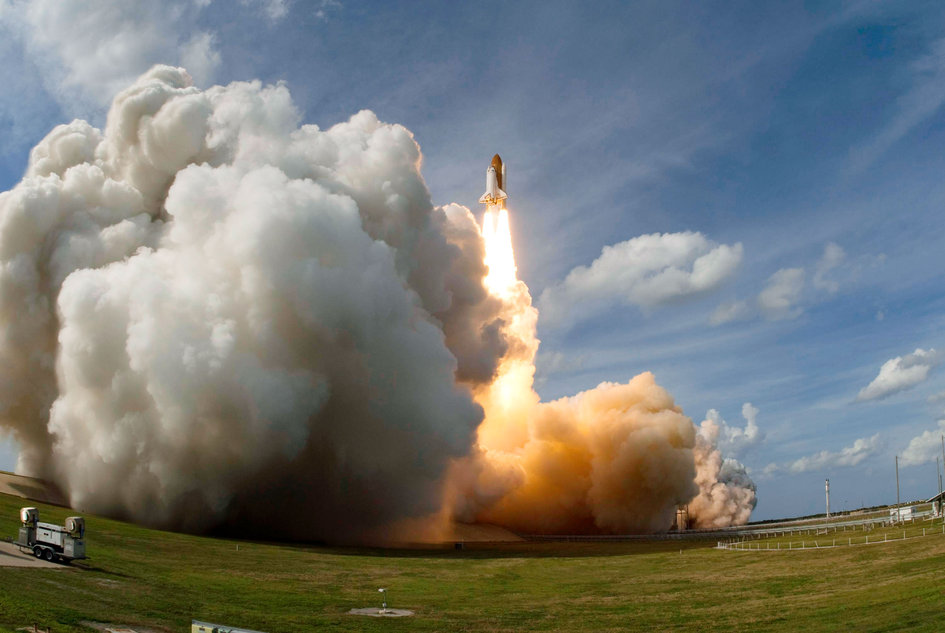
Columbus launched onboard Space Shuttle Atlantis

Columbus launched onboard Space Shuttle Atlantis Space Shuttle Atlantis and its seven-member STS-122 crew head toward the International Space Station. Liftoff from Kennedy Space Center's launch pad 39A occurred at 12:45 (EST). The launch was the third attempt for Atlantis since December 2007 to carry ESA's Columbus laboratory to the Station. During the 11-day mission, the crew's primary objective was to attach the laboratory to the Harmony module, adding to the station's size and capabilities. Onboard are astronauts Steve Frick, commander; Alan Poindexter, pilot; Leland Melvin, Rex Walheim, ESA's Hans Schlegel, Stanley Love and ESA's Leopold Eyharts, all mission specialists. Léopold joined Expedition 16 to serve as a flight engineer aboard the International Space Station.
Credits: NASA

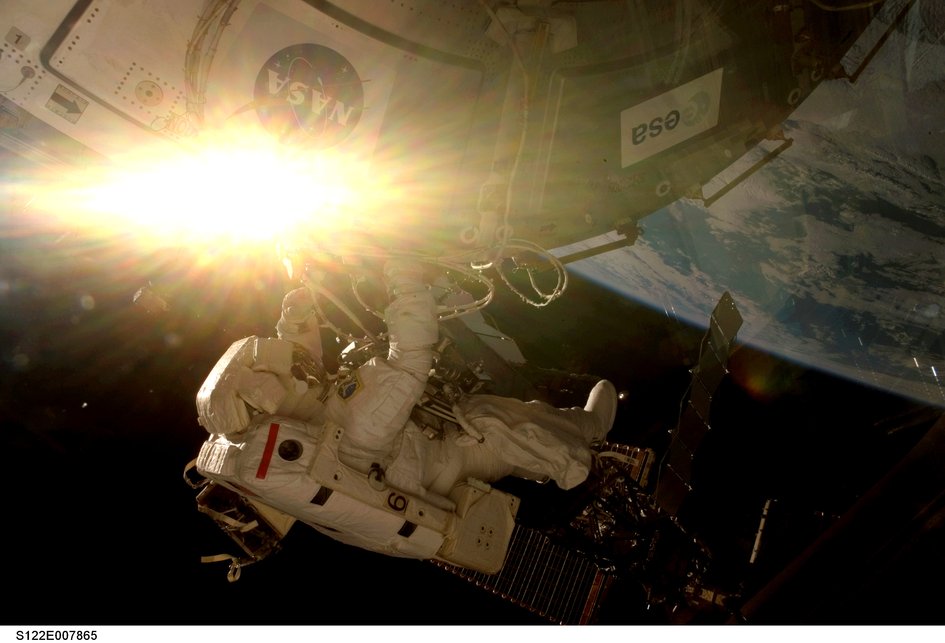
Columbus installation first spacewalk
  (937.74 kB
Columbus installation first spacewalk The European Columbus laboratory was installed during the first spacewalk of the STS-122 mission. NASA astronauts Stanley Love and Rex Walheim spent nearly 8 hours outside the International Space Station. Their tasks included preparation of the Columbus laboratory for transfer from Space Shuttle Atlantis' payload bay to the starboard side of the Station's Harmony module.
Credits: NASA
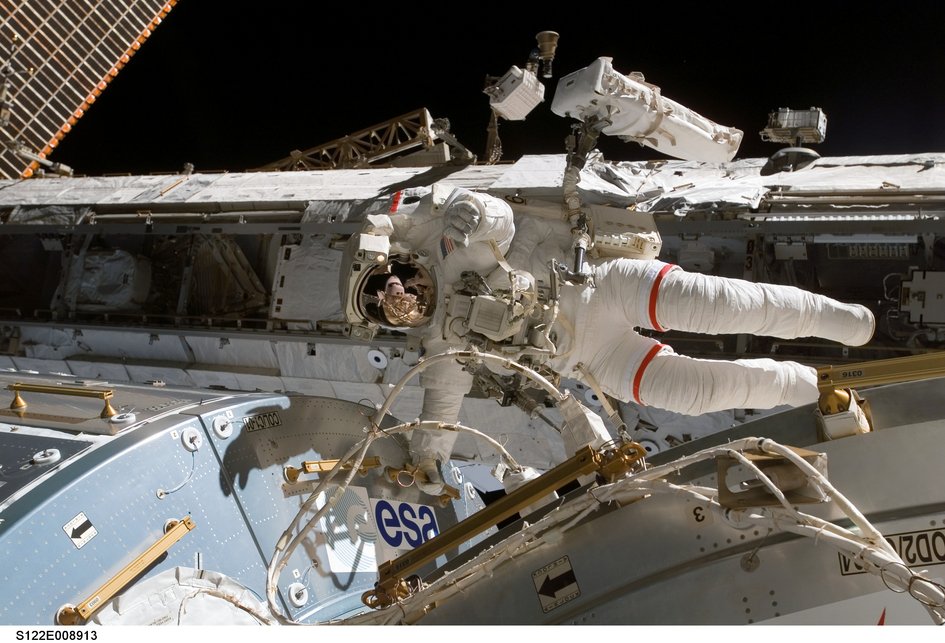
NASA Astronaut Rex Walheim hanging on to Columbus
(1.53 MB)
NASA Astronaut Rex Walheim hanging on to Columbus NASA astronaut Rex Walheim, mission specialist, holds onto a handrail on the Columbus laboratory on the International Space Station. His helmet visor mirrors the forward section of the Space Shuttle Atlantis that is docked to the Station. NASA astronaut Stanley Love (out of frame), mission specialist, shared this final period of STS-122 spacewalk with Rex.
Credits: NASA
On 7 February 2008 Space Shuttle Atlantis was launched to the International Space Station carrying ESA's Columbus laboratory.
Over 6 m long and more than 10 tonnes, its shell was built in Italy and completed in Germany. Columbus was shipped to the US to be launched from the Kennedy Space Center. ESA astronauts Léopold Eyharts and Hans Schlegel joined the Shuttle crew to install the module on the orbital complex.
Since then, more than a hundred ESA-led experiments have been conducted in many areas such as biology, fluid physics, material sciences, radiation physics and the human body.
More
Five years of supporting science from ESA's Columbus Control Centre
Related Articles:
ESA
Guillermo Gonzalo Sánchez Achutegui
ayabaca@gmail.com
ayabaca@hotmail.com
ayabaca@yahoo.com

miércoles, 30 de enero de 2013

NASA - Water Bubble in Space


NASA astronaut Kevin Ford, Expedition 34 commander, watches a water bubble float freely between him and the camera, showing his image refracted, in the Unity node of the International Space Station. Image Credit: NASA

Download Image


NASA
Guillermo Gonzalo Sánchez Achutegui
ayabaca@gmail.com
ayabaca@hotmail.com
ayabaca@yahoo.com

lunes, 7 de enero de 2013

NASA - Robonaut Operates Task Board in Space


In the International Space Station's Destiny laboratory, Robonaut 2 is pictured during a round of testing for the first humanoid robot in space. Photo Credit: NASA

NASA
Guillermo Gonzalo Sánchez Achutegui
ayabaca@gmail.com
ayabaca@hotmail.com
ayabaca@yahoo.com