Mostrando entradas con la etiqueta The Big Bang. Mostrar todas las entradas

domingo, 1 de diciembre de 2013

ESA: Las nuevas misiones de la ESA para estudiar el universo invisible


Artist's impression of an active galaxy
 

Las nuevas misiones de la ESA para estudiar el universo invisible

29 noviembre 2013
El universo caliente y energético y la búsqueda de las elusivas ondas gravitatorias serán los objetivos de las próximas dos grandes misiones de ciencia de la ESA, según se anunció ayer.
Ambos temas crean un puente entre la astrofísica fundamental y la cosmología, estudiando en detalle los procesos cruciales para la evolución a gran escala del universo y la física subyacente.
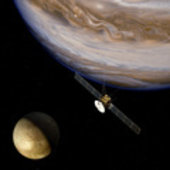
El tema científico El universo caliente y energéticoha sido el elegido para L2, la segunda gran misión en el programa de ciencia de la ESA Visión Cósmica, y se espera que se traduzca en un observatorio avanzado de rayos X.
Esta misión, cuyo lanzamiento está previsto para 2028, abordará dos cuestiones clave: cómo y por qué la materia ordinaria se agrupa para formar las galaxias y cúmulos de galaxias que vemos hoy; y cómo crecen, e influyen en su entorno, los agujeros negros.
Los agujeros negros, que permanecen ocultos en el centro de casi todas las galaxias, se consideran una de las claves para entender la formación y la evolución de las galaxias.
La misión L3 estudiará el universo gavitacional, buscandoarrugasen el tejido mismo del espacio tiempo, creadas por objetos celestes que ejercen una fuerte atracción gravitatoria, como parejas de agujeros negros cuyas órbitas los hacen acercarse poco a poco y que acabarán fusionándose.
Las ondas gravitatorias, predichas en la teoría de la relatividad general de Einstein, aún no han sido detectadas nunca. Cuando lo sean abrirán una ventana del todo nueva al universo.
El lanzamiento de esta nueva misión se prevé para el 2034. Exigirá el desarrollo de un observatorio espacial de ondas gravitatorias, o un 'gravitómetro' de alta precisión, un objetivo ambicioso que desplazará las fronteras de la tecnología actual.
“La ESA ha demostrado ampliamente su capacidad de desarrollar observatorios espaciales en la vanguardia tecnológica, que han revolucionado nuestro conocimiento de cómo se han formado y cómo han evolucionado las estrellas y galaxias”, ha dicho Álvaro Giménez, director de Ciencia y Exploración Robótica de la ESA.
“Con estos dos nuevos temas científicos seguiremos ampliando las fronteras del conocimiento y desvelando los misterios del universo invisible”.
El proceso de selección de L2 y L3 empezó en marzo de 2013, cuando la ESA publicó una convocatoria solicitando a la comunidad científica europea que sugiriera los temas científicos en que deberían centrarse las misionesLarge-Grandes- del programa Visión Cósmica.
Se recibieron 32 propuestas, que fueron evaluadas por una comisión de seniors -Senior Survey Committee-. Los dos temas principales recomendados al Director de Ciencia y Exploración Robótica de la ESA fueron elegidos, finalmente, tras una interacción intensa con la comunidad científica.
“Ha sido difícil decidir qué temas científicos escoger, de entre todos los candidatos excelentes, pero creemos que las misiones para estudiar el universo caliente y energético, y las ondas gravitatorias, generarán descubrimientos de gran valor para la cosmología, la astrofísica y la física en general”, dijo Catherine Cesarsky, presidenta de la comisión de selección.
Aunque falta más de una década para los lanzamientos de L2 y L3, ambas misiones empezarán a prepararse muy pronto. A principios de 2014 se publicará una convocatoria de conceptos para L2, un observatorio espacial de rayos X. Posteriormente se seguirá un procedimiento similar para L3.
“Hoy hemos creado una nueva hoja de ruta científica para Europa, un plan que establecerá nuestro liderazgo en el área durante las próximas dos décadas, mientras desarrollamos e implementamos las tecnologías para estas emocionantes misiones”, añadió Giménez.
El satélite más frío en alcanzar la órbita entorno al punto L2

Refrigerando los Instrumentos de Planck
3 julio 2009
El pasado jueves por la noche, los detectores del Instrumento de Alta Frecuencia de Planck alcanzaron su extraordinariamente baja temperatura de funcionamiento de -273°C, convirtiendo al satélite en el objeto conocido más frío del espacio. El satélite también acaba de alcanzar su órbita definitiva entorno al segundo punto de Lagrange del sistema Sol-Tierra, conocido como L2.
Planck está equipado con un sistema de refrigeración pasivo que reduce su temperatura hasta unos -230°C radiando calor al espacio. Tres refrigeradores activos lo relevan en este punto para reducir todavía más la temperatura hasta la extraordinaria cifra de -273.05°C, tan solo 0.1°C por encima del cero absoluto – la temperatura más baja teóricamente posible en el Universo.
Estas temperaturas tan bajas son necesarias para que los detectores de Planck puedan estudiar el Fondo Cósmico en Microondas (CMB, en su acrónimo inglés), la primera luz emitida por el universo tan solo 380 000 años después del Big Bang, midiendo su temperatura a lo largo del cielo.

Equivalente a detectar el calor de un conejo en la Luna
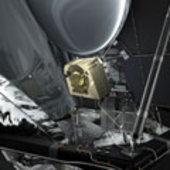
Planck telescope focal plane unit
Unidad del plano focal del telescopio de Planck
Los detectores buscarán variaciones en la temperatura del CMB del orden de la millonésima parte de un grado – lo que es comparable a detectar desde la Tierra el calor generado por un conejo sentado en la Luna. Este es el motivo por el que los detectores se deben enfriar a temperaturas cercanas al cero absoluto (-273.15°C, o cero Kelvin, 0K).
Se puede encontrar más información sobre las diferentes etapas del proceso de refrigeración en el enlace ‘Planck in depth’, situado en el menú de la derecha.

Llegada al punto L2

A partir de las 13:15 CEST del pasado Jueves, 2 de Julio, el Equipo de Control de la Misión Planck llevó a cabo una crítica maniobra de inserción en órbita, diseñada para situar al satélite en su órbita definitiva entorno al punto L2.
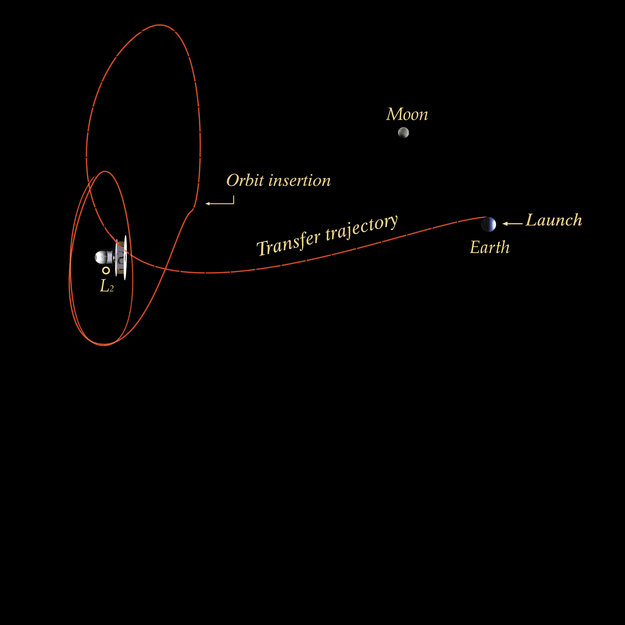
Órbita de Planck
Una vez enviado el comando, el desarrollo de la maniobra se controló de forma autónoma por el propio satélite, encendiendo sus motores durante un periodo de entre 12 y 24 horas. La maniobra dirigió al satélite hacia su órbita operacional definitiva entorno al segundo punto de Lagrange del sistema Sol-Tierra, el L2.
El encendido de los motores se planeó deliberadamente para ser un poco más corto de lo necesario, lo que permitirá realizar una pequeña maniobra de ‘ajuste fino’ en los próximos días que dejará al satélite perfectamente situado en la trayectoria definitiva.
“Si bien la maniobra en si es rutinaria, representa el último gran paso en el largo viaje hacia el L2, y todo el equipo aquí está muy contento de ver cómo Planck alcanza finalmente su órbita operacional”, comenta Chris Watson, Responsable de las Operaciones del Satélite, desde la Sala de Control Dedicada de la misión en el Centro Europeo de Operaciones Espaciales de la ESA en Darmstadt, Alemania.
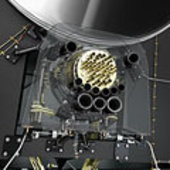
Combined focal planes of Planck's two instruments
Plano focal combinado de los dos instrumentos de Planck
La maniobra se diseñó para cambiar la velocidad del satélite en 211.6 km/hora, finalizando con una velocidad de 1010 km/hora respecto al suelo. Acompañando a la Tierra y al punto virtual L2, Planck estará orbitando entorno al Sol a una velocidad de 106 254 km/hora (29.5 km/segundo).
Al comienzo de la maniobra, Planck estaba situado a 1.43 millones de kilómetros de la Tierra.

Las Operaciones Científicas, a punto de comenzar

Planck escaneando el cielo
Todas las actividades de puesta en servicio continúan según el programa, y esta fase de la misión está prácticamente terminada. Durante las próximas semanas, se realizará un ajuste fino del funcionamiento de los instrumentos para mejorar sus prestaciones.
Planck comenzará a cartografiar el cielo a mediados de Agosto.

Nota a los editores:

Las tres etapas de refrigeración han sido construidas por diferentes institutos, como parte del consorcio para la construcción y entrega de los dos instrumentos de Planck, el Instrumento de Alta Frecuencia (HFI) y el de Baja Frecuencia (LFI):

  • El refrigerador de 20K: El Jet Propulsion Laboratory, California, Estados Unidos.
  • El refrigerador de 4K: El Rutherford Appleton Laboratory (miembro del consorcio para el HFI) en Didcot, y Astrium, ambos en el Reino Unido.
  • El refrigerador de 0.1K: Centre de Recherches des Très Basses Températures, en Grenoble, Francia y el Institut d’Astrophysique Spatiale, en Orsay, Francia (ambos miembros del consorcio para el HFI), así como DTA Air Liquide, también en Grenoble, Francia.


Guillermo Gonzalo Sánchez Achutegui
ayabaca@gmail.com
ayabaca@hotmail.com
ayabaca@yahoo.com

domingo, 8 de julio de 2012

Physic: Peter Ware Higgs and that elusive boson

Hi My Friends: AL VUELO DE UN QUINDE EL BLOG., Higgs has been awarded a number of awards in recognition of his work, including the Dirac Medal and Prize for outstanding contributions to theoretical physics from the Institute of Physics, the 1997 High Energy and Particle Physics Prize by the European Physical Society, and the 2004 Wolf Prize in Physics.

Peter Higgs

Peter Ware Higgs (born May 29, 1929), FRSE, FRS, is an emeritus professor at the University of Edinburgh. Higgs is best known for his 1960s proposal of broken symmetry in electroweak theory, explaining the origin of mass of elementary particles in general and of the W and Z bosons in particular. This so-called Higgs mechanism, which had several inventors besides Higgs, predicts the existence of a new particle, the Higgs boson. Although this particle has not turned up in accelerator experiments so far, the Higgs mechanism is generally accepted as an important ingredient in the Standard Model of particle physics. Higgs conceived of the mechanism in 1964 while walking the Cairngorms, and returned to his lab declaring he had his "one big idea".

Higgs has been awarded a number of awards in recognition of his work, including the Dirac Medal and Prize for outstanding contributions to theoretical physics from the Institute of Physics, the 1997 High Energy and Particle Physics Prize by the European Physical Society, and the 2004 Wolf Prize in Physics.

Higgs was born in Newcastle upon Tyne. His father was a sound engineer with the BBC, and as a result of childhood asthma, together with the family moving around because of his father's job, and later the Second World War, Higgs missed some early schooling and was taught at home. When his father relocated to Bedford, Higgs stayed behind with his mother in Bristol, and was largely raised there. He attended that city's Cotham Grammar School, where he was inspired by the work of one of the school's alumni, Paul Dirac, who founded the field of quantum mechanics.

At the age of 17, Higgs moved to City of London School, where he specialized in mathematics, then to King's College London, and in his 30s, to Edinburgh University. It was at Edinburgh that he first became interested in mass, developing the idea that particles were weightless when the universe began, acquiring mass a fraction of a second later, as a result of interacting with a theoretical field now known as the Higgs field. Higgs postulated that this field permeates space, giving all elementary subatomic particles that interact with it their mass. While the Higgs field is postulated to confer mass on quarks and leptons, it represents only a tiny portion of the masses of other subatomic particles, such as protons and neutrons. In these, gluons that bind quarks together confer most of the particle mass.
Large Hadron Collider could unlock secrets of the Big Bang
Richard Gray 06/04/2008
Image from http://www.gridpp.ac.uk/cubes/

The world's largest and most expensive science experiment, the new particle accelerator buried 300ft beneath the Alpine foothills along the Swiss French border is 17 miles long and up to 12 stories high. It is designed to generate temperatures of more than a trillion degrees centigrade. The £4.4 billion machine - the Large Hadron Collider - is aiming to unlock the secrets of how the universe began. Scientists will use it to try to recreate the conditions that existed just a fraction of a second after the Big Bang, the birth of the universe, by smashing pieces of atoms together at high speed.

The Sunday Telegraph joined the scientist Peter Higgs, a professor of particle physics at Edinburgh University, whose 40-year-old theories about an elusive particle known as the Higgs boson may finally be proved as part of the huge experiment, as he toured the site for the first time. This weekend will be the last time visitors will be given access to the tunnel that houses the accelerator ring.  From tomorrow, it will be completely closed off while technicians make the final preparations before it is turned on in July when, it is hoped, it will begin revealing what the matter and energy that created the universe was really like. What happens afterwards could change our understanding of the world. Most experts believe the explosions created when the particles hit each other will reveal the basic building blocks of everything around us. There are some, however, who fear it could destroy the planet.

A lawsuit filed last week by environmentalists in Hawaii is seeking a restraining order preventing the European Nuclear Research Centre from switching it on for fear it could create a black hole that will suck up all life on Earth. "The Large Hadron Collider is like a time machine that is going to take us further back towards the Big Bang than we have ever been before by recreating the conditions that existed there. "We are going to see new types of matter we haven't been able to see before," said Professor Frank Close, a particle physicist at Oxford University. "The idea that it could cause the end of the world is ridiculous."

Housed in a subterranean lair that would provide a suitable home for a Hollywood super-villain, it is hardly surprising there are conspiracy theories surrounding the work being carried out on the collider. The tunnel is large enough to drive a train through and so long that the curve is barely noticeable. To reach it requires a two-minute lift journey from ground level. Down below the scene is a mass of cables, tubes, electronics and metal panels.

Atomic particles will spiral though a series of rings, lined with powerful magnets that will accelerate the particles till they reach close to the speed of light. Each particle will race around the 17-mile route 11,245 times every second before being smashed headlong into each other, breaking them into their component parts, releasing huge amounts of energy and debris. The temperatures produced by these collisions will be 100,000 times hotter than the centre of the sun and scientists believe this will be powerful enough to reveal the first particles that existed in the moments immediately after the birth of the universe.

This massive experiment will create more than 15 million gigabytes of data every year - the equivalent of 21.4 million CDs. The scientists have had to design a new form of the internet to cope with the data. Six separate detectors have been positioned around the collider ring to allow scientists to examine what happens. Among the particles they will hunt for is the Higgs boson, a cornerstone of modern physics that is thought to be responsible for giving every other particle its mass, or weight.

Immediately after the Big Bang all particles are thought to have had no mass. As the temperature cooled, the Higgs boson "stuck" to them, making them heavy. Some particles are more "sticky" than others and so gain more weight. A massive detector known as Atlas is among those that will be hunting for the Higgs boson. As big as Canterbury Cathedral and weighing more than 100 747 jumbo jet aircraft, it is one of the most impressive parts of the collider.

Professor Jonathan Butterworth, a physicist at University College London who is among the UK scientists involved in the Atlas experiment, said: "If we find the Higgs boson then it will prove our standard model of particle physics. "If we don't find it then nature may have another way of giving particles mass and that is going to turn science on its head."

Two elevator rides and a 10-minute car journey away on the other side of the giant accelerator, another part of the experiment, dubbed Alice, will recreate the superheated gas, or plasma, that existed when the universe was formed. The collider may also reveal more exotic phenomena such as anti-matter, the opposite of ordinary matter, mini black holes and even extra dimensions.

"At the level of energy we will be creating normal matter doesn't exist. I expect we will see some things that are entirely new and could turn our current understanding of physics on its head," said Dr David Evans, a physicist from Birmingham University who has been working on the Alice project.

"Answering these new questions will be more exciting than proving theories that already exist."
Information of: Frost's Medidations
Guillermo Gonzalo Sánchez Achutegui
ayabaca@gmail.com
ayabaca@hotmail.com
ayabaca@yahoo.com