Mostrando entradas con la etiqueta Ginebra. Mostrar todas las entradas

domingo, 25 de agosto de 2013

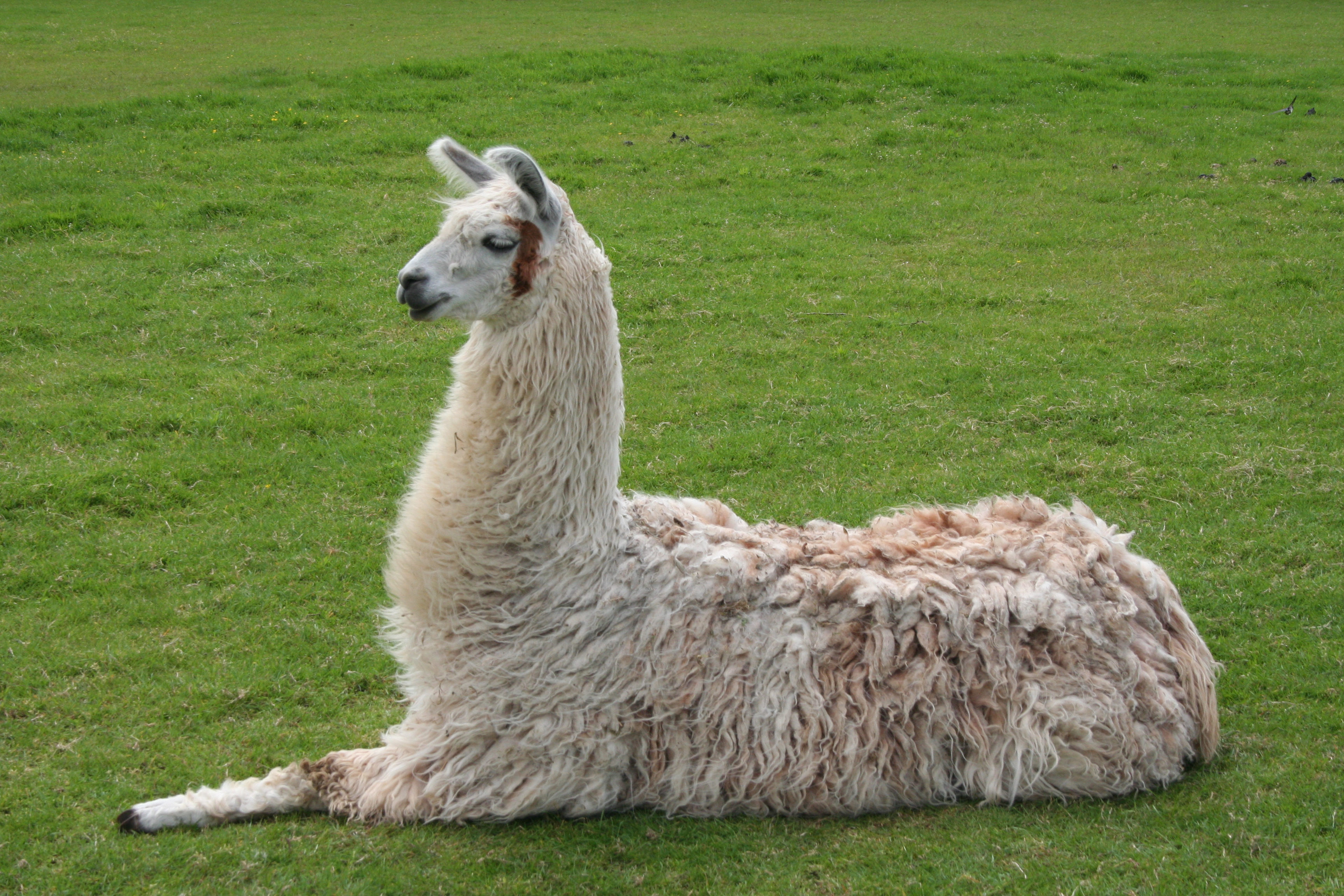
Camélido del Perú: La llama, nuevo guardián de los rebaños de ovejas en las montañas de Suiza


Full resolution(3,456 × 2,304 pixels, file size: 4.4 MB, MIME type: image/jpeg); ZoomViewer: flash/no flash

La llama (Lama glama) (en aimara qawra) es un mamífero artiodáctilo doméstico de la familia Camelidae, abundante en la Puna o Altiplano de los Andes de Argentina, Bolivia, Chile, Ecuador y Perú;[1] Fue creado por los pueblos andinos nativos mediante selección artificial a partir de guanacos salvajes que fueron domesticados, del cual, por lo tanto, la llama deriva. Según recientes estudios de ADN,[cita requerida] esto ocurrió en principio de manera independiente en tiempo y espacio, en sectores del sur del Perú, norte de Chile, noroeste de Argentina, y el oeste de Bolivia. Fue aprovechado al máximo por el imperio Inca: era utilizado como animal para sacrificios, se obtenía carne y lana de él, y era aprovechado como animal de carga (el único antes de la llegada de los españoles a América, si se exceptúan los perros de los trineos inuit o «esquimales»).
Wikipedia.

La llama, nuevo guardián de los rebaños de ovejas en las montañas de Suiza
Mapa


La llama, nuevo guardián de los rebaños de ovejas en las montañas de Suiza
(EFE) – hace 14 horas 
Ginebra, 25 ago (EFE).- Tras generaciones de hegemonía del perro y el asno como guardianes de los rebaños de ovejas en los Alpes de Suiza, los pastores locales han encontrado en la llama, camélido oriundo de los Andes, un nuevo aliado contra los ataques de lobos y linces.
El carácter atento y curioso de estos camélidos andinos, y su comportamiento en el terreno, similar al de los perros y los asnos son algunas de sus ventajas, según los ganaderos.
Bajo esta perspectiva, la Asociación Suiza para el Desarrollo de la Agricultura y del Espacio Rural (Agridea) ha decidido utilizarlos en una fase de prueba y empezado con veinte ejemplares que protegen actualmente algunos rebaños.
Agridea se ha inspirado en el testimonio positivo de Estados Unidos y Australia, donde estos animales se emplean desde hace bastante tiempo para evitar que los coyotes o los perros callejeros ataquen al ganado.
"Hemos decidido experimentar con las llamas en pastos pequeños donde la presión del lobo, aunque existe, es menor. Además, son animales con gastos de mantenimiento muy pequeños", declaró a Efe Daniel Mettler, responsable de los dos proyectos pilotos con llamas que Agridea lleva a cabo en Suiza.
El propio presidente de la Federación Suiza de Ganado Ovino y propietario de más de sesenta ovejas, German Schmutz, decidió experimentar con una llama, a la que decidió llamar "Lusko".
A "Lusko" se le encargó proteger a más de 250 ovejas que unos 30 pastores pasearon este verano por los pastos del valle de Petit-Mont en Gruyère (Cantón de Friburgo).
"Al principio fue bastante difícil porque el camélido se mostraba muy agresivo, pero ahora todo va mucho mejor y se ha vuelto más calmado. Con 250 ovejas hembras... ¡Tiene de que ocuparse!", bromeó el pastor Schmutz.
Consideró que una ventaja de la llama es que, contrariamente a lo ocurre con los canes, no ladran cada vez que pasa alguien por su lado.
Mettler corroboró que los camélidos tienen un escaso riesgo de provocar un conflicto con otros animales o con personas, especialmente turistas.
"Decidimos probar la experiencia después de la proposición de Agridea de emplear a 'Lusko'. Más vale probar cualquier cosa que no hacer nada. Algunos (pastores) están en contra sólo porque nunca se ha hecho", comentó el pastor.
Por otra parte, otro pastor y dueño de una decenas de ovejas, Hubert Tinguely, señaló que alimentar a la llama es más simple porque come hierba como las ovejas, mientras que a los perros hay que darles otro tipo de comida.
Además, la llama, que es el pariente sudamericano del camello, necesita poca agua.
Se le ha considerado un animal muy fuerte que fue domesticado por los habitantes de los Andes y durante siglos la población indígena los usó como animales de carga.
En relación a los ataques de lobos, Tinguely dudó de que fuesen una verdadera amenaza en sus pastos aunque estos animales reaparecieron en Suiza en los años noventa y en los últimos años se ha informado de varios ataques a rebaños.
"En esta zona tenemos la suerte de que no hay matorrales donde los depredadores puedan esconderse y los pastos están todo el día a pleno sol", afirmó.
El futuro de las llamas dependerá de la evolución del pastoreo en Suiza, ya que su uso responde a circunstancias específicas, que son la de pastos pequeños y una menor presión del lobo.
"Con las llamas estamos en fase de pruebas. Los perros siguen siendo elementos clave en la defensa contra los depredadores, pero los camélidos son una alternativa", concluyó Mettler. Lourdes Abad
EFE
Guillermo Gonzalo Sánchez Achutegui

domingo, 8 de julio de 2012

Physic: Peter Ware Higgs and that elusive boson

Hi My Friends: AL VUELO DE UN QUINDE EL BLOG., Higgs has been awarded a number of awards in recognition of his work, including the Dirac Medal and Prize for outstanding contributions to theoretical physics from the Institute of Physics, the 1997 High Energy and Particle Physics Prize by the European Physical Society, and the 2004 Wolf Prize in Physics.

Peter Higgs

Peter Ware Higgs (born May 29, 1929), FRSE, FRS, is an emeritus professor at the University of Edinburgh. Higgs is best known for his 1960s proposal of broken symmetry in electroweak theory, explaining the origin of mass of elementary particles in general and of the W and Z bosons in particular. This so-called Higgs mechanism, which had several inventors besides Higgs, predicts the existence of a new particle, the Higgs boson. Although this particle has not turned up in accelerator experiments so far, the Higgs mechanism is generally accepted as an important ingredient in the Standard Model of particle physics. Higgs conceived of the mechanism in 1964 while walking the Cairngorms, and returned to his lab declaring he had his "one big idea".

Higgs has been awarded a number of awards in recognition of his work, including the Dirac Medal and Prize for outstanding contributions to theoretical physics from the Institute of Physics, the 1997 High Energy and Particle Physics Prize by the European Physical Society, and the 2004 Wolf Prize in Physics.

Higgs was born in Newcastle upon Tyne. His father was a sound engineer with the BBC, and as a result of childhood asthma, together with the family moving around because of his father's job, and later the Second World War, Higgs missed some early schooling and was taught at home. When his father relocated to Bedford, Higgs stayed behind with his mother in Bristol, and was largely raised there. He attended that city's Cotham Grammar School, where he was inspired by the work of one of the school's alumni, Paul Dirac, who founded the field of quantum mechanics.

At the age of 17, Higgs moved to City of London School, where he specialized in mathematics, then to King's College London, and in his 30s, to Edinburgh University. It was at Edinburgh that he first became interested in mass, developing the idea that particles were weightless when the universe began, acquiring mass a fraction of a second later, as a result of interacting with a theoretical field now known as the Higgs field. Higgs postulated that this field permeates space, giving all elementary subatomic particles that interact with it their mass. While the Higgs field is postulated to confer mass on quarks and leptons, it represents only a tiny portion of the masses of other subatomic particles, such as protons and neutrons. In these, gluons that bind quarks together confer most of the particle mass.
Large Hadron Collider could unlock secrets of the Big Bang
Richard Gray 06/04/2008
Image from http://www.gridpp.ac.uk/cubes/

The world's largest and most expensive science experiment, the new particle accelerator buried 300ft beneath the Alpine foothills along the Swiss French border is 17 miles long and up to 12 stories high. It is designed to generate temperatures of more than a trillion degrees centigrade. The £4.4 billion machine - the Large Hadron Collider - is aiming to unlock the secrets of how the universe began. Scientists will use it to try to recreate the conditions that existed just a fraction of a second after the Big Bang, the birth of the universe, by smashing pieces of atoms together at high speed.

The Sunday Telegraph joined the scientist Peter Higgs, a professor of particle physics at Edinburgh University, whose 40-year-old theories about an elusive particle known as the Higgs boson may finally be proved as part of the huge experiment, as he toured the site for the first time. This weekend will be the last time visitors will be given access to the tunnel that houses the accelerator ring.  From tomorrow, it will be completely closed off while technicians make the final preparations before it is turned on in July when, it is hoped, it will begin revealing what the matter and energy that created the universe was really like. What happens afterwards could change our understanding of the world. Most experts believe the explosions created when the particles hit each other will reveal the basic building blocks of everything around us. There are some, however, who fear it could destroy the planet.

A lawsuit filed last week by environmentalists in Hawaii is seeking a restraining order preventing the European Nuclear Research Centre from switching it on for fear it could create a black hole that will suck up all life on Earth. "The Large Hadron Collider is like a time machine that is going to take us further back towards the Big Bang than we have ever been before by recreating the conditions that existed there. "We are going to see new types of matter we haven't been able to see before," said Professor Frank Close, a particle physicist at Oxford University. "The idea that it could cause the end of the world is ridiculous."

Housed in a subterranean lair that would provide a suitable home for a Hollywood super-villain, it is hardly surprising there are conspiracy theories surrounding the work being carried out on the collider. The tunnel is large enough to drive a train through and so long that the curve is barely noticeable. To reach it requires a two-minute lift journey from ground level. Down below the scene is a mass of cables, tubes, electronics and metal panels.

Atomic particles will spiral though a series of rings, lined with powerful magnets that will accelerate the particles till they reach close to the speed of light. Each particle will race around the 17-mile route 11,245 times every second before being smashed headlong into each other, breaking them into their component parts, releasing huge amounts of energy and debris. The temperatures produced by these collisions will be 100,000 times hotter than the centre of the sun and scientists believe this will be powerful enough to reveal the first particles that existed in the moments immediately after the birth of the universe.

This massive experiment will create more than 15 million gigabytes of data every year - the equivalent of 21.4 million CDs. The scientists have had to design a new form of the internet to cope with the data. Six separate detectors have been positioned around the collider ring to allow scientists to examine what happens. Among the particles they will hunt for is the Higgs boson, a cornerstone of modern physics that is thought to be responsible for giving every other particle its mass, or weight.

Immediately after the Big Bang all particles are thought to have had no mass. As the temperature cooled, the Higgs boson "stuck" to them, making them heavy. Some particles are more "sticky" than others and so gain more weight. A massive detector known as Atlas is among those that will be hunting for the Higgs boson. As big as Canterbury Cathedral and weighing more than 100 747 jumbo jet aircraft, it is one of the most impressive parts of the collider.

Professor Jonathan Butterworth, a physicist at University College London who is among the UK scientists involved in the Atlas experiment, said: "If we find the Higgs boson then it will prove our standard model of particle physics. "If we don't find it then nature may have another way of giving particles mass and that is going to turn science on its head."

Two elevator rides and a 10-minute car journey away on the other side of the giant accelerator, another part of the experiment, dubbed Alice, will recreate the superheated gas, or plasma, that existed when the universe was formed. The collider may also reveal more exotic phenomena such as anti-matter, the opposite of ordinary matter, mini black holes and even extra dimensions.

"At the level of energy we will be creating normal matter doesn't exist. I expect we will see some things that are entirely new and could turn our current understanding of physics on its head," said Dr David Evans, a physicist from Birmingham University who has been working on the Alice project.

"Answering these new questions will be more exciting than proving theories that already exist."
Information of: Frost's Medidations
Guillermo Gonzalo Sánchez Achutegui
ayabaca@gmail.com
ayabaca@hotmail.com
ayabaca@yahoo.com

jueves, 5 de julio de 2012

Física: El CERN anuncia el descubrimiento de nueva partícula, con gran probabilidad de ser el bosón de Higgs

Hola amigos : AL VUELO DE UN QUINDE EL BLOG., El Laboratorio Europeo de Física de Partículas (CERN) anunció hoy el descubrimiento de una nueva partícula, que podría ser el buscado "bosón de Higgs", aunque todavía no puede confirmarlo con certeza científica.
Imagen generada por ordenador y dirtribuida por el Laboratorio Europeo de Física de Partículas (CERN), que muestra una colisión entre protones en el experimento del CERN en busca del "bosón de Higgs".El director general del Centro Europeo de Física de Partículas (CERN), Rolf Heuer, confirmó hoy miércoles 4 de julio de 2012 que este centro de investigación ha descubierto una nueva partícula muy similar a lo que se cree es el "bosón de Higgs".Esto supone un avance fenomenal "en nuestra comprensión de la naturaleza", declaró Heuer, quien calificó como "histórico" el hallazgo. EFE

Miles de científicos del CERN y otros laboratorios del mundo trabajan desde hace décadas en la búsqueda de esa partícula, que es la clave para entender mejor la formación del universo. "Hemos observado un exceso de sucesos alrededor de una masa de unos 125
gigaelectronvoltios (GeV) con una significación estadística de 4,9 sigmas", dijo el físico Joe Incandela, portavoz del CMS, uno de los dos experimentos que buscan la partícula de Higgs.
Esto significa que la nueva partícula observada tiene las propiedades que se espera correspondan al "bosón de Higgs" y que esto ha podido observarse con una probabilidad de error equivalente a una en tres millones.
El CERN presentó en una conferencia científica en su sede principal los resultados obtenidos hasta el momento por el experimento CMS y ATLAS, en la víspera de una prestigiosa reunión de Física de Altas Energías en Australia. EFEverde
EFE
Guillermo Gonzalo Sánchez Achutegui
ayabaca@hotmail.com
ayabaca@gmail.com
ayabaca@yahoo.com