Mostrando entradas con la etiqueta Climate Change. Mostrar todas las entradas

domingo, 14 de julio de 2013

nsf.gov - National Science Foundation : NSF, USDA, DOE Award Grants to Improve Predictions of Climate Change on Regional, Decadal Scales

Research will lead to better understanding of climate change effects on shorter, more local scales,-
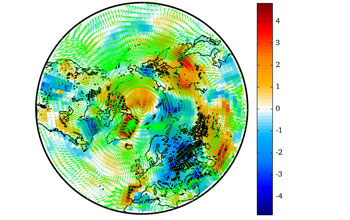
Graphic simulation of surface temperature changes due to aerosols from Northern Hemisphere fires.
Simulation of surface temperature changes due to aerosols from Northern Hemisphere fires.
Credit: Yongjia Song and Yuhang Wang, Georgia Institute of Technology
Download the high-resolution JPG version of the image. (234 KB)
Aerial view of wetlands
EaSM researchers will assess how climate change affects prairie pothole wetlands.
Credit: Ducks Unlimited
Download the high-resolution JPEG version of the image. (46 KB)
Closeup of a water droplet
Water: more precious than gold. Will there be enough in longer times of drought?
Credit: Wikimedia Commons
Download the high-resolution JPG version of the image. (113 KB)
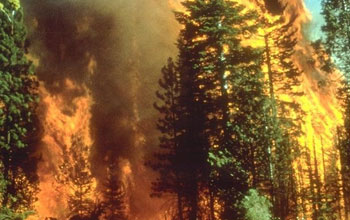
Photo of a wild fire in a forest
EaSM grantees will study wildfires and regional climate variability.
Credit: Wikimedia Commons
Download the high-resolution JPG version of the image. (127 KB)
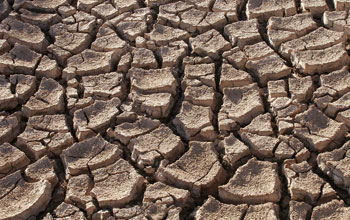
Close up image of cracks open in the land in Sonoran desert
Scorched Earth: drought in the Sonoran Desert cracks open the land.
Credit: Wikimedia Commons
Download the high-resolution JPG version of the image. (3.7 MB)
Photo of sun shining over cars in busy traffic on a highway
Hot time in the city: How will climate change affect urban and surrounding areas?
Credit: NSF Central Arizona-Phoenix Long-Term Ecological Research Site
Download the high-resolution JPG version of the image. (100 KB)

What will Earth's climate be like in a decade--or sooner? And what will it be like where you live, and around the globe?
To help find answers, the National Science Foundation (NSF) and other federal agencies have awarded new grants to study the consequences of climate variability and change.
The awards were made through the interagency Decadal and Regional Climate Prediction Using Earth System Models (EaSM) Program. At NSF, EaSM is part of the Science, Engineering and Education (SEES) portfolio of investments.
"NSF is strongly supportive of the EaSM goal of improved understanding of the climate system," says Roger Wakimoto, NSF assistant director for Geosciences.
"Better climate predictions will arm decision-makers with the quantitative information they need to help chart the appropriate future course for society," says Wakimoto.
Other agencies awarding grants in the interagency EaSM Program are the U.S. Department of Agriculture (USDA) and the U.S. Department of Energy (DOE).
NSF has invested $22.7 million in the awards; USDA, $5.2 million; and DOE, $3.3 million.
Among the subjects addressed by the EaSM awards are:
  • Quantifying and conveying the risk of prolonged drought in coming decades,
  • Exploring the connection between wildfires and regional climate variability,
  • Linking near-term future changes in weather and hydroclimate in Western North America to adaptations for ecosystem and water resource management,
  • Advancing climate and regional model validation for societal applications, and
  • Connecting human and Earth system models to assess regional effects and adaptations in urban systems and their hinterlands.
According to scientists, the EaSM program addresses one of the most pressing problems of the millennium: climate change and how it is likely to affect the world--and how people can plan for its consequences.
That challenge calls for the development of next-generation Earth system models that include coupled and interactive representations of ecosystems, agricultural working lands and forests, urban environments, biogeochemistry, atmospheric chemistry, ocean and atmospheric currents, the water cycle, land and sea ice and human activities.
EaSM projects will expand the limits of scientists' understanding of Earth's climate system, leading to better ways of predicting climate change.
The consequences of climate variability and change are becoming more immediate and profound than anticipated, research has found.
Prolonged droughts on several continents, increasing stresses on natural and managed ecosystems, losses of agricultural and forest productivity, degraded ocean and permafrost habitats, global sea-level rise, the rapid retreat of ice sheets and glaciers, and changes in ocean currents have shown that climate variability and change will likely have significant effects on decade and shorter time scales.
Those effects on humans and other animals, plants, and planet-wide systems such as the oceans, may be far-reaching.
Among the goals of the EaSM program is achieving reliable global and regional predictions of decadal climate variability and change through an understanding of the coupled physical, chemical, biological and human processes that drive the climate system.
Awardees are working to quantify the effects of climate variability and change on ecological, agricultural and other human systems, and to identify and quantify "feedback loops" through which humans affect the environment.
"As climate becomes more variable, precipitation extremes become more frequent and temperatures rise, agricultural producers, foresters and natural resource managers will need to plan and adapt in order to meet the needs of Earth's population," says Sonny Ramaswamy, director of the National Institute of Food and Agriculture at the U.S. Department of Agriculture.
"Understanding the climate system and being able to predict climate trends on decadal and regional scales will be important to helping the agriculture industry remain profitable. These grants will help us move science forward so we can make the best decisions for adaptive management and planning for the future."
Adds Sharlene Weatherwax, DOE associate director for Biological and Environmental Research, "To advance a robust predictive understanding of Earth's climate, and to inform the development of sustainable solutions to our energy and environmental challenges, a deeper understanding of natural climate variability and change is needed.
"The projects DOE supports through EaSM are expected to efficiently enhance the ability to design and deploy the most effective energy solutions for the nation."
Scientists are maximizing observational and model data for impact and vulnerability/resilience assessments, and translating model results and their uncertainties into the scientific basis for well-informed human adaptation to and management decisions for climate change.
These decisions need to happen, say climate researchers, in the coming years--not decades or centuries.
2013 NSF-USDA-DOE EaSM Awards
Gokhan Danabasoglu, UCAR
Jonathan Overpeck, University of Arizona
 
 Richard Seager, Columbia University
 Lawrence Buja, UCAR
Dmitri Kondrashov, University of California, Los Angeles
 
Yuhang Wang, Georgia Tech (jointly funded with DOE)
 Brian O'Neill, UCAR
Daniel Cooley, Colorado State University (jointly funded with DOE)
 Ray Arritt, Iowa State
Phil Mote, Oregon State University
-NSF-
Media Contacts Cheryl Dybas, NSF (703) 292-7734
Related WebsitesNSF Science, Engineering and Education for Sustainability (SEES) Investment:
http://www.nsf.gov/sees
NSF/EaSM Discovery Article: The Snows of Mount Washington:
http://www.nsf.gov/discoveries/disc_summ.jsp?cntn_id=123363&org=NSF
NSF Publication: Discoveries in Sustainability:
The National Science Foundation (NSF) is an independent federal agency that supports fundamental research and education across all fields of science and engineering. In fiscal year (FY) 2012, its budget was $7.0 billion. NSF funds reach all 50 states through grants to nearly 2,000 colleges, universities and other institutions. Each year, NSF receives about 50,000 competitive requests for funding, and makes about 11,500 new funding awards. NSF also awards about $593 million in professional and service contracts yearly.
Useful NSF Web Sites:
NSF Home Page:
 http://www.nsf.gov
NSF News:
http://www.nsf.gov/news/
For the News Media:
http://www.nsf.gov/news/newsroom.jsp
Science and Engineering Statistics:

The National Science Foundation (NSF).-
 
Guillermo Gonzalo Sánchez Achutegui

jueves, 15 de noviembre de 2012

nsf.gov - News - Climate Change Threatens Giant Pandas’ Bamboo Buffet--and Survival

China’s endangered wild pandas may need new dinner reservations--and quickly, based on models that indicate climate change may kill off swaths of bamboo that pandas need to survive
This panda is one of about 275 wild Qinling pandas that live in the study region. Their isolation has resulted in genetic variation from other giant pandas. Some of these pandas, like the one shown here, are brownish.
Credit: Yange Yong
Download the high-resolution JPG version of the image. (1.6 MB)
Because bamboo is very low in nutrients, wild pandas eat as much as 84 pounds of bamboo daily, and spend at least 12 hours per day eating bamboo. A wild panda may also occasionally eat other grasses and small rodents or musk deer fawns.
Credit: Andrés Viña, Michigan State University Center for Systems Integration and Sustainability
Download the high-resolution JPG version of the image. (526 KB)
A bamboo trove in western China.
Credit: Andrés Viña, Michigan State University Center for Systems Integration and Sustainability
Download the high-resolution JPG version of the image. (1.8 MB)

In this week's Nature Climate Change, an international journal, scientists from Michigan State University (MSU) and the Chinese Academy of Sciences provide comprehensive forecasts of how changing climate may affect the most common species of bamboo that carpet the forest floors of prime panda habitat in northwestern China. Even the most optimistic scenarios show that bamboo die-offs would effectively cause prime panda habitat to become inhospitable by the end of the 21st century.
The scientists studied possible scenarios of climate change in the Qinling Mountains in Shaanxi Province. At the northern boundary of China's panda distributional range, the Qinling Mountains are home to about 275 wild pandas, which account for about 17 percent of the remaining wild population. The Qinling pandas, which have been isolated because of thousands of years of human habitation around the mountain range, vary genetically from other giant pandas. The geographic isolation of these pandas makes them particularly valuable for conservation, but vulnerable to climate change.
"Understanding impacts of climate change is an important way for science to assist in making good decisions," said Jianguo "Jack" Liu, director of MSU's Center for Systems Integration and Sustainability (CSIS) and a study co-author. "Looking at the climate impact on the bamboo can help us prepare for the challenges that the panda will likely face in the future."
Bamboo is a vital part of forest ecosystems, being not only the sole menu item for giant pandas, but also providing essential food and shelter for other wildlife, including other endangered species like the ploughshare tortoise and purple-winged ground-dove.
Bamboo can be a risky crop to stake survival on because it has an unusual reproductive cycle. The studied species only flower and reproduce every 30 to 35 years, which limits the plants' ability to adapt to changing climate and can spell disaster for a food supply.
Mao-Ning Tuanmu, who recently finished his Ph.D. studies at CSIS, and his colleagues constructed unique models, using field data on bamboo locality, multiple climate projections and historic data of precipitation, temperature ranges and greenhouse gas emission scenarios to evaluate how three dominant bamboo species would fare in the Qinling Mountains of China.
Not many scientists to date have studied understory bamboo, Tuanmu said. But evidence found in fossil and pollen records does indicate that bamboo distribution has followed the benefits--and devastation--of climate change over time.
The fate of pandas will not only be determined by nature, but by humans as well. If, as the study's models predict, large swaths of bamboo become unavailable because of human-caused land use changes, pandas will be deprived of clear, accessible paths between meal sources.
"The giant panda population also is threatened by other human disturbances," Tuanmu said. "Climate change is only one challenge for the giant pandas. But on the other hand, the giant panda is a special species. People put a lot of conservation resources into them compared to other species. We want to provide data to guide that wisely."
The models can point the way for proactive planning to protect areas where the climate increases their potential for providing adequate food sources or to begin creating natural "bridges" to allow pandas an escape hatch from bamboo famine.
"We will need proactive actions to protect the current giant panda habitats," Tuanmu said. "We need time to look at areas that might become panda habitat in the future, and to think now about maintaining connectivity of areas of good panda habitat and habitat for other species. What will be needed is speed."
In addition to Tuanmu, who now is a postdoctoral researcher at the Department of Ecology and Evolutionary Biology at Yale University, the paper, "Climate change impacts on understory bamboo species and giant pandas in China's Qinling Mountains" was authored by Andrés Viña, assistant professor of fisheries and wildlife and a CSIS member; Julie Winkler, MSU geography professor; Yu Li, a research assistant and CSIS alumnus, and Zhiyun Ouyang and Weihua Xu, director and associate professor of the State Key Laboratory of Urban and Regional Ecology, Research Center for Eco-Environmental Sciences, Chinese Academy of Sciences.
The research was funded by the National Science Foundation and NASA as well as supported by MSU AgBioResearch.
-NSF-
Media Contacts Whiteman Lily, National Science Foundation (703) 292-8310 lwhitema@nsf.gov
Sue Nichols, Michigan State University (517) 432-0206 nichols@msu.edu
The National Science Foundation (NSF) is an independent federal agency that supports fundamental research and education across all fields of science and engineering. In fiscal year (FY) 2012, its budget is $7.0 billion. NSF funds reach all 50 states through grants to nearly 2,000 colleges, universities and other institutions. Each year, NSF receives over 50,000 competitive requests for funding, and makes about 11,000 new funding awards. NSF also awards nearly $420 million in professional and service contracts yearly.
Useful NSF Web Sites:
NSF Home Page: http://www.nsf.gov
NSF News: http://www.nsf.gov/news/
For the News Media: http://www.nsf.gov/news/newsroom.jsp
Science and Engineering Statistics: http://www.nsf.gov/statistics/
Awards Searches: http://www.nsf.gov/awardsearch/
The National Science Foundation (NSF) .
Guillermo Gonzalo Sánchez Achutegui
ayabaca@gmail.com
ayabaca@hotmail.com
ayabaca@yahoo.com