NASA Mars Rover Preparing to Drill Into First Martian Rock
PASADENA,
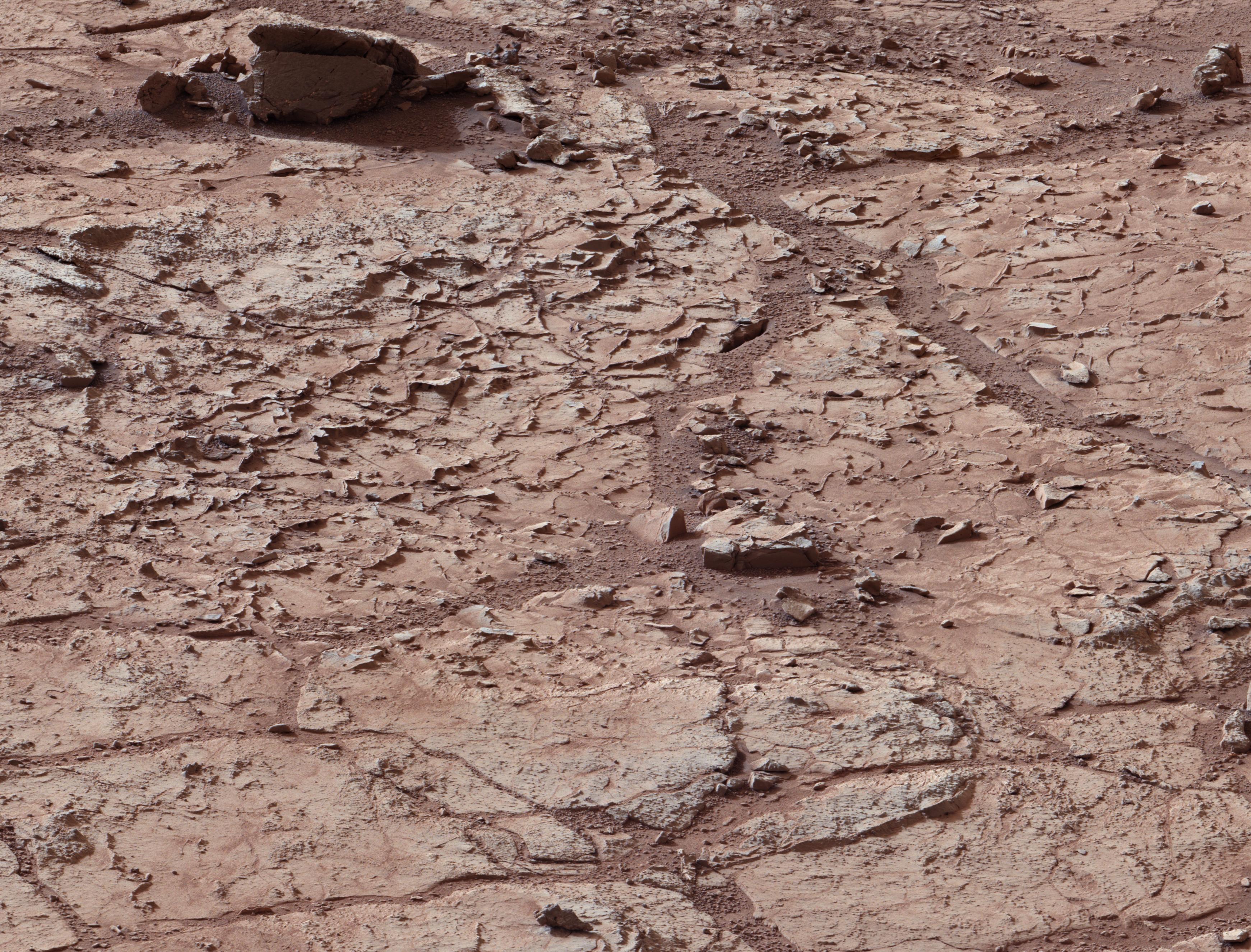
Calif. -- NASA's Mars rover Curiosity is driving toward a flat rock
with pale veins that may hold clues to a wet history on the Red Planet.
If the rock meets rover engineers' approval when Curiosity rolls up to
it in coming days, it will become the first to be drilled for a sample
during the Mars Science Laboratory mission.
The size of a
car, Curiosity is inside Mars' Gale Crater investigating whether the
planet ever offered an environment favorable for microbial life.
Curiosity landed in the crater five months ago to begin its two-year
prime mission.
"Drilling into a rock to collect a sample will
be this mission's most challenging activity since the landing. It has
never been done on Mars," said Mars Science Laboratory project manager
Richard Cook of NASA's Jet Propulsion Laboratory (JPL) in Pasadena,
Calif. "The drill hardware interacts energetically wiGale Craterth Martian material
we don't control. We won't be surprised if some steps in the process
don't go exactly as planned the first time through."
Curiosity first will gather powdered samples from inside the rock and
use those to scrub the drill. Then the rover will drill and ingest more
samples from this rock, which it will analyze for information about its
mineral and chemical composition.
The chosen rock is in an
area where Curiosity's Mast Camera (Mastcam) and other cameras have
revealed diverse unexpected features, including veins, nodules,
cross-bedded layering, a lustrous pebble embedded in sandstone, and
possibly some holes in the ground.
The rock chosen for drilling is
called "John Klein" in tribute to former Mars Science Laboratory deputy
project manager John W. Klein, who died in 2011.
"John's leadership skill played a crucial role in making Curiosity a reality," said Cook.
The target is on flat-lying bedrock within a shallow depression called
"Yellowknife Bay." The terrain in this area differs from that of the
landing site, a dry streambed about a third of a mile (about 500 meters)
to the west. Curiosity's science team decided to look there for a first
drilling target because orbital observations showed fractured ground
that cools more slowly each night than nearby terrain types do.
"The orbital signal drew us here, but what we found when we arrived
has been a great surprise," said Mars Science Laboratory project
scientist John Grotzinger, of the California Institute of Technology in
Pasadena. "This area had a different type of wet environment than the
streambed where we landed, maybe a few different types of wet
environments."
One line of evidence comes from inspection of
light-toned veins with Curiosity's laser-pulsing Chemistry and Camera
(ChemCam) instrument, which found elevated levels of calcium, sulfur and
hydrogen.
"These veins are likely composed of hydrated
calcium sulfate, such as bassinite or gypsum," said ChemCam team member
Nicolas Mangold of the Laboratoire de Planetologie et Geodynamique de
Nantes in France. "On Earth, forming veins like these requires water
circulating in fractures."
Researchers have used the rover's
Mars Hand Lens Imager (MAHLI) to examine sedimentary rocks in the area.
Some are sandstone, with grains up to about peppercorn size. One grain
has an interesting gleam and bud-like shape that have brought it
Internet buzz as a "Martian flower." Other rocks nearby are siltstone,
with grains finer than powdered sugar. These differ significantly from
pebbly conglomerate rocks in the landing area.
"All of these
are sedimentary rocks, telling us Mars had environments actively
depositing material here," said MAHLI deputy principal investigator
Aileen Yingst of the Planetary Science Institute in Tucson, Ariz. "The
different grain sizes tell us about different transport conditions."
JPL manages the Mars Science Laboratory Project for NASA's Science Mission Directorate in Washington.
To see an image of the rock, visit:
For more information about the mission, visit:
Follow the mission on Facebook and Twitter at:
NASA
ayabaca@gmail.com
ayabaca@hotmail.com
ayabaca@yagoo.com