Mostrando entradas con la etiqueta Jupiter. Mostrar todas las entradas

domingo, 21 de julio de 2013

NASA - NASA's Sofia Investigates the Southern Sky from New Zealand


Jupiter in Infrared

Download

small (800 x 476)
medium (1650 x 981)

original size (2461 x 1463)

Image #: SCI2010_0001
Date: 05/28/10
Title: Jupiter in Infrared
Caption: Infrared image of Jupiter from SOFIA’s First Light flight composed of individual images at wavelengths of 5.4 (blue), 24 (green) and 37 microns (red) made by Cornell University’s FORCAST camera. Ground-based infrared observations are impossible at 5.4 and 37 microns and normally very difficult at 24 microns even from high mountaintop observatories such as Mauna Kea due to absorption by water and other molecules in Earth's atmosphere. The white stripe in the infrared image is a region of relatively transparent clouds through which the warm interior of Jupiter can be seen. A recent visual-wavelength picture of approximately the same side of Jupiter is shown for comparison. (Images are oriented with Jupiter's south pole at the top.)
Instrument: FORCAST
Credit: NASA/SOFIA/USRA/FORCAST Team/James De Buizer (infrared image), Anthony Wesley (visible light image)
 
NASA's Sofia Investigates the Southern Sky from New Zealand
WASHINGTON -- NASA's SOFIA airborne observatory will be based in New Zealand for the next two weeks, taking advantage of the Southern Hemisphere's orientation to study celestial objects that are difficult or impossible to see in the northern sky.
SOFIA, formally known as the Stratospheric Observatory for Infrared Astronomy, deployed to the United States Antarctic Program's facilities at Christchurch International Airport last week and completed its first science flight at 4 a.m. local time July 18 (noon EDT July 17). A team of scientists, engineers, pilots and technicians from the United States and Germany are deployed with SOFIA to support as many as nine research flights through Aug. 1.
SOFIA is a modified Boeing 747SP aircraft that carries a telescope with an effective diameter of 100 inches (250 centimeters). It provides astronomers access to the visible, infrared and submillimeter spectrum.
On the first flight in New Zealand, astronomers used SOFIA to observe the disk of gas and dust orbiting the black hole at the center of our Milky Way galaxy, and two dwarf galaxies, the Large and Small Magellanic Clouds, which accompany the Milky Way. The Magellanic Clouds can be seen easily with the naked eye in the southern sky.
"SOFIA's deployment to the Southern Hemisphere shows the remarkable versatility of this observatory, which is the product of years of fruitful collaboration and cooperation between the U.S. and German space agencies," said Paul Hertz, director of NASA's Astrophysics Division in Washington. "This is just the first of a series of SOFIA scientific deployments envisioned over the mission's planned 20-year lifetime."
A vital part of the collaboration is a far-infrared spectrometer, the German Receiver for Astronomy at Terahertz Frequencies (GREAT). Mounted on SOFIA's telescope for the entire deployment, GREAT is especially suited for studies of interstellar gas and the life cycle of stars.
"The success of the GREAT spectrometer in addressing exciting scientific questions at far-infrared wavelengths was demonstrated during SOFIA's earlier, Northern Hemisphere flights," said Rolf Guesten of the Max Planck Institute for Radio Astronomy in Bonn, Germany, and leader of the German researchers who developed the spectrometer. "Now, we are turning the instrument to new frontiers such as the Magellanic Clouds, including the Tarantula Nebula -- that is the most active star-forming region known in the local group of galaxies."
SOFIA project scientist Pamela Marcum said the results anticipated from observations made during the aircraft's deployment will further scientists' understanding of star formation, stellar evolution and chemistry in stellar clouds.
"The deployment exemplifies the synergistic relationship between SOFIA's international partners, with NASA playing a crucial role in the planning and execution of the science observations," Marcum said.
SOFIA is a joint project of NASA and the German Aerospace Center, DLR. The aircraft is based at NASA's Dryden Flight Research Center's Aircraft Operations Facility in Palmdale, Calif. Dryden manages the program. NASA's Ames Research Center in Moffett Field, Calif., manages SOFIA's science and mission operations in cooperation with the Universities Space Research Association (USRA) of Columbia, Md., and the German SOFIA Institute (DSI) at the University of Stuttgart. The National Science Foundation's U.S. Antarctic Program provided vital support for SOFIA's deployment operations in Christchurch.
For a media kit with more information about SOFIA's Southern Hemisphere deployment, visit:
http://www.sofia.usra.edu/News/media/NZ/NZ2013.html

For more information about the SOFIA program, visit:
http://go.nasa.gov/18jeban
 
NASA
Guillermo Gonzalo Sánchez Achutegui

domingo, 2 de junio de 2013

NASA - NASA's WISE Mission Finds Lost Asteroid Family Members


This artist's conception shows how families of asteroids are created
This artist's conception shows how families of asteroids are created. Over the history of our solar system, catastrophic collisions between asteroids located in the belt between Mars and Jupiter have formed families of objects on similar orbits around the sun. Image credit: NASA/JPL-Caltech 

WASHINGTON -- Data from NASA's Wide-field Infrared Survey Explorer (WISE) have led to a new and improved family tree for asteroids in the main belt between Mars and Jupiter.

Astronomers used millions of infrared snapshots from the asteroid-hunting portion of the WISE all-sky survey, called NEOWISE, to identify 28 new asteroid families. The snapshots also helped place thousands of previously hidden and uncategorized asteroids into families for the first time. The findings are a critical step in understanding the origins of asteroid families, and the collisions thought to have created these rocky clans.

"NEOWISE has given us the data for a much more detailed look at the evolution of asteroids throughout the solar system," said Lindley Johnson, the program executive for the Near-Earth Object Observation Program at NASA Headquarters in Washington. "This will help us trace the NEOs back to their sources and understand how some of them have migrated to orbits hazardous to the Earth."

The main asteroid belt is a major source of near-Earth objects (NEOs), which are those asteroids and comets that come within 28 million miles (45 million kilometers) of Earth's path around the sun. Some near-Earth objects start out in stable orbits in the main asteroid belt, until a collision or gravitational disturbance flings them inward like flippers in a game of pinball.

The NEOWISE team looked at about 120,000 main belt asteroids out of the approximately 600,000 known. They found that about 38,000 of these objects, roughly one third of the observed population, could be assigned to 76 families, 28 of which are new. In addition, some asteroids thought to belong to a particular family were reclassified.

An asteroid family is formed when a collision breaks apart a large parent body into fragments of various sizes. Some collisions leave giant craters. For example, the asteroid Vesta's southern hemisphere was excavated by two large impacts. Other smash-ups are catastrophic, shattering an object into numerous fragments, as was the case with the Eos asteroid family. The cast-off pieces move together in packs, traveling on the same path around the sun, but over time the pieces become more and more spread out.

Previous knowledge of asteroid family lineages comes from observations of their orbits. NEOWISE also looked at the asteroids' reflectivity to identify family members.

Asteroids in the same family generally have similar mineral composition and reflect similar amounts of light. Some families consist of darker-colored, or duller, asteroids, while others are made up of lighter-colored, or shinier, rocks. It is difficult to distinguish between dark and light asteroids in visible light. A large, dull asteroid can appear the same as a small, shiny one. The dark asteroid reflects less light but has more total surface area, so it appears brighter.

NEOWISE could distinguish between the dark and light asteroids because it can detect infrared light, which reveals the heat of an object. The larger the object, the more heat it gives off. When the size of an asteroid can be measured, its true reflective properties can be determined, and a group of asteroids once thought to belong to a single family circling the sun in a similar orbit can be sorted into distinct families.

"We're separating zebras from the gazelles," said Joseph Masiero of NASA's Jet Propulsion Laboratory (JPL) in Pasadena, Calif., who is lead author of a report on the new study that appears in the Astrophysical Journal. "Before, family members were harder to tell apart because they were traveling in nearby packs. But now we have a better idea of which asteroid belongs to which family."

The next step for the team is to learn more about the original parent bodies that spawned the families.

"It's as if you have shards from a broken vase, and you want to put it back together to find out what happened," said Amy Mainzer, the NEOWISE principal investigator at JPL. "Why did the asteroid belt form in the first place and fail to become a planet? We are piecing together our asteroids' history."

JPL, a division of the California of Technology in Pasadena, managed and operated WISE for NASA's Science Mission Directorate. The spacecraft was put into hibernation mode in 2011, after completing its main objectives of scanning the entire sky twice.

More information is online at:

NASA
Guillermo Gonzalo Sánchez Achutegui
ayabaca@gmail.com
ayabaca@hotmail.com
ayabaca@yahoo.com

domingo, 24 de febrero de 2013

ESA - ESA chooses instruments for its Jupiter icy moons explorer


JUICE
21 February 2013
The JUpiter ICy moons Explorer mission, JUICE, will carry a total of 11 scientific experiments to study the gas giant planet and its large ocean-bearing moons, ESA announced today.
JUICE is the first Large-class mission in ESA’s Cosmic Vision 2015–2025 programme. Planned for launch in 2022 and arrival at Jupiter in 2030, it will spend at least three years making detailed observations of the biggest planet in the Solar System and three of its largest moons, Ganymede, Callisto and Europa.
These moons are thought to harbour vast water oceans beneath their icy surfaces and JUICE will map their surfaces, sound their interiors and assess their potential for hosting life in their oceans.
Today, ESA’s Science Programme Committee approved a complement of instruments that includes cameras and spectrometers, a laser altimeter and an ice-penetrating radar. The mission will also carry a magnetometer, plasma and particle monitors, and radio science hardware.
The instruments will be developed by scientific teams from 15 European countries, the US and Japan, through corresponding national funding.
“The selection of JUICE’s instruments is a key milestone in ESA’s flagship mission to the outer Solar System, which represents an unprecedented opportunity to showcase leading European technological and scientific expertise,” says Alvaro Giménez Cañete, ESA’s Director of Science and Robotic Exploration.
“The suite of instruments addresses all of the mission’s science goals, from in-situ measurements of Jupiter’s vast magnetic field and plasma environment, to remote observations of the surfaces and interiors of the three icy moons,” adds Luigi Colangeli, coordinator of ESA’s Solar System Missions.
Throughout its mission, JUICE will observe Jupiter’s atmosphere and magnetosphere, and the interaction of all four Galilean satellites – the three icy moons plus Io – with the gas giant planet.
The spacecraft will perform a dozen flybys of Callisto, the most heavily cratered object in the Solar System, and will fly past Europa twice in order to make the first measurements of the thickness of its icy crust.
JUICE will end up in orbit around Ganymede, where it will study the moon’s icy surface and internal structure, including its subsurface ocean.
The largest moon in the Solar System, Ganymede is the only one known to generate its own magnetic field, and JUICE will observe the unique magnetic and plasma interactions with Jupiter’s magnetosphere in detail.
“Jupiter and its icy moons constitute a kind of mini-Solar System in their own right, offering European scientists and our international partners the chance to learn more about the formation of potentially habitable worlds around other stars,” says Dmitrij Titov, ESA’s JUICE Study Scientist.
The selection of the instruments today helps to ensure that JUICE remains on schedule for launch in 2022.
List of selected experiments:
JANUS: Jovis, Amorum ac Natorum Undique Scrutator, camera system
MAJIS: Moons and Jupiter Imaging Spectrometer
UVS: UV Imaging Spectrograph
SWI: Sub-millimetre Wave Instrument
GALA: Ganymede Laser Altimeter
RIME: Radar for Icy Moons Exploration
J-MAG: Magnetometer for JUICE
PEP: Particle Environment Package
RPWI: Radio & Plasma Wave Investigation
3GM: Gravity & Geophysics of Jupiter and Galilean Moons
PRIDE: Planetary Radio Interferometer & Doppler Experiment (note this does not include spacecraft hardware but will exploit VLBI – Very Large Base Interferometry – to conduct radio science)
 
For further information, please contact:
Markus Bauer

ESA Science and Robotic Exploration Communication Officer

Tel: +31 71 565 6799

Mob: +31 61 594 3 954

Email: markus.bauer@esa.int
Luigi Colangeli
Head of ESA’s Solar System Missions Division and Coordinator of Solar System Missions
Email: luigi.colangeli@esa.int
Dmitrij Titov
ESA’s JUICE Study Scientist
Email: dmitri.titov@esa.int

ESA
Guillermo Gonzalo Sánchez Achutegui
ayabaca@gmail.com
ayabaca@hotmail.com
ayabaca@yahoo.com

martes, 27 de noviembre de 2012

ESA - Space Science - Do missing Jupiters mean massive comet belts?


http://www.esa.int/images/GJ581_H3.jpg
Debris disc around GJ 581
Download:
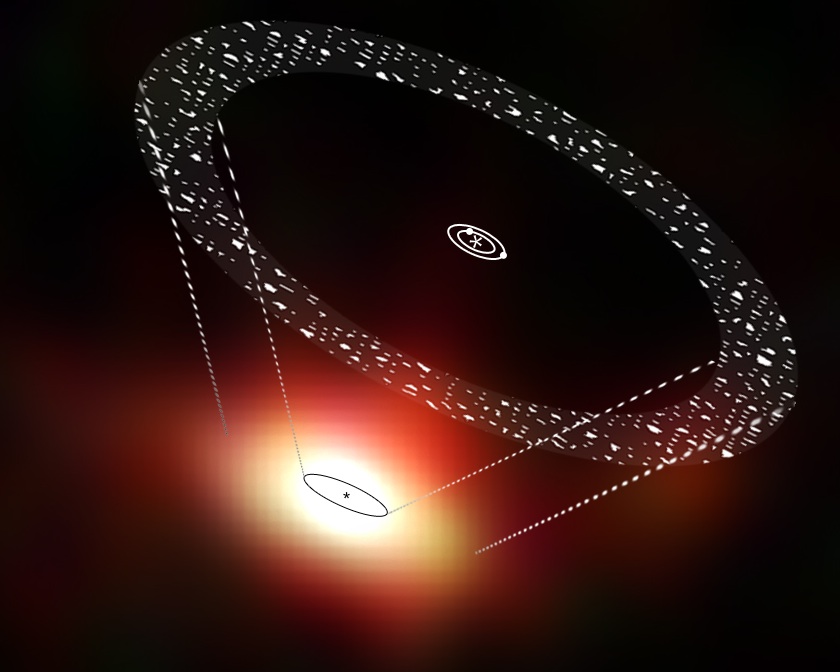
 Artist impression of the debris disc and planets around the star known as Gliese 581, superimposed on Herschel PACS images at 70, 100 and 160 micrometre wavelengths.
The line drawing superimposed on the Herschel image gives a schematic representation of the location and orientation of the star, planets and disc, albeit not to scale.
The black oval outline sketched onto the Herschel data represents the innermost boundary of the debris disc; the approximate location of the outermost boundary is represented by the outer set of dashed lines. It is not possible to identify the central star due to smearing of the Herschel data.
GJ 581’s planets have masses between 2 and 15 Earth masses and are all located within 0.22 Astronomical Units (AU, where 1 AU is the distance between Earth and our Sun) of the central star. A vast debris disc extends from approximately 25 AU to 60 AU.
Background galaxies are also visible in the Herschel field-of-view. 
Credits: ESA/AOES

Using ESA’s Herschel space observatory, astronomers have discovered vast comet belts surrounding two nearby planetary systems known to host only Earth-to-Neptune-mass worlds. The comet reservoirs could have delivered life-giving oceans to the innermost planets.

In a previous Herschel study, scientists found that the dusty belt surrounding nearby star Fomalhaut must be maintained by collisions between comets.
In the new Herschel study, two more nearby planetary systems – GJ 581 and 61 Vir – have been found to host vast amounts of cometary debris.
Herschel detected the signatures of cold dust at 200ºC below freezing, in quantities that mean these systems must have at least 10 times more comets than in our own Solar System’s Kuiper Belt.
GJ 581, or Gliese 581, is a low-mass M dwarf star, the most common type of star in the Galaxy. Earlier studies have shown that it hosts at least four planets, including one that resides in the ‘Goldilocks Zone’ – the distance from the central sun where liquid surface water could exist.
Two planets are confirmed around G-type star 61 Vir, which is just a little less massive than our Sun.
The planets in both systems are known as ‘super-Earths’, covering a range of masses between 2 and 18 times that of Earth.
Interestingly, however, there is no evidence for giant Jupiter- or Saturn-mass planets in either system. 
http://www.esa.int/images/61VIR_H3.jpg
 Debris disc around 61 Vir
Download:
 Artist’s impression of the debris disc and planets around the star 61 Vir, superimposed on Herschel PACS images at 70, 100 and 160 micrometre wavelengths.
The line drawing superimposed on the Herschel image gives a schematic representation of the location and orientation of the star, planets and disc, albeit not to scale.
The black oval outline sketched onto the Herschel data represents the innermost boundary of the debris disc; the approximate location of the outermost boundary is represented by the outer set of dashed lines. It is not possible to identify the central star due to smearing of the Herschel data.
The two planets around 61 Vir have masses between 5 and 18 Earth masses and are both located within 0.22 Astronomical Units (AU, where 1 AU is the distance between Earth and our Sun) of the central star. A vast debris disc extends from approximately 30 AU to 100 AU. 
Credits: ESA/AOES

The gravitational interplay between Jupiter and Saturn in our own Solar System is thought to have been responsible for disrupting a once highly populated Kuiper Belt, sending a deluge of comets towards the inner planets in a cataclysmic event that lasted several million years.
“The new observations are giving us a clue: they’re saying that in the Solar System we have giant planets and a relatively sparse Kuiper Belt, but systems with only low-mass planets often have much denser Kuiper belts,” says Dr Mark Wyatt from the University of Cambridge, lead author of the paper focusing on the debris disc around 61 Vir.
“We think that may be because the absence of a Jupiter in the low-mass planet systems allows them to avoid a dramatic heavy bombardment event, and instead experience a gradual rain of comets over billions of years.”
“For an older star like GJ 581, which is at least two billion years old, enough time has elapsed for such a gradual rain of comets to deliver a sizable amount of water to the innermost planets, which is of particular importance for the planet residing in the star’s habitable zone,” adds Dr Jean-Francois Lestrade of the Observatoire de Paris who led the work on GJ 581.
However, in order to produce the vast amount of dust seen by Herschel, collisions between the comets are needed, which could be triggered by a Neptune-sized planet residing close to the disc.
“Simulations show us that the known close-in planets in each of these systems cannot do the job, but a similarly-sized planet located much further from the star – currently beyond the reach of current detection campaigns – would be able to stir the disc to make it dusty and observable,” says Dr Lestrade.
“Herschel is finding a correlation between the presence of massive debris discs and planetary systems with no Jupiter-class planets, which offers a clue to our understanding of how planetary systems form and evolve,” says Göran Pilbratt, ESA’s Herschel project scientist.
 Notes for Editors
 ESA
Guillermo Gonzalo Sánchez Achutegui
ayabaca@gmail.com
ayabaca@hotmail.com
ayabaca@yahoo.com