Mostrando entradas con la etiqueta The Hubble Space Telescope. Mostrar todas las entradas

domingo, 2 de junio de 2013

ESA - La nebulosa del anillo desde una nueva perspectiva


Ring Nebula
27 mayo 2013 El Telescopio Espacial Hubble nos muestra la Nebulosa del Anillo con un nivel de detalle sin precedentes.
En esta imagen se distingue la compleja estructura que sólo se podía intuir en las observaciones anteriores, y que ha permitido elaborar un modelo tridimensional de la nebulosa que desvela la auténtica forma de este sorprendente objeto. 
La Nebulosa del Anillo es una nebulosa planetaria típica, formada por una estrella que se está deshaciendo de sus capas más externas a medida que agota su combustible. A pesar de su nombre, estas estructuras no tienen nada que ver con los planetas - recibieron este adjetivo por su aspecto circular y difuso, al ser observadas con los primeros telescopios. 
La Nebulosa del Anillo, también conocida como Messier 57 o NGC 6720, fue descubierta en 1779 por el astrónomo Antoine Darquier de Pellepoix. Charles Messier la estudió poco después, convirtiéndola en el objeto número 57 de su famoso catálogo astronómico. 
Esta nebulosa se encuentra a poco más de 2.000 años luz de nuestro planeta y tiene una forma ligeramente elíptica. 
Los astrónomos han combinado los datos tomados desde tierra con las nuevas observaciones del Telescopio Espacial NASA/ESA Hubble para estudiar de nuevo la nebulosa, buscando pistas sobre su estructura, evolución, condiciones físicas y movimiento. 
Descubrieron que la nebulosa tiene forma de cilindro distorsionado. Desde nuestra posición podemos ver uno de sus extremos, con sus paredes extendiéndose en dirección opuesta a nuestro planeta. 
Aunque este cilindro parezca estar hueco, en realidad está lleno de materia de menor densidad que se expande a lo largo de su eje, con una forma parecida a la de un balón de rugby encajado en el interior del cilindro. 
La parte más brillante es lo que vemos como el anillo de colores, que está formado por el gas expulsado por la estrella moribunda en el centro de la nebulosa. Esta estrella acabará convirtiéndose en una enana blanca - un cuerpo muy pequeño, denso y caliente que es la última etapa en la vida de una estrella como nuestro Sol. 
Puedes contemplar más imágenes de la Nebulosa del Anillo en este enlace.
El nuevo estudio sobre Messier 57 se describe en una serie de tres artículos de C. R. O'Dell et al.
“Studies of NGC 6720 with Calibrated HST WFC3 Emission Line Filter Images – I: Structure and Evolution,” publicado en The Astronomical Journal. Descarga este artículo.
“Studies of NGC 6720 with Calibrated HST WFC3 Emission Line Filter Images – II: Physical Conditions,” publicado enThe Astronomical Journal. Descarga este artículo.
“Studies of NGC 6720 with Calibrated HST WFC3 Emission Line Filter Images – III: Tangential Motions using AstroDrizzle Images,” que se publicará en The Astronomical Journal. Descarga este artículo.
Las observaciones del Telescopio Espacial NASA/ESA Hubble utilizadas para este estudio fueron dirigidas por C.R. O’Dell (Universidad de Vanderbilt, EEUU), G.J. Ferland (Universidad de Kentucky, EEUU), W.J. Henney (Universidad Nacional Autónoma de México, México) y M. Peimbert (Universidad Nacional Autónoma de México, México).
ESA
Guillermo Gonzalo Sánchez Achutegui
ayabaca@gmail.com
ayabaca@hotmail.com
ayabaca@yahoo.com

domingo, 24 de febrero de 2013

ESA - Week in Images-Star HH 151


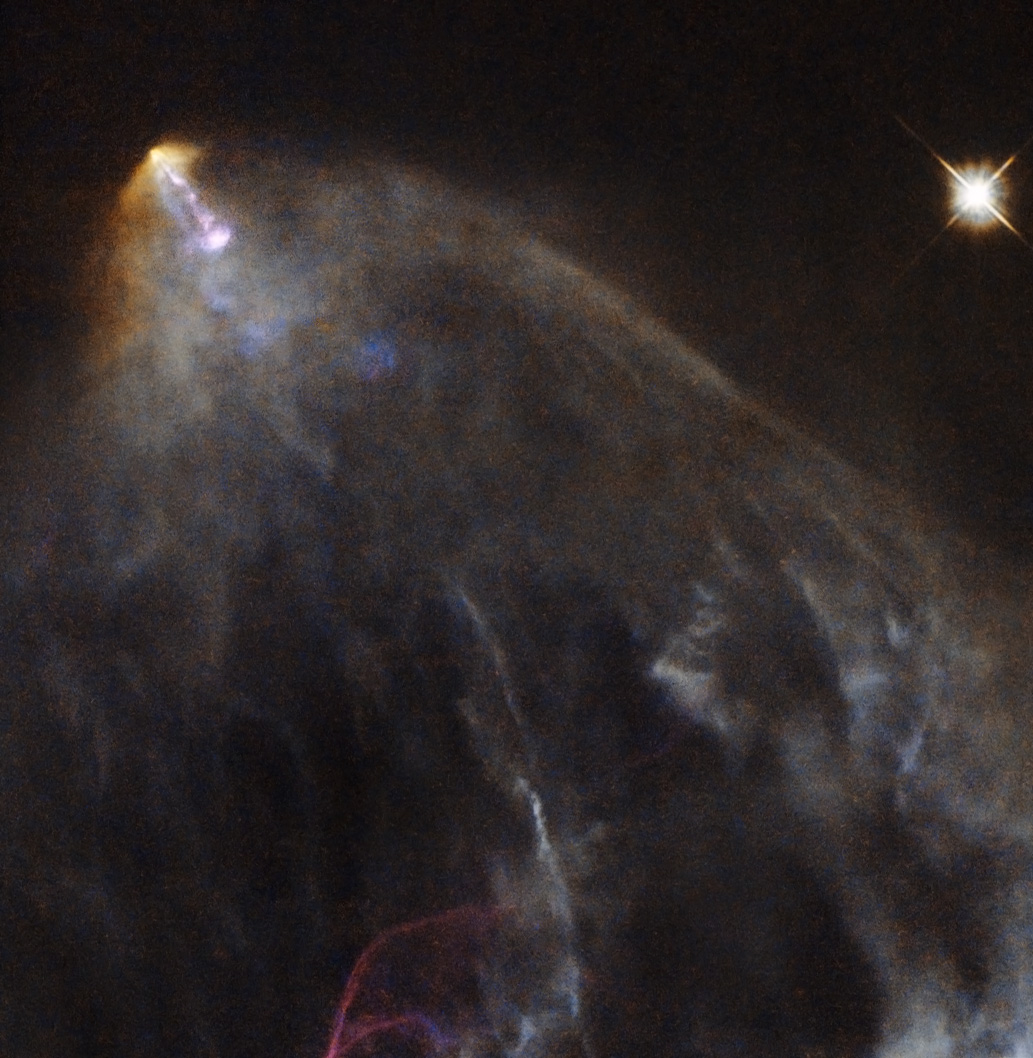
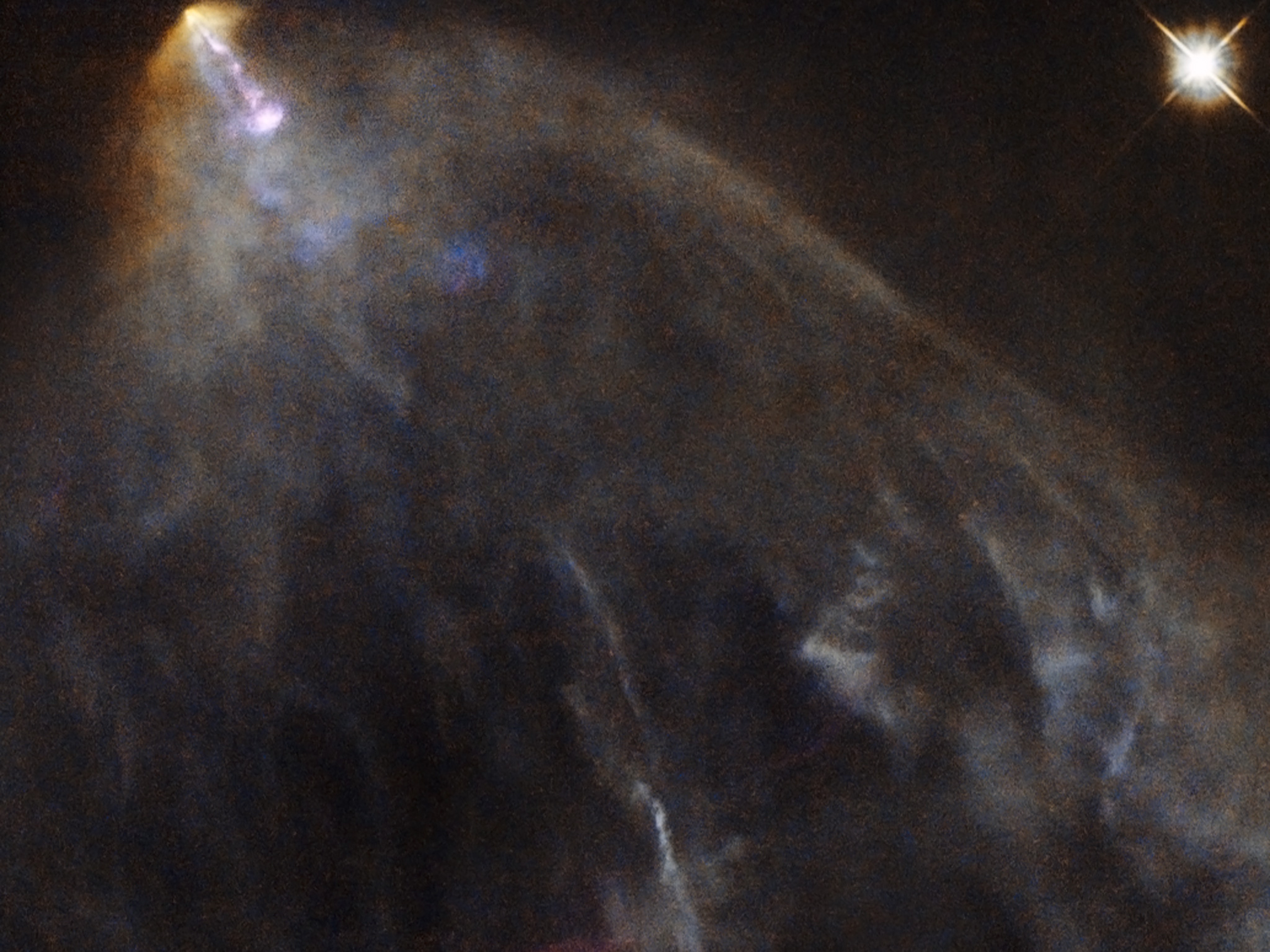
A glowing jet from a young star (747.95 kB)
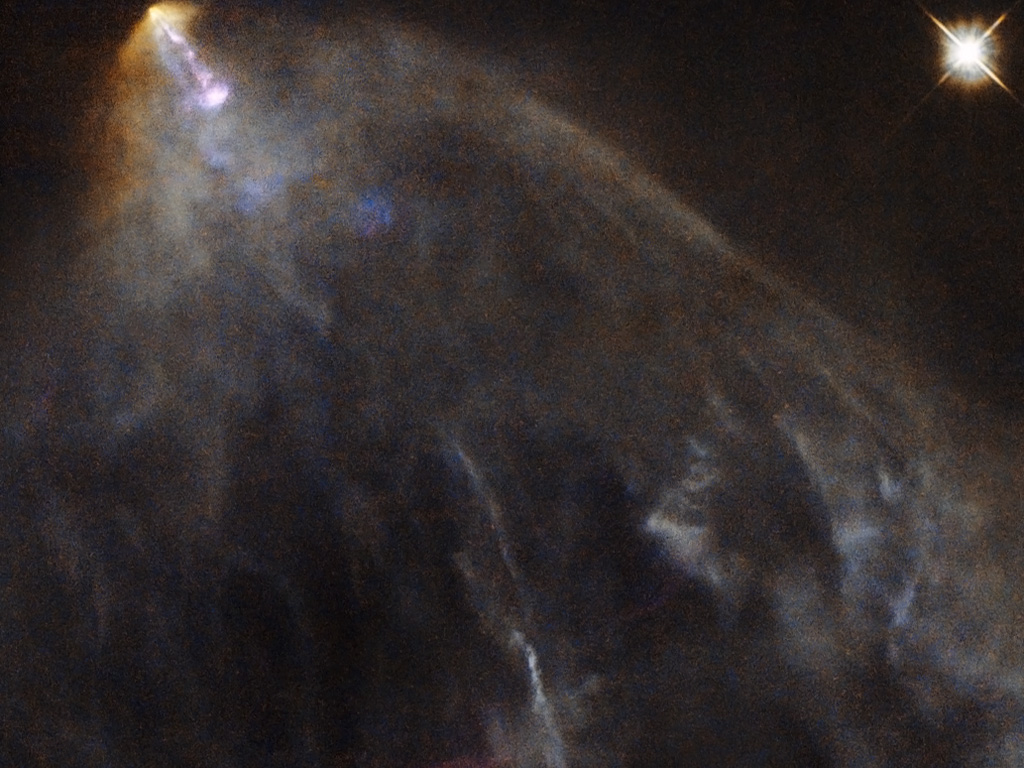
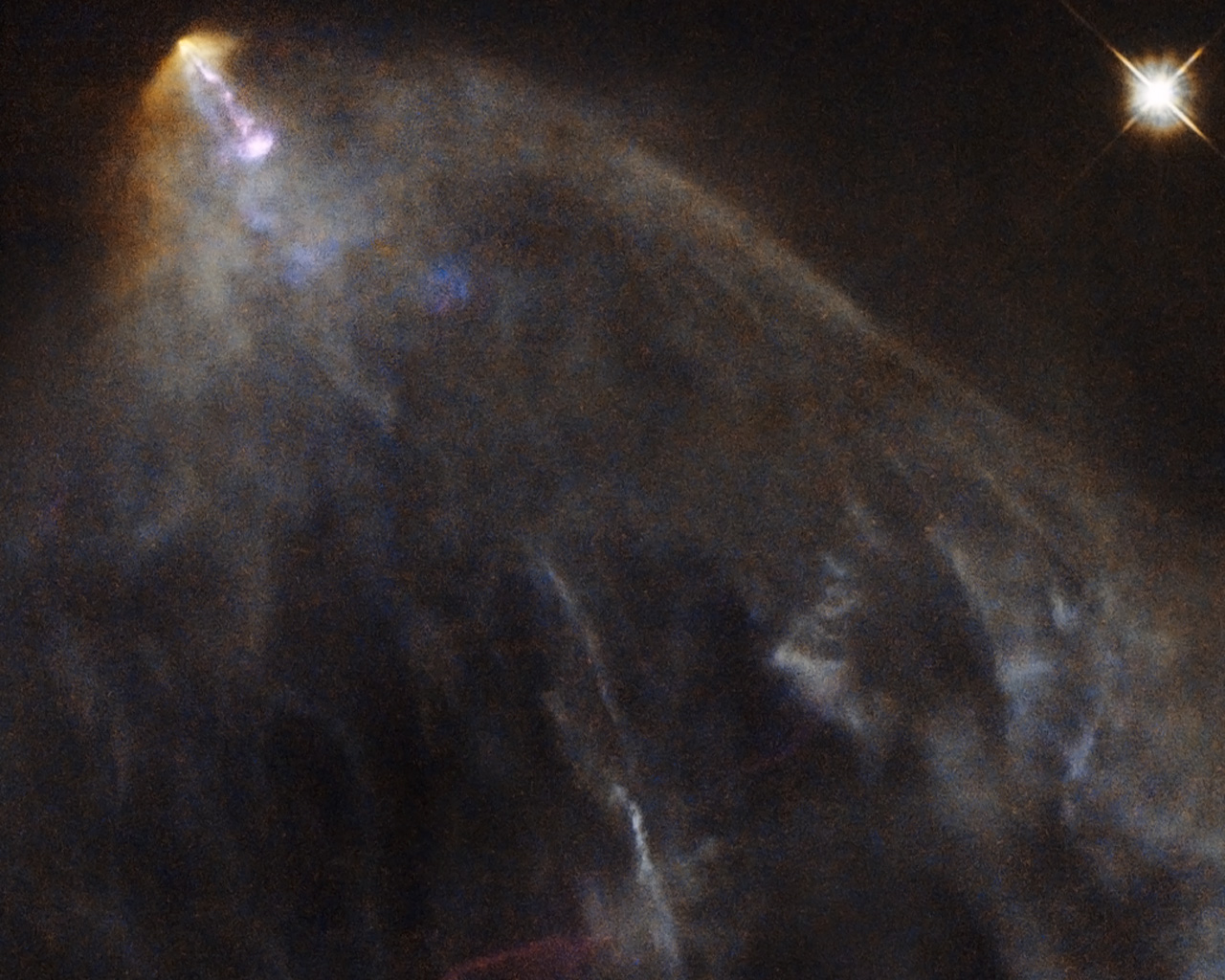
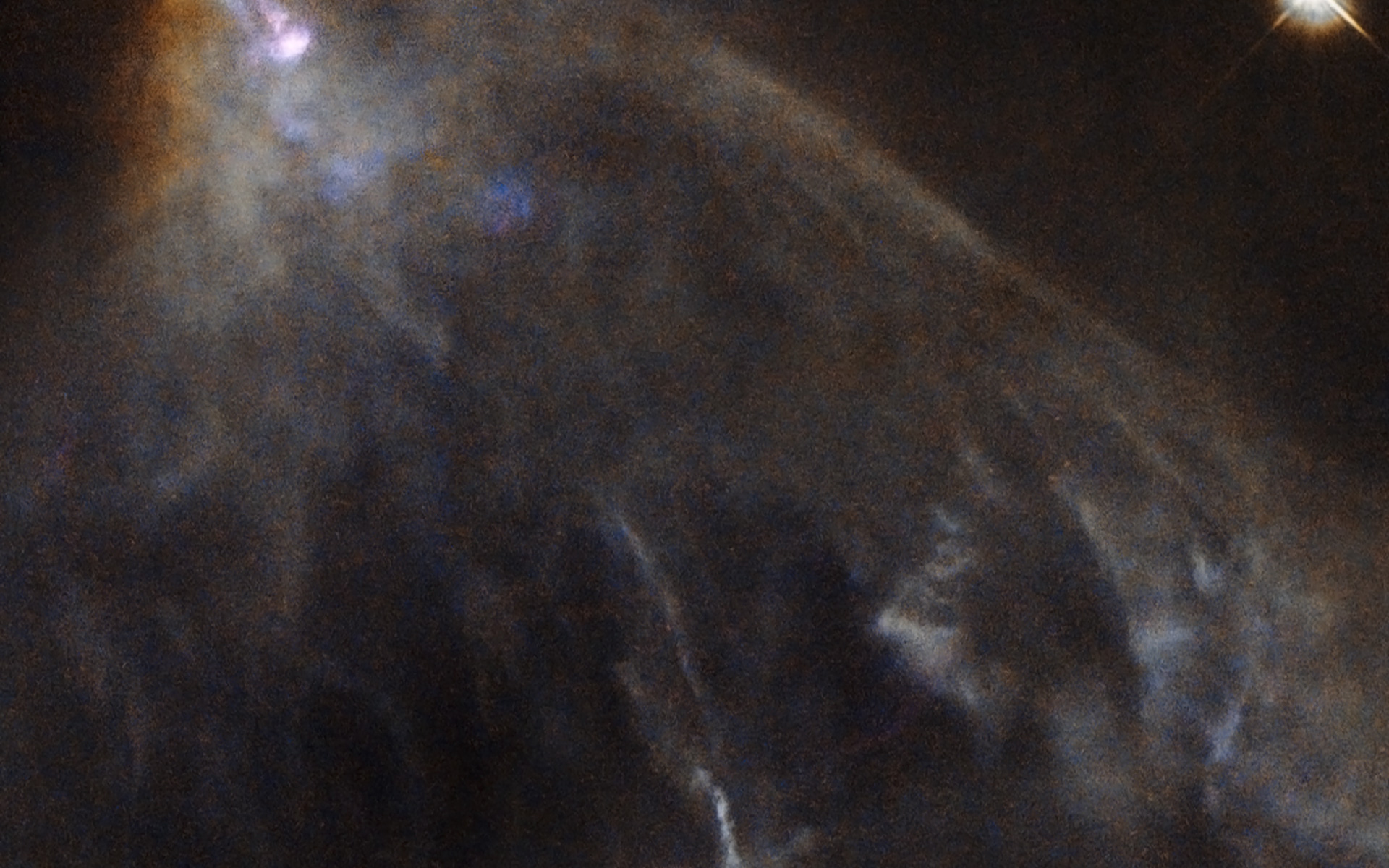
A glowing jet from a young star This image shows an object known as HH 151, a bright jet of glowing material trailed by an intricate, orange-hued plume of gas and dust. It is located some 460 light-years away in the constellation of Taurus (The Bull), near to the young, tumultuous star HL Tau.
In the first few hundred thousand years of life, new stars like HL Tau pull in material that falls towards them from the surrounding space. This material forms a hot disc that swirls around the coalescing body, launching narrow streams of material from its poles. These jets are shot out at speeds of several hundred kilometres per second and collide violently with nearby clumps of dust and gas, creating wispy, billowing structures known as Herbig-Haro objects — like HH 151 seen in the image above.
Such objects are very common in star-forming regions. They are short-lived, and their motion and evolution can actually be seen over very short timescales, on the order of years. They quickly race away from the newly-forming star that emitted them, colliding with new clumps of material and glowing brightly before fading away.
Credits: ESA/Hubble & NASA. Acknowledgement: Gilles Chapdelaine


A glowing jet from a young star

This image shows an object known as HH 151, a bright jet of glowing material trailed by an intricate, orange-hued plume of gas and dust. It is located some 460 light-years away in the constellation of Taurus (The Bull), near to the young, tumultuous star HL Tau.
In the first few hundred thousand years of life, new stars like HL Tau pull in material that falls towards them from the surrounding space. This material forms a hot disc that swirls around the coalescing body, launching narrow streams of material from its poles. These jets are shot out at speeds of several hundred kilometres per second and collide violently with nearby clumps of dust and gas, creating wispy, billowing structures known as Herbig-Haro objects — like HH 151 seen in the image above.
Such objects are very common in star-forming regions. They are short-lived, and their motion and evolution can actually be seen over very short timescales, on the order of years. They quickly race away from the newly-forming star that emitted them, colliding with new clumps of material and glowing brightly before fading away.
A version of this image was entered into the Hidden Treasures image processing competition by Gilles Chapdelaine.
Credit:
ESA/Hubble & NASA. Acknowledgement: Gilles Chapdelaine

About the Image

Id:potw1307a
Release date:18 February 2013, 10:00
Size:1033 x 1058 px

About the Object

Name:HH 151, HL Tau, LDN 1551
Type:• Milky Way : Star : Evolutionary Stage : Young Stellar Object
• Milky Way : Star : Circumstellar Material : Outflow
• Stars Images/Videos

Colours & filters

BandWavelengthTelescope
Optical
H-alpha
656 nm Hubble Space Telescope
WFPC2
Optical
SII
673 nm Hubble Space Telescope
WFPC2
Optical
R
675 nm Hubble Space Telescope
WFPC2
Infrared
I
814 nm Hubble Space Telescope
WFPC2

Images

Large JPEG
349.0 KB
Screensize JPEG
277.7 KB

Zoomable


Wallpapers

1024x768
278.2 KB
1280x1024
409.6 KB
1600x1200
533.6 KB
1920x1200
582.2 KB
2048x1536
747.9 KB

Also see our


ESA
Guillermo Gonzalo Súnchez Achutegui
ayabaca@gmail.com
ayabaca@hotmail.com
ayabaca@yahoo.com

domingo, 25 de marzo de 2012

Astronomy: Hubble Sees Glittering Jewels of Messier 9

Hi My Friends: AL VUELO DE UN QUINDE EL BLOG., The Hubble Space Telescope has produced the most detailed image so far of Messier 9, a globular star cluster located close to the center of the galaxy. This ball of stars is too faint to see with the naked eye, yet Hubble can see over 250,000 individual stars shining in it. Hubble Sees Glittering Jewels of Messier 9
The Hubble Space Telescope has produced the most detailed image so far of Messier 9, a globular star cluster located close to the center of the galaxy. This ball of stars is too faint to see with the naked eye, yet Hubble can see over 250,000 individual stars shining in it.

Messier 9, pictured here, is a globular cluster, a roughly spherical swarm of stars that lies around 25,000 light-years from Earth, near the center of the Milky Way, so close that the gravitational forces from the galactic center pull it slightly out of shape.

Globular clusters are thought to harbor some of the oldest stars in our galaxy, born when the universe was just a small fraction of its current age. As well as being far older than the sun -- around twice its age -- the stars of Messier 9 also have a markedly different composition, and are enriched with far fewer heavier elements than the sun.

In particular, the elements crucial to life on Earth, like oxygen and carbon, and the iron that makes up our planet’s core, are very scarce in Messier 9 and clusters like it. This is because the universe’s heavier elements were gradually formed in the cores of stars, and in supernova explosions. When the stars of Messier 9 formed, there were far smaller quantities of these elements in existence.

As well as showing the individual stars, Hubble’s image clearly shows the different colors of the stars. A star’s color is directly related to its temperature -- counter-intuitively, perhaps, the redder it is, the cooler it is; and the bluer it is, the hotter. The wide range of stellar temperatures here is clearly displayed by the broad palette of colors visible in this image.

Image Credit: NASA and ESA

Guillermo Gonzalo Sánchez Achutegui


martes, 17 de enero de 2012

ASTRONOMY: A New View of an Icon

Hi My Friends: AL VUELO DE UN QUINDE EL BLOG., The Eagle Nebula as never seen before. In 1995, the Hubble Space Telescope's 'Pillars of Creation' image of the Eagle Nebula became one of the most iconic images of the 20th century. Now, two of ESA's orbiting observatories have shed new light on this enigmatic star-forming region.

Combining almost opposite ends of the electromagnetic spectrum, this composite of the Herschel in far-infrared and XMM-Newton’s X-ray images shows how the hot young stars detected by the X-ray observations are sculpting and interacting with the surrounding ultra-cool gas and dust, which, at only a few degrees above absolute zero, is the critical material for star formation itself. Both wavelengths would be blocked by Earth’s atmosphere, so are critical to our understanding of the lifecycle of stars

Credits: far-infrared: ESA/Herschel/PACS/SPIRE/Hill, Motte, HOBYS Key Programme Consortium; X-ray: ESA/XMM-Newton/EPIC/XMM-Newton-SOC/Boulanger

This 1995 Hubble Space Telescope image of the ‘Pillars of Creation’ is probably the most famous astronomical image of the 20th Century. Taken in visible light using a combination of SII/H-alpha and OIII filters, it shows a part of the Eagle Nebula where new stars are forming. The tallest pillar is around 4 light-years high

Credits: NASA/ESA/STScI, Hester & Scowen (Arizona State University)

XMM-Newton’s images of the Eagle Nebula region in X-rays, which here is colour-coded to show different energy levels (red: 0.3–1 keV, green: 1–2 keV and blue: 2–8 keV) is helping astronomers to investigate a theory that the Eagle Nebula is being powered by a hidden supernova remnant. The researchers are looking for signs of very diffuse emission and how far this extends around the region. They believe that an absence of this X-ray emission beyond that found by previous orbiting space telescopes (Chandra and Spitzer) would support the supernova remnant theory. The work on this is continuing


Credits: ESA/XMM-Newton/EPIC/XMM-Newton-SOC/Boulanger


Messier 16 is a diffuse emission nebula that contains the young open cluster NGC6611. The iconic ‘Pillars of Creation’ image taken with the Hubble Space Telescope in 1995 is captured in near-infrared by the VLT, which penetrates straight through the obscuring gas and dust, rendering them almost invisible. The pillars are only a small portion of the extensive nebulous region imaged in far-infrared by ESA’s Herschel Space Observatory, which shows cool dust and gas tendrils being carved away by the hot stars seen in the X-ray image from XMM-Newton. The wide-field optical image from the ESO MPG telescope puts the pillars into context against the full scale of the nebula, which is over 75 light-years across


Credits: far-infrared: ESA/Herschel/PACS/SPIRE/Hill, Motte, HOBYS Key Programme Consortium; ESA/XMM-Newton/EPIC/XMM-Newton-SOC/Boulanger; optical: MPG/ESO;near-infrared/VLT/ISAAC/McCaughrean & Andersen/AIP/ESO


The 8.2m-diameter VLT’s ANTU telescope imaged the famous Pillars of Creation region and its surroundings in near-infrared using the ISAAC instrument. This enabled astronomers to penetrate the obscuring dust in their search to detect newly formed stars. The research into the ‘evaporating gaseous globules’ (EGGs), which were first detected in the Hubble images, needed the near-infrared capabilities and resolution of the VLT to peel back the layers of dust and detect the low-mass young stars cocooned within the EGG shells. The near-infrared results showed that 11 of the 73 EGGs detected possibly contained stars, and that the tips of the pillars contain stars and nebulosity not seen in the Hubble image


Credits: VLT/ISAAC/McCaughrean & Andersen/AIP/ESO


This Herschel image of the Eagle Nebula, colour coded to 70 microns for blue and 160 microns for green using the PACS (Photodetector Array Camera) and 250 microns for red using the SPIRE (Spectral and Photometric Imaging Receiver) shows the self-emission of the intensely cold nebula’s gas and dust as never seen before. Each colour shows a different temperature of dust, from around 10 degrees above absolute zero (10K) for the red, up to around 40K for the blue. In the far–infrared, the nebula shows its intricate tendril nature, with vast cavities forming an almost cave-like surrounding to the famous pillars, which take on an ethereal ghostly appearance. The gas and dust provide the material for the star formation that is still under way inside this enigmatic nebula


Credits: ESA/Herschel/PACS/SPIRE/Hill, Motte, HOBYS Key Programme Consortium


Up to 1998 the ESA ISO (Infrared Space Observatory) was the most sensitive mid infrared telescope ever built. ISO observations were performed at 7 microns (and 15 microns, not shown) aiming to detect embedded sources in the pillars


Credits: ESA/ISO/Pilbratt et al.
The Eagle Nebula as never seen before. In 1995, the Hubble Space Telescope's 'Pillars of Creation' image of the Eagle Nebula became one of the most iconic images of the 20th century. Now, two of ESA's orbiting observatories have shed new light on this enigmatic star-forming region. The Eagle Nebula is 6500 light-years away in the constellation of Serpens. It contains a young hot star cluster, NGC6611, visible with modest back-garden telescopes, that is sculpting and illuminating the surrounding gas and dust, resulting in a huge hollowed-out cavity and pillars, each several light-years long.
The Hubble image hinted at new stars being born within the pillars, deeply inside small clumps known as 'evaporating gaseous globules' or EGGs. Owing to obscuring dust, Hubble's visible light picture was unable to see inside and prove that young stars were indeed forming.
The ESA Herschel Space Observatory's new image shows the pillars and the wide field of gas and dust around them. Captured in far-infrared wavelengths, the image allows astronomers to see inside the pillars and structures in the region.
In parallel, a new multi-energy X-ray image from ESA's XMM-Newton telescope shows those hot young stars responsible for carving the pillars.
Combining the new space data with near-infrared images from the European Southern Observatory's (ESO's) Very Large Telescope at Paranal, Chile, and visible-light data from its Max Planck Gesellschaft 2.2m diameter telescope at La Silla, Chile, we see this iconic region of the sky in a uniquely beautiful and revealing way.
In far-infrared, Herschel detects this cold dust and the pillars reappear, this time glowing in their own light.
Intricate tendrils of dust and gas are seen to shine, giving astronomers clues about how it interacts with strong ultraviolet light from the hot stars seen by XMM-Newton.
In 2001, Very Large Telescope near-infrared images had shown only a small minority of the EGGs were likely to contain stars being born.
However, Herschel's image makes it possible to search for young stars over a much wider region and thus come to a much fuller understanding of the creative and destructive forces inside the Eagle Nebula.
Earlier mid-infrared images from ESA's Infrared Space Observatory and NASA's Spitzer, and the new XMM-Newton data, have led astronomers to suspect that one of the massive, hot stars in NGC6611 may have exploded in a supernova 6000 years ago, emitting a shockwave that destroyed the pillars.
However, because of the distance of the Eagle Nebula, we won't see this happen for several hundred years yet.
Powerful ground-based telescopes continue to provide astonishing views of our Universe, but images in far-infrared, mid-infrared and X-ray wavelengths are impossible to obtain owing to the absorbing effects of Earth's atmosphere.
Space-based observatories such as ESA's Herschel and XMM-Newton help to peel back that veil and see the full beauty of the Universe across the electromagnetic spectrum.
With regions like the Eagle Nebula, combining all of these observations helps astronomers to understand the complex yet amazing lifecycle of stars. ESA.
Guillermo Gonzalo Sánchez Achutegui
ayabaca@gmail.com
ayabaca@hotmail.com
ayabaca@yahoo.com

viernes, 13 de enero de 2012

Astronomy: Hubble Pinpoints Farthest Protocluster of Galaxies Ever Seen

Hi My Friends: AL VUELO DE UN QUINDE EL BLOG., Using NASA's Hubble Space Telescope, astronomers have uncovered a cluster of galaxies in the initial stages of development. It is the most distant such grouping ever observed in the early universe. › Larger image

The composite image taken in visible and near-infrared light, reveals the location of five tiny galaxies clustered together 13.1 billion light-years away. The circles pinpoint the galaxies. Credit: NASA, ESA, M. Trenti (University of Colorado, Boulder and Institute of Astronomy, University of Cambridge, U.K.), L. Bradley (Space Telescope Science Institute, Baltimore), and the BoRG team.

In a random sky survey made in near-infrared light, Hubble found five tiny galaxies clustered together 13.1 billion light-years away. They are among the brightest galaxies at that epoch and very young -- existing just 600 million years after the big bang.

Galaxy clusters are the largest structures in the universe, comprising hundreds to thousands of galaxies bound together by gravity. The developing cluster, or protocluster, is seen as it looked 13 billion years ago. Presumably, it has grown into one of today's massive galactic cities, comparable to the nearby Virgo cluster of more than 2,000 galaxies.

"These galaxies formed during the earliest stages of galaxy assembly, when galaxies had just started to cluster together," said Michele Trenti of the University of Colorado at Boulder and the Institute of Astronomy at the University of Cambridge in the United Kingdom.

"The result confirms our theoretical understanding of the buildup of galaxy clusters. And, Hubble is just powerful enough to find the first examples of them at this distance.

"Trenti presented the results today at the American Astronomical Society meeting in Austin, Texas. The study will be published in an upcoming issue of The Astrophysical Journal.

Most galaxies in the universe reside in groups and clusters, and astronomers have probed many mature galactic cities in detail as far as 11 billion light-years away. Finding clusters in the early phases of construction has been challenging because they are rare, dim and widely scattered across the sky.

"We need to look in many different areas because the odds of finding something this rare are very small," said Trenti, who used Hubble's sharp-eyed Wide Field Camera 3 (WFC3) to pinpoint the cluster galaxies.

"The search is hit and miss. Typically, a region has nothing, but if we hit the right spot, we can find multiple galaxies.

"Hubble’s observations demonstrate the progressive buildup of galaxies. They also provide further support for the hierarchical model of galaxy assembly, in which small objects accrete mass, or merge, to form bigger objects over a smooth and steady but dramatic process of collision and collection.

Because the distant, fledgling clusters are so dim, the team hunted for the systems' brightest galaxies. These galaxies act as billboards, advertising cluster construction zones. From computer simulations, the astronomers expect galaxies at early epochs to be clustered together.

Because brightness correlates with mass, the most luminous galaxies pinpoint the location of developing clusters. These powerful light beacons live in deep wells of dark matter, an invisible form of matter that makes up the underlying gravitational scaffolding for construction.

The team expects many fainter galaxies that were not seen in these observations to inhabit the same neighborhood.The five bright galaxies spotted by Hubble are about one-half to one-tenth the size of our Milky Way, yet are comparable in brightness.

The galaxies are bright and massive because they are being fed large amounts of gas through mergers with other galaxies. The team's simulations show that the galaxies eventually will merge and form the brightest central galaxy in the cluster, a giant elliptical similar to the Virgo Cluster's M87.

The observations are part of the Brightest of Reionizing Galaxies survey, which uses Hubble's WFC3 to search for the brightest galaxies around 13 billion years ago, when light from the first stars burned off a fog of cold hydrogen in a process called reionization.

The team estimated the distance to the newly found galaxies based on their colors, but the astronomers plan to follow up with spectroscopic observations, which measure the expansion of space.

Those observations will help astronomers precisely calculate the cluster's distance and yield the velocities of the galaxies, which will show whether they are gravitationally bound to each other. The Hubble Space Telescope is a project of international cooperation between NASA and the European Space Agency. NASA's Goddard Space Flight Center in Greenbelt, Md., manages the telescope. The Space Telescope Science Institute (STScI) in Baltimore conducts Hubble science operations. STScI is operated for NASA by the Association of Universities for Research in Astronomy, Inc., in Washington.
NASA.


Guillermo Gonzalo Sánchez Achutegui


Astronomy: Hubble Solves Mystery on Source of Supernova in Nearby Galaxy

Hi My Friends: AL VUELO DE UN QUINDE EL BLOG., Using NASA's Hubble Space Telescope, astronomers have solved a longstanding mystery on the type of star, or so-called progenitor, which caused a supernova seen in a nearby galaxy. The finding yields new observational data for pinpointing one of several scenarios that trigger such outbursts.This image of Type Ia Supernova Remnant 0509-67.5 was made by combining data from two of NASA’s Great Observatories. The result shows soft green and blue hues of heated material from the X-ray data surrounded by the glowing pink optical shell, which shows the ambient gas being shocked by the expanding blast wave from the supernova. Credit: NASA, ESA, and B. Schaefer and A. Pagnotta (Louisiana State University, Baton Rouge); Image Credit: NASA, ESA, CXC, SAO, the Hubble Heritage Team (STScI/AURA), J. Hughes (Rutgers University)


Based on previous observations from ground-based telescopes, astronomers knew the supernova class, called a Type Ia, created a remnant named SNR 0509-67.5, which lies 170,000 light-years away in the Large Magellanic Cloud galaxy.

Theoretically, this kind of supernova explosion is caused by a star spilling material onto a white dwarf companion, the compact remnant of a normal star, until it sets off one of the most powerful explosions in the universe.

Astronomers failed to find any remnant of the companion star, however, and concluded that the common scenario did not apply in this case, although it is still a viable theory for other Type Ia supernovae.

"We know Hubble has the sensitivity necessary to detect the faintest white dwarf remnants that could have caused such explosions," said lead investigator Bradley Schaefer of Louisiana State University (LSU) in Baton Rouge.

"The logic here is the same as the famous quote from Sherlock Holmes: 'when you have eliminated the impossible, whatever remains, however improbable, must be the truth.'"The cause of SNR 0509-67.5 can be explained best by two tightly orbiting white dwarf stars spiraling closer and closer until they collided and exploded.

For four decades, the search for Type Ia supernovae progenitors has been a key question in astrophysics. The problem has taken on special importance during the last decade with Type Ia supernovae being the premier tools for measuring the accelerating universe.

Type Ia supernovae release tremendous energy, in which the light produced is often brighter than an entire galaxy of stars. The problem has been to identify the type of star system that pushes the white dwarf's mass over the edge and triggers this type of explosion. Many possibilities have been suggested, but most require that a companion star near the exploding white dwarf be left behind after the explosion.

Therefore, a possible way to distinguish between the various progenitor models has been to look deep in the center of an old supernova remnant to search for the ex-companion star.

In 2010, Schaefer and Ashley Pagnotta of LSU were preparing a proposal to look for any faint ex-companion stars in the center of four supernova remnants in the Large Magellanic Cloud when they discovered the Hubble Space Telescope already had taken the desired image of one of their target remnants, SNR 0509-67.5, for the Hubble Heritage program, which collects images of especially photogenic astronomical targets.

In analyzing the central region, they found it to be completely empty of stars down to the limit of the faintest objects Hubble can detect in the photos. Schaefer suggests the best explanation left is the so-called "double degenerate model" in which two white dwarfs collide.

The results are being reported today at the meeting of the American Astronomical Society in Austin, Texas. A paper on the results will be published in the Jan. 12 issue of the journal Nature.

There are no recorded observations of the star exploding. However, researchers at the Space Telescope Science Institute in Baltimore, Md. have identified light from the supernova that was reflected off of interstellar dust, delaying its arrival at Earth by 400 years. This delay, called a light echo of the supernova explosion also allowed the astronomers to measure the spectral signature of the light from the explosion.

By virtue of the color signature, astronomers were able to deduce it was a Type Ia supernova.

Because the remnant appears as a nice symmetric shell or bubble, the geometric center can be determined accurately. These properties make SNR 0509-67.5 an ideal target to search for ex-companions. The young age also means that any surviving stars have not moved far from the site of the explosion.

The team plans to look at other supernova remnants in the Large Magellenic Cloud to further test their observations.

The Hubble Space Telescope is a project of international cooperation between NASA and the European Space Agency. NASA's Goddard Space Flight Center manages the telescope. The Space Telescope Science Institute (STScI) conducts Hubble science operations. STScI is operated for NASA by the Association of Universities for Research in Astronomy, Inc., in Washington, D.C.

NASA.


Guillermo Gonzalo Sánchez Achutegui


Astronomy: Hubble Breaks New Ground with Discovery of Distant Exploding Star

Hi My Friends: AL VUELO DE UN QUINDE EL BLOG., NASA's Hubble Space Telescope has looked deep into the distant universe and detected the feeble glow of a star that exploded more than 9 billion years ago. The sighting is the first finding of an ambitious survey that will help astronomers place better constraints on the nature of dark energy, the mysterious repulsive force that is causing the universe to fly apart ever faster.These three images taken by NASA's Hubble Space Telescope reveal the emergence of an exploding star, called a supernova. Nicknamed SN Primo, the exploding star belongs to a special class called Type Ia supernovae, which are distance markers used for studying dark energy and the expansion rate of the universe. The top image shows part of the Hubble Ultra Deep Field, the region where astronomers were looking for a supernova blast. The white box shows where the supernova is later seen. The bottom left image is a close-up of the field without the supernova. A new bright object, identified as the supernova, appears in the image at bottom right.

Credit: NASA, ESA, A. Riess (Space Telescope Science Institute and The Johns Hopkins University), and S. Rodney (The Johns Hopkins University)

› Larger image
"For decades, astronomers have harnessed the power of Hubble to unravel the mysteries of the universe," said John Grunsfeld, associate administrator for NASA’s Science Mission Directorate in Washington. "This new observation builds upon the revolutionary research using Hubble that won astronomers the 2011 Nobel Prize in Physics, while bringing us a step closer to understanding the nature of dark energy which drives the cosmic acceleration." As an astronaut, Grunsfeld visited Hubble three times, performing a total of eight spacewalks to service and upgrade the observatory.
The stellar explosion, nicknamed SN Primo, belongs to a special class called Type Ia supernovae, which are bright beacons used as distance markers for studying the expansion rate of the universe. Type Ia supernovae likely arise when white dwarf stars, the burned-out cores of normal stars, siphon too much material from their companion stars and explode.
SN Primo is the farthest Type Ia supernova with its distance confirmed through spectroscopic observations. In these types of observations, a spectrum splits the light from a supernova into its constituent colors. By analyzing those colors, astronomers can confirm its distance by measuring how much the supernova's light has been stretched, or red-shifted, into near-infrared wavelengths because of the expansion of the universe.
The supernova was discovered as part of a three-year Hubble program to survey faraway Type Ia supernovae, opening a new distance realm for searching for this special class of stellar explosion. The remote supernovae will help astronomers determine whether the exploding stars remain dependable cosmic yardsticks across vast distances of space in an epoch when the cosmos was only one-third its current age of 13.7 billion years.
Called the CANDELS+CLASH Supernova Project, the census uses the sharpness and versatility of Hubble's Wide Field Camera 3 (WFC3) to assist astronomers in the search for supernovae in near-infrared light and verify their distance with spectroscopy. CANDELS is the Cosmic Assembly Near-infrared Deep Extragalactic Legacy Survey and CLASH is the Cluster Lensing and Supernova Survey.
"In our search for supernovae, we had gone as far as we could go in optical light," said Adam Riess, the project's lead investigator, at the Space Telescope Science Institute and The Johns Hopkins University in Baltimore, Md. "But it's only the beginning of what we can do in infrared light. This discovery demonstrates that we can use the Wide Field Camera 3 to search for supernovae in the distant universe.
"The new results were presented on Jan. 11 at the American Astronomical Society meeting in Austin, Texas.
The supernova team's search technique involved taking multiple near-infrared images over several months, looking for a supernova's faint glow. After the team spotted the stellar blast in October 2010, they used WFC3's spectrometer to verify SN Primo's distance and to decode its light, finding the unique signature of a Type Ia supernova. The team then re-imaged SN Primo periodically for eight months, measuring the slow dimming of its light.
By taking the census, the astronomers hope to determine the frequency of Type Ia supernovae during the early universe and glean insights into the mechanisms that detonated them.
"If we look into the early universe and measure a drop in the number of supernovae, then it could be that it takes a long time to make a Type Ia supernova," said team member Steve Rodney of The Johns Hopkins University.
"Like corn kernels in a pan waiting for the oil to heat up, the stars haven't had enough time at that epoch to evolve to the point of explosion. However, if supernovae form very quickly, like microwave popcorn, then they will be immediately visible, and we'll find many of them, even when the universe was very young. Each supernova is unique, so it's possible that there are multiple ways to make a supernova.
"If astronomers discover that Type Ia supernovae begin to depart from how they expect them to look, they might be able to gauge those changes and make the measurements of dark energy more precise. Riess and two other astronomers shared the 2011 Nobel Prize in Physics for discovering dark energy 13 years ago, using Type Ia supernova to plot the universe's expansion rate.
The Hubble Space Telescope is a project of international cooperation between NASA and the European Space Agency. NASA's Goddard Space Flight Center manages the telescope. The Space Telescope Science Institute (STScI) conducts Hubble science operations. STScI is operated for NASA by the Association of Universities for Research in Astronomy, Inc., in Washington, D.C.
For images and more information about Hubble,
visit:http://www.nasa.gov/hubble"
ayabaca@gmail.com
ayabaca@hotmail.ccom
ayabaca@yahoo.com

martes, 3 de enero de 2012

ASTRONOMY: Active Galaxy Centaurus A

Hi My Friends: AL VUELO DE UN QUINDE EL BLOG.The warped shape of Centaurus A's disk of gas and dust is evidence for a past collision and merger with another galaxy. The resulting shockwaves cause hydrogen gas clouds to compress, triggering a firestorm of new star formation. These are visible in the red patches in this Hubble close-up.Active Galaxy Centaurus A
Resembling looming rain clouds on a stormy day, dark lanes of dust crisscross the giant elliptical galaxy Centaurus A.

Hubble's panchromatic vision, stretching from ultraviolet through near-infrared wavelengths, reveals the vibrant glow of young, blue star clusters and a glimpse into regions normally obscured by the dust.

The warped shape of Centaurus A's disk of gas and dust is evidence for a past collision and merger with another galaxy. The resulting shockwaves cause hydrogen gas clouds to compress, triggering a firestorm of new star formation. These are visible in the red patches in this Hubble close-up.

At a distance of just over 11 million light-years, Centaurus A contains the closest active galactic nucleus to Earth. The center is home for a supermassive black hole that ejects jets of high-speed gas into space, but neither the supermassive black hole or the jets are visible in this image. This image was taken in July 2010 with Hubble's Wide Field Camera 3.

Image Credit: NASA, ESA, and the Hubble Heritage (STScI/AURA)-ESA/Hubble Collaboration http://www.nasa.gov/mission_pages/hubble/science/galaxy-firestorm.html
Guillermo Gonzalo Sánchez Achutegui